May 18, 2026
America's Cobalt Processing Gap and Why It Matters Now
Decades of offshoring industrial capacity have left the United States in a precarious position when it comes to one of the most strategically sensitive metals in the modern economy. Cobalt sits at the heart of jet engine superalloys, defence-grade rotating components, and the lithium-ion battery chemistries powering the electric vehicle transition. Yet despite consuming significant volumes of the metal each year, the United States currently refines less than 1% of the cobalt it uses domestically. The vast majority flows through Chinese processing infrastructure before it ever reaches an American factory floor.
That structural dependency has become impossible to ignore. China controls an estimated 70% or more of global cobalt hydroxide-to-metal conversion capacity, a dominance built over two decades of deliberate industrial policy. For U.S. aerospace manufacturers, defence contractors, and battery producers, this creates a single-point vulnerability embedded deep within their supply chains. A policy shift in Beijing, an export restriction from Kinshasa, or a logistics disruption along any number of chokepoints can ripple through American production schedules in ways that are difficult to hedge and expensive to remedy.
The EVelution Energy Yuma cobalt refinery, planned for Yuma County, Arizona, is one of the most substantive responses yet proposed to close this gap. If developed as outlined, it would become the first commercial-scale facility in the United States capable of producing both alloy-grade cobalt metal and battery-grade cobalt sulfate from imported cobalt hydroxide feedstock. Understanding what makes this project strategically significant requires looking beyond the headline production numbers to the underlying economics, feedstock architecture, financing structure, and the precise market dynamics that will determine whether the facility ever achieves its ambitions.
Furthermore, the broader critical minerals demand surge reshaping global industrial policy makes projects of this kind increasingly urgent for Western economies seeking supply chain independence.
This article is based on publicly available information, including an exclusive interview with EVelution Energy's executive vice-president and general counsel, Gil Michel-Garcia, published by Fastmarkets on May 18, 2026. Forecasts, financial projections, and timelines referenced throughout reflect company statements and should not be construed as investment advice.
When big ASX news breaks, our subscribers know first
What the EVelution Energy Yuma Cobalt Refinery Actually Is
Location, Scale, and Design Philosophy
The facility is planned for Yuma County in southwestern Arizona, a location chosen for its solar irradiance, proximity to established industrial infrastructure, and access to transportation networks. The refinery is designed to operate on solar power with a stated goal of carbon-neutral operations, incorporating approximately 70% process water recycling into its operational design from the outset rather than as a future retrofit.
Planned production capacity sits at two distinct output streams:
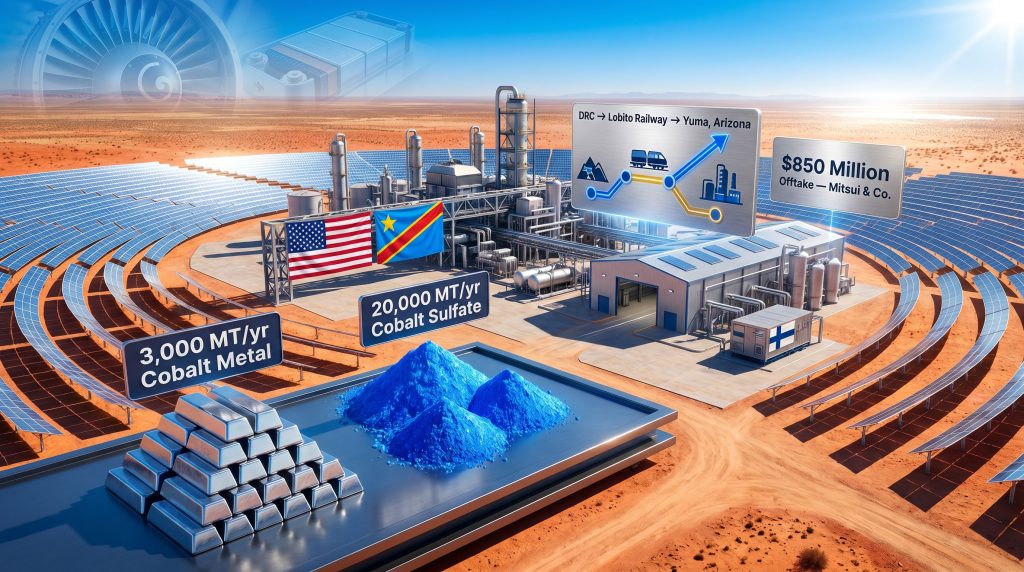
- Up to 3,000 metric tonnes per year of alloy-grade cobalt metal
- Up to 20,000 tonnes per year of battery-grade cobalt sulfate, equating to approximately 4,000 tonnes of contained cobalt based on cobalt sulfate's roughly 20% cobalt content
Construction is targeted to begin in 2027, with operational commissioning aimed at the end of 2029. One technically significant detail is that EVelution intends to start at full capacity from commissioning rather than ramping up gradually. This is a realistic expectation for a hydrometallurgical facility, given that the processing chemistry does not require the extended calibration periods associated with pyrometallurgical operations.
The Hydrometallurgical Advantage
The processing technology underpinning the Yuma refinery is a hydrometallurgical flowsheet, a well-established methodology in cobalt refining that has been deployed successfully at European and Asian facilities for decades.
Hydrometallurgical processing dissolves metal-bearing feedstock materials in aqueous chemical solutions, then uses a sequence of solvent extraction, purification, and electrowinning or crystallisation steps to recover and refine the target metal. Unlike pyrometallurgical smelting, it operates at relatively low temperatures, generates fewer gaseous emissions, and is particularly well-suited to processing cobalt hydroxide intermediates into either battery-grade sulfate or high-purity metal.
EVelution has engaged Finnish engineering firm Metso to develop a test facility using the company's proprietary flowsheet. Metal samples produced at this Finnish test facility in 2027 will be submitted for aerospace and defence certification processes, with a certification timeline estimated at two to three years from sample submission. This positions EVelution for certified alloy-grade status by approximately 2029 to 2030, aligning with the refinery's planned commissioning.
How the Dual-Output Production Model Works
The Metal vs. Sulfate Decision Framework
One of the more strategically sophisticated elements of the Yuma refinery's design is its intended production flexibility. Rather than committing entirely to one cobalt product, EVelution is building a facility capable of adjusting the ratio of cobalt metal to cobalt sulfate output based on prevailing market conditions.
The planned baseline split is roughly equal between the two products. However, the facility is being engineered to allow operators to shift output weightings in response to margin signals. This approach deliberately mirrors the operational adaptability that has allowed Chinese processors to optimise margins across commodity price cycles for years. In addition, this flexibility is central to the battery metals investment landscape thesis that underpins EVelution's commercial case.
| Product | End Market | Approximate Cobalt Content | Fastmarkets Price (May 14, 2026) |
|---|---|---|---|
| Alloy-grade cobalt metal | Aerospace, defence, rotating engine parts | ~99.8% Co | $28.50–$30.25/lb (Rotterdam) |
| Battery-grade cobalt sulfate | EV battery cathodes (NMC, NCA) | ~20% Co | Derived from standard-grade: $25.65–$26.80/lb |
Three Scenarios Where Flexibility Pays
The production flexibility model creates distinct margin-management options under different market conditions:
-
Alloy-grade premium widening scenario: If aerospace and defence procurement accelerates, or if domestic certification unlocks a meaningful price premium over imported alternatives, shifting output toward cobalt metal maximises revenue per tonne of hydroxide processed.
-
Battery sulfate demand spike scenario: Accelerating EV adoption or cathode supply tightness could make sulfate the higher-margin product at certain periods, rewarding facilities capable of pivoting quickly.
-
Hydroxide payables compression scenario: When feedstock costs rise relative to finished product prices, the ability to optimise which product to produce becomes a critical margin-protection tool rather than merely an engineering feature.
Importantly, the ability to dilute cobalt metal into sulfate provides a one-directional flexibility that is easier to execute chemically than the reverse. This means the facility's true strategic option is maintaining metal production capacity while retaining the ability to downgrade output to sulfate when price signals demand it.
The Feedstock Architecture: DRC Cobalt and the Lobito Railway
A Multi-Supplier Strategy Built for Resilience
The Yuma refinery's feedstock will be cobalt hydroxide sourced entirely from the Democratic Republic of Congo, which accounts for approximately 70% of global mined cobalt production. Rather than relying on a single supplier, EVelution has assembled a diversified supply arrangement spanning multiple commercial relationships.
| Supplier | Role | DRC Connection |
|---|---|---|
| ERG (Eurasian Resources Group) | Primary hydroxide supplier | DRC mining operations |
| Glencore | Spot and supplementary supply | DRC copper-cobalt mines |
| EGC (Entreprise Générale du Cobalt) | Artisanal cobalt formalisation | Congolese state entity |
| Trafigura | Logistics, marketing, and transport coordination | Lobito Atlantic Railway shareholder |
| Chemaf (via Trafigura) | Potential additional supply | Etoile mine and Mutoshi concession, DRC |
The primary supplier relationship is with ERG, the Luxembourg-headquartered mining group with established DRC operations. Glencore provides access to spot market volumes when primary supply needs supplementing. The most strategically novel element of the feedstock architecture is the MoU signed on May 13, 2026, with EGC and Trafigura.
The Lobito Railway and a Non-Chinese Export Corridor
Cobalt hydroxide from the DRC has historically moved through eastern African ports with significant exposure to logistics bottlenecks, before flowing predominantly into Chinese processing. The Lobito Atlantic Railway, spanning the DRC and Angola to the port of Lobito on the Atlantic coast, offers an alternative export corridor that bypasses traditional eastern routes.
Trafigura, which holds a shareholder position in the Lobito Atlantic Railway project, began using the corridor commercially in early 2026. This provides EVelution with access to a logistics route that is both faster than traditional DRC export pathways and strategically aligned with U.S. interests in building non-Chinese critical minerals supply chains.
The U.S.-DRC strategic minerals agreement signed in December 2025 provides a diplomatic framework within which preferential access arrangements for Congolese cobalt, copper, and lithium can be developed. This bilateral agreement does not automatically confer benefits on any specific project, but it establishes the policy architecture within which supply relationships of this kind can be formalised.
Why Artisanal Cobalt Formalisation Matters for ESG Compliance
EGC's mandate as the Congolese state entity responsible for formalising artisanal cobalt production addresses one of the most persistent ESG concerns in cobalt supply chains. Artisanal and small-scale mining in the DRC has historically been associated with inadequate safety standards and child labour, creating significant traceability and compliance risks for downstream buyers in Western markets.
By sourcing through EGC, EVelution gains access to material that passes through a formalisation process designed to improve traceability from mine to port. Complementing this, the company has offered to bring DRC workers through the same metallurgical processing training programmes used for its own employees, covering cobalt sulfate and cobalt metal production techniques. According to EVelution's Gil Michel-Garcia, this workforce development initiative has been positively received by Congolese authorities, whose broader industrial policy has increasingly focused on building domestic processing capacity within the DRC itself.
Trafigura's additional role as a potential supplier from Chemaf's Etoile mine and Mutoshi concession provides further supply optionality. Chemaf, which was acquired by US-backed Virtus Lloyds Minerals Holding in early 2026, has not been in recent production at either asset. EVelution's own facility will not commission for approximately two years, meaning the timing of Chemaf's potential restart and Yuma's feedstock requirements may align constructively.
Why Cobalt Payables Matter More Than Cobalt Prices
The Processing Spread: The True Profitability Metric
A fundamental insight that separates sophisticated cobalt market participants from casual observers is the distinction between metal prices and processing economics. For a refinery that buys cobalt hydroxide and converts it to metal or sulfate, profitability is not determined by whether cobalt costs $25 or $35 per pound. It is determined by the spread between what the refinery pays for hydroxide feedstock and what it receives for finished product.
This spread is governed primarily by the cobalt hydroxide payable indicator, which expresses the price of cobalt hydroxide as a percentage of the standard-grade cobalt metal price. When payables are low (say, 65%), refiners buy hydroxide cheaply relative to the metal they sell, generating strong margins. When payables approach 100%, the economics collapse because the refiner is essentially paying close to metal price for an intermediate product that still requires processing costs to convert.
EVelution's long-term planning uses a median hydroxide payable assumption of approximately 75% on an eight-year basis. This is the core financial logic underpinning the project's viability, not the absolute level of cobalt prices. As Michel-Garcia stated in his Fastmarkets interview, the company is indifferent to the price of cobalt but is acutely focused on the processing margin spread between hydroxide and metal.
Current Market Context: Payables Under Pressure
The cobalt market as of mid-May 2026 presents a challenging near-term backdrop for this economics framework. Fastmarkets' assessment of the cobalt hydroxide payable indicator reached 99.5% to 100.5% on May 13, 2026, levels that render hydroxide-to-metal processing essentially uneconomical on a spot basis.
| Price Assessment | Value | Date |
|---|---|---|
| Cobalt alloy grade, in-whs Rotterdam | $28.50–$30.25/lb | May 14, 2026 |
| Cobalt standard grade, in-whs Rotterdam | $25.65–$26.80/lb | May 14, 2026 |
| Cobalt hydroxide payable indicator (low end) | 99.5%–100.5% | May 13, 2026 |
This near-parity condition has been driven by the DRC cobalt export ban and subsequent quota system introduced in October 2025, which followed an export restriction that ran from February to October 2025. The quota restrictions have severely tightened spot hydroxide availability, pushing payables to levels last seen at peak market stress periods.
The critical distinction for evaluating the Yuma project is that these near-parity payables reflect a temporary supply disruption dynamic rather than a structural re-pricing of hydroxide. EVelution's eight-year median assumption of 75% payables implicitly models a normalisation of this indicator over the project's operating life. Whether that normalisation occurs on schedule will be one of the most important variables determining Yuma's financial performance.
How EVelution Is Financing the Yuma Refinery
The Capital Stack Architecture
The financing structure for the Yuma refinery is being assembled across multiple instruments and counterparties, with a sequencing logic that places the U.S. Export-Import Bank commitment as the foundational anchor before equity capital is raised.
Key financing components include:
- U.S. EXIM Bank: A non-binding Letter of Interest for a loan of up to $200 million was received in 2024. EVelution is actively working toward converting this into a firm commitment.
- Finnvera (Finnish Export Credit Agency): Discussions are underway for a loan of approximately $70 million, complementing the U.S. EXIM facility and reflecting the Finland connection through the Metso test facility partnership.
- Equity component: Planned to be raised following receipt of the EXIM firm commitment, using the government credit backing as a signal of project credibility to private investors.
- EB-5 immigrant investor programme: EVelution has explored this as an additional financing pathway, taking advantage of the solar-powered facility's eligibility profile.
The Mitsui Offtake: $850 Million in Revenue Certainty
The most commercially significant development in the Yuma project's recent history is the conversion of its 2025 letter of intent with Mitsui & Co. into a binding long-term offtake agreement announced on April 28, 2026. The agreement, valued at approximately $850 million over five years at prevailing market prices, covers substantially all of the refinery's cobalt metal and cobalt sulfate production.
For lenders and equity investors evaluating the project, this offtake from one of Japan's largest and most creditworthy trading houses provides a bankable revenue stream that meaningfully de-risks the financing case. It also reflects a broader trend of Japan-U.S. industrial coordination in critical minerals, as Japanese trading companies seek to secure supply chains that serve both domestic and allied-nation manufacturing needs.
Project Vault: A Potential Strategic Stockpiling Channel
Announced in February 2026, Project Vault is a U.S. initiative designed to build civilian-economy stockpiles of critical minerals, backed by $10 billion in financing through EXIM. This is distinct from military procurement through the Defense Logistics Agency and targets raw material security for the broader industrial base.
EVelution has expressed interest in participating in Project Vault as a seller of cobalt metal to traders within the vault membership framework. The current structure involves OEMs as owner-shareholders and commodity traders as raw material procurers. Michel-Garcia indicated that as the programme matures and extends its membership to creditworthy counterparties across the supply chain, EVelution could become a direct supplier into the vault system. This would provide a strategic backstop sales channel alongside the primary Mitsui offtake arrangement.
The next major ASX story will hit our subscribers first
The Aerospace and Defence Premium Opportunity
Why Certified Domestic Cobalt Commands a Higher Price
Alloy-grade cobalt is a critical input for the nickel-based superalloys used in rotating engine components, turbine blades, and other high-temperature aerospace and defence applications. These applications demand extreme purity levels (typically 99.8% cobalt or higher) and rigorous material certification, creating a quality barrier that distinguishes alloy-grade from standard battery-grade material.
The certification pathway EVelution is pursuing involves:
- Metal samples produced at the Metso test facility in Finland during 2027
- Submission of samples to aerospace and defence qualification processes
- A testing and approval timeline estimated at two to three years
- Target completion of certification: approximately 2029 to 2030
The current price differential between alloy-grade and standard-grade cobalt already reflects this quality premium. With alloy-grade at $28.50 to $30.25 per pound against standard-grade at $25.65 to $26.80 per pound in Rotterdam warehouses as of mid-May 2026, the spread runs to approximately $2 to $4 per pound. For a facility producing 3,000 tonnes of alloy-grade metal annually, even a modest widening of this spread driven by domestic certification represents a meaningful revenue uplift.
The deeper structural argument for a domestic premium extends beyond current price differentials. Michel-Garcia has noted that the U.S. aerospace and defence market has arrived at a point where procurement teams genuinely understand that government policy on critical minerals onshoring is durable, meaning buyers in those sectors will increasingly need to source certified domestic or allied-nation material and will need to price that requirement into their procurement economics.
Key Risks and the Yuma Project Risk Matrix
What Could Go Wrong?
Investors and industry observers should approach the Yuma project with a clear-eyed view of the risks that could delay, reduce, or undermine its financial performance.
| Risk Category | Specific Risk | Severity | Mitigation in Place |
|---|---|---|---|
| Feedstock Supply | DRC export restrictions tighten further | High | Multi-supplier strategy across ERG, Glencore, EGC/Trafigura |
| Feedstock Cost | Hydroxide payables remain near parity above 90% | High | Long-term payable modelling at 75% median |
| Financing | EXIM firm commitment delayed or reduced in scope | Medium-High | Parallel Finnvera discussions; EB-5 pathway |
| Certification | Aerospace qualification extends beyond three years | Medium | Early Metso test facility engagement from 2027 |
| Market Timing | Cobalt price depression at 2029 commissioning | Medium | Flexible metal/sulfate output ratio |
| Geopolitical | U.S.-DRC diplomatic relationship deteriorates | Low-Medium | Formal minerals agreement signed December 2025 |
| Competition | Chinese processors expand capacity, compressing spreads | Medium | Domestic premium thesis; Project Vault access pathway |
The two highest-severity risks both involve feedstock. If DRC export restrictions intensify or become permanent at current quota levels, the entire hydroxide market tightens structurally in ways that could invalidate EVelution's 75% payable assumption. The multi-supplier strategy provides partial mitigation, but all sources draw from the same DRC production base, meaning a country-level export policy decision affects all supply streams simultaneously. Consequently, monitoring developments within the broader cobalt mining industry will remain essential for anyone tracking this project's progress.
Global Benchmarking: Where Yuma Sits in the Cobalt Refining Landscape
EVelution vs. Established Processors
Understanding EVelution's competitive positioning requires placing it within the context of the global cobalt refining industry.
| Processor | Location | Approx. Annual Cobalt Capacity | Primary Products | Strategic Positioning |
|---|---|---|---|---|
| Huayou Cobalt | China | 50,000+ tpa Co equivalent | Sulfate, metal, pCAM | Integrated DRC-to-cathode |
| Freeport Cobalt | Finland | ~10,000 tpa Co | Sulfate, metal | European supply chain |
| Umicore | Belgium | ~5,000+ tpa Co | pCAM, recycling | Circular economy focus |
| EVelution Energy | USA (Arizona) | ~7,000 tpa Co equivalent (metal + sulfate) | Metal, sulfate | U.S. domestic reshoring |
Chinese processors such as Huayou Cobalt benefit from scale, vertically integrated DRC-to-cathode supply chains, and historically low-cost power inputs. Freeport Cobalt in Finland provides the closest Western analogue to what EVelution is attempting to build, demonstrating that commercially viable cobalt refining outside China is achievable at meaningful scale. Umicore's Belgian operations are increasingly focused on battery material recycling and precursor cathode active material production rather than primary hydroxide processing.
EVelution's first-mover advantage in U.S. domestic processing is its most distinctive competitive attribute. At approximately 7,000 tonnes of cobalt equivalent annually (combining the contained cobalt in both product streams), Yuma would occupy a mid-scale position globally while holding an uncontested domestic position in the United States. America's first cobalt refinery of this scale would represent a genuinely transformative development for Western supply chain resilience.
Project Timeline and the Broader U.S. Critical Minerals Agenda
Development Milestones
| Year | Milestone |
|---|---|
| 2023 | Project initially announced |
| 2024 | U.S. EXIM non-binding Letter of Interest ($200 million) received |
| April 2025 | LOI signed with Mitsui & Co. for cobalt offtake |
| October 2025 | DRC cobalt export quota system introduced |
| December 2025 | U.S.-DRC strategic minerals agreement signed |
| February 2026 | Project Vault announced ($10 billion EXIM financing) |
| April 28, 2026 | Binding $850 million offtake agreement with Mitsui confirmed |
| May 13, 2026 | MoU signed with EGC and Trafigura for DRC hydroxide supply |
| 2027 | Construction begins; Metso test facility produces metal samples |
| 2029 | Target commissioning date; aerospace certification expected |
Arizona's Emerging Role as a Critical Minerals Processing Hub
The EVelution Energy Yuma cobalt refinery is not the only significant critical minerals project taking shape in Arizona. South32's Taylor zinc-lead-silver project in the same state, while facing its own timeline adjustments, reflects a broader pattern of critical minerals processing and extraction activity consolidating in a state with established mining heritage, favourable solar energy conditions, and improving logistics infrastructure.
The Yuma project's alignment with the Inflation Reduction Act's domestic content requirements for EV battery tax credits adds another layer of strategic relevance. Battery manufacturers seeking to qualify their products for IRA incentives need cobalt sourced from domestic processors or free-trade-agreement partner nations. A certified U.S. cobalt processor would provide an IRA-compliant supply pathway that currently does not exist, creating a structural demand source independent of spot market conditions.
The convergence of bipartisan political support for critical minerals onshoring, a binding commercial offtake with a major Japanese trading house, a diversified DRC feedstock architecture, and a technically proven processing approach gives the EVelution Energy Yuma cobalt refinery a more credible foundation than many announced projects in this space. The variables that remain genuinely uncertain, particularly hydroxide payables normalisation and the timing of the EXIM firm commitment, will determine whether that foundation translates into operating reality by the end of the decade.
Forward-looking statements regarding project timelines, production capacities, financial projections, and market conditions involve inherent uncertainty. Readers should conduct independent due diligence and consult qualified financial advisers before making investment decisions based on information contained in this article.
Want to Stay Ahead of the Next Major Critical Minerals Discovery?
Discovery Alert's proprietary Discovery IQ model delivers real-time alerts on significant ASX mineral discoveries — instantly turning complex data across more than 30 commodities into actionable investment insights for both short-term traders and long-term investors. Explore how historic mineral discoveries have generated substantial returns, or start your 14-day free trial today to position yourself ahead of the market.