June 13, 2026
The advancement of electrified transportation systems has fundamentally transformed critical mineral processing requirements across global supply networks. Battery manufacturing precision demands increasingly sophisticated hydrometallurgical techniques that can consistently deliver ultra-high purity compounds while managing complex multi-metal recovery operations. Modern cobalt sulphate test work represents a convergence of established metallurgical principles with cutting-edge purification technologies essential for meeting lithium-ion battery specifications.
These validation programmes bridge the gap between laboratory-scale experimentation and commercial production readiness, where even minor process deviations can compromise battery performance characteristics. Furthermore, comprehensive testing protocols ensure that facilities can reliably produce compounds meeting stringent environmental regulations whilst maintaining competitive production costs.
What is Cobalt Sulphate Test Work and Why Does It Matter for Battery Manufacturing?
Defining Cobalt Sulphate Test Work in Metallurgical Processing
Cobalt sulphate test work encompasses comprehensive validation studies that confirm hydrometallurgical processes can reliably produce battery-grade compounds meeting lithium-ion manufacturer specifications. This specialised testing evaluates every stage of metal extraction, from initial pressure oxidation through final crystallisation, ensuring consistent quality control across variable operating conditions.
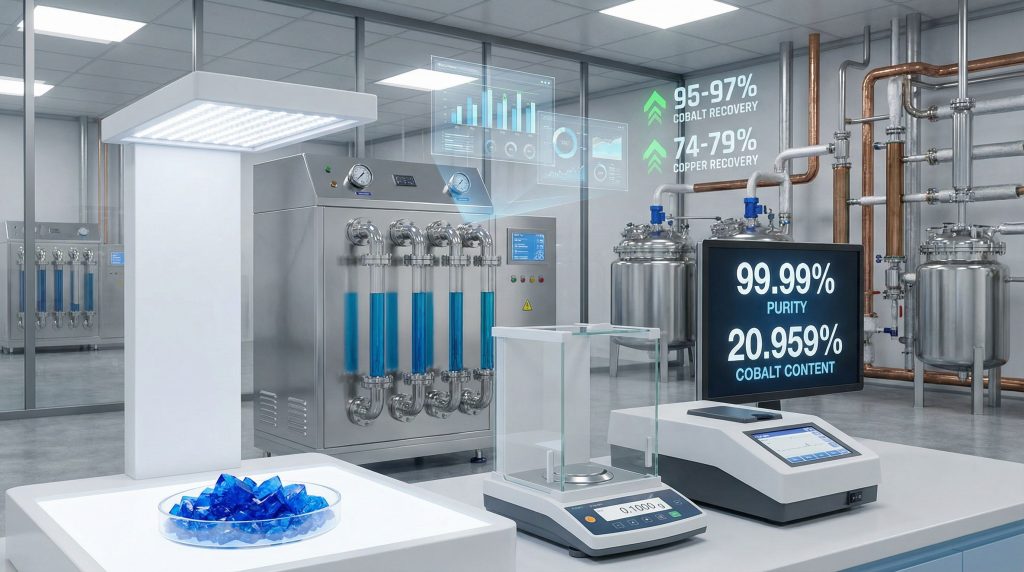
Battery-grade cobalt sulphate must achieve 99.99% purity with precisely 20.959% cobalt content in the heptahydrate form (CoSO₄·7H₂O). This specification represents one of the most stringent purity requirements in industrial chemical production, comparable to pharmaceutical-grade compounds. The 20.959% figure reflects the theoretical stoichiometric cobalt content in the crystalline structure, serving as a universal standard across battery manufacturing operations.
Heavy metal contamination presents particular challenges for cobalt processing operations. Arsenic, lead, and mercury must remain below specified threshold limits to meet both battery industry requirements and environmental safety regulations. Advanced cobalt sulphate test work validates that pre-neutralisation techniques can remove approximately 99% of contained arsenic without incurring cobalt losses, demonstrating process robustness critical for commercial viability.
The distinction between laboratory batch testing and validation-scale production cannot be overstated. While bench-scale experiments establish basic process parameters, validation test work confirms these conditions translate reliably to larger operational scales, reducing project execution risk when transitioning to commercial production.
The Critical Role of Validation Testing in Mining Operations
Validation testing serves multiple strategic functions beyond simple process confirmation. These comprehensive programmes evaluate flowsheet performance across different concentrate grades, establishing operational flexibility essential for managing natural ore grade variations that occur throughout mine life cycles.
Multi-stage verification protocols examine every aspect of the hydrometallurgical sequence:
• Pressure oxidation conditions and autoclave performance parameters
• Solution purification effectiveness across variable feed compositions
• Manganese removal efficiency and downstream impact assessment
• Solvent extraction optimisation for maximum metal recovery
• Crystallisation processes that consistently achieve battery-grade specifications
World-class metallurgical facilities like SGS Canada Inc. in Lakefield, Ontario provide the sophisticated equipment and analytical capabilities required for comprehensive cobalt sulphate test work. These facilities can simulate commercial-scale conditions while maintaining precise analytical control over process variables and product quality measurements.
The temporal aspect of validation testing reflects the complexity of modern hydrometallurgical operations. Comprehensive programmes typically span several months to over a year, depending on the number of optimisation variables examined and the breadth of feed grade scenarios evaluated. This extended timeline allows for statistical validation of results and identification of any seasonal or operational variations that could impact commercial performance.
Battery Industry Quality Standards and Purity Requirements
Lithium-ion battery manufacturers maintain extraordinarily tight specification tolerances because even trace impurities can compromise cell performance, safety characteristics, and long-term cycle life. The 99.99% purity requirement (equivalent to ≤100 ppm total impurities) demands sophisticated analytical techniques and process control systems throughout the entire production chain.
Battery-grade cobalt sulphate specifications extend beyond simple purity measurements. Manufacturers evaluate:
• Crystalline structure uniformity for consistent handling characteristics
• Particle size distribution affecting dissolution rates in battery electrolyte systems
• Moisture content stability preventing degradation during storage and transportation
• Heavy metal contamination profiles ensuring compliance with safety regulations
The heptahydrate form (CoSO₄·7H₂O) provides optimal stability characteristics for industrial handling and shipping applications. This crystalline structure maintains consistent cobalt content during extended storage periods while offering predictable dissolution behaviour when integrated into battery manufacturing processes.
Battery-grade cobalt sulphate must achieve 99.99% purity with exactly 20.959% cobalt content to meet lithium-ion manufacturer requirements. Heavy metal contaminants including arsenic, lead, and mercury must remain below specified threshold limits.
Advanced analytical techniques employed during test work validation include inductively coupled plasma mass spectrometry (ICP-MS) for trace metal analysis and X-ray diffraction (XRD) for crystalline structure confirmation. These methods provide the precision necessary to verify compliance with battery industry specifications across multiple production batches.
When big ASX news breaks, our subscribers know first
How Do Hydrometallurgical Flowsheets Optimise Cobalt Recovery Rates?
Understanding Pressure Oxidation and Autoclave Processing
Pressure oxidation represents the foundation of modern cobalt extraction technology, providing controlled conditions where cobalt-bearing minerals undergo oxidative dissolution. High-temperature, high-pressure autoclave environments facilitate rapid metal dissolution whilst maintaining precise control over reaction chemistry and byproduct formation.
Autoclave processing parameters typically include:
• Temperature ranges between 200-250°C for optimal cobalt dissolution
• Pressure conditions from 20-35 bar oxygen partial pressure
• Residence times of 60-120 minutes depending on concentrate mineralogy
• Oxygen injection rates calculated to maintain oxidising conditions throughout the reaction sequence
The integration of multiple mineral dissolution stages within a single autoclave vessel represents a significant advancement in processing efficiency. Modern facilities can simultaneously recover cobalt, copper, and gold from combined feed streams, improving both capital utilisation and overall metal recovery rates.
Recent technological developments have demonstrated that direct pre-neutralisation following autoclave discharge can remove approximately 99% of arsenic contamination without requiring additional oxygenation or heating systems. This process improvement reduces equipment sizing requirements whilst eliminating cobalt losses that might otherwise occur during extended purification sequences.
Metal Extraction Efficiency Benchmarks and Performance Metrics
Contemporary cobalt extraction operations achieve recovery rates significantly exceeding historical industry benchmarks through optimised process design and advanced reagent chemistry. Current validation testing demonstrates substantial improvements over earlier pilot plant work completed in 2008.
Performance Comparison: 2008 vs. 2026 Test Results
| Recovery Metric | 2008 Pilot Plant | 2026 Validation | Improvement Factor |
|---|---|---|---|
| Cobalt Extraction | 95% | 97% | 1.02x |
| Copper Recovery | 70% | 74% | 1.06x |
| Gold Capture | 95% | 97-98% | 1.03x |
Off-specification feed grade processing reveals the robustness of modern hydrometallurgical flowsheets. When processing lower-grade concentrates, facilities maintain 95% cobalt extraction whilst achieving 79% copper recovery, actually exceeding baseline copper performance by nine percentage points. This operational flexibility proves essential for managing natural ore grade variations throughout mine life cycles.
Blended feed scenarios offer balanced performance characteristics, combining benefits from different input streams. Testing with mixed feed compositions achieves 96% cobalt extraction and 76% copper recovery, demonstrating process adaptability across diverse operational conditions.
The economic implications of these recovery improvements extend beyond simple metal accounting. Enhanced gold recovery from 95% to 97-98% can generate substantial additional revenue streams, particularly for projects containing significant gold byproduct potential exceeding one million ounces of in-situ resources.
Process Flow Integration for Multi-Metal Recovery Systems
Integrated processing systems maximise resource utilisation by capturing multiple valuable metals from single ore bodies through coordinated extraction sequences. Advanced facilities produce diversified commodity portfolios including cobalt sulphate, bismuth ingots, copper cement, and gold from unified processing operations.
Strategic integration approaches include:
• Bismuth circuit residue blending before autoclave processing to capture recoverable gold
• Multi-metal dissolution in shared autoclave systems reducing capital requirements
• Sequential purification streams optimised for individual metal specifications
• Byproduct revenue optimisation through coordinated production scheduling
Projects containing significant bismuth resources offer unique strategic positioning within global supply chains. Operations controlling 12% of global bismuth reserves provide supply security for specialised industrial applications whilst generating additional revenue streams that improve overall project economics.
Gold recovery optimisation through circuit integration represents a particularly valuable process improvement. By blending bismuth leach circuit residues into the main cobalt autoclave charge, facilities capture gold that would otherwise deport to separate processing streams, achieving 97-98% gold recovery compared to 95% in standalone circuits.
Which Purification Methods Achieve Battery-Grade Cobalt Sulphate Standards?
Solvent Extraction and Solution Purification Techniques
Advanced solvent extraction systems provide the precision required to achieve battery-grade purity specifications through selective metal separation and contaminant removal. These sophisticated chemical processes utilise organic extractants that selectively bind target metals whilst rejecting impurities, enabling the ultra-high purity levels demanded by lithium-ion battery manufacturers.
Modern solvent extraction circuits typically employ:
• Multi-stage counter-current extraction for maximum separation efficiency
• Selective organic extractants designed for cobalt/nickel separation
• pH control systems maintaining optimal extraction conditions
• Temperature management ensuring consistent extraction performance
The manganese removal stage represents a critical purification step, as manganese contamination can significantly impact battery performance characteristics. Specialised precipitation techniques remove manganese compounds whilst preserving cobalt values, ensuring the final product meets stringent battery industry specifications.
Solution purification effectiveness depends heavily on upstream process optimisation. Effective arsenic removal through direct pre-neutralisation eliminates downstream purification challenges whilst reducing reagent consumption and equipment sizing requirements throughout the entire processing chain.
Crystallisation Processes for Heptahydrate Production
Controlled crystallisation represents the final step in battery-grade cobalt sulphate production, transforming purified solutions into the stable heptahydrate form required by battery manufacturers. This process requires precise control over temperature, concentration, and nucleation conditions to achieve consistent crystal size distribution and purity levels.
Evaporation-crystallisation systems achieve the necessary concentration levels whilst maintaining product quality through:
• Controlled evaporation rates preventing impurity concentration
• Temperature management optimising crystal formation
• Seed crystal addition ensuring uniform particle size distribution
• Continuous monitoring of solution chemistry throughout the crystallisation sequence
The heptahydrate form (CoSO₄·7H₂O) provides optimal handling characteristics for industrial applications. This crystalline structure maintains stable cobalt content during extended storage periods whilst offering predictable dissolution behaviour when integrated into battery manufacturing processes.
Quality control during crystallisation requires sophisticated analytical techniques. X-ray diffraction analysis confirms proper crystalline structure whilst inductively coupled plasma spectroscopy verifies cobalt content accuracy to the required 20.959% specification level.
Heavy Metal Impurity Control and Quality Assurance
Heavy metal contamination control represents one of the most challenging aspects of battery-grade cobalt sulphate production. Arsenic, lead, and mercury must be reduced to extremely low levels through specialised removal techniques that operate without compromising cobalt recovery rates.
Arsenic removal receives particular attention due to its toxicity and regulatory implications. Advanced pre-neutralisation techniques can eliminate approximately 99% of arsenic contamination without requiring additional heating or oxygenation systems, demonstrating both environmental responsibility and process efficiency.
Quality assurance protocols encompass every stage of production:
• Raw material analysis establishing baseline contamination levels
• Process stream monitoring tracking impurity removal efficiency
• Final product certification confirming battery-grade specifications
• Environmental compliance ensuring safe waste handling and disposal
The analytical precision required for heavy metal detection demands sophisticated instrumentation. ICP-MS systems provide the sensitivity necessary to quantify trace contamination at parts-per-million levels, ensuring consistent compliance with both battery industry specifications and environmental regulations.
What Are the Key Process Improvements in Modern Cobalt Sulphate Production?
Direct Pre-Neutralisation for Arsenic Removal
Direct pre-neutralisation represents a significant technological advancement that addresses one of the most challenging aspects of cobalt processing: arsenic contamination control. This innovative approach removes approximately 99% of contained arsenic immediately following autoclave discharge without requiring additional heating, oxygenation, or complex chemical additions that might compromise cobalt recovery rates.
The process operates through controlled pH adjustment of autoclave discharge solutions, precipitating arsenic compounds whilst maintaining cobalt in solution. This approach offers several operational advantages:
• Simplified equipment requirements reducing capital expenditure
• Lower operating costs through reduced reagent consumption
• Enhanced safety profiles minimising arsenic exposure risks
• Improved environmental compliance facilitating waste management protocols
Traditional arsenic removal methods often required complex multi-stage processes involving oxidation, precipitation, and filtration steps that increased both capital and operating costs whilst potentially compromising metal recovery rates. Direct pre-neutralisation eliminates these complications whilst achieving superior arsenic removal efficiency.
Equipment Sizing Optimisation and Capital Cost Reduction
Process improvements achieved through validation test work directly translate into reduced equipment sizing requirements across multiple processing stages. Enhanced metal recovery rates, improved arsenic removal efficiency, and optimised reagent consumption all contribute to smaller equipment footprints and lower capital expenditures.
Capital cost reduction strategies include:
• Autoclave sizing optimisation through improved dissolution kinetics
• Purification circuit simplification reducing equipment count and complexity
• Crystallisation system efficiency minimising evaporation and cooling requirements
• Waste treatment optimisation reducing environmental compliance infrastructure
The cumulative impact of these improvements can significantly affect project economics and investment attractiveness. Reduced equipment sizing translates directly into lower construction costs, shorter project development timelines, and decreased ongoing maintenance requirements throughout facility operational life.
Operating cost reductions complement capital savings through improved process efficiency. Enhanced metal recovery rates reduce feed requirements per unit of production whilst simplified flowsheets decrease reagent consumption and energy requirements across the entire processing chain.
Blending Strategies for Enhanced Metal Recovery
Strategic feed blending represents an advanced optimisation technique that maximises metal recovery whilst maintaining consistent product quality. By combining different concentrate grades or integrating residues from parallel processing circuits, facilities can achieve superior overall performance compared to processing individual feed streams separately.
Effective blending strategies consider:
• Grade complementarity balancing high and low-grade feeds for optimal recovery
• Mineralogical compatibility ensuring consistent dissolution behaviour
• Impurity management preventing contamination concentration in final products
• Process stability maintaining consistent operating conditions throughout production cycles
Validation testing with blended feeds demonstrates robust processing capability, achieving 96% cobalt extraction and 76% copper recovery across variable input compositions. This operational flexibility proves essential for commercial mining operations where ore grades naturally fluctuate throughout mine life cycles.
Integration of bismuth circuit residues into the main cobalt processing stream exemplifies successful blending strategy implementation. This approach captures gold values that would otherwise deport to separate circuits whilst recovering additional cobalt and copper, achieving 97-98% gold recovery compared to 95% in standalone operations.
How Do Different Feed Grades Impact Cobalt Sulphate Test Work Results?
Design Grade vs. Off-Specification Feed Performance Analysis
Feed grade variability presents one of the most significant operational challenges in commercial cobalt processing operations. Comprehensive programmes evaluate flowsheet performance across different concentrate grades, establishing operational parameters that maintain acceptable recovery rates even when feed quality deviates from design specifications.
Feed Grade Performance Comparison
| Feed Type | Cobalt Recovery | Copper Recovery | Processing Characteristics |
|---|---|---|---|
| Design Grade | 97% | 74% | Optimal performance conditions |
| Off-Spec Low Grade | 95% | 79% | Robust processing capability |
| Blended Feed | 96% | 76% | Balanced operational approach |
Design grade processing achieves maximum cobalt extraction efficiency at 97% whilst maintaining 74% copper recovery, establishing baseline performance expectations for optimal operating conditions. These results represent significant improvements over historical pilot plant work, reflecting advances in process optimisation and reagent chemistry development.
Off-specification low-grade feed processing demonstrates remarkable process robustness, achieving 95% cobalt extraction whilst actually exceeding copper recovery expectations at 79%. This performance suggests that certain process conditions may be more favourable for copper dissolution when processing lower-grade concentrates, providing operational flexibility during periods of variable ore quality.
The ability to maintain acceptable recovery rates across different feed grades reduces operational risk and improves project economics. Mining operations rarely produce consistent ore grades throughout their operational life, making process adaptability essential for maintaining production targets and revenue projections.
Concentrate Quality Variables and Processing Adaptability
Concentrate quality extends beyond simple metal grade measurements to encompass mineralogical composition, particle size distribution, and associated gangue characteristics. Each of these variables can significantly impact processing performance and product quality outcomes.
Critical concentrate quality variables include:
• Primary mineral composition affecting dissolution kinetics and reagent requirements
• Secondary mineral associations influencing impurity levels and purification requirements
• Particle size distribution impacting mass transfer rates and processing efficiency
• Moisture content affecting handling characteristics and process chemistry
Validation test work evaluates processing adaptability across these variables, ensuring commercial operations can maintain consistent performance despite natural variations in concentrate characteristics. Consequently, this comprehensive approach reduces technical risk whilst providing operational guidance for mine planning and concentrate management strategies.
Blended feed processing offers a balanced approach to managing concentrate quality variations. By combining different feed streams, operations can achieve more consistent processing conditions whilst potentially improving overall metal recovery rates through synergistic effects between different concentrate types.
Economic Sensitivity Analysis for Variable Feed Scenarios
Feed grade variability directly impacts project economics through changes in metal recovery rates, reagent consumption, and processing throughput requirements. Comprehensive economic sensitivity analysis evaluates these impacts across different operational scenarios, providing critical input for feasibility studies and investment decision-making.
Economic impact factors include:
• Recovery rate variations affecting total metal production and revenue generation
• Reagent consumption changes impacting operating cost structures
• Throughput modifications influencing equipment utilisation and labour productivity
• Product quality considerations affecting market positioning and pricing strategies
The two percentage point improvement in cobalt recovery (from 95% to 97%) when processing design grade feed can generate substantial additional revenue, particularly for large-scale operations processing thousands of tonnes of concentrate annually. Similarly, the enhanced copper recovery demonstrates additional byproduct value potential.
Risk assessment protocols evaluate the probability and impact of different feed grade scenarios, enabling project developers to establish appropriate contingency planning and risk mitigation strategies. This analysis proves essential for securing project financing and establishing realistic operational expectations.
What Alternative Products Can Be Produced from Cobalt Processing?
Cobalt Mixed Hydroxide (CoMHP) as Lower-Cost Alternative
Cobalt mixed hydroxide (CoMHP) represents an intermediate product option that can provide significant advantages for project startup scenarios or market positioning strategies. This alternative product requires less intensive purification processing whilst maintaining valuable cobalt content that battery manufacturers can further refine to final specifications.
CoMHP production offers several operational advantages:
• Lower capital requirements through simplified processing equipment
• Reduced operating costs with fewer purification stages
• Faster project development timelines due to simplified flowsheet design
• Market flexibility serving different customer segments and applications
Preliminary test work demonstrates successful CoMHP production with attractive cobalt, nickel, and copper contents, providing a viable alternative for operations seeking to enter markets with reduced initial capital investment. This product option can serve as a bridge strategy whilst developing full battery-grade cobalt sulphate production capabilities.
The intermediate nature of CoMHP means it typically commands lower market prices compared to battery-grade cobalt sulphate. However, the reduced production costs can maintain attractive project margins whilst establishing market presence and customer relationships.
Capital and Operating Cost Comparisons
Detailed cost analysis between different cobalt products reveals significant variations in capital and operating expenditure requirements. Battery-grade cobalt sulphate production demands sophisticated purification equipment and analytical systems that substantially increase both initial investment and ongoing operational expenses.
Product Option Cost Comparison
| Product Type | Capital Intensity | Operating Cost | Market Position |
|---|---|---|---|
| Battery-Grade CoSO₄ | High | High | Premium pricing |
| Cobalt Mixed Hydroxide | Medium | Medium | Intermediate pricing |
| Cobalt Concentrate | Low | Low | Commodity pricing |
Capital cost variations stem primarily from purification equipment requirements. Battery-grade production necessitates sophisticated solvent extraction systems, crystallisation equipment, and advanced analytical instrumentation that can represent 40-60% of total processing facility investment.
Operating cost differences reflect the complexity of achieving ultra-high purity specifications. Battery-grade production requires specialised reagents, extended processing times, and intensive quality control protocols that increase per-unit production costs whilst ensuring consistent specification compliance.
Economic sensitivity analysis helps determine optimal product strategies based on market conditions, capital availability, and operational capabilities. Some projects may benefit from phased development approaches, initially producing intermediate products whilst developing full battery-grade capabilities over time.
Market Positioning for Different Cobalt Products
Global cobalt markets encompass diverse applications with varying purity requirements and pricing structures. Understanding these market segments enables producers to optimise product portfolios and maximise revenue potential across different customer bases and application areas.
Primary market segments include:
• Lithium-ion battery manufacturing requiring ultra-high purity cobalt sulphate
• Aerospace and defence applications utilising specialised cobalt alloys
• Industrial catalyst production employing intermediate purity cobalt compounds
• Chemical manufacturing consuming various cobalt salts and derivatives
Battery-grade cobalt sulphate commands premium pricing due to stringent purity requirements and limited global production capacity. This market segment offers the highest revenue potential but demands significant technical capabilities and capital investment to achieve consistent quality standards.
Furthermore, intermediate products like CoMHP serve regional markets and smaller battery manufacturers who maintain in-house purification capabilities. This segment offers more accessible entry points for new producers whilst providing pathways to eventual battery-grade production.
Strategic market positioning considers both current demand patterns and future growth projections. The expanding electric vehicle market continues driving battery-grade cobalt demand, whilst traditional industrial applications maintain steady consumption of intermediate purity products.
The next major ASX story will hit our subscribers first
Which Laboratory Testing Facilities Provide World-Class Metallurgical Services?
SGS Lakefield Capabilities and Testing Standards
SGS Canada Inc.'s Lakefield facility in Ontario represents one of the world's premier metallurgical testing centres, offering comprehensive analytical capabilities and pilot-scale processing equipment essential for advanced cobalt sulphate test work validation. This facility provides the sophisticated instrumentation and technical expertise required to simulate commercial-scale operations whilst maintaining precise analytical control.
Core facility capabilities include:
• Pressure oxidation autoclave systems for high-temperature, high-pressure testing
• Hydrometallurgical processing circuits including leaching, purification, and crystallisation equipment
• Advanced analytical instrumentation featuring ICP-MS, XRD, and specialised purity analysis systems
• Pilot plant facilities enabling scaled testing programmes beyond laboratory bench work
The facility's accreditation and quality management systems ensure testing results meet international standards for metallurgical research and commercial process validation. This credibility proves essential when presenting test work results to potential investors, project partners, or regulatory authorities.
Technical staff expertise encompasses specialised knowledge in critical mineral processing, battery material production, and environmental compliance requirements. This combination of equipment capabilities and human resources provides comprehensive support for complex validation programmes spanning multiple months or years.
Pilot Plant vs. Laboratory Scale Testing Considerations
Scale-up considerations represent critical factors in translating laboratory test results to commercial production reality. Whilst bench-scale testing establishes fundamental process parameters, pilot plant validation provides essential confirmation that these conditions perform reliably at larger scales where heat and mass transfer dynamics differ significantly.
Key scaling factors include:
• Heat transfer efficiency affecting temperature control and reaction kinetics
• Mass transfer limitations influencing dissolution rates and contact time requirements
• Equipment geometry effects impacting mixing patterns and residence time distribution
• Process control complexity requiring automated systems for consistent operation
Pilot plant testing typically processes 10-100 kg batches compared to laboratory programmes using 1-5 kg samples. This scale increase reveals potential operational issues that might not be apparent in smaller-scale testing whilst providing statistically significant data for process optimisation.
The progression from laboratory to pilot plant to commercial scale requires careful attention to equipment design scaling factors. Autoclave systems, in particular, exhibit complex scaling relationships where surface area to volume ratios significantly impact heat transfer and reaction performance.
Validation Requirements for Commercial-Scale Operations
Commercial-scale validation encompasses both technical performance verification and regulatory compliance confirmation. Modern mining operations must satisfy increasingly stringent environmental regulations whilst meeting customer quality specifications and maintaining competitive production costs.
Validation protocols address:
• Process consistency across extended operating campaigns
• Product quality uniformity meeting battery industry specifications
• Environmental compliance for waste management and emissions control
• Occupational safety protocols for handling toxic materials and high-pressure systems
Statistical validation requires sufficient test work data to establish confidence intervals around key performance metrics. This typically involves processing multiple batches across different feed compositions and operating conditions to demonstrate process robustness.
Regulatory validation focuses on environmental impact assessment and waste management protocols. For instance, arsenic removal efficiency must satisfy both product purity requirements and environmental disposal regulations, requiring comprehensive analytical documentation.
How Do Government Funding Programmes Support Cobalt Processing Development?
Natural Resources Canada Global Partnerships Initiative
Government funding programmes recognise the strategic importance of critical mineral processing capabilities for national economic security and supply chain resilience. Natural Resources Canada's Global Partnerships Initiative specifically targets advanced processing technologies that enhance domestic value-addition capabilities whilst reducing dependence on foreign processing facilities.
Programme objectives include:
• Technology development supporting advanced metallurgical processing research
• Supply chain security reducing dependence on foreign processing capabilities
• Economic development creating high-value manufacturing jobs in mining regions
• Environmental advancement promoting cleaner processing technologies
Funding mechanisms typically involve contribution agreements where government agencies provide partial funding for eligible research and development activities. These programmes recognise that advanced metallurgical test work requires significant investment that might exceed individual company capabilities, particularly for smaller mining companies developing complex projects.
Collaboration requirements often mandate partnerships between private companies, research institutions, and government agencies, fostering knowledge transfer and technology development that benefits the entire mining sector. This approach accelerates innovation whilst building domestic technical capabilities.
U.S. Defense Production Act Title III Strategic Funding
The U.S. Defense Production Act Title III programme represents a national security initiative targeting critical mineral supply chain development. Cobalt processing capabilities receive particular attention due to the strategic importance of battery materials for defence applications and the current concentration of global processing capacity in potentially unreliable supply regions.
Strategic funding priorities include:
• Domestic processing capacity development reducing foreign supply dependence
• Technology advancement supporting innovative processing techniques
• Supply chain resilience creating alternative supply sources for critical applications
• Industrial base strengthening maintaining domestic metallurgical expertise
Title III awards typically involve substantial funding commitments that can significantly reduce project development risks whilst accelerating commercial deployment timelines. These programmes recognise that critical mineral processing requires long-term investment horizons that may not align with traditional private sector financing approaches.
International cooperation aspects allow qualified Canadian projects to participate in U.S. strategic programmes, reflecting the integrated nature of North American mineral supply chains and the mutual benefits of enhanced processing capabilities across both countries.
Provincial Innovation Programmes and Clean Technology Support
Provincial innovation programmes complement federal initiatives by focusing on regional economic development and technology commercialisation objectives. Alberta Innovates' Clean Resource Intake programme, for example, specifically targets advanced processing technologies that reduce environmental impacts whilst creating high-value employment opportunities.
Provincial programme benefits include:
• Regional economic development supporting local employment and industrial growth
• Technology commercialisation bridging the gap between research and commercial application
• Environmental improvement promoting cleaner processing technologies
• Skills development building specialised technical capabilities within provincial workforce
Clean technology focus areas emphasise processing innovations that reduce environmental impacts, improve energy efficiency, or enable more complete resource recovery. Cobalt processing technologies that minimise waste generation or eliminate toxic byproducts align well with these programme objectives.
Coordinated funding approaches combine federal and provincial resources to provide comprehensive support for complex projects spanning multiple years and requiring substantial investment. This layered funding structure reduces individual programme risk whilst maximising public sector impact on strategic technology development.
What Are the Economic Drivers Behind Cobalt Sulphate Test Work Optimisation?
Capital Cost Escalation Mitigation Strategies
Contemporary mining project development faces unprecedented capital cost escalation pressures driven by inflation, supply chain disruptions, and increasingly complex environmental requirements. Process optimisation through comprehensive test work provides one of the most effective strategies for controlling project costs whilst maintaining technical performance standards.
Cost mitigation approaches include:
• Equipment sizing optimisation reducing capital expenditures through improved process efficiency
• Flowsheet simplification eliminating unnecessary processing stages and associated infrastructure
• Reagent consumption reduction decreasing ongoing operational expenses
• Waste treatment optimisation minimising environmental compliance infrastructure requirements
Direct pre-neutralisation for arsenic removal exemplifies successful cost mitigation through process innovation. By eliminating the need for complex arsenic removal systems, this technological improvement reduces both equipment costs and ongoing operational expenses whilst achieving superior environmental performance.
The cumulative impact of process optimisations can significantly improve project economics and investment attractiveness. Equipment sizing reductions of 10-20% through improved recovery rates translate directly into millions of dollars in capital savings for large-scale processing facilities.
Risk reduction represents an additional economic benefit of comprehensive test work programmes. Detailed process validation reduces technical uncertainty, enabling more accurate cost estimation and improving access to project financing at favourable terms.
Operating Cost Reduction Through Process Efficiency
Ongoing operating cost optimisation provides sustained competitive advantages throughout project operational life. Enhanced metal recovery rates reduce feed requirements per unit of production whilst simplified processing reduces labour, reagent, and energy consumption across the entire facility.
Operating Cost Impact Analysis
| Optimisation Area | Cost Reduction Method | Economic Impact |
|---|---|---|
| Metal Recovery | Increased extraction efficiency | Reduced feed requirements |
| Reagent Consumption | Optimised chemical usage | Lower ongoing expenses |
| Energy Requirements | Process simplification | Reduced utility costs |
| Labour Productivity | Automated systems | Lower staffing requirements |
The improvement in cobalt recovery from 95% to 97% represents a 2% increase in saleable production from the same feed tonnage. For large-scale operations processing significant volumes annually, this improvement generates substantial additional revenue that compounds throughout the project operational life.
Enhanced copper recovery from 70% to 74% provides additional byproduct revenue that improves overall project margins. Byproduct credits can represent 20-40% of total project revenue for multi-metal operations, making recovery optimisation particularly valuable for project economics.
Gold recovery improvements from 95% to 97-98% offer exceptional economic benefits given gold's high unit value. For projects containing more than one million ounces of in-situ gold resources, each percentage point improvement in recovery translates to tens of thousands of additional ounces over project life.
North American Supply Chain Strategic Positioning
Strategic positioning within North American supply chains provides long-term competitive advantages that extend beyond simple cost considerations. Domestic processing capabilities reduce supply chain risks whilst capturing value-addition opportunities that strengthen project economics and national resource security.
Strategic positioning benefits include:
• Supply chain security reducing dependence on overseas processing facilities
• Value-addition capture processing raw materials to higher-value finished products
• Customer proximity serving North American battery manufacturers with reduced transportation costs
• Regulatory alignment operating within familiar legal and environmental frameworks
Current global cobalt processing capacity remains heavily concentrated in China and other overseas locations, creating supply chain vulnerabilities for North American battery manufacturers. Additionally, EVs transforming mining operations require reliable domestic sources of critical battery materials to support continued growth.
The development of domestic processing capabilities aligns with broader strategic initiatives targeting mining industry innovation and supply chain resilience. Furthermore, successful implementation of battery-grade lithium refinery operations demonstrates the technical feasibility and economic benefits of establishing regional processing capabilities for critical battery materials.
Recent advances in cobalt blue expansion projects provide valuable case studies for understanding the complexities and opportunities associated with developing domestic cobalt processing capabilities. These projects demonstrate that comprehensive test work programmes can successfully validate commercial-scale production whilst achieving both technical performance targets and environmental compliance objectives.
External partnerships with established metallurgical testing facilities provide essential technical validation for complex processing technologies. Facilities like SGS Lakefield offer the sophisticated equipment and analytical capabilities required to conduct comprehensive validation programmes spanning multiple years and various operating scenarios.
The integration of advanced metallurgical techniques with modern cobalt determination methods ensures accurate analytical results throughout the testing process. These analytical capabilities provide the precision necessary to verify compliance with increasingly stringent battery industry specifications whilst supporting environmental regulatory requirements.
Current market conditions favour domestic processing development, with substantial government funding programmes and strategic initiatives supporting critical mineral processing capabilities. The combination of technical validation through comprehensive test work and strategic positioning within North American supply chains creates compelling investment opportunities for advancing cobalt processing technologies and capabilities.
Ready to Capitalise on Critical Mineral Processing Opportunities?
Discovery Alert's proprietary Discovery IQ model delivers real-time alerts on significant ASX mineral discoveries, instantly empowering subscribers to identify actionable opportunities in the critical metals sector ahead of the broader market. As cobalt and battery materials demand continues accelerating, stay ahead of major mineral discoveries that could reshape global supply chains and generate substantial returns for informed investors.