July 31, 2026
The Geology That Makes ISR Work Where Conventional Mining Cannot
Most rare earth extraction narratives begin with grade and tonnage. The more consequential variable, one that determines whether a project can actually generate sustainable returns, is the physical and chemical architecture of the mineralisation itself. Ionic adsorption clay deposits occupy a fundamentally different position in that framework compared to hard-rock rare earth systems, and understanding why is the starting point for evaluating the Cobra Resources Boland ISR rare earth production study in any technically meaningful way.
In hard-rock systems, rare earth elements are locked within the crystal lattice of minerals such as bastnäsite, monazite, or xenotime. Liberating them requires crushing, grinding, flotation, and aggressive chemical processing, each step adding capital plant, operating cost, and environmental liability. Ionic adsorption clays, however, work on a different physical principle entirely. The rare earth ions are held by electrostatic attraction on clay mineral surfaces rather than locked within crystal structures.
This means they can be displaced and mobilised using a relatively mild ionic solution, without any requirement to physically break the host rock. The implications for extraction methodology, and therefore for project economics, are profound. Furthermore, the in situ leaching benefits are directly tied to this grain-level chemistry, which is precisely what makes in situ recovery viable as an extraction pathway.
Rather than mining the clay and processing it at surface, fluid is injected through a wellfield network, the ionic solution displaces rare earth ions from clay surfaces, and the pregnant leach solution is recovered and processed downstream. The deposit remains largely undisturbed. There are no tailings dams. There is no open pit. The surface footprint is confined to the wellfield infrastructure and associated reagent handling.
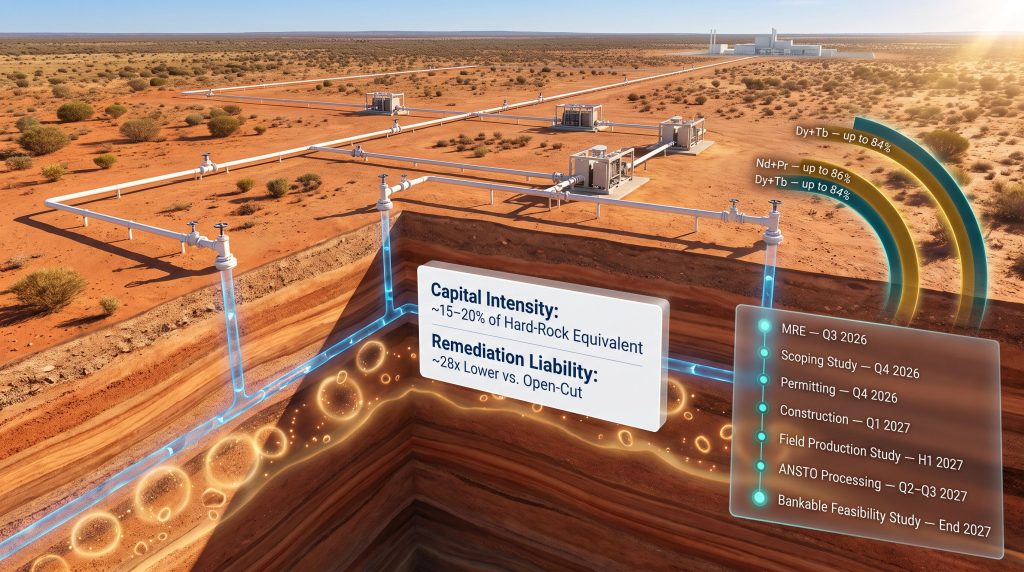
ISR operations targeting ionic adsorption clay deposits have been cited as carrying capital intensity at approximately 15 to 20% of equivalent hard-rock mining operations, with remediation liabilities per pound estimated at roughly 28 times lower than those of open-cut mines such as the Ranger uranium mine in the Northern Territory.
That remediation gap is not a minor cost footnote. For a junior developer, the difference between a confined wellfield operation and an open-cut mine with a multi-decade rehabilitation liability represents a structural difference in project viability.
When big ASX news breaks, our subscribers know first
What the Boland Production Study Is Actually Designed to Prove
The distinction between a field demonstration and a production study matters more than it might initially appear. A loosely scoped demonstration establishes proof of concept: does the fluid move through the ground, and does it pick up rare earths? A fully engineered production study does something more demanding.
It validates specific operating assumptions, including reagent consumption rates, subsurface permeability behaviour, impurity suppression performance, and product specification achievement, using a process flowsheet designed to carry those validated parameters directly into economic modelling.
The Cobra Resources Boland ISR rare earth production study has been structured as the latter. Engineering design and process modelling have been completed ahead of permitting, which represents a meaningful technical de-risking step. The study sits at the validation layer between a Mineral Resource Estimate and a Bankable Feasibility Study, and every element of its design reflects that function.
The Two-Site Architecture and Why It Compresses Capital Requirements
The production study operates across two physically separate locations, and the logic behind that structure is commercially deliberate.
The field component takes place at the existing Boland wellfield in South Australia, where the ISR process will run across up to four wellfields over an anticipated 60-day field programme. This stage handles leaching, pH control, sequential recovery, and remediation, producing an intermediate precipitated slurry on site.
The chemically complex downstream separation steps are then completed at the Australian Nuclear Science and Technology Organisation (ANSTO) pilot facility, where dissolution, iron removal, cerium removal, aluminium removal, and final carbonate precipitation complete the flowsheet.
| Stage | Location | Function |
|---|---|---|
| ISR Field Trial | Boland Wellfield, South Australia | Leaching, pH control, sequential recovery, remediation |
| Downstream Processing | ANSTO Pilot Facility | Dissolution, iron/cerium/aluminium removal, carbonate precipitation |
| Target Output | Combined | 400 to 600 kg Mixed Rare Earth Oxides (MREO) |
| Field Duration | Boland Site | Approximately 60 days |
By routing chemically intensive separation to an existing facility rather than constructing on-site plant, the field capital requirement stays minimal while still generating a product that meets a defined specification. The design also creates two independent validation points: the wellfield tests subsurface behaviour against modelled predictions, while the ANSTO stage tests whether the intermediate product can be finished to a commercial specification without solvent extraction.
The Reagent Economics: Why Acid Consumption Is the Operating Cost Hinge
In any ISR operation targeting ionic adsorption clays, sulphuric acid consumption per tonne of material treated is the single most important variable in the operating cost structure. It determines the reagent procurement budget, the environmental footprint of the leach chemistry, and the project's exposure to external supply chain risk.
Metallurgical test work at Boland has produced modelled acid consumption in the range of 1 to 16 kilograms of sulphuric acid per tonne of material treated across the deposit. However, individual drill holes have returned acid consumption values as high as 60 kg per tonne, reflecting spatial variability in the deposit's chemistry. The production study is specifically designed to test whether the deposit's own capacity for natural acid generation can offset a substantial share of externally sourced acid requirements.
Why this matters operationally: If natural acid generation from the deposit could displace up to 50% of total acid requirements, the reduction in both operating expenditure and external supply risk would be material. Sulphuric acid supply is currently constrained both domestically in Australia and in international markets, making any in-ground generation capacity a structural operating advantage rather than simply a cost optimisation exercise.
The study is also testing whether saline groundwater native to the Boland site can drive an ammonium sulphate reaction that reduces dependence on ammonium nitrate, a higher-cost reagent input. The chemistry underpinning this substitution relies on the reaction between ammonium-bearing solutions and the sulphate content of saline groundwater to produce an effective leaching agent. If successful, this would alter the reagent cost structure at the project level and reduce exposure to ammonium nitrate procurement challenges.
pH Management as Both a Cost and a Quality Control Mechanism
The same pH control system that governs acid consumption also plays a central role in product quality. Managing solution chemistry through the leach cycle suppresses radionuclide mobilisation and controls impurity content in the pregnant leach solution. This dual function, cost management and quality control from a single process parameter, is one of the more elegant aspects of the Boland flowsheet design.
Radionuclide content in ionic rare earth deposits is a commercially sensitive issue that does not receive sufficient attention in most market-facing discussions. The presence of naturally occurring radioactive materials, including uranium and thorium series radionuclides, can complicate product classification, shipping, and end-user acceptance. Managing radionuclide content through pH control during the leach stage, rather than through expensive downstream separation, is both a cost and a commercial positioning advantage.
Metallurgical Performance: What the Test Work Has Established
The metallurgical case for Boland rests on several distinct data points, each addressing a different dimension of project economics and product quality.
Overall rare earth recovery from test work stands at approximately 66% total rare earth recovery, with a Mixed Rare Earth Carbonate product achieving 62.4% total rare earth oxide (TREO) content in earlier work. Recovery rates for the commercially highest-value magnet rare earth pairs, tested at pH 3, are significantly stronger:
| Rare Earth Element Pair | Recovery Rate |
|---|---|
| Dysprosium + Terbium (Dy+Tb) | Up to 84% |
| Neodymium + Praseodymium (Nd+Pr) | Up to 86% |
These selective recovery rates matter because neodymium, praseodymium, dysprosium, and terbium are the elements that underpin permanent magnet manufacturing for electric motors and wind turbine generators. They command materially higher prices than light rare earths such as cerium or lanthanum, and their concentration in the final product directly determines the project's revenue potential per kilogram of output. Moreover, understanding critical minerals demand driven by the energy transition helps contextualise why these magnet rare earths are so commercially significant.
The Cerium Removal Strategy and Its Effect on Heavy Rare Earth Fraction
One of the less widely understood aspects of the Boland flowsheet is the deliberate removal of cerium during the ANSTO impurity processing stage. Cerium typically constitutes the largest single fraction of total rare earth content in most ionic adsorption clay deposits, but it carries limited commercial value relative to the magnet rare earths. Rather than selling cerium as a low-value product that dilutes the apparent quality of the output, the Boland flowsheet removes it during downstream processing.
The consequence of cerium removal is that the heavy rare earth proportion of the final product rises to approximately 43%, and this is achieved at under 0.9% total impurities without the use of solvent extraction. Avoiding solvent extraction is significant because solvent extraction circuits are capital-intensive, chemically complex, and difficult to permit in many jurisdictions. Achieving a high-grade, heavy rare earth-enriched product without this processing step represents a genuine process efficiency advantage.
The Drilling Dataset That Underpins the Resource Estimate
All assay results from the completed 74-hole Sonic core drilling programme across the Boland and Head prospects are now in hand. The dataset confirmed extensions of high-grade mineralisation at the Head prospect, including an intercept of 2.35 metres at 1,567 ppm TREO from 11 metres depth, which sits comfortably in the range of economically significant ionic adsorption clay grades. Interpreting drill results of this nature requires careful attention to both grade and spatial continuity within the deposit.
Permeability screening across 50 samples produced a particularly important result: 70% of samples matched or exceeded the permeability of the installed Boland wellfield. For an ISR project, permeability is not simply a geological curiosity. It is a direct determinant of fluid flow rates through the deposit, which in turn governs both the speed of rare earth extraction and the operational efficiency of the wellfield. A result showing that the majority of sampled material meets or exceeds the permeability benchmark set by the existing wellfield infrastructure is a meaningful confirmation of ISR suitability across the broader deposit.
Global consultancy ERM has been engaged to complete the maiden Mineral Resource Estimate, targeted for the third quarter of 2026. Importantly, ERM's mandate extends beyond a conventional grade-and-tonnage resource model. The MRE is being structured to incorporate permeability and natural acid generation capacity alongside grade, producing resource estimate insights that carry ISR-specific operating parameters from the outset.
Embedding permeability and acid generation data into the resource model at the MRE stage is an unconventional approach that compresses the gap between resource estimation and economic modelling. It reduces the number of assumptions that must be validated later in the feasibility sequence, and it means the scoping study receives a resource already framed around the variables that drive cost rather than one that treats operating assumptions as separate inputs to be determined later.
The higher-confidence Pidinga formation is expected to anchor an Indicated resource component, with shallower formations contributing additional scale at lower confidence classifications.
South Australia's ISR Regulatory Track Record as a Project Enabler
The technical case for Boland does not exist in a regulatory vacuum. South Australia has developed one of the more commercially functional ISR permitting environments in Australia, with four ISR pilot studies completed across copper and uranium in the preceding two years. Among these was a uranium ISR pilot completed by Alligator Energy in the same general geological region, alongside commercial ISR uranium operations already running in equivalent South Australian geological formations.
This track record matters for two reasons. First, it establishes that the state's regulatory framework can process ISR pilot approvals within commercially viable timeframes. Second, it means that the baseline hydrological assessment and environmental approvals process that Cobra must complete for Boland is following a well-worn procedural path rather than establishing new regulatory precedent. Environmental consultants JBS&G Environmental Consultants and Rendement Consulting have been engaged to manage the approvals process.
| Jurisdiction Factor | South Australia | States Without ISR Precedent |
|---|---|---|
| Completed ISR Pilots (past 2 years) | 4 | 0 |
| Uranium ISR Commercial Operations | Active | None |
| Regulatory ISR Framework | Established | Untested or adversarial |
| Timeline Risk | Lower | Higher |
The next major ASX story will hit our subscribers first
The 18-Month Catalyst Sequence: Technical Milestones Mapped to Validation Objectives
The development pathway from current position to Bankable Feasibility Study is structured around a tightly sequenced series of milestones, each designed to validate specific technical assumptions before committing capital to the next stage.
| Milestone | Target Period |
|---|---|
| Maiden Mineral Resource Estimate (MRE) | Q3 2026 |
| Scoping Study Completion | Q4 2026 |
| Demonstration Permitting | Q4 2026 |
| ISR Study Infrastructure Construction and Installation | Q1 2027 |
| Boland Wellfield Field Production Study | H1 2027 |
| ANSTO Processing Stage | Q2 to Q3 2027 |
| Bankable Feasibility Study | Through to end of 2027 |
Each stage has a defined technical function within the broader validation sequence:
- MRE: Establishes resource classification with permeability and acid generation parameters embedded alongside grade, creating an ISR-ready economic foundation.
- Scoping Study: Applies ISR-specific cost inputs to the resource model to produce a preliminary economic framework, informing whether the Bankable Feasibility Study is commercially justified.
- Field Production Study: Tests subsurface permeability behaviour against modelled predictions, validates reagent consumption rates, and confirms that pH management reliably suppresses radionuclides and impurities across the full leach cycle.
- ANSTO Processing Stage: Validates the downstream flowsheet, confirms impurity removal performance including cerium separation, and produces a product sample against which commercial specifications can be assessed.
- Bankable Feasibility Study: Incorporates field-validated operating parameters into a full commercial economic model, replacing modelled assumptions with measured results.
How the Boland ISR Model Compares Structurally to Conventional Rare Earth Production
The cost and disturbance differential between ISR and conventional rare earth extraction methods is substantial enough to warrant direct comparison across multiple dimensions. Furthermore, rare earth supply chains remain under significant geopolitical and commercial pressure, which makes low-cost, low-disturbance production models increasingly attractive to downstream consumers and offtake partners.
| Dimension | ISR (Boland Model) | Conventional Hard-Rock | Open-Cut Mining |
|---|---|---|---|
| Capital Intensity | ~15 to 20% of hard-rock equivalent | High | Very High |
| Surface Disturbance | Minimal (wellfield-based) | Significant | Extensive |
| Remediation Liability | ~28x lower per pound vs. open-cut | Moderate | High |
| Tailings Generation | None | Significant | Significant |
| Reagent Supply Risk | Partially offset by in-ground generation | External supply dependent | External supply dependent |
| Heavy REE Fraction | ~43% post cerium removal | Variable | Variable |
| On-Site Processing Plant | Not required (ANSTO used) | Required | Required |
The absence of tailings is worth emphasising as a distinct structural advantage. Tailings storage facilities represent one of the largest sources of long-term environmental liability and insurance cost in conventional mining. For an ISR operation, where no physical rock is brought to surface and processed, this liability category effectively disappears.
Frequently Asked Questions: Cobra Resources Boland ISR Production Study
What is the Boland ISR production study and what will it produce?
A small-scale field trial at the existing Boland wellfield in South Australia, designed to generate 400 to 600 kg of Mixed Rare Earth Oxides as an intermediate product, with downstream finishing completed at the ANSTO pilot facility. Cobra Resources' broader project strategy targets undercutting conventional industry production costs by up to 50% using this ISR approach.
Why does natural acid generation matter to the project's economics?
Sulphuric acid is the primary operating cost driver in ISR. If the deposit's chemistry can generate and sustain a meaningful share of the acid required for leaching, the project's operating cost profile improves materially and its exposure to external reagent supply constraints is reduced. Current supply constraints for sulphuric acid, both domestically in Australia and internationally, make this variable more commercially significant than it would be in a normalised supply environment.
What rare earth elements does the Boland process prioritise?
The flowsheet is designed to selectively recover higher-value magnet rare earths, particularly neodymium, praseodymium, dysprosium, and terbium, while removing cerium during impurity processing to elevate the heavy rare earth proportion of the final product to approximately 43%.
What is the significance of embedding permeability into the Mineral Resource Estimate?
Conventional MREs report grade and tonnage. An MRE that also carries permeability and acid generation parameters allows the scoping study to apply ISR-specific cost inputs directly to resource classifications without requiring a separate permeability characterisation exercise. This compresses the timeline between resource estimation and preliminary economic assessment, and it reduces the risk that a later permeability characterisation produces results inconsistent with the resource model.
What makes South Australia's regulatory environment favourable for this type of project?
South Australia has processed four ISR pilot study approvals across copper and uranium in the past two years, establishing a functional regulatory pathway for this extraction method. Existing commercial ISR operations in the same geological formations provide additional precedent. For a junior developer, operating within an established ISR permitting framework reduces both approval timeline risk and the probability of encountering regulatory frameworks that have no prior template for this type of operation. Consequently, the London Stock Exchange exploration update for Boland reflects the project's advancing status within this supportive regulatory context.
This article is intended for informational purposes only and does not constitute financial advice. Investment in junior mining and exploration companies carries significant risk, including the potential loss of capital. Forward-looking statements, project timelines, and economic projections referenced in this article are subject to change and involve material uncertainty. Readers should conduct their own due diligence and seek independent financial advice before making any investment decisions.
Want to Capitalise on the Next Major Critical Minerals Discovery Before the Broader Market?
Discovery Alert's proprietary Discovery IQ model delivers real-time notifications on significant ASX mineral discoveries — including rare earths and other critical minerals driving the energy transition — translating complex data into actionable insights for investors at every experience level. Explore historic discoveries and their exceptional returns, then begin your 14-day free trial to position yourself ahead of the market.