July 30, 2026
When the Ground Becomes the Hazard: Understanding Methane Risk in Underground Coal Mining
Coal seams are not simply repositories of combustible rock. They are geological pressure vessels, storing vast quantities of methane gas within their molecular structure over millions of years of organic decomposition and compaction. When those seams are opened by drilling, blasting, or mechanical cutting, that gas does not dissipate passively. It migrates, accumulates in confined spaces, and waits for an ignition source.
This is not a fringe risk in underground coal mining. It is the defining occupational hazard of the industry, and it has claimed thousands of lives across every major coal-producing nation on earth. Understanding mining risk management is, consequently, essential for anyone working in or near the sector.
What makes methane particularly dangerous underground is the precision of its explosive range. Concentrations below roughly 5% in air are too lean to combust. Above approximately 15%, the mixture becomes too rich to ignite. But within that narrow band, a single spark from a fractured drill bit, a failing electrical connection, or even a steel tool striking rock at the wrong angle can trigger a pressure wave capable of demolishing underground structures in milliseconds.
At depths exceeding 1,000 metres, the physics become even less forgiving: gas release rates increase with overburden pressure, natural ventilation becomes physically impossible without mechanical systems, and the thermal and structural consequences of a blast are amplified by the confined geometry of deep mine workings.
It is within this technical reality that the Pakistan coal mine blast death toll rises to 34 must be understood — not as an isolated tragedy, but as the predictable outcome of systemic gaps in hazard management within one of the world's most under-regulated mining environments.
When big ASX news breaks, our subscribers know first
What Happened at Sorange: Incident Facts and Official Data
The Explosion That Destroyed Two Mine Sections
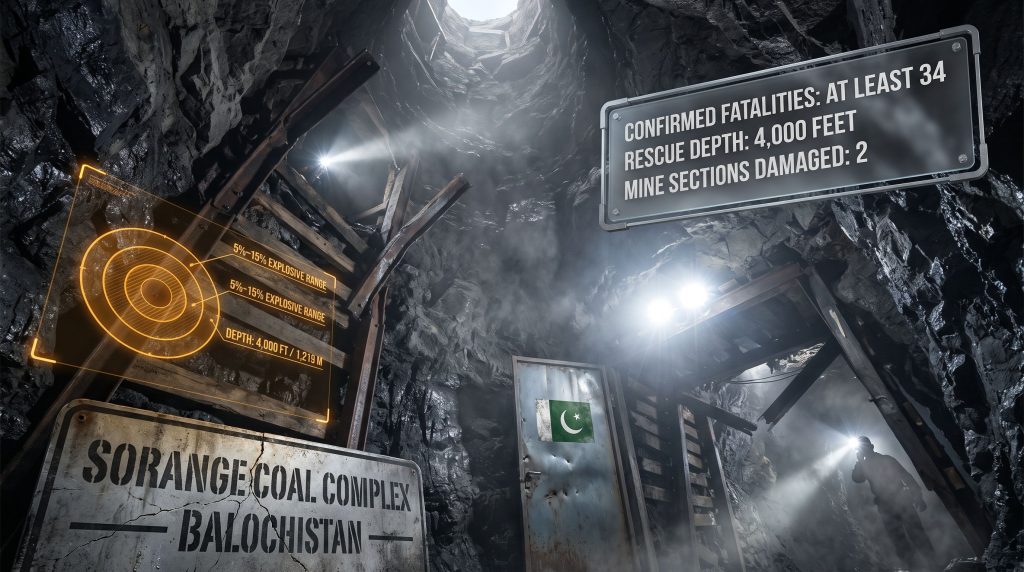
On 31 July 2026, a powerful methane gas explosion tore through the Sorange coal mining complex in Balochistan province, destroying two adjacent mine sections simultaneously. Sorange is a remote district located in the interior of Balochistan, situated near the provincial capital of Quetta. The area is characteristic of the province's coal belt: geologically rich, commercially active, and infrastructurally constrained.
According to Abdul Ghani Baloch, a senior government mining official in the region, two mines in close proximity were destroyed by the same methane ignition event. The fact that two separate but adjacent shafts were compromised in a single blast points to a shared methane pocket spanning the geological boundary between the two workings — a risk scenario that multi-shaft mining complexes must explicitly account for in their ventilation and gas monitoring designs.
Casualty and Rescue Data
| Metric | Reported Figure |
|---|---|
| Confirmed fatalities | At least 34 |
| Workers in collapsed section (official) | 36 |
| Workers potentially underground (field reports) | Up to 42 |
| Miners still unaccounted for | 2 to 10 (varying reports) |
| Rescue operation depth | 4,000 feet (1,219 metres) |
| Mine sections damaged | 2 adjacent shafts |
Muhammad Fahad, Director of Operations for the Provincial Disaster Management Authority (PDMA), confirmed the death toll of at least 34 and stated that rescue operations remained active to locate the two remaining trapped miners. Shoaib Nosherwani, Balochistan's Minister for Mines and Mineral Development, confirmed that 36 workers were present in the collapsed section at the time of the explosion.
Muhammad Atif, the Chief Inspector of Mines in the province, confirmed that rescue teams were working at a depth of approximately 4,000 feet below the surface. Reporting from multiple outlets covering the blast confirms the scale of the tragedy unfolding at Sorange.
The discrepancy between the official figure of 36 workers and field reports suggesting up to 42 were underground is itself a diagnostic indicator. It points directly to the absence of reliable real-time workforce tracking at the mine site — a foundational safety capability that modern mining operations in comparable geological conditions treat as non-negotiable.
Why Depth Matters: The Compounding Physics of Deep Mine Rescues
Methane Behaviour at Extreme Depths
The 4,000-foot rescue depth at Sorange places this incident in a category of technical complexity that strains even well-resourced emergency response systems. At such depths, several compounding hazards converge:
- Residual methane pockets can persist in fractured rock for hours or days after the initial explosion, creating secondary ignition risks for rescue teams.
- Structural instability intensifies at depth, where overburden pressure means that roof failures can propagate laterally through weakened rock zones well beyond the initial blast zone.
- Oxygen levels can fall rapidly in sealed or partially collapsed sections, creating hypoxic conditions for any trapped survivors.
- Communication between surface command and underground rescue teams degrades significantly at extreme depths without dedicated fibre optic or leaky feeder radio systems.
- Heat and humidity increase with depth, physically degrading rescue team performance over extended operations.
The involvement of the PDMA as the primary coordinating body confirms that the disaster exceeded the response capacity of mine-level emergency teams alone. This is a pattern seen repeatedly in Balochistan's coal sector: mine operators lack the pre-positioned rescue equipment, trained mine rescue brigades, and atmospheric monitoring infrastructure to mount an effective first-response.
Furthermore, this leaves provincial disaster management agencies to absorb the operational burden retroactively — a reactive posture that costs lives in time-critical rescue scenarios.
Pakistan's Coal Mining Safety Record: A Structural Problem, Not a Statistical Anomaly
Balochistan's Persistent Fatality Pattern
Balochistan is not experiencing a string of unrelated accidents. It is experiencing the recurring consequences of a structural safety deficit. The province accounts for a significant share of Pakistan's domestic coal production, yet its mine inspection capacity relative to the number of active shafts remains critically understaffed.
Methane gas has been consistently identified as the primary cause of fatal explosions across the province's coal belt over the past two decades. Understanding mining waste management and hazardous gas control are two sides of the same operational discipline that Pakistan's sector has yet to systematically address.
Pakistan ranks among the countries with the highest per-capita coal mining fatality rates globally. This distinction is driven primarily by conditions in Balochistan and Khyber Pakhtunkhwa, where small-to-medium informal or semi-formal mining operations predominate. These operations typically lack the capital investment required to deploy continuous atmospheric gas monitoring, automated ventilation trigger systems, or electronic workforce tracking technologies.
A particularly under-recognised dimension of this crisis is its demographic concentration. Balochistan's coal mining workforce includes a disproportionate number of workers from the Hazara ethnic community, who have borne a persistently elevated share of the human cost of inadequate mine safety standards across the province's coal belt.
How Pakistan's Regulatory Framework Compares Globally
| Jurisdiction | Primary Regulatory Body | Mandatory Methane Monitoring | Inspection Frequency |
|---|---|---|---|
| Pakistan (Balochistan) | Provincial Mines Department / PDMA | Inconsistently enforced | Irregular |
| Australia | State Mines Safety Regulators (e.g., QLD Resources Safety) | Mandatory continuous monitoring | Regular statutory intervals |
| China | National Mine Safety Administration | Mandatory | Frequent (post-reform era) |
| United States | Mine Safety and Health Administration (MSHA) | Mandatory federal standard | Quarterly minimum |
The contrast is stark. In jurisdictions with mature mine safety frameworks, continuous methane monitoring is not a capital expenditure to be deferred. It is a legal prerequisite for operating underground. Atmospheric sensors with automatic ventilation triggers, personal gas detectors for every underground worker, and surface-level data dashboards updated in real time are standard features of compliant operations in Australia and the United States.
The Fragmented Oversight Problem
Mine safety oversight in Balochistan is distributed across at least three separate bodies:
- The Provincial Disaster Management Authority (PDMA), which functions reactively after disasters occur.
- The Chief Inspector of Mines, responsible for technical compliance monitoring.
- The Department of Mines and Mineral Development, which manages licensing and resource extraction frameworks.
This fragmentation creates accountability voids, particularly in remote districts like Sorange. When no single authority holds comprehensive enforcement power and operates with adequate resourcing, compliance culture weakens across the sector. Pakistan's Mines Act and associated provincial regulations have faced sustained criticism for insufficient enforcement mechanisms and infrequent, inconsistently applied inspection cycles. The mining claims framework applied in more regulated jurisdictions demonstrates how consolidated oversight structures can meaningfully reduce these gaps.
FAQ: Pakistan Coal Mine Blast, Key Questions Answered
What caused the Pakistan coal mine explosion in Balochistan?
The blast was caused by a methane gas explosion that destroyed two adjacent mine sections within the Sorange coal mining complex near Quetta on 31 July 2026.
How many people died in the Pakistan coal mine blast?
The Pakistan coal mine blast death toll rises to 34, with rescue operations still active to locate remaining trapped workers at the time of reporting.
Where exactly did the Pakistan mine explosion occur?
The explosion occurred in the Sorange area of Balochistan province, a remote district near Quetta. Details of the incident were widely reported internationally, reflecting the severity of the event.
How deep were rescue operations conducted?
Rescue teams were working at approximately 4,000 feet (1,219 metres) below the surface.
How many miners were trapped underground?
Official reports indicated 36 workers were in the collapsed section at the time of the blast. Some field reports suggested up to 42 workers may have been underground, with as many as 10 unaccounted for at various points during the rescue.
Is methane gas a recurring hazard in Pakistan's coal mines?
Yes. Methane accumulation is one of the most persistent and deadly hazards in Pakistan's underground coal sector, particularly in Balochistan, where geological conditions and limited ventilation infrastructure create recurring risk across the province's active coal workings.
The next major ASX story will hit our subscribers first
What Reforms Could Prevent the Next Disaster?
Immediate Regulatory Priorities
The reforms required are not technically complex. They are politically and financially demanding in a context where mine operators are often small-scale, capital-constrained, and operating in remote areas with limited regulatory oversight. However, the technical pathway is well established:
- Mandatory continuous methane monitoring: All underground coal operations in Balochistan should be required to install real-time atmospheric gas sensors linked to automatic ventilation and alarm systems. This is standard practice in every comparable jurisdiction globally.
- Electronic workforce tracking: Real-time tagging of all underground personnel would eliminate the uncertainty about workforce numbers that complicated the Sorange rescue from its earliest hours.
- Joint ventilation assessments for multi-shaft complexes: Where adjacent mine shafts share geological formations, regulators must require coordinated gas monitoring and ventilation design, not independent compliance assessments for each shaft in isolation.
Medium-Term Structural Reforms
- Consolidating mine safety oversight under a single, adequately resourced provincial authority with genuine enforcement powers, including licence suspension for non-compliance.
- Establishing dedicated mine rescue brigades in high-risk districts such as Sorange, with pre-positioned equipment and regular training exercises conducted before emergencies occur.
- Introducing mandatory safety certification for mine operators, with clear escalation mechanisms tied to inspection findings.
Grasping mining permitting basics is, in addition, a necessary foundation for any operator seeking to understand why compliance requirements exist in the first instance — and why shortcuts carry such catastrophic consequences.
Long-Term Governance Considerations
Pakistan's coal sector requires a gradual but deliberate transition away from informal small-scale operations toward regulated enterprises capable of funding modern safety infrastructure. The mine reclamation importance discourse emerging globally underscores that responsible resource extraction must account for worker welfare and environmental stewardship throughout the entire operational lifecycle — not merely at closure.
International Labour Organisation engagement, alongside technical assistance partnerships, could support the development of a national mine safety framework aligned with globally accepted standards. Until that transition occurs, the conditions that caused the Pakistan coal mine blast death toll to rise to 34 will remain in place across dozens of active mining districts throughout the country.
This article contains factual reporting based on confirmed official statements. Casualty figures and rescue operation details were subject to change as operations continued at the time of publication. Regulatory comparisons and reform recommendations represent analytical assessments and should not be construed as legal or operational advice.
Want to Stay Ahead of Significant ASX Mineral Discoveries Before the Broader Market Does?
Discovery Alert's proprietary Discovery IQ model delivers real-time alerts on significant ASX mineral discoveries, transforming complex geological data into actionable investment insights for both short-term traders and long-term investors — explore historic examples of exceptional discovery outcomes to understand the scale of opportunity involved, and begin your 14-day free trial at Discovery Alert to position yourself ahead of the market.