August 8, 2026
Why Porphyry Systems Demand a Different Kind of Attention From Copper Investors
The global copper mining industry runs on porphyry deposits. Of the roughly 700 million tonnes of copper produced in the 20th century, the majority came from large, low-grade porphyry systems concentrated in the Andes, the American Southwest, and parts of Central Asia. Yet despite this dominance, porphyry systems remain among the most misunderstood targets in junior exploration — partly because their true scale only becomes readable through a specific sequence of geological signals that most investors are not trained to recognise.
Understanding those signals is the correct starting point for evaluating the Cobra Resources Manna Hill copper assays, which are expected from the laboratory in August 2026. The drilling programme completed at the Blue Rose prospect in South Australia has not produced confirmed grades yet. What it has produced is a coherent set of mineralogical, structural, and geophysical indicators that collectively reframe the project from a shallow skarn anomaly into a candidate for something considerably larger.
When big ASX news breaks, our subscribers know first
The Geological Architecture That Gives Blue Rose Its Scale Argument
Two-Tier Mineralisation: Skarn at Surface, Porphyry at Depth
Blue Rose operates as a two-tier system, which is a configuration that exploration geologists treat very differently from a single-style deposit. Near-surface mineralisation takes the form of skarn: high-temperature metasomatic replacement of carbonate host rocks by copper-bearing fluids emanating from an intrusion below. Skarns can be high-grade but are typically limited in volumetric scale.
What lies beneath the skarn is the more consequential geological question. The intrusive complex of diorite and monzonite identified at Manna Hill functions as the heat engine that drove those mineralising fluids upward. Porphyry systems centred on this type of intrusive architecture host some of the world's largest copper inventories, including deposits in Chile and Peru that collectively account for a substantial share of global refined copper supply. Furthermore, understanding IOCG deposits guide can provide useful context for appreciating the broader geological framework in which such systems operate.
South Australia's Proterozoic Belt: An Underexplored Copper Corridor
South Australia sits within a Proterozoic geological framework that has historically attracted less systematic porphyry-focused exploration than comparable belts in South America or Central Asia. This relative underexploration is a structural feature of the region rather than a reflection of its geological prospectivity.
The Olympic Dam copper-uranium-gold deposit, one of the largest known accumulations of copper in the world, occupies the same broad Proterozoic province, which provides a geological precedent for large intrusion-related copper systems in the region. Cobra Resources plc (LSE: COBR) has exercised its option to acquire full ownership of the Manna Hill ground, consolidating its position across this tenure as the exploration thesis develops.
How the Diamond Drilling Programme Was Engineered
Programme Scope and Strategic Design
The programme consisted of four diamond drill holes totalling 1,465 metres of continuous core. Diamond drilling was selected over reverse circulation for this phase for a specific reason: diamond core preserves the three-dimensional texture, mineralogy, and alteration relationships of the rock in a way that RC chips cannot replicate. When the primary objective is to interpret the style and proximity of alteration to a porphyry core, that textural information is operationally essential.
The programme was designed to answer two questions sequentially:
- Does the high-grade copper mineralisation identified in prior RC drilling extend to meaningful vertical depths beneath the known skarn horizon?
- Is there evidence of a buried porphyry intrusive core beneath the skarn, indicated by characteristic alteration mineralogy and sulphide assemblage changes?
The RC Baseline That Preceded This Programme
The prior reverse circulation campaign had already established an impressive shallow copper footprint across approximately 1.6 kilometres of strike at Blue Rose. The confirmed assay results from that work include:
| Hole ID | From (m) | Interval (m) | Cu Grade (%) | Au Grade (g/t) |
|---|---|---|---|---|
| MHRC (early) | 72m | 74m | 1.02% Cu | 0.25 g/t Au |
| MHRC (early) | 18m | 86m | 0.60% Cu | 0.14 g/t Au |
| MHRC (early) | 11m | 47m | 2.20% Cu | 0.78 g/t Au |
| MHRC (early) | — | 132m | 0.52% Cu | — |
| MHRC0013 | 62m | 62m | 1.00% Cu | 0.08 g/t Au |
| MHRC0013 (HG zone) | Within above | 16m | 1.92% Cu | — |
| MHRC0011 | 20m | 22m | 0.80% Cu | — |
| MHRC0011 (HG zone) | Within above | 6m | 1.56% Cu | — |
| MHRC0009 | 30m | 22m | 0.48% Cu | 0.17 g/t Au |
| MHRC0010 | 24m | 6m | 0.77% Cu | — |
| MHRC0010 (Mo) | 94m | 4m | 0.073% Mo | — |
Data Note: All figures in the table above represent laboratory-confirmed assay results from prior RC drilling. Visual logging observations from the current diamond programme remain pending laboratory verification, anticipated in August 2026.
Depth extension, not surface width, was the critical unanswered question entering the current programme.
What the Diamond Core Visually Revealed Beneath the Skarn
Copper Sulphide Continuity to 300 Metres Vertical Depth
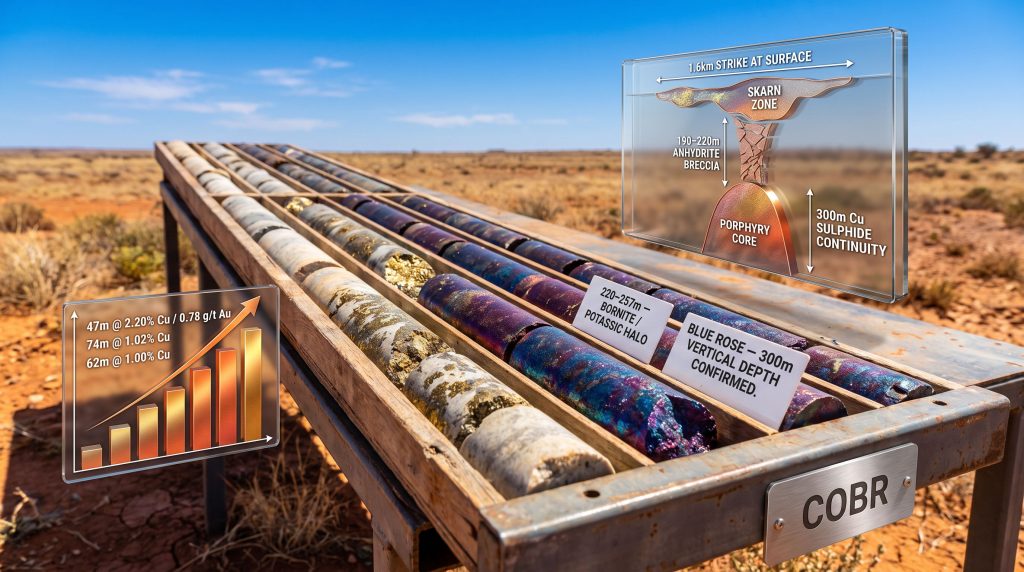
The key hole in the programme was collared beneath the two RC holes that had returned the 74m at 1.02% Cu and 86m at 0.60% Cu intercepts. Visual examination of the recovered core traced copper sulphide mineralisation continuously to 300 metres depth — a vertical extension that fundamentally changes the geometric interpretation of the deposit.
A shallow skarn constrained to the uppermost 80 to 100 metres of a system tells a limited economic story. A sulphide system traced to 300 metres beneath an already confirmed high-grade surface footprint implies a deposit geometry more consistent with a porphyry shoulder than with an isolated skarn lens. These are categorically different investment propositions, and the distinction carries direct implications for the scale of any eventual resource.
The Mineralogical Shift That Matters Most: Chalcopyrite to Bornite
Within the deeper portion of the same hole, the copper mineralogy changed in a way that porphyry geologists specifically watch for. Chalcopyrite, the most common primary copper sulphide and the dominant copper mineral in the shallower skarn intervals, contains approximately 32 to 33% copper by weight. At depths between approximately 220 and 257 metres, the dominant copper mineral shifted to bornite within a potassic alteration zone adjacent to diorite and monzonite intrusions.
Key Mineralogical Concept: Bornite (Cu₅FeS₄) carries approximately 63% copper by weight — nearly double the copper density per unit of mineral volume compared to chalcopyrite. In a system where widths are comparable, bornite-dominant intervals should theoretically assay at substantially higher copper grades than chalcopyrite-dominant intervals of the same thickness.
The association of bornite with biotite schist in a potassic alteration halo is a textbook porphyry indicator. Potassic alteration zones form closest to the intrusive heat source, where temperatures are highest and copper-to-iron ratios in the hydrothermal fluid are elevated. The presence of this assemblage at depth confirms that the drill bit has entered the inner alteration envelope of a porphyry system — the zone that, in analogous deposits globally, hosts the highest-grade copper concentrations.
What the Potassic Halo Signals About System Proximity
Porphyry copper systems display a concentric alteration zonation pattern radiating outward from the intrusive core. The progression from the core outward typically runs: potassic alteration (K-feldspar and biotite dominant) transitioning to phyllic alteration (sericite and quartz dominant), then to argillic, and finally to propylitic at the outermost margins. The economic copper grades in major porphyry mines globally tend to be concentrated within or immediately adjacent to the potassic zone.
Intersecting biotite-dominated potassic alteration with bornite at Manna Hill places at least one drill hole within this innermost zone. Whether the intrusive core itself has been intersected, or whether the hole has clipped the potassic halo above a still-deeper core, will be partially resolved by the assay data and further clarified by the planned geophysical modelling work. In addition, the significance of correctly interpreting drill results at this stage cannot be overstated for investors following the project.
What the Anhydrite Breccia Tells Experienced Geologists
Fluid Pathways, Not Ore — But Critically Important
One of the four diamond holes intersected a large fault-bound anhydrite breccia running from 190 to 220 metres depth. For investors unfamiliar with porphyry geology, this result can appear unremarkable — anhydrite (calcium sulphate, CaSO₄) carries negligible copper. The significance lies not in the mineral itself but in what its presence at this scale implies about the plumbing architecture of the system.
Anhydrite breccias in porphyry systems form within the conduit zones that channel copper-bearing hydrothermal fluids upward from the intrusive source. They precipitate from the same fluid that deposits copper sulphides in the surrounding host rocks. A large, fault-controlled anhydrite breccia of this character is therefore a structural map of the fluid delivery pathway — pointing directly toward the parent intrusion below.
Critically, anhydrite breccias of this scale are documented at major porphyry systems globally, including in the Chilean and Peruvian copper belts, but are uncommon in the Australian exploration context. Their rarity in Australian drill records means that intersecting one at Manna Hill is geologically significant beyond the local project scale — it indicates the presence of a fluid system of a scale not commonly encountered in Australian exploration campaigns.
Using Breccia Geometry as a Drill Vector
Experienced exploration teams use the orientation and geometry of anhydrite breccia pipes to vector subsequent drilling toward the parent intrusion. The structural axis of the breccia provides a directional indicator toward the zone of highest fluid flux, which correlates with the location of the intrusive core. This vectoring approach is a well-established methodology in porphyry exploration and is one of the primary tools the Manna Hill technical team will apply in designing the September 2026 step-out programme.
The Southern Step-Out: A Footprint Larger Than the Model Predicted
Oxide Mineralisation Beyond the Known Skarn Boundary
A step-out hole drilled from the southern margin of the established skarn model returned shallow copper oxide mineralisation from 14 to 67.5 metres depth, entirely outside the boundaries of the current geological model. The oxide assemblage observed visually comprised jarosite, malachite, and chrysocolla — the classic supergene copper mineral suite that forms through surface weathering of primary copper sulphides.
The implications of this intersection are straightforward but significant:
- The prior mineralised boundary was defined by drill spacing, not by a geological boundary
- Primary copper sulphide mineralisation must exist below the oxide zone at the southern margin, as supergene oxides require a primary sulphide source to form through weathering
- The true lateral extent of the Blue Rose mineralised system is larger than the current model represents
- The southern zone adds a new drill target that is blind to the existing resource framework
What Supergene Copper Mineralogy Reveals About the Underlying System
The specific oxide minerals observed carry interpretive value beyond simply confirming copper presence. Malachite and chrysocolla are secondary copper carbonates and silicates that typically form in the upper oxidised portions of a copper sulphide body. Jarosite, an iron sulphate hydroxide, forms through the oxidation of iron sulphides and is commonly associated with zones of intense supergene enrichment above primary sulphide ores.
The co-occurrence of all three minerals at the southern margin suggests a primary sulphide system of sufficient grade and volume to produce a recognisable oxide cap during weathering. The next RC step-out programme, planned for September 2026, will specifically target definition of the sulphide source beneath these southern oxides.
The next major ASX story will hit our subscribers first
Geophysics as a Grade Probability Tool
Magnetic Low Anomalies Correlate Directly With Higher-Grade Zones
One of the most operationally useful outcomes of the current programme is the establishment of a direct correlation between deep magnetic low anomalies and the higher-grade copper zones identified in prior drilling. The mechanism involves the reversed magnetisation of diorite porphyry intrusions, which creates measurable magnetic low signatures detectable from surface or airborne surveys.
The bornite-bearing intersection in the potassic halo coincides spatially with an inversion-modelled magnetic anomaly. This alignment establishes a geophysics-to-grade-indicator link that the technical team can now use to rank step-out targets by grade probability before committing drill metres. Rather than drilling into geophysical uncertainty, the team can prioritise holes into magnetic low anomalies that the empirical data suggest are more likely to intersect higher-grade mineralisation.
Senior Technical Appointments Strengthening the Interpretive Framework
Cobra Resources has added two senior technical appointments to translate the geophysical model into actionable drilling targets. Stephen McIntosh, former global head of exploration at Rio Tinto and currently active in copper exploration in South America, brings institutional-grade porphyry exploration methodology to the targeting process. Professor Ross Large, a recognised geochemist, is contributing petrology and petrophysics work aimed at refining the magnetic inversion model.
The combination of inversion modelling and expert petrophysics interpretation is a methodology more commonly associated with major mining company exploration budgets than with junior explorers. Its application at Manna Hill materially reduces the geological risk in the next drill round by replacing visual targeting with a quantitative grade probability framework. However, understanding broader copper market trends remains equally important for contextualising why discoveries of this type are attracting serious technical attention.
The Risk Framework: What August Assays Can and Cannot Confirm
Visual Logging vs. Laboratory Assay: A Critical Distinction
Critical Investor Distinction: Visual core logging estimates mineral abundance based on colour, lustre, crystal form, and texture. Fire assay and ICP-MS laboratory analysis measure actual elemental concentrations with precision to parts per million. The two methodologies can diverge significantly, particularly in bornite-rich zones where the visual richness of the mineral does not always translate linearly to the assayed copper grade across full drill intervals.
The company has been explicit that all current observations from the diamond programme represent visual estimates only, and that laboratory results are required before any grade conclusions can be drawn. This is the correct and responsible position, and investors should treat the visual logging data as directional evidence rather than as a grade proxy.
Three distinct outcomes are possible when the August 2026 assays are released:
- Assays confirm or exceed visual estimates — the de-risking sequence holds in full, bornite widths translate to high copper grades, and the September step-out programme becomes a high-conviction follow-up drill campaign
- Assays broadly reproduce prior RC grades across broader widths — system scale is confirmed at established economic grades, the vertical extension argument holds, and the resource geometry expands substantially
- Assays undershoot the visual estimates — the scale argument for the system remains structurally valid, but the economic case requires reassessment and the September programme design may need to be recalibrated
It is also worth noting that the distinction between true vs apparent widths in drill intercepts will be a key consideration when assessing those results in context.
Board Alignment: Insider Capital at the Highest-Risk Point
Non-Executive Chairman Andrew Michelmore subscribed for £140,000 of shares ahead of the assay results. This is a meaningful signal in the context of junior resource exploration. Insider capital deployment at the pre-assay stage, before the primary value-determining event, aligns board incentives with shareholder outcomes at precisely the moment when the binary risk is highest.
In the behaviour patterns of junior mining investment, chairman-level buying ahead of a primary catalyst tends to be interpreted as a conviction signal rather than a routine portfolio transaction. Michelmore's long track record in the resources industry adds weight to that interpretation.
The Full Catalyst Sequence Through 2026 and Into 2027
| Catalyst | Expected Timing | Significance |
|---|---|---|
| Diamond drill assay results | August 2026 | Primary grade confirmation event; key re-rating trigger |
| RC step-out programme | September 2026 | Tests lateral and vertical scale extensions |
| Boland rare earth maiden resource estimate | Q3 2026 | Independent news flow; second asset de-risking |
| Boland scoping study | Post-Q3 2026 | Economic framing for the rare earth project |
| Boland in situ recovery production trial | TBC 2026-2027 | Small-scale production proof-of-concept |
| Boland bankable feasibility study | 2027 | Full project economic assessment |
Running a copper discovery programme and a rare earth development project in parallel creates two independent streams of potential re-rating catalysts. The Boland rare earth project, targeting a maiden mineral resource estimate in Q3 2026 followed by a scoping study, adds a molybdenum and rare earth dimension that is entirely separate from the Blue Rose copper thesis.
For investors, this dual-asset structure reduces single-event binary risk: if one asset's results disappoint in a given quarter, the other can sustain market attention and provide an alternative revaluation pathway. For further context on how a discovery of this scale can unfold, the development of a major copper system in Argentina offers a comparable reference point in terms of the exploration signals that tend to precede significant resource delineation.
Frequently Asked Questions: Cobra Resources Manna Hill Copper Assays
What are the highest-grade copper intervals confirmed at Blue Rose?
The strongest laboratory-confirmed intervals from prior RC drilling include 47m at 2.2% Cu and 0.78 g/t Au from 11m depth, 62m at 1.0% Cu including an inner 16m at 1.92% Cu from 62m depth, and 74m at 1.02% Cu and 0.25 g/t Au from 72m depth. These are all RC assay results; diamond drill grades from the current programme remain pending. The Manna Hill project page provides additional background on the project's history and tenure.
What is the practical difference between a skarn and a porphyry copper system?
A skarn forms where hot hydrothermal fluids from a buried intrusion chemically alter carbonate host rocks, creating localised but frequently high-grade copper zones. A porphyry system is the larger disseminated deposit centred on the intrusion itself, characterised by stockwork veining and pervasive alteration over a much larger volume of rock. The world's largest copper mines are porphyry systems. Manna Hill appears to host both styles simultaneously, with the skarn at surface drawing from the same intrusive system that may host a porphyry deposit at depth.
Why does bornite in a potassic halo matter so much?
Bornite carries approximately 63% copper by weight compared to roughly 33% for chalcopyrite. Its occurrence within potassic alteration adjacent to diorite intrusions places it within the innermost and highest-temperature alteration zone of a porphyry system — the zone most closely associated with elevated copper grades in analogous deposits globally. It is a positive directional indicator, but laboratory assay confirmation is required to translate its presence into a grade statement.
What does the anhydrite breccia tell geologists?
Anhydrite breccias form within the fluid conduit pathways that transport copper-bearing hydrothermal fluids from a buried porphyry intrusion. They carry minimal copper themselves but function as structural indicators of proximity to a large parent intrusion. Their scale at Manna Hill, from 190 to 220m in one hole, is uncommon in Australian exploration and implies a fluid system consistent with a substantial intrusive source.
When are the assay results expected?
Laboratory assay results from the four-hole, 1,465-metre diamond programme are anticipated in August 2026.
What the Data Has and Has Not Established: A Summary Framework
| What Has Been Established (Visual/Prior RC) | What Remains Unconfirmed (Assay-Dependent) |
|---|---|
| Copper sulphide continuity to 300m vertical depth | Laboratory-confirmed grade at depth extensions |
| Bornite within potassic alteration halo at 220-257m | Whether bornite widths translate to confirmed copper grades |
| Anhydrite breccia from 190-220m as a fluid pathway vector | Structural orientation and true width of the breccia system |
| Southern oxide mineralisation beyond the modelled skarn | True footprint extent and sulphide depth below southern oxides |
| Magnetic low correlation with higher-grade intervals | Grade probability mapping from refined magnetic inversion model |
| 1.6km strike of surface copper mineralisation (RC confirmed) | Resource geometry incorporating new diamond hole data |
Investment Framework Note: The August 2026 assay release is the single most significant near-term value-determining event for this project. Visual logging has addressed the question of scale; laboratory results will determine whether that scale carries economic grade. These are two separate and sequential questions. Only the second one determines value.
The Cobra Resources Manna Hill copper assays programme has successfully reframed the project's geological identity. It entered as a shallow high-grade skarn with an uncertain depth profile. It exits the visual logging phase as a candidate porphyry system with sulphide continuity to 300 metres, a bornite-bearing potassic halo, a large-scale fluid pathway breccia, a widening southern footprint, and a geophysical framework capable of guiding the next drill round. The one variable the programme was deliberately structured not to answer prematurely is the grade at depth. That answer is with the laboratory, and it will determine everything that follows.
This article contains forward-looking statements and speculative analysis based on publicly available information and visual drilling observations that have not yet been confirmed by laboratory assay. It does not constitute financial advice. Investors should conduct their own due diligence and consult a licensed financial adviser before making investment decisions. Mineral exploration is inherently uncertain, and visual logging results may not be replicated in laboratory assay data.
Ready to Catch the Next Major Copper Discovery the Moment It Hits the ASX?
Discovery Alert's proprietary Discovery IQ model scans ASX announcements in real time, instantly identifying significant mineral discoveries — including major copper systems like those explored in this article — and converting complex geological data into clear, actionable insights for investors at every level. Explore how historic discoveries have delivered extraordinary returns on Discovery Alert's dedicated discoveries page, and begin your 14-day free trial today to position yourself ahead of the market.