
August 7, 2026
Porphyry Systems and the Architecture of Discovery: Why What Lies Below Matters More Than What Was Found
In copper exploration, the most consequential question is rarely about the interval already drilled. It is about whether that interval represents the top of something much larger. The porphyry-epithermal model, the dominant framework for understanding large copper-gold systems in the Andes, is built on a fundamental geological truth: near-surface mineralisation is often only the distal expression of a far more metal-endowed system rooted at depth. Understanding this architecture is what separates a grade announcement from a district-scale opportunity, and it connects directly to broader copper market trends shaping investor interest across the sector.
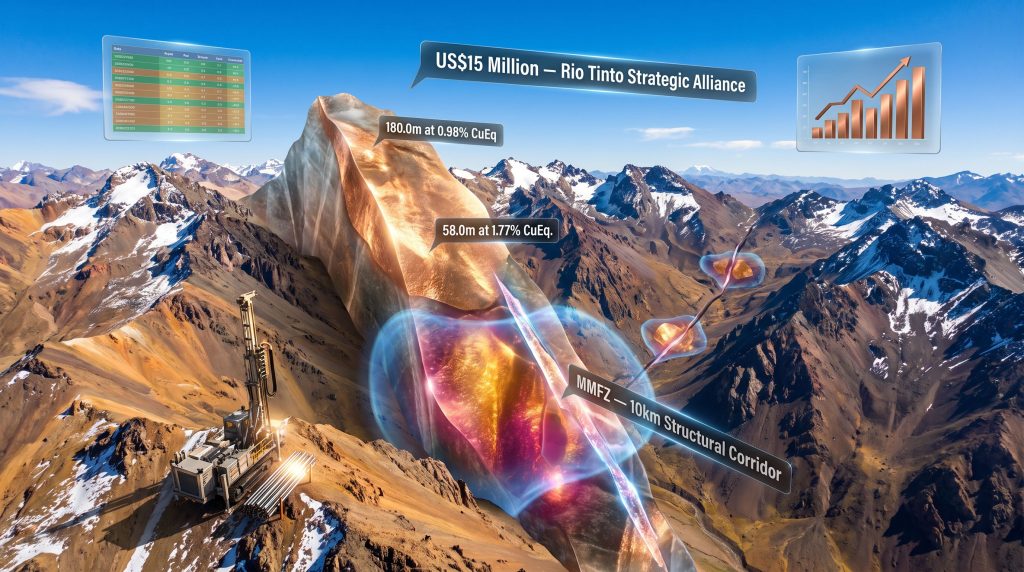
That distinction sits at the heart of what Mogotes Metals Inc. (TSXV: MOG | FSE: OY4 | OTCQB: MOGMF) has disclosed at its Filo Sur property in Argentina. The confirmed drill result from hole FS_DDH_016 returned 180.0 metres at 0.98% copper equivalent, commencing at just 108 metres depth, with a higher-grade sub-interval of 58.0 metres at 1.77% copper equivalent within that broader zone. Those numbers justify serious attention on their own. However, the geological narrative developing below that interval is what defines the Mogotes Albor deeper porphyry target as the central exploration thesis heading into the next drill season.
When big ASX news breaks, our subscribers know first
What the Core Below 287.85 Metres Is Actually Telling Geologists
Reading Alteration Zonation as a Depth Vector
When drill hole FS_DDH_016 passed through 287.85 metres, it intersected a strand of the Macho Muerto Fault Zone (MMFZ), which truncated the confirmed mineralised interval. Beyond that structural boundary, the drill continued into andesite wall rock carrying diminished mineralisation. Under a simplistic reading, the hole ended the story there. Under the porphyry zonation model, it did the opposite.
The key observation is that potassic alteration grows stronger with depth below the confirmed intercept, not weaker. In the classical porphyry copper model, potassic alteration is the fingerprint of the innermost, highest-temperature zone of a magmatic-hydrothermal system. It develops closest to the intrusive source of mineralising fluids. When a drill hole encounters intensifying potassic alteration at depth, the geological reading is that the core of the system lies below, not above.
This signal becomes considerably more meaningful when paired with independent geophysical data. A coincident IP chargeability high identified in earlier surveys sits directly adjacent to the zone of deepening potassic alteration. Induced Polarisation (IP) surveying measures the ability of subsurface material to hold an electrical charge, and chargeability highs in porphyry environments are widely used as a proxy for sulfide mineral concentrations at depth. Neither the alteration signal nor the geophysical anomaly alone would be sufficient to define a drill target. Their spatial convergence is what elevates the Mogotes Albor deeper porphyry target from geological curiosity to actionable exploration objective.
Multi-Phase Hydrothermal Activity: A Signal of System Longevity
The core from FS_DDH_016 also contains textural evidence that adds interpretive depth beyond alteration mineralogy. Geologists logged multiple overlapping hydrothermal events within the same interval, including quartz stockwork veining, magmatic-hydrothermal breccias, and copper-bearing sulfide overgrowths that cross-cut earlier vein generations. This kind of paragenetic complexity is characteristic of long-lived mineralising systems, where repeated pulses of hydrothermal fluid over extended geological timeframes produce layered overprinting of mineralisation styles.
Furthermore, this ore deposit formation context is important to understand ore deposit formation processes at work across similar Andean districts. In porphyry copper geology, multi-phase hydrothermal overprinting is one of the clearest indicators that a system experienced sustained metal input over time. Single-event systems tend to be more limited in scale. Systems showing repeated cross-cutting events are typically associated with larger metal endowments.
This is the geological context that elevates a 180-metre intercept from a standalone discovery into a potential window into something substantially larger.
Decoding the Evidence: Confirmed Data vs. Interpreted Targets
Precision in distinguishing confirmed drill results from interpreted targets is critical for investors assessing risk at the exploration stage. Consequently, interpreting drill results with appropriate rigour remains essential when evaluating junior exploration companies. The table below structures what is known, what is observed, and what remains to be tested at Albor.
| Data Type | Status | Significance |
|---|---|---|
| 180m at 0.98% CuEq intercept | Confirmed drill result | High-grade near-surface discovery |
| 58m at 1.77% CuEq sub-interval | Confirmed drill result | Elevated grade within confirmed zone |
| Potassic alteration intensifying below 287.85m | Observed in drill core | Geological indicator of deeper porphyry root |
| IP chargeability high coincident with alteration | Geophysical interpretation | Supports deeper mineralisation hypothesis |
| Second porphyry target at depth | Interpreted, undrilled | Exploration upside, not yet a resource |
The deeper Albor target carries genuine geological merit, but it remains entirely undrilled. Investors should treat it as exploration optionality sitting above an already-confirmed result, not as a second confirmed discovery.
The Macho Muerto Fault Zone: A 10-Kilometre Corridor Producing Results
How Structural Corridors Function as Mineral Concentrators
The MMFZ is a trans-Andean structural corridor extending approximately 10 kilometres through the Filo Sur property, linking multiple known targets including Meseta, Luz del Sol, Albor, and Cruz del Sur. In porphyry and epithermal systems, fault zones of this scale serve a dual geological function. They act as permeability pathways along which magmatic-hydrothermal fluids migrate from depth toward the surface, and they can simultaneously act as structural traps where mineralising fluids focus and deposit metal.
The MMFZ strand that intersected FS_DDH_016 at 287.85 metres is therefore both a practical boundary that limited the current hole's intersection of the deeper system, and a potential conduit that may have concentrated hydrothermal activity in the interpreted zone below. This ambiguity is geologically common and is precisely why offset drilling with adjusted hole geometry is needed to properly test the deeper target. For additional context on how this fits within a major copper system in Argentina, the broader Vicuña district provides a compelling regional framework.
Two Discoveries in One Season: What the Statistical Rarity Implies
The 2025-2026 drill season at Filo Sur produced confirmed discoveries at both Albor (180.0 metres at 0.98% CuEq) and Cruz del Sur, a separate porphyry system along the same fault corridor. Generating two porphyry-style discoveries along a single structural trend within one exploration season is an uncommon outcome in junior copper exploration, where discovery rates at any individual target typically run well below 50%.
When two discoveries occur along a corridor of this length, the geological implication shifts from isolated deposit to potential district-scale mineralising system. Analogues exist in the broader Central Andes, where fault-hosted corridors of comparable strike length have proven to contain multiple distinct but genetically related porphyry centres. The MMFZ now warrants evaluation through that district lens rather than as a host to unrelated individual targets. Mogotes' official drill results announcement provides the full technical detail behind these figures.
The Sol Target Cluster: A Geological Framework That Anticipates the Deeper Albor Target
The interpretive model applied to the Mogotes Albor deeper porphyry target is not new to Filo Sur. The company has applied a consistent porphyry-epithermal framework across the property's Sol Target Cluster, which groups the Luz del Sol, Meseta, and Cuenca targets based on their spatial proximity and overlapping geological characteristics. Within that framework, near-surface alteration is read as a hydrothermal cap above deeper, blind porphyry mineralisation, consistent with published zonation models for Andean copper-gold districts.
The Albor deeper target is essentially the same interpretive model applied to a new location where the same geological signals are appearing. If the framework is correct across multiple targets on the property, its predictive value increases with each corroborating dataset. The deeper Albor interpretation, furthermore, benefits from the internal geological consistency of the broader Filo Sur thesis. A well-defined mineral exploration strategy underpins how teams like Mogotes systematically prioritise and sequence their drill targets.
Rio Tinto's Entry and What Proprietary Targeting Tools Mean for a Blind Target
Understanding the Strategic Alliance Structure
Four days after the Albor final assay release, Rio Tinto Exploration Canada Inc. committed approximately US$15 million for an initial equity stake of roughly 5% in Mogotes Metals. The alliance structure includes 15 months of project exclusivity over Filo Sur and, critically, access to Rio Tinto's proprietary geochemistry and geophysics targeting tools.
The timing is not incidental. Major mining companies conduct rigorous technical due diligence before committing capital at the exploration stage. A commitment finalised within days of a drill result communicates that the technical review was not initiated by the announcement itself, but that the announcement provided the final datapoint needed to proceed. An independent analysis of the Albor discovery outlines in further detail what this result means for the broader Filo Sur project.
Why Major-Company Targeting Technology Changes the Risk Profile
For a blind porphyry target that has not yet been drilled, the quality of pre-drill targeting is directly correlated with the probability of a successful intercept. Standard junior exploration geophysics, whilst competent, operates at different resolution, depth penetration, and interpretive sophistication compared to the proprietary methodologies developed by major mining companies over decades of Andean exploration.
Access to Rio Tinto's targeting tools could materially refine the geometry, dip, and priority zone of the deeper Albor target before a single offset hole is collared. This represents a qualitative upgrade in exploration methodology that carries real implications for capital efficiency and discovery probability.
CD Capital's Pre-Emptive Rights Exercise: Reading Institutional Confidence
One day after the Rio Tinto announcement, existing investor CD Capital Fund IV L.P. exercised pre-emptive rights to subscribe for up to C$15,190,000 in additional shares, increasing its position to 19.9% on a partially diluted basis. The combination of a strategic major committing capital and an informed existing institutional investor simultaneously increasing its position within a one-week window following a drill result carries a specific signal.
When sophisticated institutional capital moves in concentrated fashion immediately following a technical disclosure, it typically reflects prior knowledge of the project's geological thesis and a conviction that the disclosed result validates, rather than initiates, that thesis.
Both financings remain subject to customary closing conditions, including TSX Venture Exchange approval.
The next major ASX story will hit our subscribers first
Scenario Analysis: What Offset Drilling Could Reveal
The next drill season will prioritise offset holes specifically designed to test the Mogotes Albor deeper porphyry target. Three materially different outcomes are possible.
| Scenario | Geological Outcome | Investment Implication |
|---|---|---|
| Bull Case | Offset drilling confirms mineralisation at or above Albor grades at depth | Second confirmed discovery at Filo Sur; resource-scale potential at Albor |
| Base Case | Deeper drilling intersects mineralisation but narrower or lower grade | System confirmed at depth; additional step-out drilling required to define scale |
| Bear Case | Offset holes do not intersect significant mineralisation | Deeper target interpretation unsupported; exploration focus returns to MMFZ corridor and Sol Cluster |
The bear case does not eliminate value. Two confirmed discoveries along the MMFZ corridor and a robust Sol Target Cluster remain intact regardless of the deeper Albor outcome. The risk is asymmetric: a successful deeper intercept adds a third discovery layer to an already productive exploration programme, whilst a negative result narrows but does not eliminate the project's geological case.
Key Catalysts and Milestones to Monitor
Investors tracking the development of the Mogotes Albor deeper porphyry target should focus on the following near-term events:
- Assay results from the 2 remaining 2025-2026 season drill holes in Chile, which could further define the Albor system or extend known mineralisation along the MMFZ corridor.
- Commencement of the 2026-2027 drill season, which will include offset holes specifically designed to test the deeper interpreted porphyry target below FS_DDH_016.
- Pre-drill targeting updates incorporating Rio Tinto's proprietary geophysical and geochemical methodologies, which may refine the geometry of the deeper Albor target before drilling begins.
- Further exploration along the 10-kilometre MMFZ corridor to assess whether additional porphyry systems exist in the untested segments between known discoveries.
Disclaimer: This article is for informational purposes only and does not constitute financial advice. Exploration targets, geological interpretations, and projected outcomes discussed herein involve material uncertainty. Past drill results do not guarantee future discoveries. Investors should conduct their own due diligence and consult a licensed financial adviser before making investment decisions. All financings referenced remain subject to regulatory approvals and customary closing conditions.
Want to Be First When the Next Major Copper Discovery Hits the ASX?
Discovery Alert's proprietary Discovery IQ model delivers real-time alerts on significant mineral discoveries the moment they are announced, transforming complex geological data into actionable investment insights — explore the historic returns major discoveries have generated and begin your 14-day free trial to position yourself ahead of the broader market.