June 23, 2026
The Copper Supply Equation That Makes Cobre Panamá Impossible to Ignore
Global copper markets are caught in a structural bind. Demand from electric vehicle manufacturing, grid-scale battery storage, and renewable energy infrastructure is accelerating faster than new mine supply can be brought online. Against this backdrop, the reopening of Cobre Panamá has become one of the most consequential questions in global mining, as every idled large-scale copper operation carries outsized significance.
Before its forced closure in late 2023, Cobre Panamá ranked among the largest copper mines in the Western Hemisphere, producing approximately 300,000 to 350,000 tonnes of copper in concentrate annually at its operational peak. That single asset accounted for roughly 1% of total global copper mine supply, a share that sounds modest until you consider how tight the concentrate market has become. Its absence has contributed to tighter spot treatment charges for smelters in Asia and squeezed concentrate availability for European downstream processors.
With copper demand projections pointing toward a structural deficit through the end of the decade, the question of whether the reopening of Cobre Panamá is achievable — and under what conditions — is one of the more consequential stories in global mining right now.
When big ASX news breaks, our subscribers know first
How a Constitutionally Flawed Contract Brought Down a $10 Billion Asset
Understanding what needs to happen next requires understanding exactly why the mine closed. The answer involves more than politics.
In late 2023, Panama's Supreme Court ruled that the operating contract underpinning Cobre Panamá was unconstitutional. The ruling was not simply a procedural finding. It struck at the legal foundation upon which First Quantum Minerals, the Canadian operator holding an 80% interest in the project through its subsidiary Minera Panamá, had invested billions of dollars. The remaining 20% stake is held by Korea Panama Mining Corp, a consortium of Korean entities.
The constitutional finding triggered a wave of civil protests that were remarkable in scale and organisation. Critically, those demonstrations were not purely anti-mining in character. A significant portion of the public opposition was directed at the perceived lack of transparency in how the contract had been structured and ratified. The process was seen as bypassing meaningful democratic input, which gave the protest movement a legitimacy that extended well beyond resource nationalism.
The closure also triggered international arbitration. First Quantum filed claims against the Republic of Panama under multiple investment protection frameworks, including proceedings under the Canada-Panama Free Trade Agreement. The Cobre Panamá arbitration created significant financial exposure for Panama's sovereign balance sheet, adding a layer of economic pressure on both sides of the dispute.
What resulted was a problem with four simultaneous dimensions: legal invalidity, political sensitivity, social resistance, and commercial dispute. No single decision could resolve all four at once.
The Two Developments That Have Changed the Equation in 2026
Arbitration Withdrawal: Clearing the First Obstacle
The most significant development in the path toward a potential reopening of Cobre Panamá came in March 2026, when First Quantum suspended and subsequently withdrew its international arbitration proceedings against Panama. This move was directly connected to a precondition established by Panamanian President José Raúl Mulino, who had made the cessation of legal hostilities a prerequisite for any formal dialogue about the mine's future.
The withdrawal is strategically ambiguous. On one reading, it represents a significant concession by First Quantum, relinquishing legal leverage in exchange for a seat at the negotiating table. On another, it reflects a calculated repositioning: the company may have determined that the long-term value of a renegotiated concession outweighs the uncertain and time-consuming path of international arbitration, which typically takes years to resolve and carries no guarantee of enforceability.
From a financial perspective, First Quantum's balance sheet has been under meaningful pressure since the closure. The company carries substantial debt, and the loss of Cobre Panamá's cash flow contribution has constrained its capital allocation flexibility significantly.
Stockpile Processing: Confidence Signal or Pure Housekeeping?
In April 2026, Panama's government authorised First Quantum to begin processing and exporting material from existing on-site stockpiles. The official framing positioned this as an environmental and operational safety measure, intended to manage material that had been accumulating since the closure.
Important distinction: Authorising the processing of surface stockpiles is operationally and legally distinct from sanctioning the restart of active mining. Panama's government has been explicit that this step does not imply a broader green light for operations. However, some market observers have interpreted the decision as a quiet confidence-building measure, reflecting a degree of bilateral trust that did not exist twelve months earlier.
The stockpiles at Cobre Panamá are believed to contain material with a copper grade broadly consistent with the ore body's average, which sits at approximately 0.35 to 0.4% copper across the deposit. While not high-grade by global standards, the sheer scale of Cobre Panamá's resource — estimated at over 3 billion tonnes of ore — makes grade less critical than throughput capacity. The mine was designed for very high-volume processing, and its value lies in that industrial scale rather than exceptional ore quality.
The Audit Requirement: What Panama Needs to Know Before It Negotiates
The Panamanian government has established a clear sequencing requirement: a comprehensive multi-dimensional audit must be completed before formal reopening negotiations can begin. This audit framework covers three distinct areas.
| Audit Dimension | Core Assessment Areas | Relevance to Reopening |
|---|---|---|
| Environmental | Water system impacts, contamination legacy, biodiversity risk, tailings management | Determines whether new operating conditions are technically viable |
| Social | Community displacement effects, indigenous rights, labour market disruption | Shapes the political feasibility and public acceptability of a new contract |
| Economic | Historical GDP contribution, royalty and tax structures, employment multipliers, fiscal dependency risk | Establishes Panama's negotiating baseline for commercial terms |
The audit process was estimated to require approximately three to four months from the point of initiation. Completion of the audit is the single most important near-term catalyst determining whether formal negotiations proceed. Without it, any timeline discussion is premature.
One underappreciated dimension of the economic audit is the fiscal dependency question. At peak production, Cobre Panamá contributed an estimated 4 to 5% of Panama's GDP and represented a significant share of the country's merchandise export revenues. That level of concentration creates a structural vulnerability for any small open economy, and Panama's negotiators will be aware that rebuilding dependency on a single extractive project carries long-term sovereign risk.
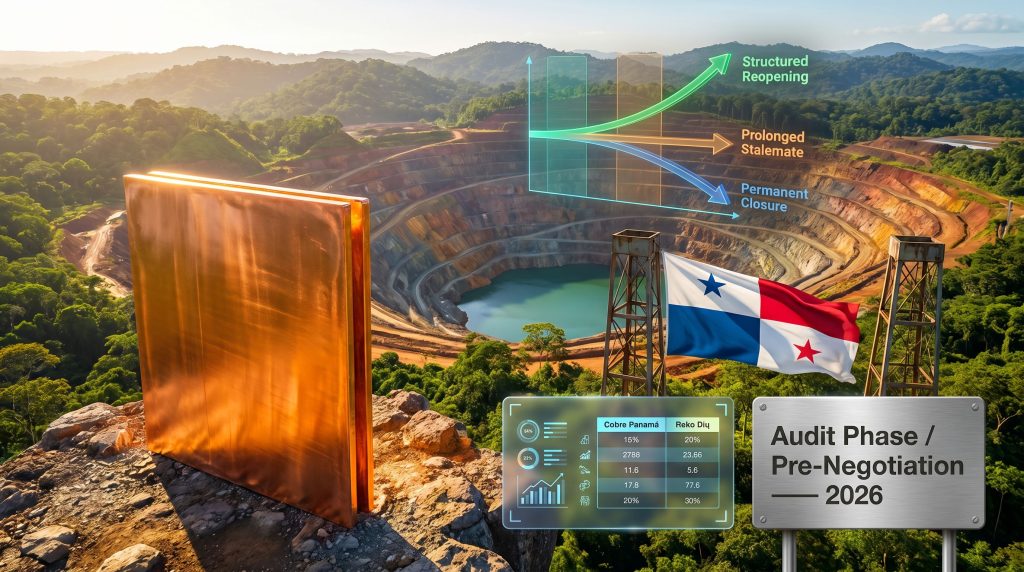
Three Scenarios for Cobre Panamá's Future
Scenario 1: Structured Restart Under a New Legal Architecture
The most optimistic pathway requires the audit to conclude with findings that support a viable operating model, followed by the development of a new concession contract that addresses the constitutional deficiencies identified by the Supreme Court. Any new agreement would likely require legislative action and possibly constitutional clarification before it could withstand future legal challenge.
Key commercial parameters in a new contract would probably include:
- Higher royalty rates than the original agreement, reflecting current market norms in Latin American copper jurisdictions
- Binding environmental compliance thresholds with third-party verification
- Community benefit-sharing mechanisms and local employment commitments
- An explicit revenue-sharing structure designed to reduce political vulnerability over the contract's life
Even under this optimistic scenario, a realistic restart timeline — accounting for audit completion, negotiations, legislative ratification, and physical recommissioning — would be measured in years rather than months. The mine has been on care-and-maintenance for an extended period, and infrastructure that has sat idle requires significant recommissioning expenditure before it can reach nameplate capacity.
Scenario 2: Prolonged Negotiation Stalemate
The history of Latin American mining disputes offers sobering precedent. Projects including Tía María in Peru spent over a decade in development limbo despite periodic signs of progress. If public opposition re-emerges, if commercial terms prove irreconcilable, or if Panama's political landscape shifts ahead of future electoral cycles, negotiations could enter a multi-year loop.
For First Quantum, this scenario is financially corrosive. The company's production guidance has already been reshaped around the absence of Cobre Panamá's contribution, but carrying the costs of care-and-maintenance on an asset of this size without revenue generation creates ongoing balance sheet strain.
Scenario 3: Divestiture or Permanent Closure
Under extreme conditions, a negotiated sale of the asset becomes conceivable. Several major copper producers, including those with existing Latin American footprints, would have both the strategic rationale and financial capacity to acquire an asset of Cobre Panamá's scale, particularly if a new legal framework were already established.
Permanent closure would be economically damaging for Panama. The mine directly employed an estimated 40,000 workers across direct and indirect employment categories during its operational period. Restoring those jobs and the associated fiscal contributions through alternative economic activity is not a near-term possibility.
What the Reko Diq Experience Reveals About Successful Renegotiation
The comparison with the Reko Diq project in Pakistan is instructive. That project was cancelled by Pakistan's Supreme Court in 2013 following a dispute over licensing terms, triggering international arbitration by the operator. After years of legal dispute and eventual settlement of over $11 billion in arbitration claims, the project was restructured under a new framework and is now in active development with an expanded ownership structure that includes Pakistani sovereign participation.
The Reko Diq outcome suggests that even the most entrenched mining disputes can be resolved if both parties accept the need for a fundamentally renegotiated structure rather than attempting to revive the original terms. The key ingredient was a willingness on both sides to treat the asset as a forward-looking investment rather than a rearward-looking grievance.
The Cobre Panamá situation shares DNA with Reko Diq: a constitutional invalidity finding, public opposition, international arbitration, and a subsequent shift toward negotiated resolution. The difference lies in the social licence dimension, which is considerably more complex in Panama's case given the nature and scale of the 2023 protests.
The next major ASX story will hit our subscribers first
Why the Energy Transition Raises the Urgency for Both Sides
Copper's role in the clean energy transition is not speculative. The critical minerals demand outlook from the International Energy Agency projects that copper demand could nearly double by 2040 under accelerated energy transition scenarios, driven by the metal's irreplaceable role in electric motors, grid wiring, EV charging infrastructure, and offshore wind connections.
Each gigawatt of offshore wind capacity requires approximately 8,000 tonnes of copper. A single electric vehicle contains roughly 83 kilograms of copper, compared to around 23 kilograms in a conventional internal combustion vehicle. At scale, these figures translate into demand growth that the current pipeline of new copper projects cannot fully satisfy.
Furthermore, the global copper supply gap is already placing pressure on producers and policymakers alike. This macro context changes the negotiating calculus for Panama. The longer the mine remains idle, the more value is forfeited from an asset sitting atop one of the world's significant undeveloped copper ore bodies.
Key Milestones Investors and Industry Observers Should Monitor
The path forward for the reopening of Cobre Panamá is conditional on a sequence of developments, none of which is guaranteed. The copper supply crunch adds further urgency to these milestones, which represent the critical decision points:
- Audit publication — the findings will define Panama's negotiating position and signal whether a viable operating model is achievable
- Legislative or constitutional framework developments — any signal that Panama is constructing a durable legal basis for a new concession
- First Quantum's capital allocation disclosures — balance sheet updates and production guidance revisions that indicate financial readiness for a restart
- Public consultation process quality — whether community engagement is substantive or procedural will determine social licence durability
- Copper market conditions — sustained elevated prices increase the economic urgency for both parties to reach agreement
Disclaimer: This article contains forward-looking analysis and scenario modelling that involves assumptions and projections. It does not constitute financial or investment advice. Readers should conduct their own due diligence and consult qualified advisers before making investment decisions related to any company or asset mentioned.
Want to Stay Ahead of the Next Major Copper Discovery on the ASX?
Discovery Alert's proprietary Discovery IQ model delivers real-time alerts the moment significant copper and critical mineral discoveries are announced on the ASX, transforming complex geological data into actionable investment insights for both short-term traders and long-term investors. Explore historic discoveries and the substantial returns they have generated, then begin your 14-day free trial to ensure you are positioned ahead of the broader market when the next major find is announced.