
June 13, 2026
When Sovereign Risk Becomes Economic Reality: The Cobre Panamá Collapse Examined
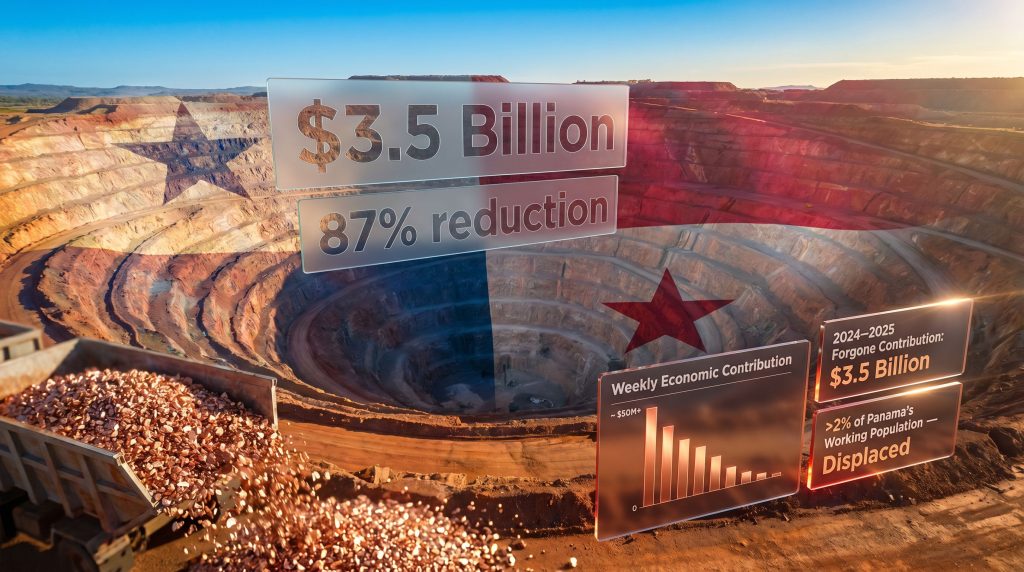
There is a category of economic risk that textbooks discuss in the abstract but that markets rarely price with precision until it crystallises into a number impossible to ignore. That number, in Panama's case, is $3.5 billion. It represents the estimated cumulative forgone economic contribution across 2024 and 2025 resulting from the shutdown of Cobre Panamá, one of the largest open-pit copper operations ever built in the Western Hemisphere. The First Quantum Panama contribution falls 87% after copper mine shutdown headline is not merely a corporate performance story. It is a case study in what happens when resource governance, judicial authority, and civil society conflict converge without a structured resolution framework.
When big ASX news breaks, our subscribers know first
The Scale of What Was Lost: Putting 87% Into Context
An 87% decline in economic contribution is a figure that demands disaggregation. Before operations were suspended, Cobre Panamá was generating an estimated weekly economic contribution exceeding $50 million, encompassing direct wages, royalty payments, corporate tax flows, local procurement spending, and foreign exchange earnings from copper concentrate exports.
The table below captures the magnitude of the gap between where Panama's fiscal relationship with the mine was headed and where it landed:
| Metric | Pre-Shutdown Trajectory | Post-Shutdown Reality |
|---|---|---|
| Weekly economic contribution | ~$50 million+ | Near zero (preservation only) |
| Estimated 2025 forgone contribution | $1.8 billion | Not realised |
| Cumulative 2024-2025 forgone contribution | $3.5 billion | Confirmed aggregate loss |
| Share of Panama's working population | More than 2% | Workforce displaced |
| Contribution decline rate | Baseline | ~87% reduction |
The 87% figure is not simply an indicator of lost corporate revenue. It reflects the simultaneous collapse of wage income, procurement supply chains, government royalty receipts, and copper export earnings, all triggered by a single regulatory and judicial event.
What makes this particularly acute for Panama is the structural characteristic shared by many small open economies: when a single extractive asset accounts for a disproportionate share of export income and formal employment, its removal does not produce a linear contraction. It produces an amplified shock that radiates through sectors with no direct connection to the mine itself. The Cobre Panamá arbitration impacts on investor sentiment have further deepened the country's economic difficulties.
What Cobre Panamá Actually Represented Fiscally
To understand why the shutdown created such a wide economic crater, it is necessary to understand the mine's role across multiple fiscal dimensions simultaneously. Cobre Panamá was not simply a large employer. It was a multi-channel contributor to Panama's national accounts operating across at least four distinct pathways:
- Direct government revenue through royalty payments, corporate income tax, and surface rights fees
- Employment and household income for a workforce representing more than 2% of Panama's total working population
- Local procurement and supply chain activity for domestic contractors, logistics operators, and service businesses concentrated in the Colón and Donoso regions
- Foreign exchange earnings through copper concentrate exports that supported Panama's trade balance within a fully dollarised economy
The mine's copper concentrate production, before suspension, placed it among the top-tier operations globally in terms of output scale. Its abrupt removal from the production base did not just affect Panama's balance of payments. It sent a signal to global copper markets already operating under supply constraints, briefly influencing spot pricing dynamics and forward contract assumptions during 2024.
The Policy Timeline: How a Contract Became a Constitutional Crisis
The sequence of events that produced the current situation unfolded across several distinct stages, each compounding the risk profile of the next.
Stage One: The Concession Renewal and Public Backlash
The legislative renewal of the mining concession in 2023 was the immediate trigger for mass civil society mobilisation. Environmental groups, indigenous communities, and urban protesters challenged not just the specific terms of the agreement but the legitimacy of the process through which it was negotiated and approved. The political economy of resource contract design contains a well-documented vulnerability: concession terms that appear balanced at the time of signing frequently become flashpoints when commodity prices rise, making the royalty and tax provisions appear inadequate relative to the value being extracted.
Stage Two: Supreme Court Intervention
Panama's Supreme Court ruled the concession contract unconstitutional in late 2023. This judicial determination interacted with existing street-level protest momentum to create what effectively became an irreversible political outcome. The government's decision to halt operations was framed as compliance with the court ruling, but the distinction between a judicial directive and a political choice became increasingly difficult to maintain as the shutdown extended from weeks into months and eventually into years. According to reporting on the mine's economic toll, Panama has forfeited an estimated $3.5 billion in total economic value as a direct consequence.
Stage Three: Preservation Mode as Indefinite Policy
First Quantum moved Cobre Panamá into preservation and safe management mode rather than pursuing immediate forced arbitration. Panama's official position characterised this as an environmental protection measure, not a transition phase toward restart. In a legally significant but politically ambiguous move, Panama authorised the export of copper concentrate that had already been mined and stockpiled before the shutdown, generating partial fiscal return while simultaneously maintaining that the mine would not reopen.
Policy Paradox: Authorising the monetisation of stockpiled copper concentrate while denying any restart pathway creates a legal and political middle ground that is difficult to sustain indefinitely. It satisfies neither investor expectations nor the civil society demands that originally drove the shutdown.
The First Quantum arbitration withdrawal in 2025 is interpreted by some analysts as a strategic de-escalation designed to preserve the possibility of negotiated resolution, while others view it as a reflection of the limited practical leverage available to the company under Panama's current political configuration.
The Four Economic Wounds That Don't Heal Quickly
Direct Revenue Void in the National Budget
The cessation of royalty payments and corporate tax contributions from Cobre Panamá created a structural gap in Panama's fiscal position that could not be easily offset. Panama's dollarised economy means the government has no monetary policy tools available to manage fiscal shortfalls. Every dollar of mining revenue lost is a dollar that must either be replaced through alternative taxation, borrowing, or expenditure reduction.
Workforce Displacement and Multiplier Collapse
Mining employment carries an economic multiplier effect that is consistently underestimated in public debate. Each direct mining job typically supports multiple indirect jobs in retail, housing, transportation, and services. When more than 2% of a country's entire working population is displaced from a single industry simultaneously, the downstream consumption contraction is severe and geographically concentrated in communities that lack the economic diversification to absorb it.
Supply Chain Disruption at the Regional Level
The Colón and Donoso regions hosted dense networks of small and medium enterprises whose revenue was substantially dependent on Cobre Panamá's operational procurement. Logistics contractors, maintenance service providers, and local suppliers that built their business models around a major mining anchor client face structural unviability when that anchor disappears without a credible timeline for return. Furthermore, analysis of the mine closure's regional impact suggests the supply chain damage alone accounts for over $1.7 billion in lost economic activity.
Export Compression in a Dollarised System
Panama's reliance on the US dollar removes exchange rate adjustment as a mechanism for absorbing trade balance deterioration. The removal of copper concentrate from the export portfolio therefore translated directly into current account pressure, with limited policy tools available to compensate.
The Arbitration Overhang: Legal Exposure Panama Cannot Ignore
International investment arbitration frameworks, including mechanisms available through the International Centre for Settlement of Investment Disputes (ICSID) and applicable bilateral investment treaties, create significant financial exposure for Panama if proceedings resume and result in a ruling favourable to First Quantum. The company's 2025 decision to suspend arbitration reduced immediate legal pressure but did not extinguish the underlying claim.
Regulatory Warning: Indefinite preservation mode is not a cost-free policy. Every month the mine remains idle accumulates financial carrying costs, environmental compliance obligations, and legal exposure that accrues to the Panamanian state regardless of the political narrative surrounding the shutdown.
The question of who bears the cost of maintaining a large open-pit copper operation in safe and environmentally compliant condition indefinitely, without any restart pathway, represents one of the least-discussed but most consequential aspects of Panama's current position. This concern extends well beyond Panama's borders, as broader mining geopolitical risk assessments increasingly cite the case as a benchmark for sovereign intervention in extractive industries.
The next major ASX story will hit our subscribers first
Global Copper Markets: The Ripple Effect of One Nation's Policy Failure
Cobre Panamá's shutdown did not occur in isolation from the broader copper market context. The mine's pre-shutdown production placed it among the significant contributors to global copper concentrate supply. Its removal coincided with a period of growing copper demand driven by electric vehicle manufacturing, grid expansion programmes, and renewable energy infrastructure deployment.
Copper is physically irreplaceable in the core infrastructure of the clean energy transition. Electric motors, power transmission cables, EV battery systems, and solar panel wiring all depend on copper's unique combination of conductivity, malleability, and durability. The structural copper supply crunch already being forecast through 2030 by multiple industry analysts was measurably worsened by the Cobre Panamá closure.
This creates what might be described as the central policy contradiction of the current decade: governments globally are accelerating copper demand through clean energy mandates and electrification targets, while individual nations are restricting copper supply through regulatory interventions, judicial rulings, and social licence failures. Panama's situation illustrates this contradiction in its most concentrated form.
The investment risk signal transmitted to global mining capital by the Cobre Panamá outcome has been noted across the Latin American mining sector. Chile, Peru, and Ecuador, all facing their own versions of social licence pressure and regulatory uncertainty, are being benchmarked against Panama's experience by mining companies assessing greenfield exploration and development risk in the region. In addition, major copper project developments elsewhere are being scrutinised through the lens of Panama's experience as investors recalibrate sovereign risk assumptions.
Panama's Three Pathways Forward
Option One: Renegotiated Concession Framework
A revised contract structure that satisfies constitutional requirements while offering First Quantum viable operating economics represents the theoretically optimal outcome. Revenue-sharing models from comparable jurisdictions, including Chile's royalty reform framework and Peru's windfall profit approaches, offer potential design templates. However, the political feasibility of this pathway remains constrained by entrenched civil society opposition and the precedent the original shutdown created.
Option Two: Permanent Closure and Rehabilitation
Full decommissioning of a large-scale open-pit copper operation carries substantial financial and environmental costs. Under international mining law, clarity on who bears rehabilitation liability when a concession is voided by judicial order rather than commercial decision is not straightforward. The long-term economic alternatives for communities built around Cobre Panamá's operational footprint remain largely undefined.
Option Three: Extended Preservation With Selective Export Authorisation
The current approach is financially unsustainable as a permanent position. The stockpile of pre-shutdown copper concentrate is a depleting asset. Once it is exhausted, the partial revenue bridge disappears and Panama is left holding a non-producing asset with ongoing carrying costs and no revenue offset.
Frequently Asked Questions
What caused the Cobre Panamá mine to shut down?
Panama's Supreme Court ruled the mining concession contract unconstitutional in late 2023, following mass public protests against the concession's renewal. The government subsequently ordered the cessation of operations, transitioning the mine into preservation and safe management mode.
How much has Panama's economy lost since the mine closed?
The estimated cumulative forgone economic contribution across 2024 and 2025 is approximately $3.5 billion, with $1.8 billion of that attributable to 2025 alone.
Is Cobre Panamá permanently closed?
The mine is currently in preservation and safe management mode. Panama's official position does not include a restart timeline, but no formal permanent closure declaration has been made. The legal and political status remains unresolved.
What is First Quantum's current position?
First Quantum suspended formal arbitration proceedings in 2025, a move interpreted as a preference for negotiated resolution over confrontational legal action, while continuing to maintain the mine in an environmentally safe condition.
How does the closure affect global copper supply?
The mine's pre-shutdown production represented a meaningful share of global copper concentrate output. Its removal has contributed to the supply-demand imbalance in copper markets during a period of rising clean energy demand, with potential long-term implications for copper pricing and availability.
The Deeper Lesson: Governance Design as Economic Infrastructure
The First Quantum Panama contribution falls 87% after copper mine shutdown situation ultimately illustrates a principle that resource-dependent economies consistently underweight: the quality of concession framework design is as important as the quality of the ore body itself. Transparency in contract negotiation, genuine community benefit mechanisms, constitutionally compatible royalty structures, and independent environmental assessment are not obstacles to mining investment.
They are, consequently, the foundations of durable social licence without which even the world's largest copper deposits cannot be converted into sustained economic value.
Disclaimer: This article contains forward-looking analysis, economic estimates, and scenario projections based on publicly available information. Figures related to forgone economic contributions are estimates and should not be relied upon as precise financial data. Readers should conduct their own research before making investment or policy-related decisions.
Want To Be First When The Next Major Copper Discovery Hits The ASX?
Discovery Alert's proprietary Discovery IQ model delivers real-time alerts on significant ASX mineral discoveries, cutting through complex geological and commodity data to surface actionable investment opportunities the moment they're announced — explore historic discovery returns to understand what's at stake, then begin your 14-day free trial at Discovery Alert to position yourself ahead of the market.