July 26, 2026
Why Governance at State-Owned Mining Giants Is Never Just an Internal Matter
The global mining industry operates on a fundamental assumption that rarely gets tested until it fails: that the world's largest sovereign resource producers are institutionally stable enough to be treated as reliable pillars of commodity supply. When that assumption cracks, the consequences travel far beyond the country where the fracture occurred.
State-owned enterprises occupy a structurally different position in the mining ecosystem than their publicly listed counterparts. A privately owned miner facing a CEO transition must answer primarily to shareholders and a board with fiduciary obligations. A sovereign miner facing the same transition must answer to shareholders, a board, a government ministry, a parliament, indigenous communities, antitrust regulators, and the court of public opinion simultaneously.
Furthermore, the accountability chains are longer, more politically entangled, and far more susceptible to paralysis when institutional trust erodes.
Codelco, the Chilean state copper mining company, currently sits at the centre of exactly this kind of multi-front institutional stress test. The Codelco chair resignation and lithium post departure of Máximo Pacheco, who stepped down from both the Codelco chairmanship and the board of the Nova Andino Litio joint venture, represents more than a routine leadership change. It reflects a governance system under strain at a moment when global copper and lithium markets can least afford the uncertainty.
When big ASX news breaks, our subscribers know first
Codelco's Strategic Weight in the Global Minerals Hierarchy
Understanding why this matters requires appreciating the scale of what Codelco represents. The company is the world's largest copper producer by volume, responsible for a substantial share of global mined copper output. Copper is not a discretionary commodity. It is the conductive backbone of electrical infrastructure, renewable energy systems, electric vehicle drivetrains, and data centre construction.
Every significant decarbonisation pathway runs through copper, and a disproportionate share of the world's copper runs through Chile. The chile copper price forecast reflects just how central this nation is to global supply dynamics.
Beyond copper, Codelco has been in the process of reinventing its institutional identity. The formation of Nova Andino Litio, a joint venture with SQM, one of the world's largest private lithium producers, marked the company's strategic attempt to add lithium to its resource portfolio. The Atacama Salt Flat, where the venture is focused, is among the most productive lithium brine systems on the planet.
Chile holds approximately 37% of the world's known lithium reserves, making the country's regulatory and governance environment for lithium a subject of intense international attention from battery manufacturers, EV producers, and energy storage developers. When a company of this magnitude experiences a leadership crisis, the ripple effects are not contained by national borders.
What the Internal Audit Revealed and Why It Matters
The sequence of events that led to the Codelco chair resignation and lithium post exit began with an internal audit. The audit identified that 2025 copper production figures had been improperly reported, triggering a response that included the firing of at least one executive and disciplinary action against others.
The scale of the misreporting was significant enough to contribute to what has been described as a 27-year output low, a figure that carries enormous weight in a commodity where Codelco's numbers are used as reference points by traders, downstream manufacturers, and sovereign wealth funds globally.
Production misreporting at a state-owned mining company is categorically different from an accounting irregularity at a private firm. At a private company, the primary victims are shareholders who can demand restitution through legal mechanisms. At a sovereign enterprise, however, the affected parties include the national treasury, citizens who depend on resource revenues, international partners who have structured long-term supply agreements around production forecasts, and commodity markets that price future supply based on reported output.
The credibility damage from this kind of event has a long half-life. Markets that have been burned by misreported production data tend to apply a persistent discount to forward guidance from the same institution, even after new leadership is installed. This is not irrational. It reflects the institutional memory of commodity markets and the recognition that governance cultures are rarely transformed overnight.
The Political Pressure That Accelerated the Departure
The audit findings did not exist in a political vacuum. Congressional factions in Chile applied intensifying pressure for leadership changes following the revelations, framing the production scandal as evidence of broader accountability failures at the state-owned enterprise. This political dimension is critically important because it illustrates how quickly SOE governance crises can become policy battlegrounds.
Pacheco addressed this dynamic directly in his resignation correspondence to incoming chairman Bernardo Fontaine. His stated rationale for departing was to prevent ongoing controversy from damaging the institution he had helped lead, framing his exit as an act of institutional preservation rather than an acknowledgment of personal culpability.
Whether that framing is accepted or contested by political observers, the practical effect is the same: the individual most associated with Codelco's strategic direction over the relevant period has stepped away from both of his most important governance responsibilities simultaneously.
The Nova Andino Litio Dimension: A Joint Venture Losing Its Champion
The significance of the Codelco chair resignation and lithium post exit from Nova Andino Litio cannot be overstated. The joint venture structure between Codelco and SQM was not a simple commercial arrangement. It was a politically contested, legally complex instrument designed to anchor Chile's national lithium industrialisation ambitions within a state-controlled framework.
In addition, chile's lithium resources make the stakes of any governance instability within this venture particularly high for global supply chains.
| Feature | Detail |
|---|---|
| Joint Venture Name | Nova Andino Litio |
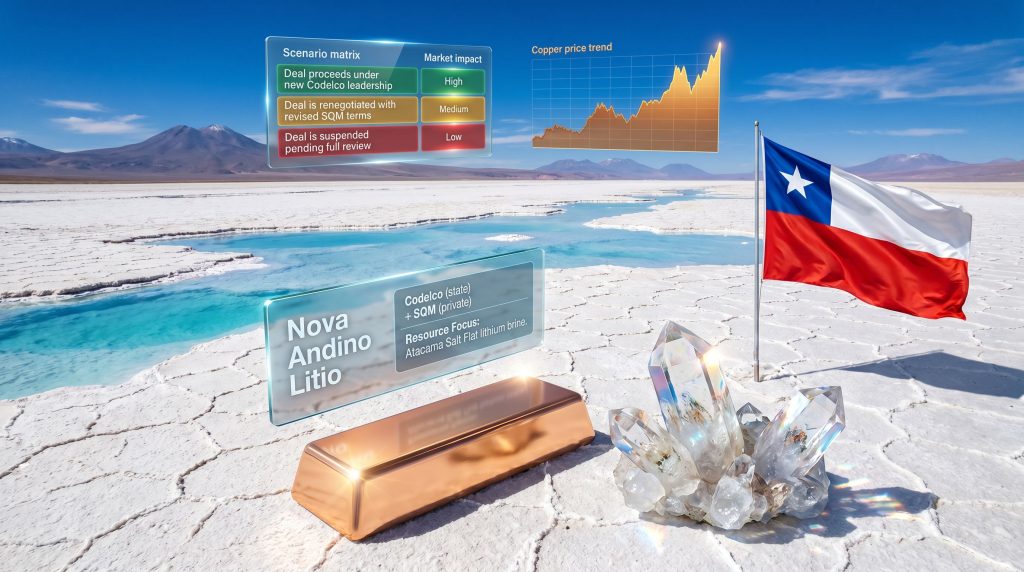
| Partners | Codelco (state) + SQM (private) |
| Resource Focus | Atacama Salt Flat lithium brine |
| Strategic Objective | Codelco's entry into lithium production |
| Political Status | Subject to congressional review and indigenous consultation |
| Regulatory Status | Pending antitrust approval |
The venture faces obstacles on multiple fronts simultaneously:
- A congressional commission has formally recommended that the partnership be dissolved, reflecting deep political opposition to the structure of the deal
- Antitrust review requirements must be satisfied before the joint venture can operate at full commercial scale
- Mandatory indigenous consultation processes are legally required given the overlap between the Atacama Salt Flat and indigenous territorial claims
- Transparency critiques have persisted, with critics arguing the structure of the agreement disproportionately benefits private interests despite its national framing
Pacheco was the most prominent institutional defender of the Nova Andino Litio arrangement. His simultaneous exit from both the Codelco chairmanship and the JV board removes the deal's primary advocate from every table where its future will be debated.
This creates a compounding governance risk. The incoming chairman, Bernardo Fontaine, inherits not only a corporate repair mandate but also a live political controversy surrounding the country's most strategically significant lithium arrangement, without the institutional continuity of the executive who built and defended it.
Scenario Analysis: Three Political Pathways for Nova Andino Litio
The future of the joint venture is not predetermined. Consequently, three credible scenarios exist, each with distinct implications for global lithium supply timelines.
| Scenario | Probability Driver | Market Impact |
|---|---|---|
| Deal proceeds under Fontaine's leadership | New chairman maintains JV commitment and navigates regulatory hurdles | Neutral to positive for lithium supply outlook |
| Deal is renegotiated with revised SQM terms | Congressional pressure forces structural modifications | Short-term uncertainty; potential production delays |
| Deal is suspended pending comprehensive review | Political opposition reaches critical mass | Negative for Chilean lithium supply timelines; potential benefit for competing producers |
The third scenario, while not the most likely, carries the most significant market consequences. Any prolonged suspension or restructuring of Nova Andino Litio would delay the development of new lithium production capacity from the Atacama, creating supply gaps that would affect battery manufacturers and EV producers operating on tight material sourcing schedules.
The Atacama Salt Flat: Why the Geology Adds Complexity to the Politics
The Atacama Salt Flat is not a generic mineral deposit. It is one of the most productive lithium brine systems in the world precisely because of the unique hydrogeological conditions that concentrate lithium salts in underground brines at commercially viable grades. Understanding lithium brine extraction helps clarify why the Atacama's profile is so unique among global lithium operations.
Lithium brine extraction differs fundamentally from hard-rock lithium mining. Rather than blasting and processing solid rock, operators pump lithium-rich brine to the surface and allow solar evaporation to concentrate the lithium content over months-long evaporation cycles in large ponds.
This process is highly water-dependent in one of the world's driest environments. The Atacama receives less than 15 millimetres of rainfall annually in some areas, making water management a critical operational and regulatory issue. Indigenous communities in the region, including the Atacameno people, have legally protected rights over water resources and land use that create mandatory consultation requirements before any new extraction activity can proceed.
These are not bureaucratic formalities. They are legally binding obligations under Chilean law, and failure to satisfy them can result in project injunctions regardless of commercial or political arrangements made at the national level. This geological and environmental complexity means that the Nova Andino Litio joint venture was never going to be a straightforward commercial transaction.
The next major ASX story will hit our subscribers first
Copper Market Sensitivity: When Reporting Credibility Becomes a Price Variable
The copper market implications of the Codelco governance crisis extend beyond the immediate question of Pacheco's departure. The 2025 production misreporting scandal has introduced a credibility variable into how markets should interpret Codelco's forward guidance. When an institution responsible for a substantial share of global copper output reveals that its internal production reporting mechanisms failed for an extended period, rational market participants apply a discount to subsequent figures from the same source.
This dynamic is not unprecedented. Historical cases of SOE governance failures at major mining companies, including episodes at Zambia's ZCCM-IH and controversies surrounding state-managed operations in the DRC, demonstrate that institutional credibility, once lost, takes years to rebuild. The market price effect tends to be asymmetric: credibility losses translate into supply-side uncertainty premiums that persist long after the governance issues have been formally resolved.
The 2026 Codelco crisis has unfolded against a backdrop of already elevated copper prices. This timing amplifies the sensitivity of commodity markets to any further negative signals from Chile. For instance, investors and industrial buyers who were already pricing in supply tightness are now also pricing in an institutional risk premium at the world's single largest copper producer.
Sovereign Risk, Investor Psychology, and Chile's Comparative Position
International mining investors approach Chile from a starting position of relative confidence. The country's legal frameworks, institutional history, and track record of honouring resource agreements have historically placed it in a more favourable risk category than peer jurisdictions such as Peru, which has experienced repeated project suspensions due to community opposition, or the DRC, where contract renegotiations have been a persistent feature of the investment landscape.
The Codelco governance crisis tests that comparative advantage. The combination of a production reporting scandal, congressional opposition to a major state resource agreement, and a high-profile leadership departure creates a cluster of negative signals that, even if individually manageable, collectively raise questions about the institutional environment surrounding Chilean mining.
Investor psychology in commodity markets tends to respond more strongly to clusters of negative signals than to individual events. The compounding of the audit scandal, the political opposition to Nova Andino Litio, and the Codelco chair resignation creates a risk perception event that is larger than the sum of its parts.
Furthermore, Codelco's copper strategy in the context of global trade tariffs adds yet another layer of complexity for investors already navigating this institutional uncertainty.
What Incoming Chairman Fontaine Must Prioritise
Bernardo Fontaine's appointment signals the Chilean government's intent to stabilise the institution following a period of reputational damage. The governance reform agenda facing new leadership is substantial:
- Audit transparency: Establishing independent audit oversight with mandatory public disclosure timelines to prevent recurrence of production misreporting
- Production reporting standards: Aligning Codelco's reporting methodology with international mining disclosure codes to restore market credibility
- Joint venture continuity: Determining and communicating a clear position on Nova Andino Litio to reduce political uncertainty around Chile's lithium strategy
- Stakeholder communication: Rebuilding trust with congressional stakeholders, indigenous communities, and international commodity buyers simultaneously
- Leadership succession planning: Ensuring that the institutional knowledge held by departing executives does not disappear with them
Each of these priorities carries its own timeline and its own set of political constraints. None of them can be resolved quickly, and the order in which Fontaine addresses them will signal as much about the government's true priorities as any formal policy statement.
Chile's Lithium Industrialisation Vision: What Instability Costs
The broader context for the Codelco chair resignation and lithium post exit is Chile's national ambition to move beyond raw lithium export toward domestic processing and the production of battery-grade lithium chemicals. This industrialisation agenda was designed to capture more value from Chile's extraordinary lithium endowment by processing raw brine into lithium carbonate, lithium hydroxide, and eventually battery precursor materials within the country.
Codelco's role as a state actor was meant to anchor this strategy by ensuring that the most productive lithium resource in the country remained under meaningful national control even when private partners were involved in the operational structure. Every month of governance instability at Codelco delays progress toward that long-term industrial vision, because the political and regulatory energy required to advance the lithium industrialisation agenda cannot be deployed while the institution's leadership is managing an internal credibility crisis.
For context, Bolivia and Argentina have both pursued different models of state involvement in lithium. Bolivia's attempts at full state control have been marked by slow progress and limited private investment. However, Argentina's lithium brine market has attracted significant capital through its more permissive provincial approach, though it has limited the national government's ability to direct industrialisation outcomes.
Chile's hybrid model, using Codelco as a state anchor within a private partnership, was intended to avoid both failure modes. The current governance crisis puts that design under its most serious test yet. According to Reuters reporting on Chile's lithium ambitions, Codelco must simultaneously kick-start lithium industry development while reviving copper output — a dual mandate now complicated significantly by the leadership vacuum.
Frequently Asked Questions
What is Nova Andino Litio?
Nova Andino Litio is the lithium joint venture between Codelco, Chile's state-owned copper mining company, and SQM, one of the world's largest private lithium producers. It is focused on lithium brine extraction from the Atacama Salt Flat and represents Codelco's strategic entry into the lithium sector.
Why did Máximo Pacheco leave Codelco?
Pacheco's departure followed heightened institutional pressure triggered by an internal audit that identified improperly reported 2025 copper production figures. Political stakeholders called for leadership changes, and Pacheco framed his resignation as an act of institutional preservation intended to prevent prolonged controversy from damaging Codelco.
Who replaced Pacheco as Codelco chairman?
Bernardo Fontaine was named as the incoming chairman of Codelco following Pacheco's resignation.
Does the resignation affect the Codelco-SQM lithium deal?
Pacheco's simultaneous exit from both the Codelco chairmanship and the Nova Andino Litio board removes the deal's primary institutional advocate from both governance structures at once, creating meaningful uncertainty about the pace and political direction of the joint venture.
Is the SQM-Codelco lithium joint venture at risk of cancellation?
The joint venture faces multiple unresolved hurdles, including a congressional recommendation that it be dissolved, pending antitrust review, and mandatory indigenous consultation obligations. Its future depends substantially on how new Codelco leadership navigates this multi-front opposition.
How does this affect global lithium supply?
Any prolonged delay or restructuring of Nova Andino Litio would slow the development of new lithium production capacity from one of the world's most productive brine systems, with downstream consequences for battery supply chains and EV manufacturers reliant on South American lithium supply.
This article contains analysis and forward-looking assessments relating to regulatory, political, and commodity market developments. Such assessments involve inherent uncertainty and should not be construed as financial or investment advice. Readers should conduct independent due diligence before making investment decisions related to companies or commodities discussed.
Want to Track the Next Major Mineral Discovery Before the Market Does?
Discovery Alert's proprietary Discovery IQ model delivers real-time alerts on significant ASX mineral discoveries across copper, lithium, and more than 30 other commodities — turning complex geological data into clear, actionable investment insights for traders and long-term investors alike. Explore historic discoveries and their exceptional market returns to understand the scale of opportunity, then begin your 14-day free trial to secure a market-leading edge before the next major find is announced.