July 11, 2026
The Hidden Cost of Incentive-Driven Reporting in State Mining
When production targets are directly tied to executive compensation at state-owned enterprises, the architecture of accountability is tested in ways that private-sector governance rarely encounters. The pressure to meet nationally mandated output benchmarks, combined with internal classification systems that lack independent oversight, creates conditions where misreporting becomes less an act of deliberate fraud and more a structural inevitability. Codelco fires executive after audit confirms overstated output, and the recent findings at the world's largest copper producer offer one of the most instructive case studies in this dynamic that the global mining industry has seen in decades.
When big ASX news breaks, our subscribers know first
Why State Ownership Creates Distinct Governance Vulnerabilities
The Incentive Paradox Inside Sovereign Mining Enterprises
State-owned mining companies occupy an unusual position in the global resource economy. They serve simultaneously as commercial operators, national revenue generators, and instruments of industrial policy. This multi-role function creates competing pressures that are rarely present in listed private-sector peers.
Performance-linked compensation frameworks, common across both private and public enterprises, take on a qualitatively different risk profile when applied to state-owned miners. In a publicly listed company, independent auditors, securities regulators, and market analysts provide layered checks on reported production figures. At a sovereign enterprise operating outside listed market disclosure obligations, however, those external verification layers are thinner, and the internal audit function must carry a heavier accountability burden.
When bonuses for thousands of workers and senior executives are calculated using internally generated production data that has not been subjected to independent third-party validation, the classification decisions made at the operational level carry direct financial consequences for the individuals making them. That conflict of interest does not require bad faith to produce bad outcomes. It requires only the absence of sufficiently robust approval chains.
Codelco's Role in Chile's Economic Architecture
Understanding why this governance failure matters beyond the company itself requires appreciating the scale of Codelco's position. As the world's largest copper producer by volume, Codelco contributes a material share of Chile's sovereign revenue. Furthermore, the Chile copper price outlook remains deeply intertwined with Codelco's reported performance, as copper represents the backbone of Chile's export economy and Codelco's figures feed directly into national accounts, global commodity pricing models, and the supply forecasts used by manufacturers, infrastructure planners, and commodity traders worldwide.
A misstatement of approximately 26,875 tonnes of fine copper, roughly 2% of annual output, may appear marginal in percentage terms. In absolute volume, however, it represents a quantity sufficient to distort marginal supply signals in a market where analysts and traders parse monthly inventory movements at far finer granularities. Codelco operates as a price-influencing actor in the copper market, not merely a price-taker, which elevates the downstream consequences of any production reporting error.
Codelco is not a publicly listed company. It operates under Chilean state authority, meaning governance failures carry direct implications for public resource stewardship and prosecutorial accountability, not just shareholder returns.
What the Internal Audit Actually Found
The Technical Mechanism Behind the Misclassification
The core of the audit finding centres on how copper at intermediate processing stages was recorded as finished product before it had completed the full refining cycle. In copper production, material passes through multiple stages, from ore extraction through concentration, smelting, and refining, before it qualifies as refined fine copper suitable for delivery against commercial contracts.
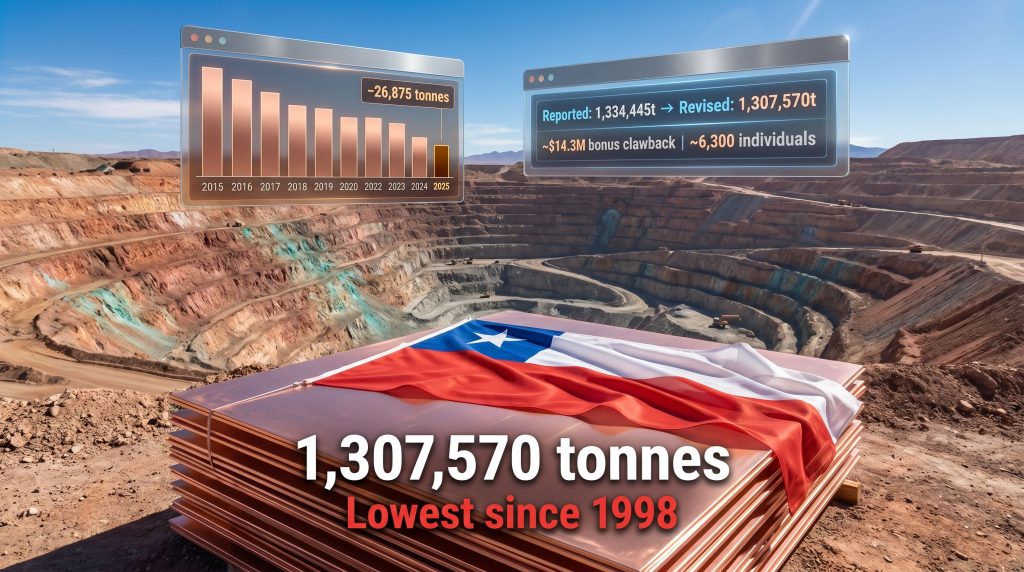
The misclassification originated at two operations: Chuquicamata, one of the largest open-pit copper mines in the world, and Ministro Hales, a more recently developed underground and open-pit hybrid operation. At Chuquicamata, approximately 20,000 tonnes were prematurely classified as finished goods. At Ministro Hales, the figure was approximately 6,875 tonnes. Combined, these errors inflated Codelco's 2025 copper output from the corrected figure of 1,307,570 tonnes to the previously reported 1,334,445 tonnes.
The mechanism enabling this was not a simple data entry error. The audit identified what are described as exception rules — internal accounting workarounds that permitted classification decisions to bypass the standard approval protocols that would normally apply. The absence of mandatory approval chains at critical reporting junctures meant that these non-standard classifications were not escalated for review, and consequently persisted through multiple reporting cycles before the internal audit identified them.
Production Figures at a Glance
| Metric | Reported Figure | Revised Figure | Variance |
|---|---|---|---|
| 2025 Copper Output (fine copper) | 1,334,445 tonnes | 1,307,570 tonnes | -26,875 tonnes (~2%) |
| Chuquicamata misclassification | N/A | 20,000 tonnes | Premature finished goods classification |
| Ministro Hales misclassification | N/A | 6,875 tonnes | Premature finished goods classification |
| Performance bonuses triggered | ~USD $14.3 million | Subject to clawback | Paid to ~6,300 workers and executives |
| Historical context | N/A | Lowest since 1998 | 27-year production low |
Did This Affect Audited Financial Statements?
A critical distinction emerged from the audit review. No amendments to Codelco's audited 2025 financial statements were required. Production disclosures, however, will be formally revised. This separation reflects the difference between financial materiality thresholds applied in accounting standards and the operational reporting integrity standards that govern physical production disclosures.
This distinction matters considerably for how the incident should be interpreted. The absence of a financial restatement does not diminish the governance breach. It instead illustrates how operational metrics and financial accounts can diverge in ways that mask genuine underperformance while still triggering compensation outcomes that directly benefit those generating the flawed data.
The fact that audited financials remain unchanged actually deepens the governance concern rather than resolving it. It confirms that internal production reporting systems operated in a space largely insulated from the scrutiny that financial statement preparation applies.
Accountability Measures: Who Was Dismissed and What Happens Next
Executive Actions and Prosecutorial Referrals
| Individual or Group | Role | Action Taken |
|---|---|---|
| César Márquez Márquez | Manager, Budget and Management Control | Dismissed |
| 7 current executives | Various operational and control roles | Formally sanctioned |
| 1 former executive | Previously departed | Formally sanctioned |
| All named individuals | Multiple roles | Referred to Chile's Public Prosecutors Office |
| ~6,300 workers and executives | Bonus recipients | Subject to ~USD $14.3 million clawback |
The referral to Chile's Public Prosecutors Office represents a significant escalation. According to Reuters, at a state-owned enterprise, misuse of public resources — which is what the payment of approximately USD $14.3 million in unjustified bonuses constitutes — can cross the threshold from administrative negligence into criminal liability. Chile's prosecutorial framework applicable to state enterprise misconduct distinguishes between errors of judgment and deliberate circumvention of control systems. The audit's identification of purposive use of exception rules to bypass approval chains will be central to how prosecutors assess that distinction.
The Bonus Clawback Challenge
Recovering approximately $14.3 million from roughly 6,300 individuals spanning frontline workers through to senior executives presents formidable legal and logistical complexity. Performance bonus frameworks at large mining enterprises are typically contractual in nature. Clawback provisions, where they exist, require precise triggering conditions and may face legal challenge from affected employees who received payments in good faith without direct knowledge of the underlying classification errors.
This creates a precedent question with implications extending well beyond Codelco. State-controlled mining entities globally have often structured worker compensation to include production-linked bonuses as a mechanism for aligning workforce incentives with national output targets. If those bonuses are calculated using self-reported production metrics that lack independent verification, the governance risk embedded in that model is systemic, not idiosyncratic. Consequently, the copper capital allocation decisions that flow from flawed reporting frameworks carry compounding risks for the broader industry.
A 27-Year Production Low: The Operational Context
Structural Decline Beneath the Headline Figures
The corrected 2025 figure of approximately 1,307,570 tonnes represents Codelco's lowest annual copper output since 1998. This is not simply a rounding correction. It reflects a production trajectory that has been declining for over a decade, driven by aging ore bodies across Codelco's legacy mine portfolio, falling ore grades, and the capital-intensive transition required to move from open-pit to increasingly deep underground operations.
Codelco's flagship operations, including Chuquicamata, El Teniente, and Andina, are among the oldest large-scale copper mines in the world. As these deposits mature, ore grades decline and extraction costs rise. The capital expenditure required to sustain production, let alone grow it, has increased substantially. Against this operational backdrop, the pressure to report production figures that maintained the appearance of stability was structurally significant. The Codelco production recovery narrative, which had been gaining traction in early 2025, is now considerably more complicated by these revised figures.
Why Ore Grade Deterioration Makes Reporting Integrity More Important
A less commonly understood dimension of this issue relates to the interaction between ore grade and production classification. As ore grades fall at legacy copper operations, the proportion of material that moves through intermediate processing stages as work-in-progress relative to final refined output increases. This creates a larger volume of material sitting in ambiguous classification states at any given point in the production cycle.
In lower-grade mining environments, the distinction between what qualifies as finished product and what remains intermediate material is therefore both more consequential and more susceptible to classification judgment. The exception rules identified in Codelco's audit were applied precisely in this classification grey zone, making ore grade decline a contributing geological and operational factor in the governance failure, not merely a backdrop to it.
The KPI Architecture That Made Misreporting Rational
Corporate target-setting processes that link bonus eligibility directly to production thresholds create a logical pressure point. When the internal systems used to measure production against those thresholds are also operated by the individuals whose compensation depends on the outcomes, the independence of the measurement function is compromised by design.
The distorted corporate KPI calculations identified in the audit did not simply produce an incorrect number. They produced a number that crossed the threshold required to trigger approximately $14.3 million in bonus payments to approximately 6,300 people. That outcome is the predictable consequence of governance architecture that conflates the production measurement function with the production delivery function.
When performance bonuses are calculated using internally generated production data, without independent third-party validation, the incentive to influence classification decisions becomes embedded in the reporting process itself. This is a structural problem, not a personal one.
Leadership Transition and the Governance Reform Mandate
A New CEO Inherits an Active Investigation
The departure of CEO Rubén Alvarado and the appointment of Jorge Gómez as incoming chief executive coincides directly with the audit findings and the referral of multiple executives to the Public Prosecutors Office. The timing creates an immediate mandate for new leadership that goes beyond operational performance recovery. The incoming CEO must manage an active criminal investigation while simultaneously rebuilding institutional credibility with offtake partners, lenders, and the Chilean state. In addition, the Codelco copper strategy for managing global trade pressures must now be pursued under the shadow of these governance findings.
Three Control Failures That Must Be Remediated
The audit identified three distinct systemic breakdowns:
-
Improper application of exception rules within the production classification system, allowing non-standard classifications to bypass standard protocols.
-
Absence of mandatory approval chains at critical reporting stages, meaning that classification decisions made at the operational level were not escalated for independent review.
-
Distorted corporate KPI calculations that fed directly into bonus eligibility determinations, creating a measurement system whose outputs financially benefited those controlling its inputs.
Each failure category requires a structurally different remediation response. Exception rules require a governance framework that treats their use as an escalation trigger rather than a processing shortcut. Missing approval chains require both procedural redesign and cultural reinforcement. Distorted KPI calculations require the introduction of independent verification before any compensation-relevant production figure is treated as final.
A Pattern Across Multiple Divisions
The Codelco governance story does not begin or end with the production overstatement. In March 2026, three executives at the El Teniente division were dismissed in connection with a cover-up related to a 2023 rock burst event and a subsequent 2025 mine collapse. That incident and the production misclassification audit are independent events with distinct fact patterns.
Their proximity in time and their occurrence across different Codelco operations raises a more uncomfortable systemic question. Two separate governance suppression events at different divisions of the same enterprise within a short timeframe suggests that the accountability deficit may be enterprise-wide rather than confined to specific individuals or operations. That is a significantly more challenging remediation problem than an isolated reporting error.
The next major ASX story will hit our subscribers first
Implications for Copper Markets and Global Mining Governance
How Production Overstatements Distort Supply Signals
Codelco's position as the world's largest copper producer means that its reported output figures are incorporated into global supply models used by commodity traders, manufacturers, and infrastructure planners. A 26,875-tonne overstatement in reported annual production feeds into those models as genuine supply, suppressing price signals that would otherwise reflect the actual tightness of the market.
Copper is the most electrically conductive non-precious metal and is foundational to grid infrastructure, electric vehicles, and industrial machinery. Supply projection errors at Codelco's scale, even at the 2% margin identified here, can influence capital allocation decisions across downstream industries that rely on those projections for multi-year planning cycles. Furthermore, the broader copper supply crunch facing global markets makes accurate production reporting from major producers more critical than ever.
The Case for Independent Production Audits
The incident makes a compelling structural argument for mandatory independent production audits at sovereign mining entities, conducted separately from financial statement audits. As reported by BNAmericas, international frameworks including ICMM standards and the Extractive Industries Transparency Initiative principles address production reporting integrity in principle, but their application at state enterprises varies considerably in practice.
Five structural reforms emerge from the Codelco case as priority measures applicable across state-controlled mining enterprises globally:
-
Independent production auditing conducted by parties with no compensation interest in the outcome.
-
Compensation decoupling from self-reported production metrics until independent verification is complete.
-
Mandatory approval chain enforcement with automatic escalation triggers for any exception-based classifications.
-
Whistleblower protection mechanisms that create safe pathways for operational staff to report classification irregularities.
-
Board-level oversight of operational KPIs, removing the measurement function from the exclusive control of the operational teams it measures.
Reputational Consequences and Counterparty Risk
Institutional counterparties, including offtake partners, project lenders, and sovereign wealth funds that engage with Codelco through joint ventures, assess governance quality as a component of counterparty risk. A 27-year production low disclosed through an audit rather than through proactive management transparency carries a reputational cost that extends beyond the immediate financial quantum of the misstatement.
For a state enterprise seeking joint venture participation in new project development, particularly as Codelco's legacy portfolio requires increasingly capital-intensive deepening, the governance credibility of the reporting institution is a material factor in partner and lender confidence. The events of 2025 and early 2026 make that conversation considerably more difficult for incoming leadership to navigate.
Disclaimer: This article is intended for informational purposes only and does not constitute financial, investment, or legal advice. All figures cited reflect publicly available information at the time of writing. Forecasts, projections, and analysis of market implications involve inherent uncertainty and should not be relied upon as the basis for investment decisions.
Want to Stay Ahead of Significant ASX Mineral Discoveries Before the Broader Market Does?
Discovery Alert's proprietary Discovery IQ model delivers real-time alerts on major ASX mineral discoveries, transforming complex data into actionable investment insights for both short-term traders and long-term investors — explore historic examples of exceptional discovery returns to understand what early positioning can mean, then begin your 14-day free trial at Discovery Alert to gain a genuine market-leading edge.