July 10, 2026
The Hidden Fault Lines in Mining's Most Valuable Jurisdiction
Every major commodity cycle in modern history has exposed the same structural tension: the more valuable a mineral-rich nation's resources become, the more aggressively its government moves to capture a larger share of the returns. This pattern has played out across Zambia's copper belt, Tanzania's gold fields, and Guinea's bauxite highlands. However, nowhere is this dynamic more acute, or more consequential for global supply chains, than in the Democratic Republic of Congo, where the DRC mineral wealth intersects with one of the most challenging fiscal enforcement environments on earth.
The Congo tax agency seals Glencore mine offices in payment dispute story represents the latest chapter in a long-running conflict touching on tax sovereignty, corporate negotiation strategy, geopolitical capital flows, and the structural fragility of global copper and cobalt supply chains. Understanding what this moment actually represents requires moving well beyond the headline and into the mechanics of how the DRC's fiscal architecture operates.
When big ASX news breaks, our subscribers know first
Why the DRC's Fiscal System Creates Extraordinary Pressure on Mining Operators
The DRC's budgetary reality is inseparable from its extractive sector. Mining royalties and corporate taxes from copper and cobalt operations represent a disproportionately large share of state revenues, creating institutional incentives for aggressive enforcement unusual in economies with more diversified fiscal bases. The DRC government has publicly estimated that the country loses approximately $1.5 billion annually to tax evasion across the mining sector, a figure that has hardened enforcement resolve considerably.
This structural dependency becomes especially pronounced during commodity price upswings. Copper surged more than 40% in 2025 and continued rising into 2026, driven by twin demand engines: the AI infrastructure build-out and the ongoing clean energy transition. Furthermore, when the underlying commodity appreciates this sharply, any outstanding tax obligation assessed on historical income suddenly looks undervalued to the state, creating fresh momentum for enforcement action.
How the DGI Calibrates Its Enforcement Tactics
The Direction Générale des Impôts operates with a toolkit that is both administratively powerful and strategically restrained. Its decision to seal KCC's commercial offices in Kolwezi rather than interfere with actual mining or processing operations reflects a sophisticated enforcement posture. The state's interest lies in extracting revenue, not in destroying the productive asset that generates it. A full operational shutdown would impair the royalty stream the DRC depends on, making it a self-defeating measure.
The temporary closure of a metal storage warehouse, which was unsealed within approximately 24 hours, further illustrates the DGI's preference for incremental pressure escalation. These actions serve as negotiating signals rather than terminal interventions, designed to demonstrate enforcement capability without crossing the threshold that would constitute genuine operational sabotage.
The DRC's enforcement architecture is built around a core principle: apply maximum commercial discomfort at the administrative layer while preserving the productive layer that funds the state's own fiscal recovery.
Anatomy of a Multi-Year Fiscal Standoff
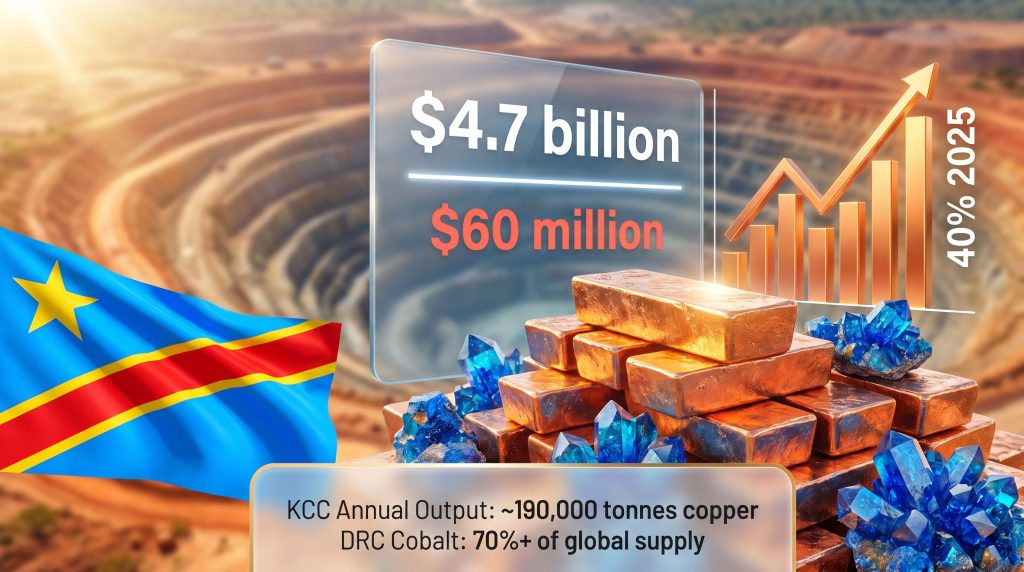
The dispute that culminated in the July 10, 2026 office seizure did not emerge from a single disagreement. It reflects years of compounding friction between Glencore's Congolese subsidiaries and DRC tax authorities over competing interpretations of financial obligations. At its reported peak, the DGI's claim against Glencore's DRC operations reached approximately $4.7 billion, a figure partly anchored in allegations of insurance fraud within the company's subsidiary structures.
In April 2026, Glencore responded with a settlement proposal of $60 million, representing roughly 1.3% of the original claim. The gap between these two figures is not merely a negotiating spread; it reflects fundamentally incompatible legal interpretations of the underlying liability. Glencore's position suggests its legal team views the original assessment as substantially inflated or procedurally flawed. The DRC's position, however, reflects a state apparatus with both the legal authority and the fiscal motivation to pursue the matter to its conclusion.
The Dan Gertler Royalty Dimension
Layered beneath the insurance fraud allegations is a structurally distinct but operationally linked dispute involving approximately €800 million (roughly $894 million) in unpaid royalties at KCC. This claim connects to historical payment arrangements with Dan Gertler, the Israeli businessman sanctioned by the US Treasury Department in 2017 for allegedly acquiring mining assets in the DRC through corrupt dealings with the government.
Gertler's legacy arrangements have become one of the most persistent sources of legal friction in Congolese mining. Because sanctions prevent direct payments to Gertler, some royalty streams tied to KCC have been placed in escrow or disputed, creating a situation where the DRC government believes it is owed funds that cannot be cleanly resolved without navigating US sanctions law. This intersection of Congolese fiscal claims and American extraterritorial enforcement creates a complexity that no bilateral settlement negotiation can easily resolve.
The convergence of the insurance fraud claim and the royalty dispute has reportedly intensified tensions between the DRC's national security council and its finance ministry, with different institutional actors holding different views on how aggressively to proceed.
KCC's Strategic Profile: Why This Asset Sits at the Centre of Global Supply Chains
Understanding the stakes of this dispute requires a clear picture of what Kamoto Copper Company actually represents in production terms.
| Metric | Detail |
|---|---|
| Current Annual Copper Output | ~190,000 tonnes |
| Production Target | 300,000 tonnes per annum |
| Glencore Ownership Stake | 70% |
| DRC State Ownership | 30% (government and state-owned entity) |
| Primary Commodities | Copper and cobalt |
| Location | Kolwezi, Lualaba Province, DRC |
KCC operates within the Central African Copperbelt, one of the world's most mineralogically significant geological formations. The Copperbelt straddles the DRC and Zambia and is characterised by sediment-hosted stratiform copper-cobalt deposits, a geological classification that distinguishes it from porphyry copper systems found in South America. These stratiform deposits typically exhibit higher cobalt grades than porphyry systems, which is a core reason the DRC holds such an outsized share of global cobalt supply.
The ore at KCC is primarily processed through a combination of flotation and hydrometallurgical techniques, including solvent extraction and electrowinning, to produce copper cathode and cobalt hydroxide. KCC's trajectory toward 300,000 tonnes per annum of copper positions it firmly in tier-one asset territory, amplifying both its commercial value and the DRC government's leverage in any fiscal negotiation.
The Orion CMC Transaction and Its Geopolitical Dimension
In February 2026, Orion CMC announced a preliminary agreement to acquire a 40% interest in Glencore's 70% stake in KCC, along with a position in a second Congolese copper-cobalt mine. Orion CMC is backed by the US International Development Finance Corporation, a US government development finance institution. As of July 2026, this transaction had not yet closed. Consequently, this reflects the broader US-Congo mining partnership dynamic now shaping capital flows into the region.
The timing creates a compounding risk dynamic. An unresolved tax liability of up to $4.7 billion represents a material contingent liability that any sophisticated buyer must factor into due diligence. The involvement of a US government-backed financing vehicle adds a reputational and compliance dimension, as entities associated with DFC funding operate under heightened scrutiny regarding the governance environments in which they deploy capital.
How the DRC's Enforcement Approach Compares Globally
| Jurisdiction | Enforcement Mechanism | Typical Trigger | Production Impact |
|---|---|---|---|
| DRC | Office seizure, warehouse closure | Tax arrears, royalty disputes | Generally limited |
| Zambia | Asset freezes, licence reviews | Windfall tax non-compliance | Moderate |
| Tanzania | Export bans, renegotiated contracts | Revenue sharing disputes | Significant |
| Guinea | Operational suspensions | Environmental and fiscal breaches | Variable |
| Kazakhstan | Court-ordered freezes | Transfer pricing disputes | Limited |
The DRC's calibrated approach contrasts sharply with Tanzania's historical use of export bans and Guinea's operational suspensions, both of which have directly impaired production and eroded investor confidence. The DRC model preserves the revenue base while maximising negotiating leverage, a more economically rational strategy for a government that depends heavily on the sector it is pressuring.
Glencore's Prior Compliance Record in the DRC
In 2022, Glencore reached an agreement to pay $180 million to resolve corruption-related claims with the DRC government. That settlement was criticised by transparency advocates for opacity around fund allocation and accountability mechanisms. The recurrence of large-scale fiscal disputes suggests the 2022 resolution did not establish a durable compliance and governance framework capable of preventing future confrontations. For institutional investors assessing Glencore's DRC risk exposure, the pattern of repeated major disputes warrants incorporation into long-term jurisdiction risk models.
Commercial and Operational Risk Assessment
As of the date of the office seizure, copper and cobalt production at KCC's mines and processing facilities continued without interruption. This is a critical distinction. The DGI's action remained confined to administrative premises, preserving the state's own royalty and tax income stream in the near term.
However, the risk calculus changes materially if enforcement escalates. Scenarios worth modelling include:
- Escalation to logistics infrastructure: Interference with concentrate transport or port access could disrupt the export chain without touching the mine itself.
- Licence suspension threat: While unlikely in the near term given the DRC's own fiscal dependency on KCC, a threatened licence review would immediately affect the Orion CMC transaction.
- Workforce and contractor impacts: Prolonged administrative uncertainty at the operational level can impair contractor confidence and workforce stability even without direct production interference.
- Cobalt market sensitivity: Because the DRC supplies over 70% of global cobalt, any genuine production disruption at a major operation like KCC would have outsized downstream effects on battery supply chains and EV manufacturers. In addition, the DRC cobalt export ban already in place adds further complexity to supply chain planning.
Supply chain participants relying on DRC-origin copper and cobalt should treat fiscal enforcement escalation as a low-probability but high-impact tail risk requiring active scenario planning rather than passive monitoring.
The next major ASX story will hit our subscribers first
What the Dispute Signals for Critical Mineral Supply Chain Strategy
The broader lesson from the Congo tax agency seals Glencore mine offices episode is not primarily about Glencore. It is about the structural vulnerability that emerges when critical mineral supply chains are geographically concentrated in jurisdictions with high fiscal dependency on extractive industries, complex historical ownership arrangements, and evolving enforcement capacity.
Copper demand is being structurally elevated by forces that show no signs of abating. AI infrastructure alone is driving unprecedented growth in power transmission requirements, with copper-intensive data centre construction accelerating across North America, Europe, and Asia. Furthermore, the energy transition continues to expand copper demand across EV drivetrains, grid infrastructure, and renewable generation systems. These converging demand drivers increase the long-term strategic value of assets like KCC and, critically, they increase the DRC government's leverage in any fiscal negotiation precisely because the counterparty cannot easily walk away.
For investors and procurement strategists, the cobalt price impacts stemming from fiscal uncertainty at major operations like KCC further underscore the following structural insights from this episode:
- Jurisdiction risk is non-linear in high-dependency states: The DRC's fiscal reliance on mining does not moderate enforcement risk; it amplifies it, because the government's incentive to maximise recovery is structurally embedded.
- Settlement gap analysis matters: A $4.7 billion claim versus a $60 million offer signals a protracted negotiation timeline, not an imminent resolution.
- Pending transactions amplify vulnerability: The unclosed Orion CMC deal means Glencore is negotiating a tax dispute while simultaneously managing an ownership transition, creating overlapping pressure vectors.
- Historical settlements do not reset institutional relationships: The 2022 corruption settlement did not inoculate Glencore against subsequent fiscal disputes, a pattern that should inform how the industry frames post-settlement governance investment.
Moreover, the Congolese cobalt rivalry between major global powers adds a geopolitical layer that makes resolution timelines even harder to predict for market participants.
Frequently Asked Questions
What actions did the DRC tax agency take against Glencore?
The DGI sealed KCC's administrative offices in Kolwezi on July 10, 2026. A metal storage warehouse was also temporarily closed but unsealed within approximately 24 hours. Mine and processing operations were unaffected.
How large is the DRC's financial claim against Glencore?
The DGI's claim reached approximately $4.7 billion, partly linked to alleged insurance fraud within Glencore's DRC subsidiary structures. Glencore's April 2026 counter-proposal of $60 million was not accepted, triggering the enforcement action.
Is there more than one financial dispute involved?
Yes. A separate but structurally linked claim involves approximately €800 million ($894 million) in unpaid royalties at KCC connected to historical payment arrangements associated with sanctioned businessman Dan Gertler.
Does the tax dispute affect the Orion CMC acquisition?
The pending sale of a 40% interest in KCC to Orion CMC, which is backed by the US International Development Finance Corporation, had not closed as of July 2026. The active tax dispute introduces material execution risk to that transaction.
Has Glencore faced similar regulatory challenges in the DRC before?
Yes. In 2022, Glencore paid $180 million to resolve corruption-related claims with the DRC government. The recurrence of major fiscal disputes indicates that the DRC compliance environment remains structurally demanding for foreign operators regardless of prior settlement history.
Disclaimer: This article contains forward-looking analysis, scenario projections, and references to unresolved commercial and legal disputes. It is intended for informational purposes only and does not constitute financial, legal, or investment advice. Outcomes in ongoing disputes and unclosed transactions may differ materially from scenarios described herein.
Want to Stay Ahead of Major Mineral Discoveries Shaping Global Supply Chains?
As critical minerals like copper and cobalt become increasingly central to the energy transition and AI infrastructure build-out, Discovery Alert's proprietary Discovery IQ model delivers real-time alerts on significant ASX mineral discoveries, transforming complex commodity data into actionable investment insights — explore historic discoveries and their returns to understand what early positioning can mean, then begin your 14-day free trial at Discovery Alert to ensure you're positioned ahead of the market.