
June 16, 2026
When the World's Biggest Copper Producer Gets Its Numbers Wrong, Everyone Notices
Global copper markets rest on a fragile foundation of trust. Traders, sovereign wealth funds, industrial procurement teams, and infrastructure planners all build their forward models around production data published by the world's largest suppliers. When that data turns out to be wrong, the ripple effects extend far beyond the balance sheets of a single state-owned enterprise. The reliability of supply forecasting for one of the most electrically critical metals on earth becomes an open question, and that uncertainty has a price.
That is precisely the position in which the copper market now finds itself, as a formal Codelco production audit in September approaches and analysts wait to understand the full scale of what went wrong at two of Chile's most significant mining operations.
When big ASX news breaks, our subscribers know first
How the Reporting Irregularities Surfaced
Production discrepancies in the mining sector rarely announce themselves. They tend to emerge from the friction between internal data streams, where ore tonnage records from the pit face, grade reconciliation from the processing plant, and copper-in-concentrate figures arriving at the smelter gradually diverge from one another until the gap becomes too large to attribute to normal measurement variance.
At Codelco, that divergence was significant enough to escalate from an internal review to a board-level response. The company's Audit, Compensation, and Ethics Committee was formally instructed to engage external auditors, transforming what began as an internal discrepancy investigation into a forensic production review with regulatory oversight from Cochilco, Chile's independent state copper commission.
The timeline of escalation matters here. Internal irregularities were identified, flagged to the board, and the decision was made to go external. That sequence suggests the internal findings were substantial enough that self-correction was not considered sufficient. A preliminary report from the external review process is expected to be published in September 2026, with Cochilco's interim executive vice president confirming the target release window.
What the Internal Review Found
Before external auditors were brought in, internal analysis had already identified two specific discrepancies across separate operations:
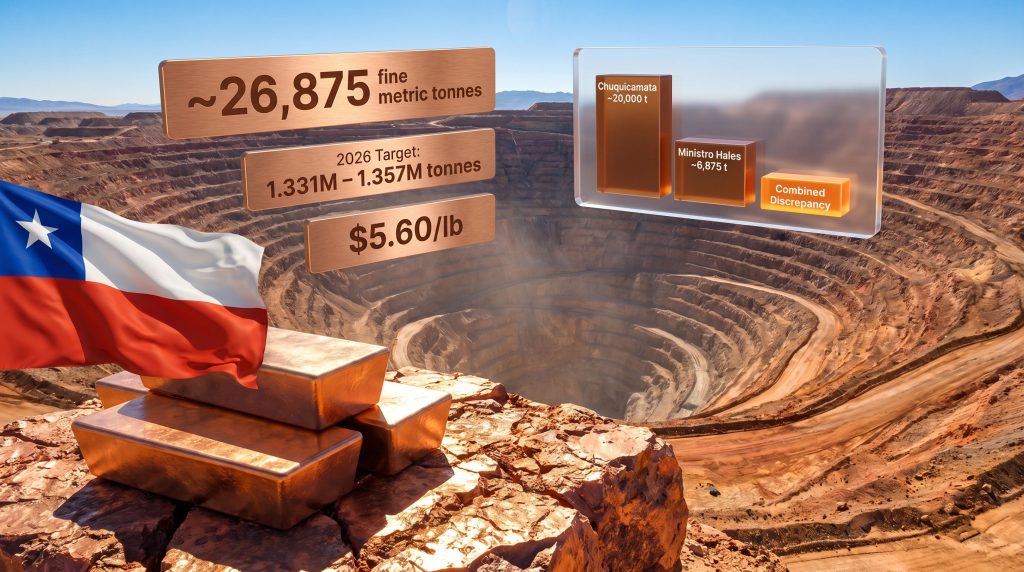
- An overstatement of approximately 20,000 fine metric tonnes linked to Chuquicamata operations
- An additional discrepancy of approximately 6,875 fine metric tonnes attributed to Ministro Hales
- A combined potential misstatement of roughly 26,875 fine metric tonnes across two structurally different mining operations
Codelco has committed to issuing corrective notes in its annual report and official communications. According to reporting on the disciplinary measures taken, at least one executive has been dismissed in connection with the irregularities, and Chilean prosecutors have opened a separate review, lifting the matter from the domain of corporate governance into potential legal proceedings.
Putting 26,875 Tonnes Into Market Context
Abstract tonnage figures can obscure the real significance of a production discrepancy. The table below frames the numbers against Codelco's broader output profile and current copper pricing.
| Metric | Estimated Figure |
|---|---|
| Chuquicamata overstatement | ~20,000 fine metric tonnes |
| Ministro Hales overstatement | ~6,875 fine metric tonnes |
| Combined discrepancy | ~26,875 fine metric tonnes |
| Codelco's 2026 production target | 1.331M to 1.357M tonnes |
| Discrepancy as % of 2026 target | ~2.0% |
| Approximate value at $5.60/lb copper | ~$330M+ in implied output value |
A two percent variance might appear modest in percentage terms. In practice, it is anything but. Codelco's output leadership means it supplies roughly a tenth of the world's mined copper output annually, which means its reported figures carry enormous weight in global supply-demand modelling. When analysts at trading desks, commodity-linked funds, or long-term infrastructure procurement offices build their copper balance sheets, Codelco's numbers are treated as some of the most reliable anchor points in the dataset.
An overstatement of this scale, worth several hundred million dollars in implied output value at prevailing prices, is not a rounding error in any conventional sense. It represents copper that was reported as produced but did not physically exist in the supply chain, which means anyone using those figures for forward planning was working from an inflated baseline.
A production overstatement at this scale from the world's largest copper producer does not stay contained within Chile's borders. It distorts supply-demand calculations used by copper consumers, traders, and investors across every major market globally.
Chuquicamata and Ministro Hales: Different Operations, Shared Problem
One of the more troubling aspects of this situation is that the discrepancies emerged from two operationally distinct sites. Chuquicamata is one of the largest open-pit copper mines ever developed, located in the hyper-arid Atacama Desert in northern Chile. It has been in continuous production for over a century and represents one of Codelco's flagship assets, with deep institutional knowledge and established measurement infrastructure.
Ministro Hales represents a more recent chapter in Codelco's development strategy, an underground operation that required substantial capital investment and reflects the company's push into deeper, higher-cost extraction as surface ore grades at legacy sites continue to decline.
The fact that discrepancies appeared independently at both an open-pit surface operation with a long production history and a newer underground mine is what elevates this beyond an isolated incident. It raises legitimate questions about whether this reflects a systemic weakness in Codelco's data governance framework rather than a localised reporting failure.
The Mechanics of a Forensic Production Audit
External forensic production audits are uncommon in the mining industry. Most producers operate under stock exchange disclosure requirements or national regulatory frameworks that rely substantially on self-reporting, supported by internal checks and periodic reviews by nominated competent persons. A full external forensic review of the kind now underway at Codelco is typically reserved for situations where internal processes have demonstrably failed.
The methodology follows a systematic verification pathway:
-
Raw extraction data review: Independent auditors examine ore tonnage records directly from mine site operations, including extraction logs, grade control sampling, and ore movement records from the pit or underground workings.
-
Smelter and refinery cross-referencing: Reported copper-in-concentrate figures are compared against actual intake records at downstream processing facilities, identifying gaps between what was supposedly produced and what was physically received.
-
Inventory and stockpile verification: Adjustments for stockpile movements, inter-facility material transfers, and work-in-progress inventory are scrutinised to identify whether these categories were used to inflate reported output.
-
Classification of the discrepancy: Auditors assess whether the gap reflects deliberate misreporting, methodological inconsistencies in how copper content was calculated, or systemic data management failures at the operational level.
-
Preliminary findings and recommendations: The first-phase report is published with corrective action guidance and enhanced reporting protocol recommendations, with further investigation phases possible depending on initial conclusions.
The credibility of the September preliminary report will depend heavily on the independence of the appointed auditors and the degree of unrestricted access they receive to mine-site operational records, not just corporate reporting systems.
Why Grade Reconciliation Is Central to This Investigation
A dimension of this investigation that receives less attention in general reporting is the role of ore grade reconciliation. In copper mining, the reported metal content of any given production period depends not only on the physical volume of rock extracted but on the copper grade assigned to that material at each stage of the processing chain.
Grade control sampling at the mine face, followed by mill feed sampling, concentrate assay, and final smelter settlement all produce slightly different grade readings. Managing the reconciliation between these figures is one of the most technically demanding aspects of production accounting. Furthermore, interpreting mining data of this complexity requires rigorous independent verification at every stage to ensure reporting integrity.
When reconciliation systems are inadequate or are manipulated, inflating output figures is far easier than inflating physical tonnage, because the error is embedded in an intermediate calculation rather than in a physical measurement that can be directly weighed or counted. This is why forensic production audits focus heavily on the quality of sampling protocols, the independence of assay laboratories, and the chain of custody for grade data at each stage of the value chain.
Cochilco's Oversight Role and the September Timeline
Cochilco occupies a unique institutional position in Chile's mining governance architecture. As the state copper commission, it functions as an independent regulatory watchdog with the authority to commission, oversee, and publish independent production audits of Codelco and other Chilean copper operations. Its involvement in this process is what distinguishes this audit from an internal corporate review and gives the September report genuine market authority.
Cochilco's interim executive vice president confirmed the September 2026 target for the preliminary report's release. The word preliminary carries significant weight in this context. A first-phase forensic audit rarely captures the complete picture. It establishes the scope of confirmed discrepancies and identifies the likely causes, but detailed remediation work and potential historical restatements for prior reporting periods can extend well beyond the initial release.
Copper traders, sovereign buyers, and industrial consumers who rely on Codelco's production figures for supply chain planning will be watching the September release closely. They will be focused not only on the tonnage conclusions but on what the report says about the governance structures that allowed this situation to develop.
Production Challenges Already Facing Codelco
This Codelco production audit in September arrives at a moment when the company was already carrying significant operational weight. The Codelco production decline has been compounded by a prolonged period of structural headwinds, including:
- Declining ore grades at legacy open-pit operations as the highest-concentration copper mineralisation is progressively exhausted
- Ageing infrastructure at flagship sites requiring capital-intensive modernisation programmes
- The complexity and cost of transitioning from surface mining to deeper underground extraction at several key operations
- Multi-year production targets that have required increasingly demanding operational performance to achieve
Codelco has set a 2026 production target of between 1.331 million and 1.357 million tonnes from its own operations. Whether the audit findings require a formal restatement of 2024 or 2025 production figures will directly affect how analysts assess year-on-year performance trends and the credibility of forward guidance.
Adding to the complexity is a leadership transition underway at the top of the organisation. Reports indicate that executives from major copper producers including Antofagasta's Arriagada and Collahuasi's leadership are considered frontrunners for Codelco's chief executive role. A leadership change coinciding with the audit timeline creates an additional layer of governance uncertainty that markets will factor into their assessment of the company's near-term stability.
The next major ASX story will hit our subscribers first
Chile's Copper Governance Under the Microscope
Chile produces approximately 25 to 27 percent of global mined copper supply. That concentration of production in a single jurisdiction means that data integrity failures at Chile's largest producer are not purely domestic governance concerns. They have direct implications for the accuracy of the global copper supply balance. Consequently, the broader copper supply crunch narrative that has dominated market discussion is now complicated by questions about whether historical supply figures were accurate in the first place.
Comparative context is useful here. Major copper producers in other jurisdictions operate under varying governance frameworks. Australian producers listed on the ASX are subject to JORC Code requirements for resource and reserve reporting, with mandatory competent person sign-off. Peruvian and DRC operations face different regulatory environments with varying levels of independent verification. Chile's Cochilco framework has historically been regarded as one of the more rigorous national oversight mechanisms for a resource-dependent economy.
The paradox at the centre of this situation is that a genuine audit process, however disruptive in the short term, ultimately reinforces institutional credibility if conducted with transparency and followed through. The September preliminary report represents an opportunity for Cochilco and Codelco to demonstrate that the system can self-correct. How comprehensively that opportunity is taken will shape market confidence in Chilean copper production data for years to come, and the Chile copper price outlook will inevitably reflect the degree of governance reform that follows.
Key Indicators to Watch When the September Report Drops
Investors and analysts tracking the Codelco production audit in September should focus on several critical outputs from the preliminary report. According to Codelco's own audit announcement, the review covers both 2024 and 2025 production figures, making the scope of potential restatements particularly significant.
- Whether the confirmed discrepancy aligns with, exceeds, or is narrower than the approximately 26,875 tonne figure identified in internal reviews
- The scope of historical restatements required for 2024 and 2025 annual production figures and how this affects multi-year production trend analysis
- Structural recommendations for overhauling Codelco's internal data governance, grade reconciliation systems, and production reporting protocols
- Prosecutorial developments following the Chilean legal review, including whether criminal charges are pursued against implicated personnel
- The appointment of a new chief executive and how incoming leadership signals a commitment to governance reform
- Copper spot price movements in the trading sessions immediately following the report's publication, as the market prices in the final confirmed scope of the discrepancy
Disclaimer: This article is intended for informational purposes only and does not constitute financial or investment advice. Figures relating to production discrepancies, copper pricing, and audit timelines are based on publicly available information current at the time of writing. Readers should conduct their own research before making any investment decisions. Forward-looking statements and projections are inherently uncertain and subject to change.
Want to Stay Ahead of Major Copper and Mineral Discovery Announcements on the ASX?
Discovery Alert's proprietary Discovery IQ model delivers real-time alerts the moment significant ASX mineral discoveries are announced, transforming complex commodity data into clear, actionable insights for traders and investors at every level. Explore how historic mineral discoveries have generated substantial returns by visiting Discovery Alert's dedicated discoveries page, and begin your 14-day free trial today to position yourself ahead of the broader market.