
June 16, 2026
The Infrastructure Backbone Reshaping Africa's Critical Minerals Export Map
Commodity supply chains are only as reliable as the physical infrastructure that underpins them. Across sub-Saharan Africa, where some of the world's most strategically valuable mineral deposits sit deep in landlocked terrain, the gap between resource wealth and export efficiency has historically been measured in weeks of transit time, not days. That gap is now closing along one of the continent's most consequential freight corridors, and the implications stretch far beyond Angola's borders into the boardrooms of European battery manufacturers and the procurement strategies of North American automakers.
The Lobito Corridor railway reopening in June 2026, following severe flood damage sustained just two months prior, brought renewed global attention to an infrastructure project that is quietly reshaping the economics of copper and cobalt extraction across central Africa. Understanding why this corridor matters requires stepping back from the immediate event and examining the deeper structural forces that made this railway so critical in the first place.
When big ASX news breaks, our subscribers know first
A Railway Born from Colonial Logistics, Reborn for the Energy Transition
The physical route that defines the Lobito Corridor today traces its origins to the Benguela Railway, a line constructed during the early 20th century to move copper from the mineral-rich interior of central Africa to the Atlantic coast. At its peak, the Benguela Railway was one of the continent's most commercially significant freight arteries, connecting the Copper Belt regions of what are now the Democratic Republic of the Congo and Zambia to the port of Lobito in Angola.
Angola's prolonged civil conflict, which lasted from independence in 1975 until 2002, effectively destroyed the railway as a functioning export route. Decades of neglect and deliberate sabotage left large sections of track impassable, forcing DRC and Zambian copper producers to reroute exports through Indian Ocean ports, adding enormous costs and transit times to their supply chains.
The 2015 rehabilitation effort marked the first serious attempt to restore the corridor's physical viability after the conflict era. However, restoring track geometry is not the same as restoring commercial operability, and the gap between those two outcomes took several additional years to close. For further context on the corridor's history and background, the official Lobito Corridor resource provides a thorough account of its development.
The Concession Structure That Changed Everything
The transformation of the Lobito Corridor from a rehabilitated but underutilised railway into a commercially functioning freight system accelerated decisively with the award of a 30-year operating concession to the Lobito Atlantic Railway consortium in 2022 and 2023. This private concession model introduced something that state-led operation had consistently failed to deliver: long-term capital commitment backed by commercial incentives.
The consortium bringing that commitment together includes three entities with complementary capabilities:
- Trafigura, one of the world's largest commodity trading and logistics companies, with deep commercial relationships across the DRC and Zambian mining sectors
- Mota-Engil, a Portuguese construction and infrastructure group with an extensive operational footprint across Africa
- Vecturis, a specialist railway operations company with experience managing freight rail concessions in Africa
This combination of commercial scale, construction capability, and operational railway expertise is precisely what a 30-year infrastructure development mandate requires. The concession structure incentivises the consortium to maximise throughput over the long term, aligning private commercial interests with the corridor's broader strategic function.
The corridor's development to date can be tracked through a sequence of milestones that illustrate both its progress and its ongoing vulnerabilities:
| Milestone | Year | Significance |
|---|---|---|
| Major rehabilitation funding secured | 2015 | Restored physical track viability after civil war damage |
| Lobito Atlantic Railway concession awarded | 2022-2023 | Introduced private operating expertise and long-term capital commitment |
| Corridor declared operational | 2024 | First commercial freight movements under the new concession |
| April 2026 flooding event | April 2026 | Severe weather caused significant damage across key rail sections |
| Emergency rehabilitation completed | June 2026 | Track restored to operational standard following flood damage |
| First post-flood copper train from DRC | 15 June 2026 | Freight traffic officially recommences; corridor returns to full operational status |
The April 2026 Flood Event: Anatomy of a Supply Chain Disruption
Severe flooding across Angola in April 2026 inflicted what operators characterised as significant damage to rail infrastructure along the corridor. The event was not a minor weather inconvenience but a serious structural disruption that halted copper and cobalt freight movements from the DRC entirely, forcing affected mining operators to either stockpile product at mine sites or seek costlier alternative routing.
The downstream consequences rippled through supply chains with a precision that illustrated just how little redundancy exists in the region's export logistics. When the Lobito Corridor stops functioning, landlocked copper and cobalt producers in the DRC face an uncomfortable reality: their alternatives are slower, more expensive, and in some cases equally vulnerable to weather and political disruption.
Emergency rehabilitation works were mobilised rapidly following the April damage assessment. By 15 June 2026, the first post-flood copper train from the DRC completed its journey to Lobito, confirming that the corridor had returned to operational status within approximately six to seven weeks of the initial damage.
Critical Perspective: The April 2026 flood disruption is instructive not because it reveals a fatal flaw in the Lobito Corridor's design, but because it exposes a structural reality common to all single-corridor export systems. The speed of recovery, roughly six weeks from significant infrastructure damage to resumed freight operations, actually demonstrates a level of operational responsiveness that compares favourably to historical disruptions on comparable African railway infrastructure. The more pressing question is whether climate adaptation investment will keep pace with increasing extreme weather frequency.
Transit Economics: Why Atlantic Access Transforms the Numbers
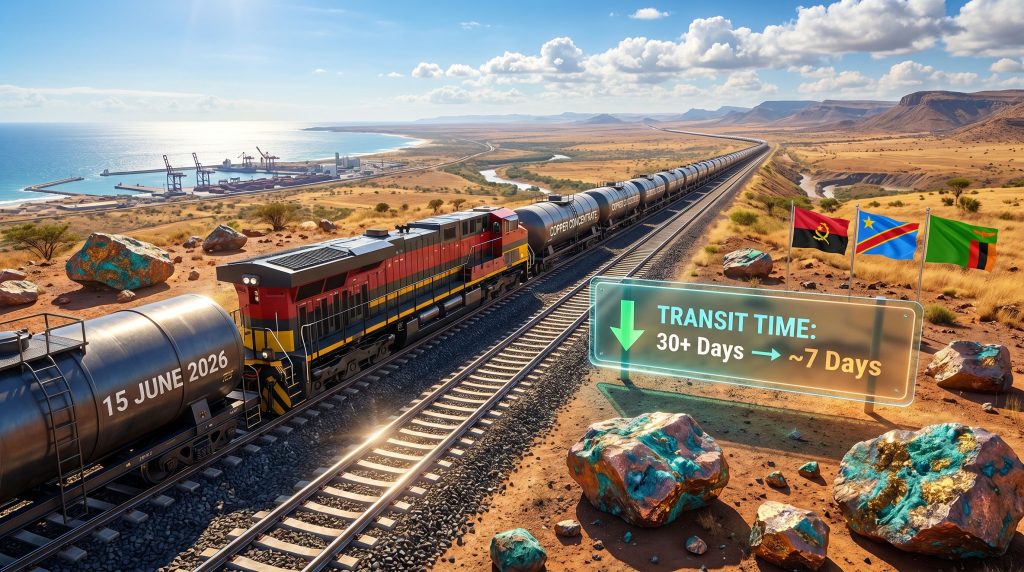
The commercial case for the Lobito Corridor rests on a single, powerful variable: transit time compression. Under the logistics arrangements that DRC and Zambian copper producers were forced to use during the corridor's decades of inoperability, overland freight to viable Indian Ocean ports could consume more than 30 days of transit time.
The European Union, which has committed resources to studying and supporting the corridor's development, has indicated that the route is being developed to compress that journey to approximately one week. The arithmetic here is straightforward but the implications are profound. Furthermore, the copper supply crunch facing global markets makes this transit efficiency even more commercially significant.
Consider the supply chain economics for a copper concentrate producer shipping high-value cargo:
| Export Route | Approximate Transit Time | Ocean Access | Key Limitations |
|---|---|---|---|
| Legacy overland via Indian Ocean ports | 30+ days | Indian Ocean | Distance, road degradation, border crossings |
| Lobito Corridor (Atlantic route) | ~7 days | Atlantic Ocean | Weather vulnerability, single-line capacity |
| Northern Corridor (via Mombasa) | 20-30 days | Indian Ocean | Port congestion, political complexity |
A 75-80% reduction in transit time does not merely reduce freight costs in isolation. It fundamentally restructures the working capital requirements for mining operators. Copper and cobalt concentrate sitting in transit represents locked-up capital that cannot be deployed elsewhere. Reducing that lock-up from a month to a week changes inventory financing calculations, improves cash conversion cycles, and enhances the competitive economics of operations that are already viable but constrained by logistics costs.
For European copper smelters and battery material refiners, Atlantic routing from the DRC shortens ocean shipping distances compared to Indian Ocean alternatives, reducing both cost and the carbon footprint of maritime transport. These factors are increasingly material considerations for companies operating under European supply chain due diligence frameworks.
The DRC-Zambia Copper Belt: Scale, Concentration, and Global Dependency
Any assessment of the Lobito Corridor's significance must be grounded in an honest accounting of what it serves. The DRC-Zambia Copper Belt is one of the most extraordinary concentrations of critical mineral resources on the planet.
The DRC alone accounts for approximately 70-75% of global cobalt supply, a statistic that places the entire battery supply chain for electric vehicles in a position of profound geographic concentration. Cobalt is not merely a useful material in lithium-ion battery chemistries; for many high-energy-density cathode formulations, it remains functionally irreplaceable at scale. The broader DRC cobalt export risks have been well documented, reinforcing just how exposed global manufacturers remain to disruptions in this single geography.
Every electric vehicle manufacturer dependent on cobalt-containing cathodes carries DRC exposure in their supply chain, whether they acknowledge it explicitly or not. Zambia's position is complementary rather than redundant. As one of Africa's largest copper producers, Zambia contributes meaningfully to global refined copper supply, and ongoing investment in new mine development across the Zambian Copper Belt suggests that production volumes are likely to increase over the medium term.
Both nations share a strategic dependency on export infrastructure that connects their mineral wealth to global demand centres efficiently and reliably. The corridor's value proposition is therefore not abstract — it is the physical link between some of the world's most critical battery material deposits and the manufacturing ecosystems in Europe and North America that need those materials to execute energy transition ambitions.
The next major ASX story will hit our subscribers first
Geopolitical Dimensions: Why Western Powers Are Watching Closely
The Lobito Corridor has attracted public support from both the European Union and the United States, though the nature and extent of that support differs in important ways.
The EU has committed to supporting corridor development including feasibility studies and railway-sector capacity building in the region. European interest is directly tied to the bloc's battery manufacturing ambitions and the Critical Raw Materials Act, which establishes targets for domestic processing and diversified sourcing of strategic minerals. The corridor fits within a broader EU framework for securing transparent, traceable supply chains for materials deemed essential to the energy transition. In addition, Europe's critical minerals supply chain strategy explicitly identifies corridors like this one as central to reducing strategic vulnerability.
United States engagement reflects a similar strategic logic, shaped by the imperative to diversify critical mineral supply chains and reduce dependence on processing infrastructure concentrated in specific geographies. American interest in the Lobito Corridor aligns with broader infrastructure diplomacy frameworks for sub-Saharan Africa, though the specific financial commitments and mechanisms differ from those pursued by the EU.
For the three nations directly hosting the corridor, the stakes are equally concrete:
- Angola positions the Port of Lobito as a regional logistics hub capable of generating transit fee revenue and attracting parallel infrastructure investment in port facilities and ancillary services
- The DRC benefits from reduced export costs and improved competitiveness for Congolese mining operations, which is particularly significant for smaller and mid-tier copper producers whose margins are most sensitive to logistics costs
- Zambia gains an Atlantic routing alternative that reduces dependence on the Northern Corridor through Kenya, which has experienced congestion and pricing pressures as Zambian copper production has grown
How Does the Congolese Cobalt Dynamic Influence Corridor Priorities?
The intensifying Congolese cobalt rivalry between western nations and China adds a further layer of strategic urgency to the corridor's development. Western-backed infrastructure investment in the Lobito route is, in part, a deliberate attempt to create supply chain pathways that are not reliant on Chinese-controlled logistics networks, which currently handle a significant proportion of DRC cobalt flows.
Branch Lines, Capacity Expansion, and the Long-Term Development Pipeline
The corridor's current operational footprint represents phase one of a considerably more ambitious infrastructure vision. Feasibility studies are underway examining branch line extensions that would connect additional mining districts in the DRC and Zambia to the main corridor, expanding the volume of mineral tonnage accessible via Atlantic routing. The EU's Lobito Corridor support programme outlines precisely how European development finance is being deployed to accelerate this expansion.
These extensions are not trivial undertakings. Branch line construction through geologically and topographically challenging terrain in central Africa requires sustained capital commitment, regulatory coordination across multiple jurisdictions, and the kind of long-term commercial certainty that the 30-year concession structure was specifically designed to provide.
Capacity upgrades along the existing mainline are also a stated priority. The current track configuration, though restored to operational standard, was not designed to handle the freight volumes that full exploitation of the DRC and Zambian Copper Belt's potential would generate. Signalling improvements, rolling stock procurement, and passing loop construction to increase train frequency are all elements of a multi-year investment pipeline.
The Port of Lobito itself is being developed in parallel, with infrastructure upgrades designed to handle increased mineral export volumes as corridor throughput scales. Port capacity is a genuine constraint on the corridor's maximum throughput, and addressing it requires investment decisions that run concurrently with railway upgrades rather than sequentially.
Climate Resilience: The Engineering Challenge That April 2026 Made Unavoidable
The flooding that disrupted the corridor in April 2026 was not an unprecedented event in Angola's climate history, but its severity and the scale of infrastructure damage it caused has elevated climate adaptation from a future planning consideration to an immediate operational priority.
Engineering responses under active consideration include:
- Improved drainage infrastructure along flood-vulnerable sections of the corridor
- Elevated track construction in areas with demonstrated susceptibility to inundation
- Early warning systems integrated with regional hydrological monitoring to enable proactive operational adjustments before flood damage occurs
- Hardened bridge and culvert designs capable of handling higher peak water flows consistent with climate projections for central Africa
The broader lesson for critical mineral supply chain planners is that infrastructure resilience is not a fixed attribute achieved at construction and maintained indefinitely. It is an ongoing investment commitment that must account for a changing climate baseline. Supply chains that depend on single corridors through climate-vulnerable terrain carry a form of physical risk that cannot be fully hedged through commercial contracts or insurance arrangements.
Industry Perspective: The April 2026 disruption will likely accelerate discussions around infrastructure redundancy for DRC and Zambian copper exporters. While no immediate alternative to the Lobito Corridor exists at comparable efficiency, the commercial case for investing in road feeder network upgrades and exploring secondary rail routing options has strengthened considerably following the flood event.
What Efficient Corridor Operations Mean for Global Battery Supply Chains
The downstream beneficiaries of a fully functional, high-throughput Lobito Corridor extend well beyond the mining companies directly using the route. When transit costs fall and supply reliability increases, the competitive economics of DRC and Zambian copper and cobalt improve relative to alternative sources, influencing pricing dynamics across global commodity markets. Consequently, the broader surge in critical minerals demand driven by the energy transition makes the corridor's reliable operation more strategically important with each passing year.
European battery material refiners operating under increasing supply chain transparency requirements gain a more auditable, accessible source of feedstock. North American electric vehicle manufacturers seeking to reduce supply chain concentration risk gain a functioning western-aligned routing option for cobalt and copper that did not reliably exist a decade ago.
The corridor does not resolve all the structural challenges of the global battery supply chain, but it removes one of the most persistent and practically significant bottlenecks that has constrained efficient mineral flows from one of the world's most critical resource regions.
The Lobito Corridor railway reopening in June 2026 is, in this context, more than an operational update from a single railway line in Angola. It is a data point in the longer story of whether the infrastructure commitments necessary to support the energy transition are being built at the pace and scale that transition demands.
Disclaimer: This article contains forward-looking assessments regarding infrastructure development timelines, capacity expansion plans, and supply chain projections. These involve inherent uncertainties and should not be interpreted as investment advice. Readers should conduct independent research and seek professional advice before making investment decisions related to any companies, projects, or commodities mentioned.
Want to Capitalise on the Next Major Critical Minerals Discovery Before the Market Moves?
Discovery Alert's proprietary Discovery IQ model delivers real-time alerts on significant ASX mineral discoveries across copper, cobalt, and over 30 other commodities — instantly transforming complex data into actionable investment insights for both traders and long-term investors. Explore historic discoveries and their market returns on Discovery Alert's dedicated discoveries page, and begin your 14-day free trial today to position yourself ahead of the broader market.