June 16, 2026
Why Copper Royalties Are Having a Defining Moment in Mining Finance
The mining finance landscape is undergoing a quiet but significant structural shift. For decades, institutional capital seeking commodity exposure defaulted to either direct equity in mining companies or passive positions in commodity ETFs. Neither approach offered the combination of upside participation and operational insulation that sophisticated investors increasingly demand. Royalty companies have existed in precious metals for years, but the Evolve Royalties copper royalty company represents a new breed, applying this model to copper at precisely the right moment in the commodity cycle.
The structural logic is compelling. A royalty holder receives a percentage of mine revenue without contributing to capital expenditure, labour costs, energy bills, or environmental remediation. When copper prices rise, the royalty holder benefits immediately. When production expands, the royalty holder benefits automatically. When the mine life extends, the royalty holder receives decades of additional cash flow at zero incremental cost.
This asymmetric structure becomes even more powerful when applied to assets with the geological longevity characteristic of major copper porphyry deposits.
When big ASX news breaks, our subscribers know first
What Makes the Royalty Model Structurally Superior for Copper Exposure
NSR Royalties, Streams, and Equity: Understanding the Differences
Not all royalty structures are created equal. The three primary mechanisms for gaining non-operational exposure to mining assets each carry distinct risk and return profiles.
- Net Smelter Return (NSR) royalties entitle the holder to a fixed percentage of gross revenues from mineral sales, less defined transportation and smelting costs. They are the most common royalty structure and provide clean, predictable cash flow exposure directly tied to production and price.
- Streaming agreements involve an upfront payment in exchange for the right to purchase a set volume of metal at a predetermined price, typically well below spot. Streams provide more operational certainty but require greater upfront capital and carry more complex repricing dynamics.
- Direct equity stakes expose the investor to the full cost structure of the mining operation, including capital overruns, labour disputes, and environmental liabilities. The upside is uncapped, but so is the downside.
For copper specifically, the NSR royalty model carries a unique advantage: the extraordinarily long mine lives characteristic of large copper porphyry systems mean that a single royalty acquisition can generate cash flow across multiple commodity price cycles. Furthermore, unlike gold mines, which typically operate for ten to fifteen years before resource depletion forces closure, copper mines frequently operate for twenty-five to seventy-five years or more. A single royalty position on a well-managed copper asset can therefore compound value across three or four full commodity cycles.
Copper's Structural Demand Case and What It Means for Royalty Valuations
The demand fundamentals underpinning copper's long-term copper price forecast are well-documented. Electric vehicles require three to four times the copper of an internal combustion engine, grid-scale battery storage systems are copper-intensive, and renewable energy infrastructure relies heavily on copper wiring and transmission components. The International Energy Agency has projected substantial copper supply deficits emerging later this decade.
The copper supply crunch emerging from this demand surge creates a particularly compelling environment for royalty holders. As copper prices rise, operators invest more aggressively in exploration and throughput expansion, directly increasing royalty payment volumes. The royalty holder participates in this value creation without writing a single additional cheque.
Royalty companies benefit from rising commodity prices and mine expansions without absorbing the associated capital costs. This structural advantage becomes more pronounced during periods of supply constraint, when operators ramp production and invest in extensions precisely because economics justify it.
Evolve Royalties: Building a Copper Royalty Platform From a Proven Playbook
Company Profile and Strategic Positioning
The Evolve Royalties copper royalty company is listed on the Canadian Securities Exchange under the ticker EVR and on the OTCQX in the United States under the ticker EVRYF. The company completed its public listing in December 2024, making it one of the newest entrants to the royalty sector globally.
Despite its youth, Evolve has assembled a portfolio with notable depth:
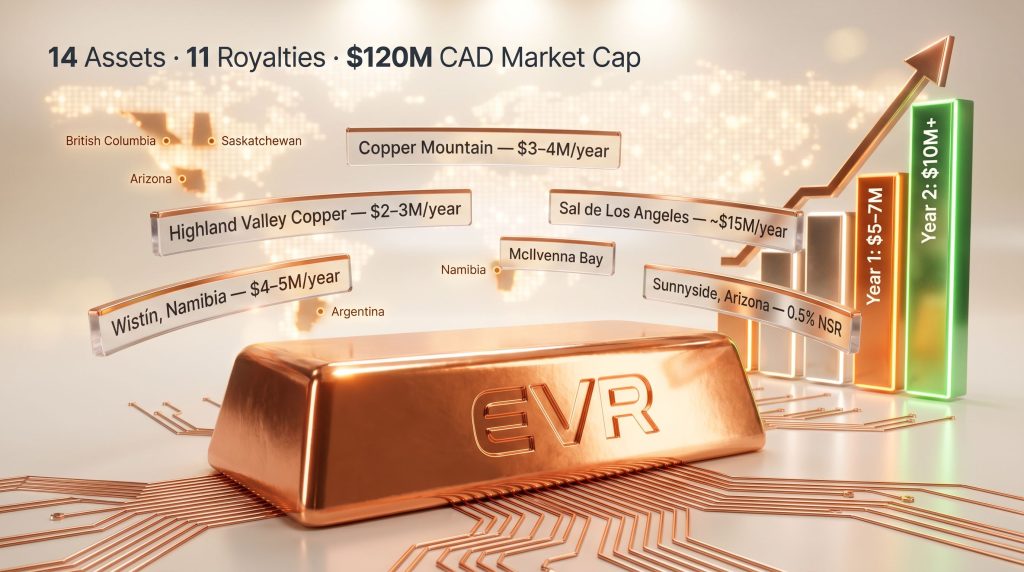
- 14 total assets, including 11 royalties
- Current market capitalisation of approximately $120 million CAD
- Projected revenues of $5 to $7 million in its first full year
- A stated target of exceeding $10 million in Year 2
- Portfolio composition target of 75% copper and 25% strategic metals including tin, lithium, and other critical minerals
The company's $37.5 million IPO financing, completed at listing, was predominantly sourced from institutional investors, reflecting early credibility with sophisticated capital allocators.
The Founding Team's Track Record
The leadership team behind Evolve is not new to the royalty model. The same core group previously built Nomad Royalty, a precious metals royalty company that was acquired by Sandstorm Gold in 2022 in a deal that validated the team's ability to structure, grow, and exit a royalty platform at scale. The decision to pivot from precious metals to copper and critical minerals reflects a deliberate thesis.
The royalty model, which has been refined over decades in the gold sector, has never been systematically applied to the copper market. The timing, consequently, aligns with a structural copper supercycle driven by electrification demand. This distinction matters for investors evaluating early-stage royalty companies, as the management team is reapplying a validated playbook to a new commodity set, with the benefit of institutional relationships and operational credibility built over the preceding decade.
The Portfolio: Asset-by-Asset Analysis
Overview of Evolve's Royalty Portfolio
| Asset | Location | Commodity | Status | Estimated Annual Royalty Revenue |
|---|---|---|---|---|
| Highland Valley Copper | British Columbia, Canada | Copper | Producing | $2–3M/year |
| McIlvenna Bay | Saskatchewan, Canada | Copper-Zinc (VMS) | Near-production | Ramp-up phase |
| Copper Mountain (North Pit) | British Columbia, Canada | Copper | Producing (threshold pending) | $3–4M/year (est. Q4 2025–Q1 2026) |
| Wistín (WEC) | Namibia | Tin | Producing | $4–5M/year |
| Sal de Los Angeles | Salta, Argentina | Lithium Brine | Pre-construction | ~$15M/year at current prices |
| Sunnyside | Arizona, USA | Copper | Development | Acquired for $2.25M (0.5% NSR) |
Highland Valley Copper: The Backbone of the Portfolio
Canada's largest producing copper mine sits at the core of Evolve's royalty portfolio. Operated by Teck Resources, Highland Valley Copper in British Columbia has been in continuous production since the 1960s, making it one of the longest-running copper operations in North American history. It has already undergone three mine life extensions, and Teck has now sanctioned construction on a fourth extension that will carry production beyond 2045.
For royalty holders, this operational history tells a clear story. A well-capitalised operator in a Tier-One jurisdiction has consistently reinvested in extending this asset's life because the economics justify it. Royalty holders benefit from each extension at zero additional cost, receiving cash flow for decades that a one-time acquisition price secured.
The royalty currently generates $2 to $3 million annually for Evolve. Beyond 2045, the deposit's substantial remaining resource base suggests further extensions are probable, meaning the true duration of this royalty's cash flow may extend well into the second half of the century.
The critical insight here is not just mine life but operator behaviour. Large, well-capitalised mining companies have a financial incentive to maximise the return on their already-sunk infrastructure investments. That means more exploration, more expansion studies, and more capital directed at the deposit — all of which accrues to the royalty holder at no incremental cost.
McIlvenna Bay: A Marquee Canadian Copper Asset at an Inflection Point
McIlvenna Bay in Saskatchewan is a volcanogenic massive sulphide copper-zinc deposit, and understanding VMS ore deposits is key to appreciating its potential. The project underwent a pivotal ownership transition when Eldorado Gold acquired operator Foran Mining. Evolve acquired its royalty position at a strategically advantageous moment, with construction nearing completion and a series of value-adding catalysts on the horizon.
VMS deposits are known within the geology community for a specific behavioural characteristic: the resource outlined at the commencement of production is rarely the ceiling. These deposits frequently host additional zones at depth and along strike that require systematic exploration to define. In the case of McIlvenna Bay, this dynamic is already unfolding.
Eldorado Gold has outlined several near-term catalysts that directly benefit Evolve's royalty position:
- Tesla Zone maiden resource expected in 2025, representing a new mineralised zone drilled over the past eighteen months
- Regional exploration programme accelerated under Eldorado's ownership
- Plant throughput doubling study brought forward from Foran's original multi-year timeline
- Extended mine life potential from both exploration success and expanded production rates
The royalty covers a large and contiguous land package, meaning exploration success anywhere on the property contributes to royalty value. With a current estimated mine life of 20 years, and meaningful expansion and exploration potential ahead, McIlvenna Bay could look substantially different within five years of today.
VMS deposits are company-makers precisely because what is visible on day one rarely represents the full geological extent of mineralisation. The combination of a new, well-capitalised operator and an active exploration programme makes McIlvenna Bay one of the most dynamic royalty positions in Evolve's portfolio.
Copper Mountain (North Pit): Approaching a Key Cash Flow Milestone
The Copper Mountain mine, also located in British Columbia and operated by Hudbay Minerals, holds a structurally important position in Evolve's near-term cash flow timeline. Evolve holds a 5% NSR royalty on the North Pit zone, a meaningful royalty rate on a producing copper mine.
The mechanics of this asset require particular attention. When Evolve acquired the royalty, a $10 million carve-out in favour of the prior vendor was embedded in the structure. This means the first $10 million in royalty proceeds from the North Pit flows to the vendor, not to Evolve. Based on current mining activity, Evolve models this carve-out threshold being cleared in Q4 2025 or Q1 2026.
Once that threshold is crossed, the royalty is projected to deliver $3 to $4 million per year to Evolve. Hudbay's work programme includes pit stripping in the North Pit zone and plant upgrades designed to bring production to its designed capacity.
Wistín (WEC): Tin's Role in a Critical Minerals Royalty Portfolio
The Wistín tin mine in Namibia represents Evolve's primary exposure to the tin market, a commodity that shares several structural characteristics with copper but operates in a significantly smaller and less liquid market. Tin's demand profile is closely tied to semiconductor manufacturing and electronics assembly, where it functions as the primary component in solder.
Key operational facts for Wistín:
- Mine restarted and returned to production in 2022
- Recently achieved full design capacity with improving recovery rates
- Current production of approximately 1,000 tonnes of contained tin per year
- Royalty payments to Evolve estimated at $4 to $5 million annually at current tin prices
- Resource base supports an estimated 40 to 60-plus year mine life
- Significant expansion potential exists that could materially increase annual royalty volume
Namibia is recognised as a stable, Tier-One African mining jurisdiction with a well-established regulatory framework. Strategically, the Wistín acquisition also strengthens Evolve's creditworthiness with institutional lenders, opening the door to larger acquisition financing.
Sal de Los Angeles: The Asymmetric Lithium Optionality Play
Located in Salta Province, Argentina, Sal de Los Angeles sits within the geological region commonly referred to as the Lithium Triangle, which accounts for a substantial proportion of global lithium brine production capacity. This is where the world's most cost-effective lithium extraction occurs, driven by high brine concentrations and low elevation of the salt flats.
The project's status is advanced by any development-stage standard:
- Approximately $100 million invested by the operator to reach its current state
- Production wells fully drilled
- First-line plant equipment on-site and awaiting construction commencement
- Fully permitted and shovel-ready, pending an operator construction decision
- Construction decision contingent on lithium price stabilisation
Evolve acquired a 2% NSR royalty on the project for $5 million USD in 2024. At current lithium prices, that royalty is projected to generate approximately $15 million USD per year once in production, representing a potential three-times annual return on acquisition cost.
The Sal de Los Angeles acquisition exemplifies asymmetric royalty positioning: a $5 million outlay for an asset that, once in production, could generate $15 million per year. If construction begins in 2025, first royalty payments could arrive within two to three years.
Sunnyside: Expanding Into the U.S. Copper Corridor
In May 2026, Evolve announced a binding Letter of Intent to acquire a 0.5% NSR royalty on the Sunnyside copper project in Arizona for $2.25 million in staged payments. Arizona has emerged as a strategically important copper jurisdiction within North America. The Sunnyside acquisition adds geographic diversification to a portfolio currently concentrated in Canada, Namibia, and Argentina, while maintaining strict commodity focus on copper.
How Evolve Royalties Finances Growth: The Capital Flywheel
Balance Sheet Position and the Path to Credit Facility Financing
Following the deployment of IPO proceeds, Evolve holds approximately $10 million in cash and liquid investments, with no debt on its balance sheet. This clean capital structure is important context for the next phase of growth. Those evaluating broader copper investment strategies will recognise that this flywheel model is central to how royalty platforms scale effectively.
Step-by-Step: How the Royalty Acquisition Flywheel Works
- Acquire cash-flowing or near-term royalties using IPO and equity capital
- Demonstrate royalty cash flow to institutional lenders as proof of income sustainability
- Establish a revolving credit facility, targeting $25 to $50 million in capacity
- Deploy credit facility capital to acquire larger, higher-impact royalties
- Use operating cash flow from existing royalties to service credit facility obligations
- Refinance the credit facility through equity markets or cash flow when conditions allow
- Repeat the cycle at increasing scale, growing portfolio cash flow and per-share metrics
Comparative Analysis: Evolve Royalties in Context
| Metric | Evolve Royalties (EVR) | Typical Early-Stage Royalty Co. |
|---|---|---|
| Market Capitalisation | ~$120M CAD | $50–200M |
| Revenue (Year 1) | $5–7M | Often pre-revenue |
| Revenue Target (Year 2) | $10M+ | Variable |
| Commodity Focus | Copper / Critical Minerals | Often precious metals |
| Current Debt | None | Variable |
| Portfolio Assets | 14 (11 royalties) | Typically 3–8 |
| Management Track Record | Prior royalty platform exit | Variable |
The next major ASX story will hit our subscribers first
Key Catalysts and Risk Factors for Investors
Near-Term Organic Catalysts
- McIlvenna Bay Tesla Zone maiden resource announcement, anticipated in 2025
- Copper Mountain North Pit carve-out threshold clearance, projected Q4 2025 to Q1 2026
- Eldorado Gold throughput doubling study at McIlvenna Bay
- Wistín expansion feasibility assessment and resource growth updates
- Sal de Los Angeles construction decision from the operator
Acquisition-Driven Catalysts
- Announcement of revolving credit facility establishment
- New royalty acquisitions in the $25 to $50 million bracket
- Geographic expansion into additional copper jurisdictions across the Americas, Africa, or Australia
Risk Factors Investors Should Understand
Commodity Price Sensitivity: All royalty revenues are directly exposed to copper, tin, and lithium price movements. The Sal de Los Angeles royalty remains contingent on a construction decision that is explicitly price-dependent.
Operator and Counterparty Risk: Evolve does not control mine operations. Production decisions, expansion timelines, and operational continuity rest with Teck, Hudbay, Eldorado, and other operators. Financial distress or operational delays at an operator level would directly affect royalty payments.
Early-Stage Company Risk: Evolve has been a public company for less than twelve months at the time of writing. Its public operating history is limited, and its credit facility has not yet been formally established.
Jurisdiction Risk: While Canada provides Tier-One regulatory stability, Namibia and Argentina introduce emerging-market considerations including currency exposure, regulatory change risk, and political environment factors that are less predictable than domestic Canadian assets.
Disclaimer: This article is for informational purposes only and does not constitute financial advice. Forecasts, projections, and estimates referenced throughout are based on management guidance and independent analysis and are inherently uncertain. Past performance of royalty portfolios does not guarantee future results. Investors should conduct their own due diligence before making investment decisions.
Frequently Asked Questions About Evolve Royalties
What stock exchange is Evolve Royalties listed on?
Evolve Royalties trades on the Canadian Securities Exchange under the ticker EVR and on the OTCQX in the United States under the ticker EVRYF.
How does a copper royalty company generate revenue?
Evolve earns NSR royalty payments calculated as a percentage of mine revenues from operators. It bears no production costs, capital expenditure obligations, or labour exposure.
What is an NSR royalty?
A Net Smelter Return royalty entitles the holder to a fixed percentage of gross mineral sale revenues, less defined allowable costs such as transportation and smelting charges. It is the most widely used royalty structure in the global mining industry.
Why does Evolve focus on copper rather than gold?
Copper mines typically operate for twenty-five to seventy-five years or more, significantly longer than the average gold mine lifespan of ten to fifteen years. This longevity enhances the compounding value of copper royalties across multiple commodity cycles. Furthermore, copper's electrification demand profile provides a structural growth thesis absent from precious metals.
What is a VMS deposit?
A volcanogenic massive sulphide (VMS) deposit is a type of metal sulphide ore deposit formed by volcanic and hydrothermal processes on the seafloor. VMS deposits are characterised by high-grade copper, zinc, and lead mineralisation and are known for their tendency to host additional undiscovered zones, making them particularly interesting for long-duration royalty positions.
The Strategic Outlook: Building a Scaled Copper Royalty Platform
The management team's stated ambition is unambiguous. Evolve is not building a niche small-cap royalty company; the objective is a recognised, scaled copper royalty platform with meaningful portfolio cash flow within a two to four year horizon. Discovering a major copper system within the portfolio's regional exploration programmes could, moreover, accelerate this trajectory considerably.
The copper price environment actively supports this ambition. Rising copper prices do not just increase royalty payment values directly — they bring more copper projects into economic feasibility, expanding the universe of potential royalty acquisition targets. Developers seeking non-dilutive financing increasingly turn to royalty companies as an alternative to equity issuance.
Evolve's positioning as a specialist copper royalty provider differentiates it from generalist royalty companies that hold copper assets as secondary positions within precious metals-dominated portfolios. For investors seeking pure-play copper royalty exposure through the electrification cycle, the company occupies a relatively uncrowded strategic position. Those wishing to learn more about the company's approach can review Evolve's investment thesis directly on the company's website.
The scenario pathway is straightforward to model. If Evolve successfully establishes a $50 million credit facility and deploys it across two to three producing royalties over the following twenty-four months, annual portfolio cash flow could potentially scale to $20 to $30 million — a transformational step for a company currently capitalised at approximately $120 million. This is a speculative scenario and not guaranteed, but it represents the logical extension of the growth playbook the management team has previously executed at Nomad Royalty.
The Evolve Royalties copper royalty company, consequently, merits serious attention from investors seeking structured, non-operational exposure to one of the defining commodity stories of the coming decade.
Want to Catch the Next Major Copper Discovery Before the Market Does?
Discovery Alert's proprietary Discovery IQ model instantly scans ASX announcements to identify significant mineral discoveries — including copper — delivering real-time alerts that give subscribers an actionable edge the moment news breaks. Explore historic examples of major mineral discoveries and their extraordinary returns, then start your 14-day free trial at Discovery Alert to position yourself ahead of the broader market.