August 6, 2026
The Quiet Revolution Happening Beneath the World's Driest Desert
Few industrial transformations carry stakes as high as what is currently unfolding beneath the Atacama salt flat in northern Chile. The Atacama is not merely a lithium deposit — it is the defining reserve in the global energy transition conversation, containing an estimated 35 to 40 percent of the world's identified lithium resources within its ancient brine aquifers. How that resource is extracted over the next three decades will shape battery supply chains, electric vehicle economics, and the environmental credibility of the clean energy movement itself.
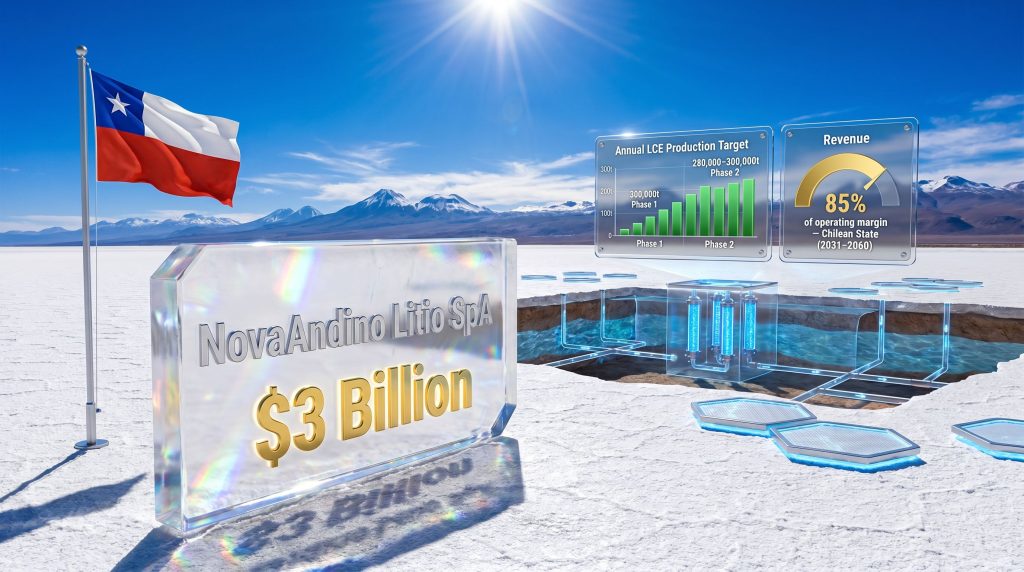
The Codelco and SQM lithium project in Chile — formalised through the joint venture entity NovaAndino Litio SpA — represents the most consequential single bet placed on next-generation lithium extraction technology anywhere in the world. With a capital budget revised upward to $3 billion USD following the completion of detailed engineering and design work, the Salar Futuro project is preparing to demonstrate whether direct lithium extraction can graduate from promising pilot results to full commercial-scale production in one of Earth's most demanding environments.
When big ASX news breaks, our subscribers know first
What Is NovaAndino Litio SpA and How Was It Structured?
The Merger Behind Chile's State-Led Lithium Champion
NovaAndino Litio SpA came into existence through the consolidation of two subsidiary entities: Codelco's Minera Tarar and SQM's SQM Salar. The resulting structure gives Codelco 50% plus one share, securing Chilean state majority control while preserving SQM's operational involvement during the project's most technically demanding early phase.
This ownership architecture is deliberate. Rather than pursuing outright nationalisation — a path that has historically resulted in technical capability gaps and production disruptions in other resource-rich nations — Chile opted for a governance model that retains private sector expertise while guaranteeing state primacy in commercial decision-making. SQM leads operational management through 2030, after which Codelco assumes full management responsibility through to 2060, creating a structured 35-year knowledge transfer with built-in accountability milestones.
The scope of NovaAndino's mandate covers the full lithium value chain within the Atacama concession area: exploration, lithium brine extraction, lithium processing, and commercialisation. Critically, as part of the broader asset restructuring, SQM also transferred its Maricunga salt flat concessions to Codelco — a secondary deposit with lower lithium grades than the Atacama but containing valuable companion elements including potassium and boron that carry their own commercial significance.
Why SQM Agreed to This Arrangement
SQM's decision to cede majority control in exchange for an extended operating licence reflects a rational calculation in an increasingly assertive resource governance environment across South America. The extended concession horizon through 2060 provides SQM with revenue certainty that outweighs the cost of surrendering majority ownership, particularly given the scale of capital investment required under the new technological framework.
Furthermore, this arrangement insulates SQM from the political risk of a more aggressive nationalisation scenario, effectively locking in a commercially viable partnership structure for the long term. You can read more about the official partnership agreement on the venture's dedicated platform.
The $3 Billion Salar Futuro Project: What the Capital Will Actually Build
Breaking Down the Revised Capital Estimate
| Metric | Detail |
|---|---|
| Total Project Budget | $3 billion USD |
| Previous Cost Guidance | $2 billion+ |
| Budget Revision Driver | Completion of full engineering and design phase |
| Environmental Study Submission Target | June 2026 |
| Estimated Construction Start | Late 2020s (subject to regulatory approvals) |
| Full Implementation Target | Mid-2030s |
| Final Investment Decision | Not yet made |
The upward revision from the earlier $2 billion-plus estimate is a direct consequence of completing the detailed engineering phase, which revealed the full technical requirements for deploying direct lithium extraction at commercial scale in the Atacama's distinctive brine chemistry environment. This type of cost evolution between pre-feasibility and detailed engineering phases is common in technically complex mining projects, and the revision should be interpreted as a signal of increasing project definition rather than cost overrun — an important distinction for those evaluating project maturity.
What the Capital Will Physically Deliver
The $3 billion investment will fund the deployment of a fundamentally different extraction architecture across the Atacama brine system. Key components include:
- Deployment of direct lithium extraction technologies including nano-filtration and ion exchange processes designed to selectively capture lithium ions from brine without large-scale evaporation
- Integration of mechanical evaporation systems alongside existing refinery infrastructure, creating a hybrid processing pathway during the transition period
- Engineering and construction of brine reinjection infrastructure, which returns lithium-depleted brine to the subsurface aquifer to maintain hydrological and geochemical equilibrium
- Gradual decommissioning of traditional solar evaporation pond infrastructure, while retaining select ponds for potassium production and pre-concentration — an important detail that signals continued multi-commodity value extraction from the brine
- Complete elimination of freshwater extraction from the Atacama system upon full project implementation, addressing one of the most contentious environmental criticisms of legacy lithium operations in the region
Understanding Direct Lithium Extraction: The Technology at the Heart of Salar Futuro
How Conventional Brine Extraction Actually Works
To appreciate why DLE represents such a meaningful departure from existing practice, it is necessary to understand what the traditional approach entails. In conventional brine lithium operations, enormous volumes of lithium-bearing underground brine are pumped to the surface and spread across vast evaporation ponds, where solar energy drives off the water content over a period of 12 to 24 months. The resulting concentrated lithium solution is then processed further into battery-grade lithium carbonate or hydroxide.
The environmental concerns with this method are significant and specific to the Atacama context. The Salar de Atacama is not a dead landscape — it hosts unique extremophile microbial communities and a complex subsurface hydrology that supports flamingo populations and other wildlife dependent on the brine chemistry. Mass brine extraction at scale disrupts this delicate balance, drawing down water tables in one of the driest places on Earth and altering the chemical equilibrium that sustains these ecosystems.
What DLE Actually Does Differently
Direct lithium extraction bypasses the evaporation step entirely by selectively capturing lithium ions directly from brine using physical or chemical processes. The technology family deployed at Salar Futuro centres on nano-filtration membranes and mechanical evaporation systems that reduce processing time from months to potentially hours or days.
This represents a dramatic compression of the operational timeline while simultaneously reducing the volume of brine that needs to be permanently removed from the subsurface. The brine reinjection component is arguably the most environmentally significant element of the entire design. By returning lithium-depleted brine to the aquifer after lithium extraction, the process aims to maintain the pressure and chemical balance of the Atacama's underground brine system.
As NovaAndino's environment manager Julio Garcia indicated in statements from the venture's Santiago offices, "this reinjection process will be subject to rigorous monitoring to verify both lithium recovery rates and the absence of adverse hydrological impacts."
The DLE Technology Landscape: Where Different Approaches Stand
| Technology Type | Core Mechanism | Current Development Stage |
|---|---|---|
| Ion Exchange / Adsorption | Selective lithium binding on solid sorbent material | Most commercially advanced globally |
| Nano-filtration Membranes | Size-based separation of lithium ions from brine | Pilot to early commercial scale |
| Solvent Extraction | Chemical solvent selectively concentrates lithium | Early commercial in select projects |
| Electrochemical Separation | Electrical potential drives selective lithium migration | Emerging and R&D stage |
NovaAndino's approach combining nano-filtration with mechanical evaporation represents a hybrid strategy that draws on the most commercially advanced elements while adapting to the Atacama's specific brine chemistry, which differs meaningfully from the lower-grade deposits in Argentina's Lithium Triangle or Bolivia's Salar de Uyuni.
Why the Atacama Is the Definitive Proving Ground for DLE
The Atacama's lithium brine contains some of the highest lithium concentrations on Earth, with grades measured in grams per litre that are substantially higher than those found in most alternative brine deposits globally. This high-grade character means that the Atacama is simultaneously the most economically attractive and most technically challenging proving ground for DLE technology.
If DLE can achieve commercial-scale performance in the Atacama — where brine chemistry, temperature extremes, altitude, and remoteness all create compounding operational challenges — the technology becomes significantly de-risked for application across lower-grade deposits in Argentina, Bolivia, and beyond. The global implications extend well beyond Chile's borders, as successful Atacama deployment would unlock the technology's potential across dozens of brine deposits that are currently considered marginal or technically inaccessible under conventional evaporation economics.
A critical and often underappreciated point: DLE's performance in the Atacama is not simply a Chilean story. It is the technology's most important commercial validation experiment, and its success or failure will materially influence investment decisions in lithium brine projects across four continents.
Production Targets and Revenue Architecture: What the Numbers Mean
Output Targets Across Two Operational Phases
| Phase | Period | Production Target |
|---|---|---|
| Phase 1 | 2025 to 2030 | Additional 300,000 tonnes LCE cumulative |
| Phase 2 | 2031 to 2060 | 280,000 to 300,000 tonnes LCE per year |
Phase 2 annual production of 280,000 to 300,000 tonnes LCE would position NovaAndino among the largest single-source lithium producers globally, at a scale comparable to or exceeding the combined annual output of major hard-rock spodumene operations in Western Australia.
How Revenue Flows to the Chilean State
The financial architecture of the NovaAndino structure channels state revenue through three distinct pathways: Corfo royalties on brine extraction volumes, standard Chilean corporate taxation on operating profits, and dividend distributions from Codelco's majority ownership stake.
- Phase 1 (2025 to 2030): Approximately 70% of operating margin directed to the Chilean state through these combined mechanisms
- Phase 2 (2031 to 2060): Approximately 85% of operating margin directed to the Chilean state
This revenue architecture is one of the most assertive sovereign participation structures in the global critical minerals economy. By comparison, many traditional mining royalty frameworks in developed jurisdictions capture between 20 and 40 percent of operating margin through taxation alone, making Chile's structure a meaningful outlier in terms of state economic capture from resource extraction.
Chile's National Lithium Strategy: Context and Competitive Positioning
Moving From Licensor to Participant
The Codelco and SQM lithium project in Chile represents a fundamental philosophical shift in how the Chilean state relates to its most strategically important resource. For decades, Chile's lithium strategy was essentially a royalty-based licensing model — extracting fiscal value from private operators while remaining at arm's length from operational decisions. The NovaAndino structure inverts this dynamic, making the Chilean state an active commercial participant in the value creation process rather than a passive revenue recipient.
This transition has important implications for how Chile positions itself in global lithium supply chain negotiations. Foreign offtake agreements must now be negotiated through a state-majority entity, fundamentally reshaping the commercial leverage that downstream buyers — including major EV manufacturers in Europe, the United States, and Asia — have historically enjoyed in dealing with private Chilean producers.
Chile Versus Regional Alternatives: A Framework Comparison
| Country | Governance Model | State Participation Approach |
|---|---|---|
| Chile | Hybrid public-private | State majority equity through Codelco |
| Argentina | Decentralised provincial | Limited federal involvement, province-led concessions |
| Bolivia | Full nationalisation | State monopoly through YPFB Litio |
Chile's lithium reserves position the country in a deliberate middle ground that seeks to combine state control with private sector technical capability — a framework that has drawn interest from Western governments seeking reliable, commercially sophisticated supply chain partners in lithium-rich South America.
The next major ASX story will hit our subscribers first
Environmental Permitting and Regulatory Risk: The Path to Construction
What the Permitting Process Requires
The submission of an Environmental Impact Study to Chilean regulators in June 2026 initiates a formal review process that encompasses multiple layers of assessment. Chilean environmental law for major mining projects requires evaluation of direct extraction impacts, hydrological modelling of brine reinjection effects, biodiversity assessments covering both surface and subsurface ecosystems, and structured community consultation with indigenous communities whose traditional territories overlap with the Atacama concession area.
No Final Investment Decision has been made by NovaAndino as of the time of the June 2026 environmental study submission, meaning that the $3 billion capital commitment remains contingent on receiving the necessary regulatory approvals and completing the FID process. Notably, China granted conditional approval for the Codelco-SQM joint venture in November 2025, representing a significant milestone in the project's international regulatory pathway.
Key Regulatory Risk Dimensions
| Risk Category | Nature of Risk | Mitigation Approach |
|---|---|---|
| Environmental Approval Delays | EIS complexity and community consultation timelines | Phased submission with pre-consultation processes |
| Hydrological Impact | Brine reinjection affecting aquifer chemistry and pressure | Continuous subsurface monitoring systems |
| DLE Scale-Up Risk | Technology unproven at full commercial scale in Atacama conditions | Staged deployment with defined performance benchmarks |
| Political Transition Risk | Policy shifts between government administrations affecting project terms | 35-year contractual framework anchored in state-entity structure |
The brine reinjection monitoring framework will likely become the single most scrutinised technical element of the permitting process, as regulators and environmental groups will demand verifiable evidence that returning depleted brine to the aquifer does not generate secondary impacts on the brine chemistry that supports the Atacama's unique biological communities.
Is DLE Commercially Proven at Scale? An Honest Assessment
The Critical Gap Between Pilot Success and Commercial Deployment
Multiple DLE technology variants have demonstrated strong performance at pilot and demonstration scale across projects in Chile, Argentina, the United States, and China. However, scaling from controlled pilot conditions to full commercial operations at Atacama volumes introduces compounding engineering and chemical challenges that pilot results cannot fully predict.
Key performance variables that remain to be validated at Atacama commercial scale include:
- Lithium recovery efficiency: The percentage of available lithium captured per unit volume of brine processed, which determines both economic returns and brine management volumes
- Reagent consumption rates: The ongoing operational cost of chemical inputs used in ion exchange and membrane processes, which can erode economic advantages over traditional evaporation at scale
- Equipment durability: The longevity of membranes, sorbent materials, and mechanical components under the Atacama's extreme temperature cycling, high salinity, and remote operational conditions
- Reinjection volume management: Ensuring that the volume and chemistry of reinjected brine does not alter the natural stratification layers within the Atacama aquifer, which could create unintended consequences for brine quality in subsequent extraction cycles
This last point deserves particular emphasis because it represents a risk category that is genuinely novel in the history of lithium extraction. No brine operation at anything approaching Atacama scale has previously implemented systematic reinjection, meaning that the long-term hydrological consequences remain technically uncertain even under optimistic assumptions about the technology's performance.
Global Market Implications: Supply, Pricing, and Demand Timing
What Salar Futuro's Production Scale Means for Lithium Markets
Phase 2 annual production of 280,000 to 300,000 tonnes LCE, if achieved as projected from 2031 onward, would represent a substantial increment to global lithium supply during a period when demand growth from electric vehicles and grid-scale battery storage is expected to intensify significantly. This sustained high-volume production from a single, low-cost brine source carries meaningful pricing implications for the lithium carbonate market.
Hard-rock spodumene producers — particularly those operating in Australia and Africa where production costs per tonne LCE are substantially higher than Atacama brine operations — face the prospect of sustained competitive pressure from a fully operational Salar Futuro. The economics of brine lithium extraction, even with the additional capital intensity of DLE infrastructure, are structurally advantaged over hard-rock mining and chemical conversion at comparable lithium prices.
Demand Context: Why Project Timing Matters
Global lithium demand is widely projected to grow substantially through the 2030s, driven by accelerating EV adoption and expanding stationary battery storage deployment. The mid-2030s full implementation timeline for Salar Futuro aligns precisely with what many market analysts identify as a potential supply-demand inflection point, when demand growth could outpace the production ramp-up from projects currently in development.
Two demand drivers deserve separate consideration:
- Transportation electrification: Lithium carbonate and lithium hydroxide remain indispensable inputs for lithium-ion battery cathode chemistries, and the growth trajectory of global EV sales creates a structural demand floor that is unlikely to be displaced within the project's operational horizon through 2060
- Grid-scale energy storage: The expansion of renewable energy infrastructure globally is creating rapidly growing demand for stationary battery systems, representing a second major demand driver that is largely independent of EV adoption rates and adds further demand diversification to the lithium demand outlook
Frequently Asked Questions: Codelco and SQM Lithium Project in Chile
What is NovaAndino Litio SpA?
NovaAndino Litio SpA is the joint venture formed between Chilean state mining company Codelco and lithium producer SQM to manage lithium extraction from the Salar de Atacama through 2060. The entity holds Codelco in a majority position with 50% plus one share, ensuring state control over one of the world's most significant lithium deposits.
What is the total budget for the Salar Futuro project?
The project carries a revised capital budget of $3 billion USD, updated from earlier guidance of over $2 billion following completion of comprehensive engineering and design work. No Final Investment Decision has yet been made.
How does Direct Lithium Extraction differ from traditional methods?
Traditional lithium brine extraction relies on solar evaporation ponds that require 12 to 24 months to concentrate lithium from pumped brine. DLE technologies including nano-filtration and ion exchange extract lithium directly from brine in a fraction of the time, returning the lithium-depleted brine to the aquifer through reinjection rather than losing the water volume to evaporation.
When will construction begin and when will the project reach full operation?
Subject to environmental permitting — with the Environmental Impact Study targeted for submission in June 2026 — construction is expected to begin toward the end of the 2020s, with full implementation extending into the mid-2030s.
How much of the revenue goes to the Chilean state?
The state revenue share is structured at approximately 70% of operating margin during Phase 1 (2025 to 2030), rising to approximately 85% of operating margin during Phase 2 (2031 to 2060), channelled through Corfo royalties, corporate taxation, and Codelco dividend distributions.
Key Takeaways: What Salar Futuro Signals for Lithium's Future
The Codelco and SQM lithium project in Chile is more than a large mining investment. It is simultaneously a technology validation experiment, a sovereign resource governance model, and a supply chain anchor for the global energy transition. Consequently, several dimensions deserve particular attention:
- The $3 billion capital commitment to DLE technology makes Salar Futuro the largest single investment in next-generation lithium extraction methodology globally, with implications extending well beyond Chile's borders
- State majority control through Codelco transforms Chile's commercial role from resource licensor to active participant in the lithium value chain, with downstream consequences for how offtake agreements are negotiated with EV manufacturers and battery producers
- Brine reinjection at commercial scale represents genuinely uncharted technical territory — its success or failure will determine whether DLE can be responsibly deployed across other sensitive brine ecosystems globally
- The 35-year operational horizon through 2060 provides a supply certainty that few competing lithium projects can offer, making NovaAndino a foundational counterparty for long-term battery supply chain agreements
- Environmental performance rather than production volume will ultimately determine how the Salar Futuro project is assessed by regulators, communities, and international partners — making the monitoring framework as strategically important as the extraction technology itself
This article is intended for informational purposes only and does not constitute financial or investment advice. Forecasts, production targets, and revenue projections referenced herein are based on publicly available information and involve inherent uncertainty. Readers should conduct independent research before making investment decisions related to any companies or projects discussed.
Want to Track the Next Major Mineral Discovery Before the Market Does?
Discovery Alert's proprietary Discovery IQ model delivers real-time alerts on significant ASX mineral discoveries — instantly translating complex geological data into actionable investment insights for both short-term traders and long-term investors. Explore how historic discoveries have generated substantial returns on Discovery Alert's dedicated discoveries page, and begin your 14-day free trial today to position yourself ahead of the market.