
May 21, 2026
Understanding Market Forces Behind Electrical Steel Pricing Evolution
The global transformation of electrical infrastructure represents one of the most capital-intensive industrial shifts of the modern era. Power grid modernisation, renewable energy integration, and electric vehicle charging networks demand specialised materials engineered for unprecedented efficiency standards. Within this landscape, cold-rolled grain oriented electrical steel price assessment methodologies have evolved into sophisticated benchmarking systems that reflect both technical complexity and market volatility.
These assessment frameworks serve as critical infrastructure for international commerce, enabling price discovery across fragmented regional markets where technical specifications, delivery terms, and quality standards vary significantly. The emergence of standardised pricing mechanisms reflects broader market maturation as traditional commodity trading approaches prove inadequate for materials requiring specialised production capabilities and technical validation.
When big ASX news breaks, our subscribers know first
What Defines Cold-Rolled Grain Oriented Electrical Steel and Its Market Significance
Cold-rolled grain oriented electrical steel (CRGO) represents a metallurgical achievement where crystallographic engineering meets electromagnetic performance optimisation. Unlike conventional steel products, CRGO undergoes precise grain alignment during manufacturing to create directional magnetic properties essential for high-efficiency transformer applications. This specialised material exhibits dramatically reduced core losses compared to standard electrical steel grades, making it indispensable for modern power transmission infrastructure.
The significance of CRGO pricing extends beyond material costs to encompass broader energy efficiency economics. Transformer efficiency directly impacts grid-level electricity losses, which can represent substantial operational costs across power systems. Research indicates that premium electrical steel grades can reduce transformer core losses by 15-30% compared to conventional alternatives, justifying price premiums through lifecycle energy savings.
Recent market data illustrates accelerating demand across multiple industrial sectors. Chinese GOES production reached 3.37 million tonnes in 2025, representing 14.3% year-over-year growth from 2.95 million tonnes in 2024, according to industry body Chinese Society for Metals. Simultaneously, Chinese GOES exports totalled 757,717 tonnes in 2025, up 18% from 642,077 tonnes in 2024 based on Chinese customs data, demonstrating expanding international demand.
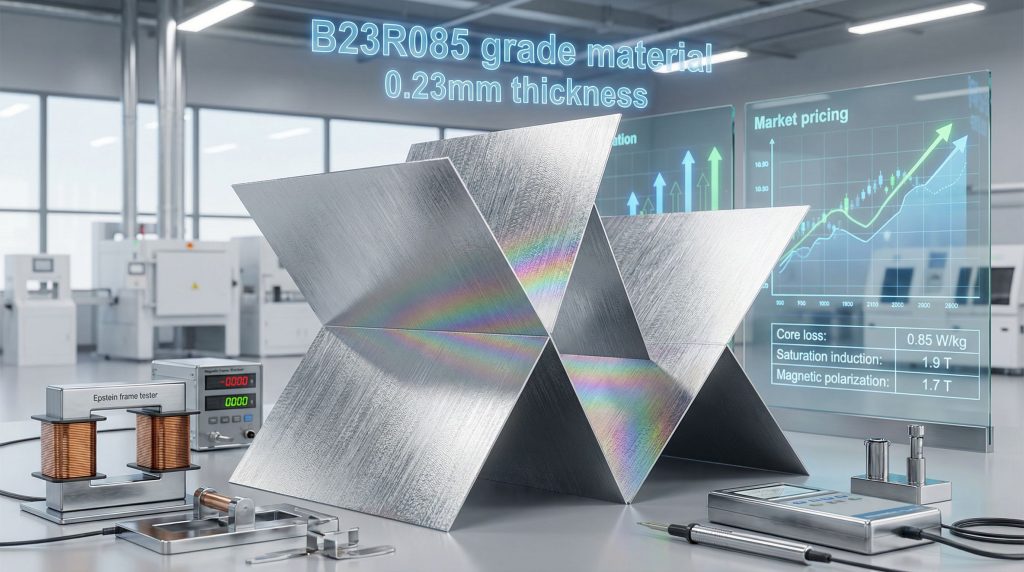
The material's technical specifications directly influence pricing mechanisms. Standard B23R085 designation indicates 0.23mm thickness with 0.85 W/kg core loss specification, while 1,000mm width accommodates transformer lamination compatibility requirements. These precise parameters create quality-dependent pricing structures where minor specification variations can significantly impact market values.
Key Industries Driving CRGO Demand
Four primary sectors are reshaping electrical steel demand patterns:
• Power transmission infrastructure expansion: Grid modernisation projects requiring high-efficiency transformers for renewable energy integration
• Energy storage systems: Battery storage installations demanding specialised transformer configurations for grid stabilisation
• Artificial intelligence data centres: High-density computing facilities requiring advanced power distribution systems
• Electric vehicle charging stations: Rapid charging infrastructure necessitating robust transformer capacity
These applications represent higher-value end uses compared to traditional electrical steel markets, supporting premium pricing for specialised grades and driving investment in assessment methodology development. Furthermore, the EV charging infrastructure impact creates new demand patterns that traditional assessment frameworks must accommodate.
Regional Price Assessment Framework Variations
Cold-rolled grain oriented electrical steel price assessment methodologies reflect regional market infrastructure differences, transportation networks, and regulatory frameworks. The introduction of Fastmarkets' cold-rolled grain-oriented electrical steel price assessment for Eastern China exemplifies how regional pricing mechanisms accommodate local market characteristics while maintaining international comparability.
This assessment employs specific parameters designed for Chinese domestic market conditions: 10 tonnes minimum quantity, ex-warehouse Shanghai location basis, 1-2 weeks delivery timing, and bi-weekly publication frequency every Friday 4-6pm Shanghai time. The methodology includes 13% VAT with $/tonne conversion from yuan/tonne, reflecting currency standardisation requirements for international market participants.
The bi-weekly publication cycle contrasts with daily assessment frequencies used in some European markets, suggesting CRGO transactions operate with longer evaluation windows compared to commodity steel products. This timing reflects the specialised nature of electrical steel procurement, where technical specifications and quality verification requirements extend transaction timelines beyond standard steel trading patterns.
Comparative Regional Assessment Structures
| Assessment Type | Geographic Focus | Delivery Terms | Publication Frequency |
|---|---|---|---|
| Chinese Ex-warehouse | Domestic Shanghai market | Ex-warehouse | Bi-weekly |
| Indian CFR | Import-based pricing | Cost and Freight | Variable |
| European CIF | Import destination | Cost, Insurance, Freight | Daily/Weekly |
Payment term standardisation represents another regional variation affecting assessment accuracy. Chinese assessments specify prompt payment upon delivery, eliminating credit term variables that could distort underlying material valuations. Extended credit arrangements, common in some markets, create pricing complications not reflected in standardised assessments.
Currency conversion methodologies require particular attention given exchange rate volatility impacts on $/tonne conversions. The yuan/tonne to $/tonne conversion process introduces variables independent of underlying steel value changes, necessitating clear documentation of conversion timing and rate sources for assessment transparency.
Manufacturing Complexity Impact on Price Formation
CRGO manufacturing represents one of the most capital-intensive steel production processes, involving specialised equipment configurations that fundamentally differentiate it from commodity steel manufacturing. The production complexity directly influences pricing structures through multiple cost impact factors across different manufacturing stages.
Bell-anneal furnace systems require high-temperature controlled atmosphere processing with precise temperature profiling to develop desired magnetic grain structures. These facilities represent facility-specific capital investments that few global steel producers possess, creating supply concentration effects in pricing.
Multi-stage cold rolling operations with crystallographic control requirements demand advanced process control technology to maintain 0.23mm thickness specifications with tight tolerances. The precision requirements exceed those of conventional steel rolling, necessitating specialised equipment and operator expertise.
Tension coating applications involve surface stress-relief treatments applied post-rolling, where coating integrity directly impacts insulation properties between transformer laminations. Quality assurance verification for coating uniformity and thickness represents additional cost factors not present in conventional steel production.
Quality Control Protocols and Cost Implications
Quality verification methodologies for CRGO involve sophisticated testing protocols that contribute to pricing premiums:
• Epstein frame testing: Standardised core loss measurement at specified frequencies providing W/kg classifications
• Permeability verification: Magnetic flux density validation using standardised test equipment
• Surface quality inspection: Coating thickness uniformity and dimensional tolerance verification
• B-H curve characterisation: Magnetic property validation for electromagnetic application performance
These testing requirements create quality assurance costs that conventional steel grades do not incur, supporting price premiums for verified CRGO materials. Failure rates and rework percentages in CRGO production typically exceed those of standard steel products, further contributing to cost structure complexity.
Energy consumption metrics across CRGO production stages can reach 3-5 times those of conventional steel rolling operations, reflecting the specialised heat treatment and processing requirements. These energy intensity factors create direct links between electricity costs and CRGO pricing, particularly in regions with volatile energy markets. Moreover, the broader mining industry evolution influences raw material availability and costs that directly impact steel production economics.
Market Dynamics Influence on Assessment Evolution
The acceleration of CRGO demand growth has fundamentally altered how market participants approach price discovery and risk management. Traditional electrical steel markets historically relied primarily on transformer manufacturing for volume, but current demand patterns reflect diversification across multiple high-growth industrial sectors.
The documented 14.3% year-over-year growth in Chinese GOES production and 18% export growth demonstrates market expansion rates that exceed general steel market trends. This growth acceleration has created capacity utilisation pressures at existing production facilities, influencing pricing dynamics through supply constraint effects.
Power transmission infrastructure expansion represents the largest single demand driver, with grid modernisation projects requiring high-efficiency transformers for renewable energy integration. Smart grid implementation initiatives across major economies create sustained demand for premium electrical steel grades, supporting price stability despite commodity market volatility.
Renewable energy transmission network development creates geographic demand shifts as wind and solar installations require substantial transformer capacity in previously underdeveloped grid regions. This infrastructure expansion generates lumpy demand patterns that traditional assessment methodologies may not fully capture.
Supply Chain Constraint Factors
Geographic concentration of CRGO manufacturing capabilities creates supply bottleneck risks that influence price formation:
• Limited global production facilities: High capital barriers restrict competitive market entry
• Regional capacity utilisation: Existing facilities operating near maximum capacity during demand surges
• Technology transfer limitations: Specialised production knowledge concentrated among few producers
• Raw material purity requirements: Silicon steel input specifications exceeding standard metallurgical grade materials
Import dependency patterns in regions with limited domestic CRGO production create price volatility through transportation cost fluctuations and trade policy changes. Ocean freight rates for 10-tonne CRGO shipments can vary significantly based on container availability and shipping route congestion, adding variable cost components to delivered pricing.
The emergence of AI data centres as a significant demand driver represents a relatively new market factor not fully understood by traditional assessment methodologies. High-density computing facilities require power distribution systems with efficiency specifications that favour premium electrical steel grades, creating demand intensity in specific geographic markets. Additionally, the tariff impact on investments creates additional complexity in international CRGO trading relationships.
International Trading Terms and Benchmarking Complexity
Cold-rolled grain oriented electrical steel price assessment accuracy depends critically on standardised treatment of international trading terms, currency conversion protocols, and delivery basis specifications. The choice of assessment basis fundamentally affects how market participants interpret underlying material costs versus logistics and risk allocation expenses.
Fastmarkets' selection of ex-warehouse Shanghai as the assessment basis reflects Chinese domestic market perspective, placing logistics risk and cost responsibility on buyers. This contrasts with CFR (Cost and Freight) and CIF (Cost, Insurance, and Freight) assessments used for import-based markets, where sellers incorporate transportation and insurance costs into quoted prices.
The implications of delivery term selection extend beyond simple cost allocation to influence market liquidity and price transparency. Ex-warehouse assessments capture pure material valuations at production facilities, while CFR/CIF assessments embed variable transportation costs that can obscure underlying steel value changes during periods of freight market volatility.
Currency and Tax Treatment Standardisation
Assessment methodologies must address complex currency and taxation variables that affect international price comparability:
| Assessment Component | Treatment Method | Market Impact |
|---|---|---|
| Currency conversion | Real-time CNY/USD rates | Exchange rate volatility |
| VAT inclusion | 13% Chinese VAT included | Regional tax variation |
| Payment terms | Prompt payment standard | Credit term elimination |
VAT treatment variations across different jurisdictions create complications for true net price comparability. The inclusion of 13% VAT in Chinese assessments requires adjustment calculations when comparing with markets employing different tax structures or VAT-exclusive pricing conventions.
Payment term standardisation eliminates credit term variables that could distort material valuations. Extended credit arrangements common in some markets create financing cost components that assessment methodologies must either incorporate or explicitly exclude for transparency.
Insurance cost premiums for CRGO during ocean transport reflect the material's specialised nature and value density. These costs typically exceed those of commodity steel products, creating additional variables in CIF assessment accuracy that require careful documentation and market validation.
The next major ASX story will hit our subscribers first
Quality Specification Impact on Assessment Precision
Quality specification frameworks for cold-rolled grain oriented electrical steel price assessment require precise definition of technical parameters, testing methodologies, and acceptance criteria to ensure market transparency and reduce valuation disputes. The B23R085 grade specification system demonstrates how technical complexity translates into pricing methodology requirements.
Grade designation components provide systematic classification where the B prefix indicates grain-oriented electrical steel category, 23 represents thickness in hundredths of millimetres (0.23mm), and R085 indicates rolling direction specification with 0.85 W/kg core loss classification. The comprehensive market analysis shows how these specifications enable cross-border trading compatibility.
Testing methodology standardisation ensures consistent quality verification across different assessment frameworks. Core loss measurements performed using standardised Epstein frame test conditions create frequency-standardised comparisons, while magnetic flux density specifications define upper and lower performance boundaries for grade classification.
Surface coating specifications require particular attention given their impact on transformer lamination performance. Coating thickness uniformity and adhesion properties directly affect insulation characteristics between laminations, creating quality variables that assessment methodologies must explicitly address.
International Standards Harmonisation
Multiple international standards frameworks create potential pricing inconsistencies unless assessments explicitly define compliance pathways:
• Chinese standards (GB/T 2521): B23R085 designation with specific thickness and core loss requirements
• Indian standards (IS 3024): 23 HP85d classification with comparable magnetic properties
• International standards (IEC 60404): Global harmonisation framework for cross-border trading facilitation
• Japanese standards (JIS): Alternative classification systems requiring conversion protocols
Tolerance range specifications for thickness (0.23mm ±tolerances) and width (1,000mm ±tolerances) create acceptance criteria that directly influence pricing. Materials falling outside specification ranges typically face rejection or discounting, making tolerance definition critical for assessment accuracy.
Defect acceptance criteria and rejection rates by defect category provide additional quality variables affecting market valuations. Surface defects, dimensional variations, and magnetic property deviations each require specific treatment in assessment methodologies to reflect market reality.
Market Intelligence and Data Collection Enhancement
Professional price reporting methodologies for cold-rolled grain oriented electrical steel employ systematic data collection approaches designed to ensure representativeness and accuracy across fragmented market participants. The specialised nature of CRGO trading creates unique challenges for traditional commodity price reporting approaches.
Transaction verification protocols require confirmed deal validation from multiple independent sources given the relatively small number of market participants compared to commodity steel markets. Minimum transaction thresholds ensure representative pricing while accommodating the concentrated nature of CRGO trading relationships.
Market participant surveys provide regular feedback from producers, traders, and end-use consumers, capturing market sentiment and forward-looking price expectations that transaction-based assessments alone cannot provide. The technical nature of CRGO procurement decisions creates information asymmetries that systematic survey methodologies can help address.
Volume weighting methodologies require adaptation for CRGO markets where individual transactions may represent significant portions of regional market activity. Standard commodity market weighting approaches may not accurately reflect CRGO market dynamics given the specialised procurement patterns.
Technology Integration for Assessment Accuracy
Digital platform integration represents an evolving frontier for CRGO price assessment enhancement:
• Real-time data collection systems: Automated transaction monitoring capabilities adapted for specialised steel markets
• API connectivity solutions: Direct integration with trading platforms serving electrical steel market participants
• Mobile accessibility platforms: Field-based price reporting capabilities for mill representatives and traders
• Blockchain verification systems: Transaction authenticity validation for high-value specialty steel trades
Artificial intelligence applications offer potential for pattern recognition in CRGO pricing trends, anomaly detection for unusual transactions, and predictive modelling for forward-looking price indications. However, the specialised nature of electrical steel markets may limit the effectiveness of AI systems trained on commodity market data.
Methodology transparency documentation requires more detailed disclosure for CRGO assessments compared to commodity steel products given the technical complexity and limited market participant base. Clear specification documentation, pricing rationale explanations, and consultation process descriptions enhance market confidence in assessment accuracy. Consequently, data-driven mining operations methodologies provide valuable insights for improving steel industry data collection approaches.
Future Assessment Framework Evolution
The trajectory of cold-rolled grain oriented electrical steel price assessment development reflects broader industrial transformation toward electrification and energy efficiency optimisation. Market expansion trends suggest assessment frameworks will require adaptation to accommodate geographic coverage extension, product specification diversification, and publication frequency optimisation based on evolving trading patterns.
Sustainability integration represents an emerging assessment dimension where carbon footprint considerations, recycled content premiums, and energy efficiency metrics may influence future pricing methodologies. Environmental impact pricing factors could create additional assessment layers beyond traditional quality and delivery specifications.
Regional market expansion into developing economies implementing electrical infrastructure modernisation programmes will require assessment methodology adaptation for local market characteristics, regulatory frameworks, and currency systems. The successful implementation of standardised assessments depends on accommodation of regional market differences while maintaining international comparability.
Technology-Driven Assessment Enhancement
Technological advancement applications in CRGO assessment methodology include:
• IoT sensor integration: Real-time quality monitoring during production and transportation
• Satellite logistics tracking: Enhanced delivery timing verification for assessment accuracy
• Digital certificate systems: Quality verification documentation with blockchain validation
• Automated testing integration: Direct feed from Epstein frame testing results to assessment databases
Market microstructure evolution toward electronic trading platforms may necessitate assessment methodology revision to accommodate algorithmic trading participation and high-frequency price discovery mechanisms currently absent from specialised steel markets.
Forward curve development for CRGO pricing could emerge as market liquidity increases and financial risk management tools become necessary for large-scale infrastructure procurement planning. Current spot-based assessment frameworks may require expansion to include forward-looking price indications.
The integration of ESG (Environmental, Social, and Governance) criteria into industrial procurement decisions suggests future assessment frameworks may incorporate sustainability scoring mechanisms that influence price premiums for responsibly produced electrical steel grades.
Assessment Framework Strategic Implications
Cold-rolled grain oriented electrical steel price assessment represents a sophisticated intersection of metallurgical science, international commerce, and financial methodology that continues evolving alongside industrial electrification trends. The development of standardised assessment protocols serves multiple strategic functions beyond simple price discovery.
Risk management facilitation through transparent pricing mechanisms enables industrial participants to make informed procurement decisions, production planning choices, and capital investment evaluations within the specialised electrical steel supply chain. The technical complexity inherent in CRGO production and application creates information asymmetries that professional assessment methodologies help address.
Market development support through standardised pricing infrastructure encourages market participant confidence and potentially expands trading liquidity by reducing transaction cost uncertainty. The emergence of reliable price benchmarks may facilitate financial instrument development and risk transfer mechanisms currently unavailable in specialised electrical steel markets.
Investment decision enhancement depends on accurate market intelligence for both producers considering capacity expansion and end-users evaluating long-term procurement strategies. The capital-intensive nature of both CRGO production facilities and electrical infrastructure projects creates substantial exposure to price volatility that assessment frameworks help quantify and manage.
The continued refinement of cold-rolled grain oriented electrical steel price assessment methodologies reflects the growing sophistication of industrial markets supporting global infrastructure transformation. As electrification trends accelerate and renewable energy integration expands, these pricing mechanisms will likely play increasingly critical roles in facilitating efficient resource allocation across the electrical steel supply chain.
"Investment Consideration: Market participants should monitor assessment methodology developments and regional market coverage expansion as indicators of underlying market maturation and potential investment opportunities in electrical steel production capabilities."
Want to Capitalise on Infrastructure-Driven Commodity Opportunities?
Discovery Alert's proprietary Discovery IQ model delivers instant notifications on significant ASX mineral discoveries, including those focused on critical metals powering electrical infrastructure transformation. Subscribers gain rapid insights into actionable trading opportunities within Australia's dynamic mining sector, positioning themselves ahead of broader market recognition. Begin your 14-day free trial today to secure your market-leading advantage in identifying the next major discovery.