July 15, 2026
The Analytical Breaking Point: Why Mining Laboratories Are Rethinking Sample Preparation From the Ground Up
Across the global mining industry, a quiet but significant operational crisis has been building inside laboratory walls for decades. The methods used to dissolve rock samples before chemical analysis have remained largely unchanged since the mid-twentieth century, yet the ore bodies that modern exploration programs are targeting have grown dramatically more complex. ColdBlock Technologies sample preparation for the mining industry represents a technically credible response to this growing mismatch between analytical method and geological reality. Refractory sulfides, lithium-bearing clays, rare earth-enriched carbonatites, and chromite-hosted platinum group elements each present chemical dissolution challenges that conventional acid digestion was never designed to handle efficiently.
This mismatch is no longer a minor inconvenience. For mining companies running time-sensitive grade control programs or race-paced resource definition drilling, laboratory turnaround times have become a genuine constraint on decision-making speed and project economics. Understanding why this technology matters requires first understanding exactly how deep the limitations of conventional methods run.
When big ASX news breaks, our subscribers know first
Why Conventional Acid Digestion Creates Operational Bottlenecks That Cascade Across Entire Mining Operations
The dominant sample preparation workflow in most commercial assay laboratories today involves some variation of hot block digestion using multi-acid combinations, often including hydrofluoric acid, nitric acid, hydrochloric acid, and in some matrices, perchloric acid. The hot block approach works by heating an acid-filled vessel from the outside, relying on thermal conduction through the liquid medium to transfer energy to the solid sample particles suspended within it.
This thermal transfer mechanism is inherently inefficient. Raising the entire acid volume to digestion temperature takes time, and more critically, the acid must be kept below its boiling point to prevent dangerous fuming and spattering. This ceiling on operating temperature is precisely what limits dissolution speed, particularly for mineralogically resistant samples.
The operational consequences are significant:
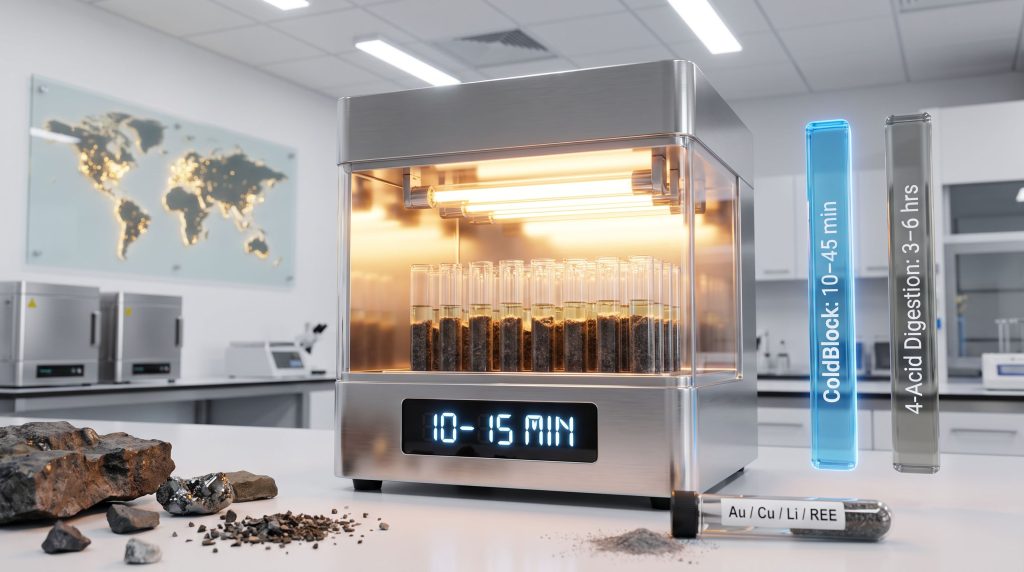
- Standard 4-acid digestion cycles typically run between 3 and 6 hours per batch
- Hot block methods average 2 to 4 hours per cycle, with additional cooling periods required before vessels can be safely handled
- Acid consumption per sample in conventional workflows reaches 20 to 25 millilitres, generating substantial hazardous waste volumes
- Sequential processing constraints mean that a single laboratory instrument can only service a limited number of samples within a working shift
For a commercial assay laboratory billing on per-sample throughput, these constraints directly limit revenue capacity. For a mine site running grade control on a narrow-vein gold operation where blasting decisions depend on assay results received the same day, they can be the difference between optimised ore selectivity and costly dilution. Furthermore, understanding drilling program workflows is essential context for appreciating why laboratory delays compound so significantly across entire exploration campaigns.
The Compounding Problem of Incomplete Dissolution
Beyond speed, conventional digestion methods introduce a subtler but analytically damaging problem: incomplete dissolution. Refractory minerals that resist full acid attack leave residual solid phases in the digest solution. When this partially dissolved solution is then analysed by inductively coupled plasma mass spectrometry or atomic absorption spectroscopy, the results underreport true elemental concentrations.
In a gold assay context, this can mean systematic underestimation of resource grades across an entire drilling programme, with compounding consequences for resource classification and project valuation. Interpreting drill results accurately depends entirely on the integrity of the upstream laboratory process, making digestion quality a foundational variable.
The problem intensifies for critical minerals. Lithium silicates, rare earth phosphates, and uranium-bearing oxides each require aggressive, high-temperature dissolution conditions that conventional hot block chemistry struggles to deliver consistently. As exploration programmes increasingly target these commodity groups in response to critical minerals demand driven by the energy transition, the analytical adequacy of the laboratory methods being used to characterise these deposits deserves serious scrutiny.
What Is ColdBlock Technologies and How Does Its Sample Preparation System Work?
ColdBlock Technologies, a Canadian company, developed a sample preparation platform built on a fundamentally different thermodynamic principle. Rather than heating the acid medium and relying on conductive transfer to energise sample particles, the system uses focused short-wave infrared radiation to target the sample particles themselves directly. The ColdBlock digestion technology has attracted considerable attention across the global mining sector for precisely this reason.
Short-wave infrared radiation in the wavelength range used by ColdBlock's system is selectively absorbed by mineral particles rather than by the surrounding liquid acid. This selectivity is the critical technical insight at the heart of the technology. The particles absorb radiative energy and reach temperatures approaching 1,000 degrees Celsius almost instantaneously, while the bulk acid temperature is simultaneously controlled by an integrated cooling mechanism that prevents boiling and fuming.
This dual-action architecture, where particle temperatures are driven extremely high while the surrounding liquid environment is kept stable, achieves something that no conventional hot block system can replicate: near-complete dissolution of refractory mineral phases without the chemical hazards or time delays associated with superheated acid systems.
Step-by-Step: How a ColdBlock Digestion Cycle Operates
Understanding the operational sequence helps clarify why this technology integrates effectively into high-throughput laboratory environments:
| Process Stage | Technical Description | Performance Metric |
|---|---|---|
| Sample Preparation | Rock material pulverised to minus 200 mesh; representative portion of 0.2 to 30 g loaded into digestion tube | Flexible sample mass range |
| Reagent Addition | 3 to 6 mL acid mixture applied; perchloric acid eliminated entirely from the reagent suite | ~75% reduction in acid volume vs. hot block |
| SWIR Digestion Cycle | Infrared lamps energise mineral particles directly; cooling block maintains system-level stability | 10 to 15 minutes active digestion |
| Batch Processing | Up to 16 to 20 samples loaded simultaneously; entire batch digests and unloads concurrently | Automation-compatible architecture |
| Safety Neutralisation | Residual hydrofluoric acid neutralised with boric acid; minimal fuming throughout | Eliminates perchloric acid; reduces HF exposure |
The total digestion time, including the SWIR active phase, typically falls between 20 and 30 minutes for most sample matrices, rising toward 45 minutes for the most chemically resistant ore types. This compares to conventional 4-acid workflows that routinely consume half a working day per batch.
Head-to-Head: ColdBlock Versus Conventional Digestion Methods
| Performance Dimension | ColdBlock SWIR Method | Conventional Hot Block | 4-Acid Digestion |
|---|---|---|---|
| Digestion Time | 10 to 45 minutes | 2 to 4 hours | 3 to 6 hours |
| Acid Consumption | 3 to 6 mL per sample | ~20 to 25 mL per sample | High volume, multi-acid |
| Perchloric Acid Required | No | Sometimes | Yes (select matrices) |
| Batch Capacity | 16 to 20 simultaneous | Variable | Variable |
| Automation Compatibility | High | Moderate | Low |
| Refractory Ore Capability | Yes | Limited | Partial |
What Ore Types and Commodities Can ColdBlock Process Effectively?
One of the less widely appreciated characteristics of SWIR-based digestion is its mineral-agnostic performance profile. Because energy transfer occurs at the particle level rather than through bulk acid chemistry, the dissolution mechanism is not constrained by the same mineralogical selectivity limitations that affect conventional methods.
The system has demonstrated reliable elemental recovery performance across:
- Precious metals: Gold, silver, and platinum group elements including challenging PGE-bearing chromite matrices
- Base metals: Copper, zinc, nickel, and cobalt across sulfide and oxide ore types
- Critical minerals: Lithium silicates and spodumene, rare earth element-bearing minerals including carbonatites and phosphates, uranium oxides, and scandium-bearing laterites
- Industrial minerals: Chromite, which is notoriously resistant to conventional acid dissolution and is commercially significant across Southern Africa's Bushveld Complex
This multi-commodity capability on a single platform reduces the need for laboratories to maintain separate digestion protocols for different client ore types, a meaningful operational simplification in commercial assay environments servicing diverse project portfolios.
Critical Minerals and the Energy Transition: Where Analytical Speed Becomes a Competitive Advantage
The global expansion of lithium, cobalt, nickel, and rare earth exploration programmes has created an analytical demand profile that existing laboratory infrastructure was not designed to service. Drilling programmes for battery material deposits often run at higher sample densities than conventional base metal exploration, reflecting the compositional complexity and grade variability of lithium brine systems, hard rock spodumene deposits, and lateritic nickel profiles.
Faster digestion cycles translate directly into shorter intervals between sample submission and analytical result delivery. For junior exploration companies operating under the pressure of tight working capital cycles and investor reporting obligations, reducing assay turnaround from days to hours can meaningfully accelerate the resource definition timeline.
Laboratories that can offer same-day or next-day assay turnaround for critical mineral programmes will carry a significant competitive advantage as exploration drilling activity in the lithium, nickel, and rare earth sectors continues to grow through the remainder of this decade.
How Does ColdBlock Technologies Address Laboratory Safety Challenges?
The occupational health dimension of this technology deserves particular attention, because it addresses hazards that have been normalised in mining laboratories for so long that many practitioners no longer fully appreciate their severity.
Perchloric acid, which is required in some conventional digestion protocols for certain refractory and organic-bearing matrices, is classified as a strong oxidiser with explosion risk when it contacts organic materials or when heated perchlorate residues accumulate in fume hood ductwork. Dedicated perchloric acid fume hoods with wash-down systems are required by occupational health regulations in most jurisdictions, representing a significant capital and maintenance cost. The ColdBlock Technologies sample preparation for the mining industry platform eliminates perchloric acid from the reagent suite entirely.
Hydrofluoric acid, which remains part of the ColdBlock reagent protocol for silicate dissolution, carries its own severe hazard profile. HF penetrates skin without immediate pain sensation and can cause systemic fluoride toxicity from relatively small dermal exposures. The system reduces HF volumes by approximately 75% per sample compared to conventional hot block workflows, and residual HF in the digested solution is neutralised with boric acid before the vessel is opened, substantially reducing worker exposure risk.
Operational Safety Benefits Across Different Laboratory Environments
The safety architecture of the ColdBlock system has particular relevance for laboratory environments where specialised chemical handling infrastructure is limited or absent:
- Remote and on-site mine laboratories in developing market jurisdictions often lack the fume hood infrastructure, chemical storage compliance systems, and emergency response capacity required to safely manage perchloric acid workflows
- Reduced acid fuming during digestion lowers ventilation requirements, which translates into lower capital costs for laboratory construction and lower ongoing energy costs for fume extraction systems
- Simplified hazardous waste streams reduce disposal compliance costs and reduce environmental liability in jurisdictions with strict chemical waste regulations
- Lower reagent volumes reduce chemical procurement costs and minimise the supply chain complexity associated with transporting concentrated acids to remote laboratory locations
What Is the Throughput and Scalability Potential of ColdBlock Systems?
The throughput mathematics of the ColdBlock architecture reveal a compounding advantage over conventional sequential digestion that becomes more pronounced as sample volumes increase.
Consider a practical scenario: a commercial assay laboratory processing 200 samples per day using conventional 4-acid digestion running 3 to 6 hour cycles would need to manage multiple overlapping batch sequences across an extended shift, with significant idle time between the end of one digestion cycle and the loading of the next. Temperature equilibration periods, cooling wait times, and the sequential nature of hot block operation all constrain effective instrument utilisation.
The same laboratory deploying ColdBlock technology, with batches of 20 samples completing full digestion cycles in 20 to 30 minutes, could process equivalent daily volumes within a dramatically compressed operational window. Consequently, the system's automation compatibility means that human intervention requirements per sample are substantially reduced.
Cost-Per-Sample Economics: A Multi-Factor Analysis
The financial case for adopting ColdBlock sample preparation extends beyond reagent savings alone:
- Chemical procurement: At 3 to 6 mL per sample versus 20 to 25 mL for hot block, acid costs per analytical cycle fall by approximately three-quarters
- Hazardous waste disposal: Lower acid volumes generate proportionally smaller waste streams, reducing disposal contractor costs
- Labor efficiency: Faster cycle times and automation compatibility reduce the labour hours required per analytical output unit
- Infrastructure capital: Elimination of perchloric acid removes the requirement for dedicated wash-down fume hoods, which can cost tens of thousands of dollars to install and certify
- Energy consumption: Focused infrared radiation directed at sample particles rather than heating an entire thermal block reduces energy input per digestion cycle
For commercial assay laboratories operating on competitive per-sample pricing models, this multi-factor cost reduction creates meaningful margin improvement potential. In addition, the broader integration of data-driven mining operations frameworks makes rapid, reliable analytical outputs increasingly valuable at a strategic level.
The next major ASX story will hit our subscribers first
Where Is ColdBlock Technology Currently Deployed Globally?
ColdBlock systems are currently operational across a geographically diverse set of mining jurisdictions, including Canada, the United States, Australia, Chile, Peru, South Africa, and Vietnam. This deployment footprint spans the full spectrum of mining activity from early-stage exploration through active mine site operations.
The South African deployment is analytically significant for reasons beyond geographic reach. The Bushveld Igneous Complex, which underlies much of South Africa's mining industry, hosts some of the world's most mineralogically complex ore bodies. Chromite layers within the Bushveld carry platinum group elements in mineralogical associations that resist conventional acid dissolution. The same complex hosts vanadium-bearing magnetite, which presents additional analytical challenges. The ability of SWIR-based digestion to handle these matrix types makes South Africa a particularly relevant proving ground for the technology's refractory ore credentials.
Why African Mining Laboratories Present a Compelling Adoption Case
Africa's mining laboratory landscape presents a combination of analytical complexity and infrastructure constraint that makes reduced-reagent, high-throughput digestion technology particularly valuable:
- West African gold deposits frequently carry elevated sulfide content and organic carbon fractions that interfere with conventional digestion chemistry, requiring more aggressive dissolution protocols
- Central African polymetallic deposits, including cobalt-copper systems in the Democratic Republic of Congo's Copperbelt, present multi-element analytical requirements that benefit from a single versatile digestion platform
- The expanding junior exploration sector across East and Southern Africa is generating growing volumes of drill samples that need rapid analytical turnaround to support resource estimation timelines
- Laboratory safety infrastructure across many African jurisdictions does not uniformly support perchloric acid handling, making its elimination from the digestion workflow a practical operational benefit rather than simply a regulatory preference
Key Operational and Financial Benefits: A Summary for Laboratory Decision-Makers
For laboratory managers and mining company procurement teams evaluating digestion technology options, the value proposition of ColdBlock Technologies sample preparation for the mining industry can be organised across five dimensions:
- Time compression: Reducing digestion from hours to minutes directly accelerates grade control feedback and resource model update frequencies
- Reagent economy: A roughly 75% reduction in acid consumption per sample lowers chemical costs and hazardous waste disposal obligations simultaneously
- Safety simplification: Eliminating perchloric acid and minimising HF exposure reduces regulatory compliance complexity and occupational health liability across all laboratory types
- Analytical versatility: Single-platform capability across precious metals, base metals, and critical minerals reduces protocol complexity in multi-commodity laboratory environments
- Automation readiness: Simultaneous batch loading and unloading architecture integrates naturally with robotic sample handling systems and laboratory information management platforms
Furthermore, the role of AI in mineral exploration is increasingly intersecting with laboratory data flows, making fast and reliable sample throughput a prerequisite for effective machine learning-driven geological modelling.
Frequently Asked Questions: ColdBlock Technologies Sample Preparation for Mining
What makes ColdBlock's digestion faster than conventional hot block systems?
The speed advantage comes from the physics of energy transfer. Conventional hot block systems heat the acid medium and rely on thermal conduction to eventually reach and dissolve solid particles. ColdBlock's SWIR radiation bypasses the acid entirely, exciting mineral particles directly to temperatures near 1,000 degrees Celsius almost instantaneously. There is no thermal lag to overcome and no temperature ceiling imposed by acid boiling constraints.
Can ColdBlock process refractory gold and complex sulfide ores?
Yes. The high-energy direct particle excitation mechanism is effective on mineralogically resistant matrices including sulfide-locked gold, arsenopyrite-hosted gold, and chromite-associated platinum group elements. These are precisely the ore types where conventional acid digestion most frequently produces incomplete dissolution and systematically biased assay results. The ColdBlock mining sector overview provides further detail on performance across these challenging matrix types.
Is ColdBlock suitable for critical mineral exploration programmes?
The system has demonstrated reliable multi-element recovery for lithium-bearing silicates, rare earth phosphates, uranium oxides, and scandium-bearing laterites. Given the growing analytical demand from energy transition-focused exploration programmes, this capability positions ColdBlock as a technically appropriate platform for the critical mineral exploration sector.
What sample sizes can the system accommodate?
The system accepts representative sample portions from 0.2 grams to 30 grams, providing flexibility across different ore types, analytical protocols, and sample preparation laboratory configurations.
Is ColdBlock compatible with automated laboratory systems?
The simultaneous batch loading and unloading architecture was designed with automation integration in mind. The system is compatible with robotic sample handling platforms and supports high-throughput commercial laboratory environments seeking to reduce manual labour requirements per analytical cycle.
The Future of Sample Preparation Technology in Mining Laboratories
The convergence of three independent trends is creating a structural tailwind for advanced sample preparation technologies across the global mining industry. First, the shift toward critical mineral exploration is placing ore types that challenge conventional digestion chemistry at the centre of laboratory workloads. Second, the broader industry movement toward laboratory automation and digital workflow integration is making automation-compatible digestion technology strategically attractive. Third, occupational health and safety regulatory environments in most mining jurisdictions are tightening requirements around hazardous chemical handling, creating both compliance pressure and liability incentive to reduce reagent complexity.
Technologies that can simultaneously address analytical performance, throughput capacity, safety compliance, and automation compatibility are rare in the laboratory equipment market. The technical architecture of SWIR-based particle digestion addresses all four of these dimensions within a single platform, which helps explain why adoption has extended across such a geographically and commodologically diverse range of mining operations.
As laboratory information management systems become more sophisticated and near-real-time grade control becomes a practical operational target at more mine sites, the bottleneck represented by sample preparation turnaround time will come under increasing scrutiny. Digestion technologies capable of compressing that bottleneck without sacrificing analytical reliability will be increasingly central to competitive laboratory operations in the decade ahead.
For further editorial coverage of laboratory technology innovations and supplier developments across the African and global mining sectors, Africa Mining and Engineering Review provides ongoing industry analysis at miningandengreview.com.
Want to Know Which ASX Mineral Discoveries Could Deliver Exceptional Returns?
Discovery Alert's proprietary Discovery IQ model scans ASX announcements in real time, instantly translating complex geological data across more than 30 commodities into clear, actionable investment insights — precisely the kind of rapid intelligence that matters when exploration results move markets. Explore historic mineral discovery returns to understand what major finds have delivered for early investors, and begin your 14-day free trial at Discovery Alert to position yourself ahead of the broader market.