July 15, 2026
The Hidden Mineral Inside Every Alumina Refinery That the World Suddenly Needs
For decades, the global aluminium industry has processed billions of tonnes of bauxite without extracting one of its most commercially valuable trace constituents. Gallium, a soft silvery metal present in bauxite ore at concentrations typically ranging from 30 to 80 parts per million, has historically been flushed through refinery circuits as a dissolved impurity in aluminate liquor. The technology to recover it has existed in various forms since the mid-twentieth century, yet economic incentives and supply complacency kept recovery rates negligible across most Western operations.
That calculation has changed dramatically. China's decision in 2023 to impose export licensing restrictions on gallium sent shockwaves through semiconductor supply chains globally, exposing a structural vulnerability that decades of outsourcing had quietly created. These critical mineral export controls have since accelerated allied government efforts to identify existing industrial infrastructure capable of gallium recovery and back it with the kind of capital commitment previously reserved for strategic defence procurement.
The Alcoa Australia gallium plant at Wagerup now sits at the centre of that response.
When big ASX news breaks, our subscribers know first
Why Gallium Occupies a Unique Position Among Critical Minerals
Unlike lithium, cobalt, or rare earths, gallium does not have a dedicated mining industry. It is almost exclusively recovered as a byproduct during the refining of bauxite into alumina via the Bayer process, a hydrometallurgical method in which crushed bauxite is digested in hot caustic soda solution to dissolve aluminium hydroxide. Gallium, which shares chemical similarities with aluminium, dissolves into the same liquor stream and accumulates with each refinery circuit cycle.
This byproduct nature creates an unusual market dynamic. Global gallium supply is not governed by mine economics but by alumina refinery throughput decisions, meaning supply expansions are tied to aluminium demand rather than gallium price signals. China exploited this structural quirk by building extensive secondary recovery capacity alongside its dominant alumina refining base, effectively cornering a market that other nations had overlooked.
The downstream applications that now depend on gallium are among the most strategically sensitive in modern industry:
- Gallium in semiconductors, specifically gallium nitride (GaN), is the standard power amplifier technology in 5G base station equipment worldwide
- Gallium arsenide (GaAs) wafers underpin high-frequency, high-power applications in radar, satellite communications, and electronic warfare systems
- GaN power electronics are increasingly deployed in electric vehicle charging infrastructure and drivetrain inverter systems
- Compound semiconductor devices using gallium are critical inputs in advanced missile guidance and signals intelligence platforms
No commercially scalable substitute exists for gallium in these high-frequency applications. Silicon carbide offers partial performance overlap in power electronics but cannot replicate GaN's electron mobility characteristics at millimetre-wave frequencies. This substitution gap is what elevates gallium from a commodity byproduct to a strategic material.
Wagerup as a Platform: The Technical Logic of Co-Location
Alcoa's Wagerup Alumina Refinery, located approximately 120 kilometres south-east of Perth in the Darling Range of Western Australia, processes bauxite from one of the world's most prolific bauxite provinces. The Darling Range deposit is a lateritic bauxite resource characterised by relatively consistent gallium grades, providing a predictable feedstock basis for recovery planning. Furthermore, understanding global bauxite supply dynamics is essential context for appreciating just how well-positioned this facility truly is.
The gallium extraction process proposed for Wagerup centres on tapping a portion of the refinery's aluminate liquor stream before it proceeds to precipitation. The plant will process up to 10% of the Wagerup liquor stream, subjecting it to solvent extraction followed by electrowinning to deposit metallic gallium. This is a proven industrial sequence used in Chinese gallium refineries, adapted here for integration with an existing Western alumina circuit.
The byproduct recovery model is arguably the most capital-efficient pathway to gallium production available to Western industry. No new ore body needs to be discovered, no new mine needs to be permitted, and no standalone processing infrastructure needs to be constructed from scratch. The refinery is already running.
The facility will occupy approximately 4 hectares within the existing Wagerup refinery boundary, co-locating with established utilities, reagent supply chains, workforce infrastructure, and environmental management systems. This containment within an operational industrial footprint substantially compresses both permitting timelines and capital expenditure compared to greenfield critical mineral projects.
Production Scale and Market Impact
| Parameter | Detail |
|---|---|
| Target annual gallium output | ~100 tonnes |
| Share of estimated global demand | Up to 10% |
| Liquor stream fraction processed | Up to 10% |
| Facility land footprint | ~4 hectares |
| Construction workforce | ~150 direct and indirect jobs |
| Permanent operational roles | 15 to 20 positions |
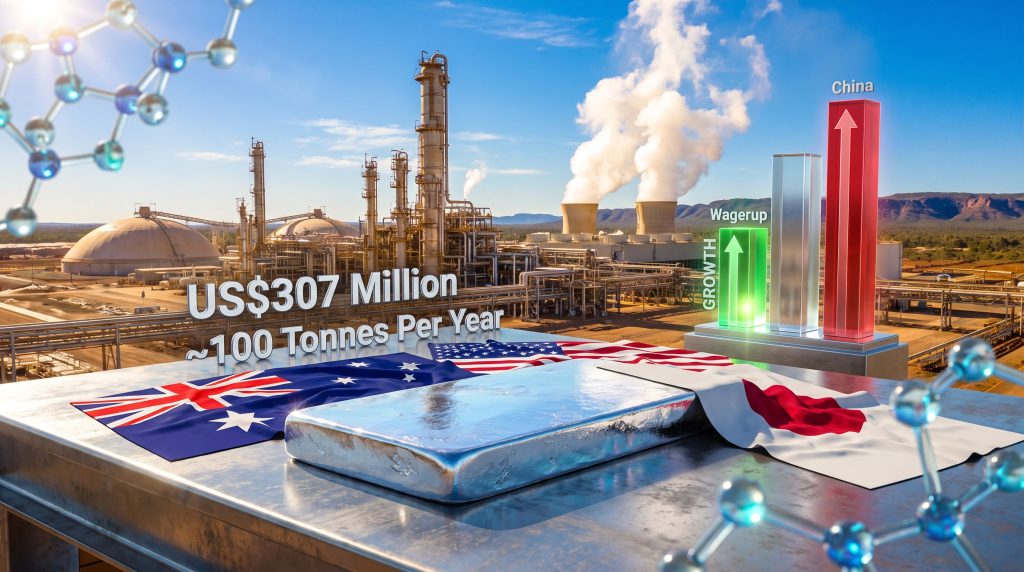
| Total project investment | ~US$307 million |
Global gallium demand is currently estimated at approximately 1,000 tonnes per year, with forward projections pointing toward sustained growth as 5G network rollout continues, compound semiconductor fabrication capacity expands, and electric vehicle penetration increases. The critical minerals demand surge is a key driver behind why allied governments are moving so decisively. At 100 tonnes per year, Wagerup would not eliminate Western dependency on Chinese supply but would constitute a structurally meaningful buffer, particularly for defence-critical procurement channels.
The Trilateral Financing Structure and What It Signals
The financial architecture underpinning the Alcoa Australia gallium plant is unprecedented in the critical minerals sector. Three sovereign governments, operating across two hemispheres and representing the core of the Indo-Pacific strategic partnership network, have coordinated capital commitments toward a single processing facility.
The Australian federal government has committed approximately US$200 million toward the project. The United States government provided support through equity and offtake mechanisms, with formal commitments announced in October 2025 alongside Australian government participation. Japan structured its involvement through Japan Australia Gallium Associates (JAGA), a joint venture between Sojitz Corporation, a major Japanese trading house with deep semiconductor sector relationships, and JOGMEC, the Japan Oil, Gas and Metals National Corporation, which functions as Japan's state resource investment vehicle.
A joint development agreement between Alcoa and JAGA was concluded several months before the Final Investment Decision, establishing the commercial framework governing offtake volumes, pricing mechanisms, and co-investment responsibilities.
The trilateral structure matters beyond its financing function. It creates overlapping offtake obligations across three jurisdictions, meaning gallium produced at Wagerup will flow into supply chains serving Japanese semiconductor manufacturers, US defence contractors, and Australian technology industries simultaneously. This geographic distribution of demand provides commercial resilience that single-nation offtake arrangements cannot replicate.
Japan's motivation deserves particular attention. Japanese semiconductor manufacturers, including those producing advanced logic and memory chips, depend on gallium-based compound semiconductors as upstream inputs. Japan's own domestic gallium recovery capacity is negligible relative to its industrial consumption, making a dedicated allied-nation supply arrangement a genuine industrial necessity rather than a political gesture.
Timeline: From Concept to Construction Decision
The project's development trajectory reflects both the urgency of supply chain diversification and the complexity of multi-sovereign capital coordination:
- Mid-2025: Joint development agreement signed between Alcoa and JAGA (Sojitz/JOGMEC), establishing the commercial framework for the project
- October 2025: Australian federal government and US government formally announce support commitments for the Wagerup gallium facility
- December 2025: Works Approval application lodged with the Western Australian Department of Water and Environmental Regulation (DWER)
- July 2026: Final Investment Decision confirmed by Alcoa, committing capital to construction
- Post-FID: Construction commences following completion of final site preparations
- Target: Production initiation in late 2026, subject to DWER regulatory approvals
The Final Investment Decision is the critical threshold in capital project development. It represents the moment at which feasibility analysis, environmental assessment, binding offtake arrangements, and financing structures are sufficiently advanced for a board to authorise construction expenditure. Alcoa CEO and President William Oplinger described the decision as reflecting a shared commitment by governments and industry to strengthen critical mineral supply chains among the partners.
The Works Approval pathway through DWER is simplified by the fact that Wagerup already operates under established environmental approvals as a major industrial facility. Adding a gallium recovery circuit within the existing refinery boundary does not require new land disturbance assessments or baseline ecological surveys at the scale required for greenfield developments.
Comparing Wagerup to the Wider Critical Minerals Development Landscape
The Wagerup gallium plant's development model stands apart from conventional critical mineral projects in almost every structural dimension:
| Factor | Wagerup Gallium Plant | Typical Greenfield Critical Mineral Project |
|---|---|---|
| New mining operations required | No | Yes |
| Infrastructure baseline | Co-located with operating refinery | Standalone construction required |
| Environmental footprint | Contained within existing boundary | New land disturbance |
| Time from decision to production | 1 to 2 years | 5 to 10+ years |
| Sovereign backing | Trilateral (Australia, US, Japan) | Typically single-nation |
| Permitting complexity | Lower (existing approvals base) | Higher (greenfield assessments) |
This comparison illustrates a broader principle in critical mineral supply chain development that policymakers are increasingly recognising: the fastest pathway to diversified supply runs through existing industrial infrastructure, not new greenfield mines. Western alumina refineries represent an underutilised asset base for gallium recovery at scale, and Wagerup is the most advanced expression of that logic currently under development globally.
The next major ASX story will hit our subscribers first
Alcoa's Strategic Expansion Context: South32 and the Upstream Ambition
The gallium plant does not exist in isolation. In July 2026, Alcoa agreed to acquire the bulk of South32's aluminium portfolio for an implied enterprise value of up to US$5.6 billion. The transaction adds bauxite, alumina, and aluminium assets spanning Brazil, South Africa, and Western Australia, substantially expanding Alcoa's upstream resource base and refinery throughput capacity.
This acquisition creates an important speculative dimension for the gallium story. A larger Alcoa alumina refinery footprint implies greater volumes of aluminate liquor available for gallium recovery. If the Wagerup model proves commercially successful at scale, the technical and commercial case for replicating gallium recovery circuits at other Alcoa refineries strengthens considerably.
The South32 assets, depending on their bauxite gallium grade profiles and refinery configurations, could represent future expansion opportunities for the Alcoa Australia gallium plant model. It is worth noting that lateritic bauxites, which characterise much of Western Australia's Darling Range resource base, generally carry higher gallium grades than karst or sedimentary bauxites common in Guinea or Jamaica. This grade advantage contributes to the economic viability of gallium recovery at Wagerup specifically.
Western Australia's Emerging Role as a Critical Minerals Processing Hub
Australia's green metals push is reflected clearly in Wagerup's development. Western Australia's established position as the world's largest lithium producer, operating through the spodumene operations of the Pilbara region, now has a complementary dimension in gallium. The state's combination of large-scale bauxite resources, operational alumina refinery infrastructure, proximity to Asian manufacturing demand centres, and deep pools of technical workforce capability positions it as a natural platform for expanding non-Chinese critical mineral supply.
Logistics economics reinforce this geographic advantage. Western Australia's proximity to Japan, South Korea, and Taiwan, which collectively account for a substantial share of global gallium consumption through their semiconductor and electronics manufacturing sectors, reduces freight costs and transit times compared to alternative supply sources in Europe or North America.
The Wagerup project also demonstrates that downstream processing of critical minerals within Australia, a policy objective consistently articulated at federal and state levels, can be achieved by leveraging existing industrial assets. Consequently, entirely new industrial ecosystems do not need to be constructed from scratch to meet this ambition.
Frequently Asked Questions: Alcoa Australia Gallium Plant
What is the Alcoa gallium plant in Australia?
The Alcoa Australia gallium plant is a purpose-built critical mineral recovery facility co-located at the Wagerup Alumina Refinery in Western Australia. It will extract gallium from the refinery's existing aluminate liquor stream, targeting annual production of approximately 100 tonnes, equivalent to roughly 10% of current estimated global gallium demand.
Where is the plant located?
The facility is situated at Alcoa's Wagerup Alumina Refinery, approximately 120 kilometres south-east of Perth, Western Australia, occupying around 4 hectares within the existing refinery footprint.
Who is funding the project?
The project carries a total estimated investment of approximately US$307 million, structured across commitments from the Australian federal government (approximately US$200 million), the United States government, and Japan through the JAGA joint venture comprising Sojitz Corporation and JOGMEC. For further detail, Alcoa's project factsheet provides a comprehensive overview of the financing and operational structure.
When is production expected to begin?
Following the Final Investment Decision confirmed in July 2026, production is targeted to begin in late 2026, subject to the completion of construction and regulatory approvals from the Western Australian Department of Water and Environmental Regulation.
Why is gallium classified as a critical mineral?
Gallium is essential for manufacturing gallium nitride and gallium arsenide semiconductors used in 5G infrastructure, defence electronics, electric vehicles, and satellite systems. Its supply is overwhelmingly concentrated in China, creating acute geopolitical risk for Western technology and defence industries with no commercially viable substitutes currently available.
How many jobs will the project create?
The construction phase is expected to generate approximately 150 direct and indirect positions, transitioning to between 15 and 20 permanent operational roles at full production.
Disclaimer: This article contains forward-looking statements and projections regarding production timelines, market share estimates, and financial figures. These are based on publicly available information as of the date of publication and are subject to change. Production commencement dates, regulatory approvals, and investment outcomes involve inherent uncertainty. Nothing in this article constitutes financial or investment advice.
Want to Stay Ahead of the Next Major Critical Mineral Discovery on the ASX?
Discovery Alert's proprietary Discovery IQ model delivers real-time alerts the moment significant mineral discoveries are announced on the ASX, instantly translating complex data across more than 30 commodities into clear, actionable insights — whether you're tracking gallium, bauxite, or the next transformative find. Explore how historic discoveries have generated substantial returns on Discovery Alert's dedicated discoveries page, and begin your 14-day free trial today to position yourself ahead of the broader market.