June 7, 2026
When Approvals Aren't Enough: The New Reality of Mining Permit Risk in Chile
The assumption that a mining project becomes legally secure once it clears a national environmental review process is being tested with increasing regularity across Latin America's most important copper-producing nation. Chile's judicial architecture around environmental governance has matured considerably over the past decade, and what was once treated as a formality-heavy but ultimately predictable permitting pathway has evolved into something far more legally complex. The Collahuasi operational continuity project court ruling in Chile, issued on May 15, 2026 by the country's Second Environmental Court, crystallises this shift in stark financial and strategic terms.
When big ASX news breaks, our subscribers know first
How Chile's Environmental Tribunal System Works — And Why It Can Override Major Mining Approvals
The Architecture of Environmental Judicial Review
Chile established its specialised environmental tribunal system to function as an independent legal check on the administrative approval process, not merely as an appellate body for pollution disputes. The courts operate with a mandate that extends well beyond assessing whether a proposed project will cause measurable environmental harm. Their scope encompasses the procedural integrity of the entire evaluation process, including whether Indigenous and coastal communities received genuine, substantive engagement during the consultation phases rather than a pro-forma notification exercise.
At the centre of this system is the Environmental Qualification Resolution, known in Chile as an RCA. An RCA represents the formal authorisation issued by the Environmental Evaluation Service, or SEA, confirming that a project meets the country's environmental standards and that its impacts have been adequately assessed. What many investors and project developers underestimate is that an RCA can be annulled not because the project was found to cause environmental damage, but because the procedural steps leading to its issuance were found to be legally deficient.
Regulatory Insight: Chile's environmental courts scrutinise the procedural integrity of the entire approval process, including whether affected communities were meaningfully consulted. A technically sound project with strong environmental credentials can still lose its RCA if the participatory process is found to be procedurally deficient — this distinction between technical merit and procedural validity is central to understanding modern Chilean mining permit risk.
This is not a theoretical vulnerability. The threshold that Chilean courts apply when evaluating the adequacy of an RCA's justification is demanding. Decision-makers within the SEA are required to demonstrate that community submissions made during public participation phases received substantive technical and legal consideration, not simply that they were received and filed. Furthermore, the mining geopolitical risk associated with such procedural vulnerabilities extends well beyond Chile's borders, influencing how global capital allocates to jurisdictions with complex community obligations.
What Is the Collahuasi Operational Continuity Project — and What Is at Stake?
Project Scale and Strategic Objectives
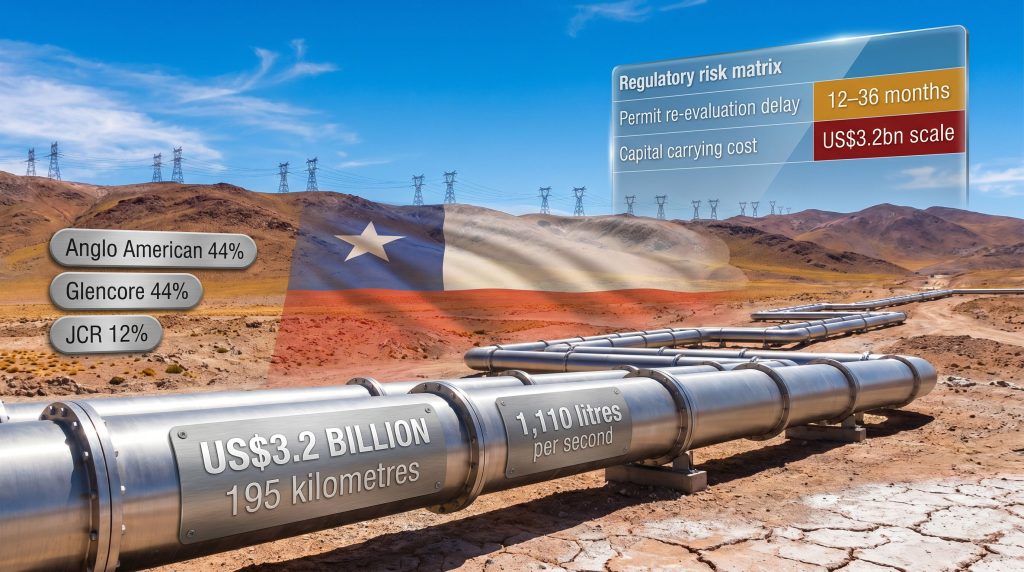
The Collahuasi C20+ project represents one of the largest single capital commitments currently underway in Chilean copper mining. Its central purpose is to extend the operational life of the Collahuasi mine — situated at an altitude of approximately 4,600 metres above sea level in the Tarapacá Region — by roughly 20 years. The total capital value of the project is estimated at US$3.2 billion, a figure that positions it among the most significant infrastructure investments in the country's mining sector.
The project's engineering scope is substantial. Because the mine operates at extreme altitude in one of the world's driest environments, freshwater access through traditional sources is neither reliable nor sustainable over a multi-decade horizon. The solution involves constructing a coastal desalination facility at Puerto Patache and pumping treated seawater to the mine site through a purpose-built pipeline network.
| Infrastructure Component | Specification |
|---|---|
| Desalination plant capacity | 1,110 litres per second |
| Pipeline network length | 195 kilometres |
| Mine operating altitude | 4,600 metres above sea level |
| High-voltage transmission towers | 122 towers across 5 substations |
| Total project capital value | US$3.2 billion |
| Projected mine life extension | Approximately 20 years |
By the time the Second Environmental Court issued its ruling in May 2026, construction of the desalination plant at Puerto Patache was reported to be nearly complete. This detail carries significant financial weight: a large proportion of the US$3.2 billion capital had already been committed or disbursed at the point when the RCA was annulled, meaning the ruling does not merely delay future expenditure but potentially puts already-deployed capital at risk of producing no operational return until the approval process is resolved.
Ownership Structure and Stakeholder Exposure
| Shareholder | Ownership Stake |
|---|---|
| Anglo American | 44% |
| Glencore | 44% |
| Japan Collahuasi Resources (JCR) | 12% |
Anglo American and Glencore each hold equal 44% stakes in Compañía Minera Collahuasi, with the Japan Collahuasi Resources consortium holding the remaining 12%. All three ownership parties carry proportional exposure to the regulatory uncertainty now surrounding the project. Techint E&C, a major engineering and construction contractor engaged on the project, also faces material supply chain consequences from any prolonged suspension of the approval process.
What Did the Court Actually Rule — and What Must Now Happen?
A Procedural Annulment, Not an Environmental Condemnation
This distinction is critical and frequently mischaracterised in coverage of the ruling. The Second Environmental Court did not determine that the Collahuasi C20+ project causes environmental harm or that it should be permanently prohibited. Its finding was narrower but legally consequential: the RCA issued by the SEA was found to lack adequate justification because the public submissions made during the citizen participation process were not given sufficient technical and legal consideration by the evaluating authority.
The challenges that triggered the ruling were filed by two Indigenous associations: the Wilamasi de Pescadores Mamq'uta Caleta Chanavaya and the Aymara de Caleta Chanavaya. Both communities are located near the coastal zone at Punta Patache, where the desalination plant's seawater intake and brine discharge systems are situated. Their legal standing to bring the challenge derives from Chile's obligations under ILO Convention 169, which requires that Indigenous peoples be consulted in good faith on projects that may affect their territories, livelihoods, or cultural practices. Indeed, Indigenous rights in mining have become an increasingly prominent legal flashpoint across multiple jurisdictions globally, reinforcing that this is not a challenge unique to Chile.
Key Legal Finding: The court concluded that the RCA lacks proper justification, specifically determining that the submissions made during the public participation phase did not receive the level of technical and legal consideration that Chilean environmental law requires. This is a procedural annulment based on the quality of engagement, not a finding that the project is environmentally harmful.
The Six-Point Reassessment the SEA Must Now Conduct
The Environmental Evaluation Service has been directed to conduct a fresh and comprehensive review, with specific attention to the following elements:
- The characterisation of the marine ecosystem at Punta Patache and the adequacy of the baseline data used in the original assessment
- The velocity of seawater intake at the desalination plant and its potential ecological impacts on marine organisms
- The management of hypersaline brine discharge onto the seabed and its long-term consequences for benthic ecosystems
- The scope and robustness of Collahuasi's environmental monitoring programme for the desalination facility
- The completeness of the human baseline study, including whether all potentially affected Indigenous communities were correctly identified and included
- Whether the consultation process met the substantive standards required under both Chilean domestic law and international Indigenous rights frameworks, particularly ILO Convention 169
Each of these six elements represents an area where the original evaluation was found insufficient. The breadth of the required reassessment signals that the court's concerns were not limited to a narrow procedural technicality but extended across multiple dimensions of the project's social and ecological assessment methodology.
Why Chile's Permit Approval Backlog Is Compounding Regulatory Risk
The DGA Bottleneck and Its Systemic Implications
Even if the SEA conducts its reassessment efficiently and issues a revised RCA, the Collahuasi project faces a second, structurally distinct layer of regulatory delay. The desalination pipeline network, which spans 195 kilometres from the coast to the mine site at high altitude, must cross numerous natural watercourses along its route. Each such crossing requires individual authorisation from Chile's General Water Directorate, known as the DGA, which operates under the Ministry of Public Works.
According to Carlos Rubilar, a former communications adviser to the DGA, the pipeline infrastructure for desalination projects typically must cross natural watercourses, each requiring a separate DGA permit — and the agency currently has more than 22,000 pending permit applications awaiting resolution. (BNamericas, May 2026) This backlog does not represent a temporary processing delay. It reflects a structural mismatch between the volume of water-related infrastructure demands generated by Chile's mining and energy sectors and the administrative capacity of the agency responsible for adjudicating them.
The compounding effect of this bottleneck on a project already facing judicial re-evaluation is significant. Even in the most optimistic scenario where the SEA completes its reassessment and issues a new RCA without further challenge, the project's water infrastructure components remain exposed to multi-year permitting delays at the DGA level. Consequently, the broader Chile copper outlook for investors must now factor in this administrative layer as a structural risk rather than an exceptional one.
How Does This Ruling Fit Into Chile's Broader Pattern of Environmental Litigation?
Precedents, Comparators, and What They Reveal
The Collahuasi operational continuity project court ruling in Chile does not exist in isolation. It forms part of a developing pattern in which Chile's environmental judiciary has demonstrated a willingness to intervene at various stages of a project's lifecycle, including well after administrative approvals have been granted and reaffirmed. The environmental tribunal's reversal of the Collahuasi project approval drew immediate attention from industry observers across the region.
| Project | Ruling Type | Core Issue | Outcome |
|---|---|---|---|
| Collahuasi C20+ | RCA Annulment | Indigenous consultation, marine baseline | SEA ordered to re-evaluate |
| Pascua Lama (Barrick) | Supreme Court Closure Order | Environmental damage, water contamination | Definitive project closure confirmed |
| SQM–Codelco Lithium | Regulatory Agreement | Salar de Atacama sustainability | Production extended to 2060 under revised conditions |
The Pascua Lama case remains the most extreme precedent in Chilean mining jurisprudence. Barrick Gold's gold and silver project in the high Andes was subject to progressive judicial enforcement that ultimately resulted in the Supreme Court confirming its permanent closure, driven by documented environmental violations including impacts on glacial water sources. While the Collahuasi ruling does not approach that severity — it does not involve confirmed environmental damage — Pascua Lama established that Chile's courts are willing to impose definitive consequences on projects of any scale.
The SQM–Codelco lithium arrangement illustrates a different pathway: one in which regulatory risk was managed through negotiated agreement rather than litigation, allowing production to continue under revised conditions extending to 2060. This contrast suggests that Chilean authorities retain a preference for negotiated resolution where possible, but that judicial enforcement remains a credible backstop when procedural obligations are not met.
The next major ASX story will hit our subscribers first
Is Chile's Indigenous Consultation Framework Fit for Purpose?
The Gap Between Process and Genuine Participation
Chile ratified ILO Convention 169 in 2008, establishing legally binding obligations to consult Indigenous communities in good faith before approving projects that may affect their traditional territories or livelihoods. The convention's requirements go beyond notifying communities that a project is being evaluated. They demand a process designed to achieve genuine agreement or at minimum demonstrate that Indigenous perspectives were substantively considered in the final decision.
Policy Gap: Courts are increasingly finding that the form of consultation, not merely its occurrence, must demonstrate genuine engagement. Projects that treat the consultation process as a procedural checkbox rather than a substantive dialogue are now facing heightened judicial exposure across Chile's mining sector.
The Wilamasi and Aymara associations at Caleta Chanavaya had legal standing to challenge the Collahuasi RCA precisely because the desalination infrastructure directly affects the coastal zone where these communities live and maintain traditional fishing practices. The court's finding that their submissions during the public participation process were inadequately addressed suggests that the consultation methodology employed did not meet the standard of meaningful engagement that Chilean and international law now requires.
What this signals to the broader mining industry is that social baseline assessments must now be treated as living, iterative documents rather than one-time exercises conducted early in the environmental impact assessment process. Communities near coastal intake and discharge points for desalination infrastructure may not have been traditionally associated with terrestrial mining impacts, yet their connection to the marine environment gives them direct legal standing to contest approvals. In addition, Chile's copper supply gap makes the timely resolution of such disputes all the more critical for global markets dependent on Chilean output.
What Are the Immediate and Long-Term Implications for Anglo American and Glencore?
Near-Term Buffer and Medium-Term Exposure
Both Anglo American and Glencore have confirmed that existing alternative water sources at Collahuasi are sufficient to maintain current production levels without the new desalination supply. This provides a meaningful near-term buffer against immediate operational disruption. The ruling does not shut down the mine — it delays the activation of the water and power infrastructure that would enable the mine's life to be extended by two decades.
The more consequential risk lies in what happens to the US$3.2 billion capital programme if the SEA re-evaluation process is prolonged, contested further in court, or results in material changes to the project's approved scope. The table below summarises the primary risk categories facing the project's investors:
| Risk Category | Description | Estimated Impact |
|---|---|---|
| Permit re-evaluation delay | SEA review timeline extension | 12–36 months additional lead time |
| Capital carrying cost | Interest on committed but idle capital | Significant at US$3.2bn scale |
| Production timeline shift | Delayed mine life extension activation | Deferred copper output over 20-year horizon |
| Contractor exposure | Techint E&C and supply chain disruption | Contract renegotiation risk |
| Reputational risk | Indigenous rights scrutiny | ESG rating implications |
For Anglo American in particular, the Collahuasi situation intersects with a broader strategic context. The company has simultaneously announced a US$295 million investment at its El Soldado copper mine in Chile to address production decline, reflecting its continued commitment to Chilean copper output even as individual projects face regulatory headwinds. This reinforces that the investment case for Chile remains intact, but that individual project execution risk has materially increased. However, this ruling is by no means an isolated case; the major copper project risk dynamic is reshaping how investors globally underwrite large-scale copper development programmes.
What Does This Mean for Chile's Desalination Pipeline Sector?
The Engineering Challenge That Defines Northern Chilean Mining
Desalination has become a structural necessity for Chile's northern copper mines rather than a strategic preference. The Atacama Desert region, which hosts some of the world's highest-grade and largest copper deposits, is one of the driest places on earth. Freshwater aquifers that historically supplied mining operations are in long-term decline, and regulatory pressure to reduce freshwater extraction from shared catchments has intensified considerably.
The engineering challenge of delivering desalinated seawater to mines operating above 4,000 metres above sea level is formidable. It requires not only large-capacity desalination plants at or near the coast but also high-pressure pumping systems capable of moving treated water across extended distances while climbing thousands of metres in elevation. The energy consumption associated with this pumping load is itself significant, which explains why the Collahuasi C20+ project also includes the construction of 5 substations and 122 high-voltage transmission towers as integral components of the water delivery system.
Strategic Implication: As Chile's mining sector becomes increasingly dependent on coastal desalination to replace depleted freshwater sources, the procedural requirements around marine ecosystem assessments and coastal community consultation are likely to become more stringent over time. Projects currently in environmental review should treat the Collahuasi ruling as a benchmark for what level of community and ecological analysis will withstand judicial scrutiny.
The ruling may also influence how future desalination projects in Chile are structured at the environmental assessment stage. Projects that invest more heavily in marine baseline studies from the outset, engage coastal communities as primary stakeholders rather than peripheral ones, and document their consultation processes to a higher evidentiary standard are likely to be more resilient to subsequent legal challenge. The Committee of Ministers' review of earlier proceedings at Collahuasi further illustrates the layered scrutiny that major mining approvals now face in Chile.
How Should Investors Interpret Chile's Evolving Regulatory Risk Landscape?
Legal Certainty as a Core Investment Variable
EY's Chile Mining and Metals Investment Guide 2026 and Chambers and Partners' Mining 2026 Chile Trends and Developments report both highlight regulatory and legal certainty as primary variables in how international capital evaluates Chilean mining opportunities. The Collahuasi operational continuity project court ruling in Chile adds a concrete, high-profile data point to this analytical framework.
What distinguishes the current regulatory environment from earlier periods is the temporal reach of judicial review. The Collahuasi RCA was secured in December 2021, reaffirmed by the Committee of Ministers in August 2023, and then annulled by the Second Environmental Court in May 2026 — nearly five years after initial approval. This timeline demonstrates that project proponents cannot treat administrative approval as a permanent resolution of legal exposure. Court challenges can materialise years into a project's implementation phase, at a point when significant capital has already been deployed.
For investors modelling Chilean mining project risk, this dynamic argues for incorporating a longer tail on regulatory uncertainty in project timelines, building scenario analysis around potential re-evaluation periods of 12 to 36 months, and ensuring that ESG documentation is structured with judicial scrutiny in mind, not merely regulatory compliance.
Chile remains one of the world's most important copper jurisdictions, and its commitment to attracting mining capital has not diminished. What has changed is the bar that projects must clear to achieve durable regulatory stability. Administrative approval from the SEA and ministerial confirmation are necessary conditions, but they are no longer sufficient ones. The procedural quality of community engagement, the depth of marine and ecological baseline documentation, and the robustness of the monitoring commitments attached to an approval now carry direct legal weight in any subsequent judicial review.
Frequently Asked Questions: Collahuasi Court Ruling and Chilean Mining Regulation
What exactly did Chile's Second Environmental Court rule regarding Collahuasi?
The court issued an order on May 15, 2026 requiring the annulment of the environmental qualification resolution granted by the SEA for the Collahuasi infrastructure and productive capacity improvement project, known as C20+. The ruling was based on a finding that the RCA lacked adequate justification because community submissions during the public participation process were not given appropriate technical and legal consideration.
Will the court ruling stop copper production at Collahuasi immediately?
No. Anglo American and Glencore have confirmed that existing alternative water sources are sufficient to maintain current production levels at the mine. The ruling affects the new infrastructure programme, not existing operations.
What is the Environmental Evaluation Service required to do following the ruling?
The SEA must conduct a fresh review of the project covering six specific areas: the marine ecosystem baseline at Punta Patache, seawater intake velocity and ecological impacts, hypersaline brine discharge management, the environmental monitoring programme, the completeness of the human baseline including all affected Indigenous communities, and the adequacy of the consultation process under Chilean and international law.
How long could the re-evaluation process take?
No fixed timeline has been confirmed. Based on the complexity of the issues to be reassessed and the precedent of other Chilean environmental review processes, industry observers broadly estimate that re-evaluation periods of this type can extend from 12 to 36 months, with the possibility of subsequent legal challenge adding further uncertainty.
What is the significance of Indigenous community consultation in Chilean mining approvals?
Chile ratified ILO Convention 169 in 2008, creating legally binding obligations to consult Indigenous communities in good faith on projects that may affect their territories. Courts are increasingly applying a substantive standard to these consultations, meaning it is not sufficient to demonstrate that consultation occurred — the quality and responsiveness of the process is subject to judicial review.
How does this ruling compare to the Pascua Lama precedent?
Pascua Lama represents the most extreme outcome in Chilean mining jurisprudence, where confirmed environmental violations led to the Supreme Court endorsing permanent project closure. The Collahuasi operational continuity project court ruling in Chile is procedural in nature and does not involve confirmed environmental harm. However, both cases illustrate that Chile's courts are willing to impose significant consequences on major mining projects when legal standards are not met.
What is the C20+ project and why is it critical to Collahuasi's long-term viability?
The C20+ project is the infrastructure and productive capacity improvement programme designed to extend Collahuasi's operational life by approximately 20 years. Its centrepiece is a desalination plant with a capacity of 1,110 litres per second, combined with a 195-kilometre pipeline network to transport water to the mine. Without this water supply solution, the mine's long-term operational sustainability would be constrained by the region's severely limited freshwater availability.
This article is intended for informational purposes only and does not constitute financial, legal, or investment advice. Forward-looking statements, timeline estimates, and regulatory outcome projections involve uncertainty and should not be relied upon as definitive forecasts. Readers should conduct independent due diligence and consult qualified advisers before making investment or business decisions based on the information contained herein.
Want To Stay Ahead of Major ASX Mineral Discoveries Before the Broader Market?
Discovery Alert's proprietary Discovery IQ model delivers real-time alerts on significant ASX mineral discoveries, translating complex geological and market data into clear, actionable insights for both short-term traders and long-term investors. Explore how historic discoveries have generated substantial returns by visiting Discovery Alert's dedicated discoveries page, and begin your 14-day free trial today to position yourself ahead of the market.