
July 19, 2026
Understanding Colombia's Economic Transformation Through Regional Policy Dynamics
Latin American economies have historically oscillated between market-oriented and state-interventionist approaches, with each transition bringing profound implications for fiscal sustainability, foreign investment, and social outcomes. This cyclical pattern reflects deeper structural tensions between resource extraction dependency and diversification imperatives that define economic policy across the region.
Colombia's current transformation under progressive leadership represents a critical case study in how rapid regulatory shifts can fundamentally alter economic trajectories. Furthermore, the speed and scope of these changes offer insights into both the opportunities and risks associated with aggressive state intervention in traditionally market-driven sectors.
When big ASX news breaks, our subscribers know first
What Drives Colombia's Current Regulatory Framework Under Gustavo Petro's Administration?
State-Centered Economic Restructuring
Gustavo Petro's regulatory reforms in Colombia have fundamentally altered the relationship between government and key economic sectors since taking office in August 2022. The administration has implemented comprehensive changes targeting healthcare, labour markets, and fiscal architecture through what analysts characterise as decree-based advancement strategies.
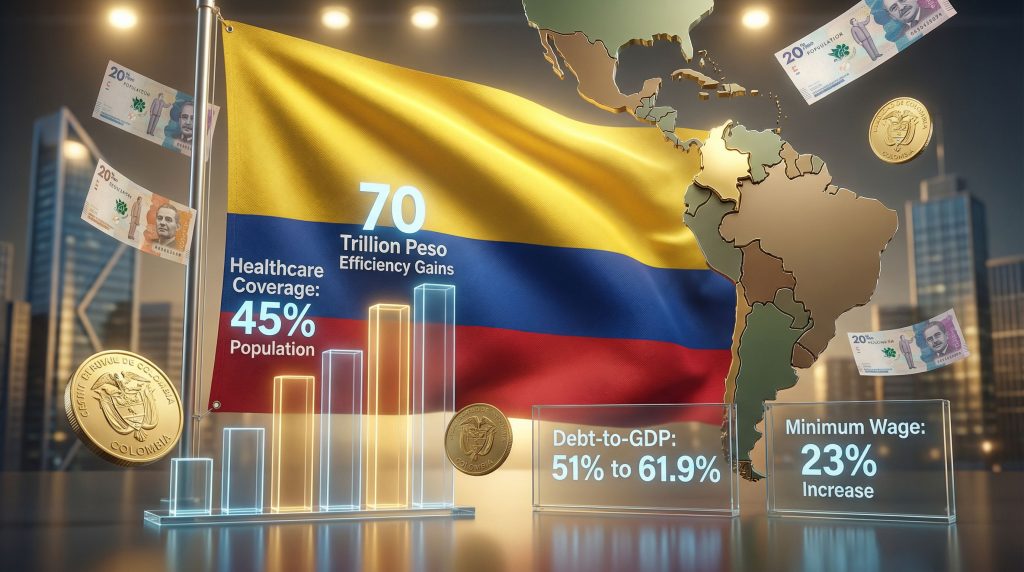
The healthcare system transition involves consolidating 45% of population coverage through EPS (Entidades Promotoras de Salud) restructuring, targeting 70 trillion pesos in efficiency gains through resource reallocation mechanisms. This represents a shift from fragmented private intermediary models toward centralised state administration, eliminating traditional insurance pathway intermediaries.
Key Healthcare Reform Components:
• Direct state intervention replacing private claims processing systems
• Provider payment restructuring eliminating insurance intermediaries
• Resource allocation targeting efficiency improvements across networks
• Centralised administration consolidating previously fragmented services
Labour market modernisation has focused on enhanced worker protections through multiple mechanisms. The 23% minimum wage increase has driven 18.5% growth in wage-related spending, while overtime compensation restructuring has enhanced weekend and holiday premiums. Digital economy protections now address gig worker classifications, and outsourcing limitations strengthen direct employment relationships.
Extractive Industry Policy Transformation
The energy sector has experienced the most dramatic policy shifts under Petro's administration. Oil production declined from 985,671 barrels per day in January 2016 to 746,444 barrels daily by January 2026, representing a 24.3% decrease over the decade. Natural gas production fell even more sharply, dropping from 1.05 billion cubic feet daily in January 2016 to 683 million cubic feet by January 2026, a 35% decline.
Production Decline Metrics:
| Resource Type | Jan 2016 Output | Jan 2026 Output | Percentage Decline |
|---|---|---|---|
| Oil Production | 985,671 bbl/day | 746,444 bbl/day | -24.3% |
| Natural Gas | 1.05 Bcf/day | 683 MMcf/day | -35% |
| Regional Ranking | 3rd in S. America | 5th in S. America | -2 positions |
The government implemented a scaled levy on oil sales triggered when Brent crude exceeds $67.30 per barrel, alongside comprehensive hydraulic fracturing bans. These measures, combined with the cessation of new exploration contracts, have created what industry observers describe as substantial regulatory uncertainty affecting foreign investment decisions.
How Do These Reforms Impact Investment Climate and Economic Fundamentals?
Foreign Capital Flight and Sectoral Repositioning
Colombia's transformation from South America's third-largest oil producer to fifth place reflects broader investment climate deterioration. Argentina and Guyana have overtaken Colombia in regional production rankings, with foreign companies systematically redirecting capital toward more favourable operating environments.
ExxonMobil's exit from Colombia exemplifies this trend. The energy supermajor ceased operations due to higher taxes, licensing reforms, and hydraulic fracturing restrictions, redirecting investment to offshore Guyana's Stabroek Block. Consequently, Exxon secured extremely favourable terms for Guyana operations, with $30 per barrel break-even economics and 40% stake alongside Chevron (35%) and CNOOC (25%).
Investment Diversion Patterns:
• Major oil discoveries drought since the 1990s in Colombia
• Only one discovery exceeding 200 million barrels since 2010
• Most recent discoveries contain less than 50 million barrels
• Only four discoveries exceeded 100 million barrels in 16-year period
This pattern reflects broader regional dynamics where the exploration licenses impact demonstrates how regulatory certainty influences international investment flows.
Fiscal Sustainability Challenges
Colombia's fiscal position has deteriorated significantly under current policies. The 2025 deficit reached 7.5% of GDP, representing the second-worst performance in the country's modern history. Projections suggest the 2026 deficit could hit a record 8.1% of GDP, potentially the highest in 125 years according to Colombian economic think tank Fedesarrollo.
Petro suspended Colombia's 2011 fiscal rule in mid-2025 to manage worsening public finances. The constitutional prohibition on re-election has led to what analysts describe as expansionary fiscal policy designed to boost electoral prospects for chosen successor Ivan Cepdeda in the 2026 presidential race.
Fiscal Deterioration Timeline:
| Period | Deficit Level | Historical Context |
|---|---|---|
| H1 2025 | 3.7% of GDP | Accelerating trend |
| Full Year 2025 | 7.5% of GDP | Second-worst in modern history |
| Projected 2026 | 8.1% of GDP | Potentially highest in 125 years |
The reinstatement of fuel subsidies beginning early 2026 reversed gradual phase-outs completed by early 2024. This policy reversal creates projected government debt of $8.8 billion with local oil companies, placing additional pressure on already strained public finances.
What Are the Long-term Structural Implications?
Economic Sector Contribution Shifts
The energy sector's contribution to Colombia's economy has declined substantially since policy implementation. By Q4 2025, the energy patch represented just over 2% of GDP compared to nearly 4% a decade earlier. Fiscal income from oil fell from 11% of government revenue in 2019 to 7% in 2025, creating structural budget pressures.
This transformation occurs despite favourable global oil price conditions, with Brent trading above $100 per barrel. The combination of reduced production capacity and regulatory constraints means higher prices fail to deliver proportional fiscal benefits compared to historical precedent.
Structural Economic Indicators:
• Energy sector GDP contribution: 4% (2015) to 2% (2025)
• Oil fiscal revenue share: 11% (2019) to 7% (2025)
• Production ranking decline: 3rd to 5th in South America
• Discovery success rate: Lowest since 1990s exploration period
Regional Competitive Dynamics
Colombia's policy approach contrasts sharply with regional alternatives that have attracted diverted investment. Guyana's emergence as one of the world's wealthiest countries on GDP per capita basis demonstrates the economic impact of favourable regulatory frameworks for extractive industries.
The Stabroek Block's success illustrates how attractive terms can generate substantial economic benefits. Guyana's regulatory approach, emphasising investor-friendly terms and operational certainty, has attracted the same multinational operators who previously invested in Colombia.
However, the regional context also includes countries implementing similar progressive policies. The Venezuela oil policy demonstrates how state intervention approaches can vary significantly in their implementation and outcomes.
Brazil's mixed economy model provides another comparative framework, balancing state intervention with market mechanisms. Chile's pension system reforms and Argentina's labour protection evolution offer additional regional precedents for understanding progressive policy implementation outcomes.
How Do Current Policies Address Social and Economic Objectives?
Redistribution and Social Program Expansion
The administration has prioritised social redistribution through multiple mechanisms. Healthcare access expansion targets 95% population coverage, while poverty reduction aims below 25% national thresholds. Income inequality improvements seek to move the Gini coefficient toward 0.45, with educational attainment increases in tertiary enrolment.
Progressive taxation implementation targets high-income brackets and corporations, utilising tax and royalty strategies similar to those seen globally. Extractive industry levy adjustments modify resource sector contributions, while social programme funding mechanisms redirect revenue streams toward welfare expansion.
Social Outcome Targets:
• Healthcare coverage expansion to 95% of population
• Poverty reduction below 25% national threshold
• Income inequality improvement toward 0.45 Gini coefficient
• Tertiary education enrolment increases
Implementation Timeline and Adjustment Mechanisms
Policy implementation follows a phased approach spanning multiple electoral cycles. Phase 1 (2022-2024) established legislative foundations and initial decree implementation. Phase 2 (2025-2026) focuses on operational system transitions and compliance monitoring. Phase 3 (2027-2030) emphasises performance evaluation and adjustment mechanisms.
Long-term horizon planning includes structural transformation assessment and sustainability validation. This timeline acknowledges that fundamental economic restructuring requires sustained political commitment beyond single electoral mandates.
What Stakeholder Responses Shape Policy Effectiveness?
Business Community Adaptation Strategies
Private sector responses have varied significantly across industries. Companies have developed compliance infrastructure for enhanced labour regulations while restructuring tax planning to address corporate levy increases. Operational efficiency improvements attempt to offset regulatory cost increases, with market positioning adjustments capitalising on domestic demand growth.
The financial services sector faces corporate tax adjustments requiring margin compression management, though challenges remain manageable through restructuring. Labour-intensive industries encounter enhanced worker protection requirements creating moderate adaptation challenges through compliance cost increases.
Sector-Specific Impact Assessment:
| Sector | Policy Impact | Investment Response | Risk Level |
|---|---|---|---|
| Healthcare | State centralisation | Private sector retreat | High uncertainty |
| Energy | Extraction tax increases | Foreign company exits | Elevated operational costs |
| Labour-Intensive | Worker protections | Compliance costs | Moderate adaptation |
| Financial Services | Corporate taxes | Margin compression | Manageable restructuring |
International Observer Analysis
Credit rating agencies monitor fiscal sustainability metrics closely, with multilateral organisations providing technical assistance for implementation. Regional integration impacts affect trade and investment relationships, whilst democratic governance evaluation assesses institutional strength during transition periods.
The international investment community has responded with portfolio rebalancing away from Colombian energy assets toward regional alternatives. This capital reallocation reflects uncertainty about policy durability and potential reversals following future electoral cycles.
For instance, the broader context of how tariffs impact investments globally shows similar patterns of capital flight when regulatory environments become uncertain.
The next major ASX story will hit our subscribers first
What Future Scenarios Could Shape Colombia's Economic Trajectory?
Optimistic Transformation Pathway
Successful implementation could validate the reform approach through measurable social outcome improvements. Fiscal consolidation might occur through enhanced revenue generation and efficiency gains, with private sector adaptation creating new equilibrium within the regulatory framework. Regional leadership in progressive economic policy implementation could inspire similar approaches across Latin America.
Key success indicators include GDP growth sustainability above 3% annually, inflation containment within 2-4% target ranges, employment rate improvements in formal sectors, and foreign direct investment maintenance above $10 billion yearly. Healthcare access expansion and educational attainment increases would demonstrate social policy effectiveness.
Challenging Adjustment Scenarios
Alternative trajectories involve fiscal stress requiring austerity measures or additional tax increases. Private investment decline could necessitate foreign capital attraction strategies, whilst inflation acceleration might demand monetary policy tightening. Political opposition could potentially reverse key reform elements following electoral transitions.
As Colombia's labor reform officially becomes law, structural challenges include managing debt-to-GDP trajectory rising from 51% to projected 61.9% by 2025. Deficit expansion reaching projected 7.5% annually creates sustainability concerns requiring policy adjustment or revenue enhancement.
Risk Management Considerations:
• Fiscal consolidation requirements amid spending expansion
• Private investment retention strategies during regulatory uncertainty
• Inflation management through wage-price spiral dynamics
• Political continuity challenges across electoral cycles
Strategic Recommendations for Key Stakeholders
Investors should consider diversification strategies emphasising sectors with regulatory clarity. Businesses require proactive compliance and efficiency optimisation programmes to navigate changing requirements. Policy makers need continuous monitoring and adjustment mechanisms for reform implementation effectiveness.
Citizens benefit from engagement in democratic processes to influence policy refinement. Educational opportunities around economic policy impacts enable informed participation in electoral decisions affecting long-term economic trajectories.
Furthermore, understanding the broader context of mining industry evolution globally provides insights into how extractive industries adapt to changing regulatory environments.
Conclusion: Balancing Transformation with Sustainability
Gustavo Petro's regulatory reforms in Colombia represent a significant experiment in rapid economic restructuring through state intervention. Success depends on balancing social objectives with fiscal sustainability whilst maintaining sufficient private sector confidence for continued economic growth.
The transformation occurs within a complex regional context where different countries pursue varying approaches to economic development. Regional and international observers will closely monitor outcomes as potential precedents for similar policy approaches across Latin America.
In addition, the Colombian experience offers valuable lessons about the challenges and opportunities associated with implementing comprehensive social and economic reforms in emerging markets. The ultimate success will depend on the administration's ability to maintain political support whilst managing the economic trade-offs inherent in such ambitious transformation efforts.
This analysis is based on publicly available data and should not be considered investment advice. Economic projections involve inherent uncertainty, and actual outcomes may differ significantly from current expectations. Readers should conduct independent research and consult qualified professionals before making financial decisions.
Ready to Capitalise on South America's Shifting Investment Landscape?
Discovery Alert's proprietary Discovery IQ model delivers real-time alerts on significant mineral discoveries across global markets, including emerging opportunities as investment flows redirect from policy-constrained regions to exploration-friendly jurisdictions. Explore Discovery Alert's comprehensive discoveries page to understand how major mineral discoveries have generated substantial returns for early investors, then begin your 14-day free trial today to position yourself ahead of shifting market dynamics.