
August 21, 2026
When the Ground Gives Way: Understanding the Human and Structural Cost of Illegal Gold Mining
Across Latin America, a quiet crisis unfolds daily in the shadows of the formal mining economy. Hundreds of thousands of workers descend into unregulated pits and hillside excavations, extracting gold without safety infrastructure, engineering oversight, or legal protection. The risks these workers accept are not abstract — they are geological, mechanical, and statistically inevitable. When slope failures occur at unlicensed open-pit operations, the consequences tend to be catastrophic and concentrated within the most economically vulnerable communities. The Colombia gold mine landslide that struck the village of Puerto Rico in Nariño's Policarpa municipality in August 2026 is the latest and most lethal expression of this systemic failure.
When big ASX news breaks, our subscribers know first
The Incident: What Happened in Policarpa, Nariño
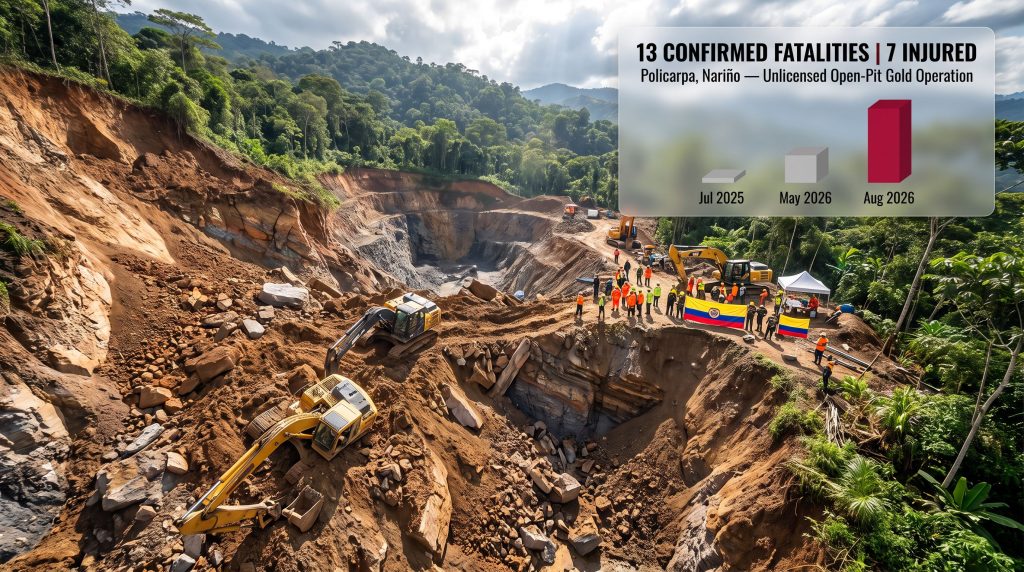
A slope section at an unlicensed open-pit gold mining site collapsed, triggering a landslide that killed 13 people and injured a further 7. The site had no formal authorisation and was reportedly operating with heavy machinery in terrain that lacked any geotechnical assessment or engineered slope design. Furthermore, according to AP News, local officials confirmed the operation had been flagged previously for operating without permits.
Key Facts at a Glance
| Detail | Information |
|---|---|
| Location | Puerto Rico village, Policarpa, Nariño Department |
| Fatalities | 13 confirmed deaths |
| Injuries | 7 injured |
| Mine Type | Unlicensed open-pit gold operation |
| Primary Cause | Slope destabilisation from unregulated extraction |
| Affected Community | Predominantly Quillacinga Indigenous workers |
| Families Impacted | At least one family lost 4 members |
| Workforce Size | Approximately 50 regular workers |
| Regulatory Status | Operating without official authorisation |
Most of the roughly 50 people who worked at the site were members of the Quillacinga Indigenous group, a community native to the Nariño and Putumayo regions of southwestern Colombia. Four of the 13 fatalities were reported to be members of a single indigenous family, a detail that underscores how concentrated the human cost becomes within tight-knit, interdependent communities where extended family networks often work the same site.
The Geology of Failure: Why Slope Collapses Are Predictable at Illegal Sites
How Unregulated Open-Pit Mining Creates Slope Instability
To understand why the Colombia gold mine landslide occurred, it is necessary to examine the geomechanical conditions that unlicensed operations routinely ignore. Open-pit mining fundamentally alters the stress distribution within a hillside or embankment. When material is removed from the toe of a slope without engineering controls, the factor of safety — a core metric used in geotechnical design — deteriorates rapidly.
Licensed operations are required to conduct slope stability analyses using established engineering frameworks, including limit equilibrium methods that calculate the ratio of resisting forces to driving forces within a given slope geometry. Unlicensed operators perform none of this work. In addition, understanding mining permitting basics makes clear just how extensive the regulatory safeguards are that these sites bypass entirely.
The specific risk factors present at sites like the one in Policarpa typically include:
- Absence of designed bench-and-berm configurations that distribute load and interrupt potential failure planes
- No drainage or dewatering infrastructure, meaning rainfall-driven groundwater pressure builds within the slope mass, dramatically reducing effective shear strength
- Heavy machinery operating directly on or near excavation faces, concentrating dynamic loads on already-weakened terrain
- Vibration from equipment progressively degrading cohesive soil and weathered rock structures over time
- No real-time geotechnical monitoring, such as inclinometers or ground movement sensors, that could detect precursor displacement before a full failure
The Role of Nariño's Terrain in Amplifying Risk
Nariño Department sits within the Andes mountain range, characterised by deeply weathered volcanic and sedimentary geology. The region's steep topography, combined with high annual rainfall and the presence of lateritic clay soils common to tropical Andean environments, creates conditions where slope instability is a baseline geological risk even without human intervention. Introduce uncontrolled excavation using heavy machinery into this environment, and slope failure transitions from a possibility to a near-certainty over time.
Tropical weathering processes can reduce the shear strength of Andean hillside soils to a fraction of the values that might be expected from the parent rock, making surface-level visual assessment of slope safety entirely unreliable without subsurface investigation.
The Quillacinga Community and the Economics of Informal Gold Mining
Why Indigenous Communities Depend on Artisanal Mining
The disproportionate presence of indigenous workers at unlicensed gold operations in Colombia is not coincidental. It reflects a structural economic reality: artisanal and small-scale gold mining (ASGM) represents one of the few income-generating activities accessible to rural and indigenous communities in remote regions where formal employment markets are functionally absent.
Colombia's ASGM sector is estimated to involve between 200,000 and 400,000 people nationally, with many households relying almost entirely on the proceeds from mineral and gemstone recovery. In communities like those in Nariño, geographic isolation, limited educational infrastructure, and the absence of alternative industries create an environment where gold extraction is not a lifestyle choice but an economic necessity.
This dependency has several compounding dimensions:
- Mineral income is typically irregular and unpredictable, creating chronic financial vulnerability
- Working-age adults from the same family frequently work at the same site, concentrating household risk at a single location
- The loss of multiple working-age members in a single incident can eliminate a family's entire income base while simultaneously creating new care obligations for survivors
- Community-level knowledge of the risks is often high, yet the absence of viable alternatives makes risk acceptance rational from a household economic perspective
The Formalisation Paradox in Indigenous Mining Communities
One of the most underappreciated dynamics in Colombia's informal mining sector is what might be called the formalisation paradox: the communities most exposed to safety risks are often the least able to access the legal frameworks designed to protect them.
Formal mining licences in Colombia require documentation, land tenure clarity, environmental assessments, and capital outlays that are structurally inaccessible to most indigenous and subsistence artisanal miners. Formalisation programmes have historically achieved limited uptake precisely because they were designed without adequate accommodation for the legal, cultural, and financial realities of these communities.
Enforcement-only approaches to illegal mining, without corresponding investment in accessible formalisation pathways, risk displacing unsafe practices rather than eliminating them — pushing operations further into remote terrain where oversight becomes even less achievable.
Colombia's Mining Fatality Pattern: A Recurring Crisis
Recent Fatal Incidents in Context
The Nariño landslide does not exist in isolation. It is the most recent entry in a troubling sequence of fatal mining incidents across Colombia, reflecting systemic regulatory enforcement gaps rather than isolated operational failures. Al Jazeera's reporting on the incident similarly contextualises it within a broader pattern of inadequate safety enforcement across the region.
| Date | Incident | Location | Casualties |
|---|---|---|---|
| July 2025 | 18 workers trapped for 18 hours due to equipment failure | Antioquia region | 18 rescued, 0 fatalities |
| May 2026 | Explosion at coal mine attributed to gas accumulation | Sutatausa, near Bogotá | 9 killed, 6 rescued |
| August 2026 | Slope collapse at unlicensed gold mine | Policarpa, Nariño | 13 killed, 7 injured |
The May 2026 coal mine explosion in Sutatausa, attributed to gas accumulation within a poorly ventilated working environment, killed nine people and required the rescue of six survivors. The July 2025 Antioquia incident, while resulting in no fatalities, demonstrated that entrapment due to equipment failure at informal operations is a recurring hazard even when outcomes are ultimately survivable.
Why Enforcement Fails in Remote Mining Zones
Several structural barriers prevent effective regulatory oversight from reaching operations like the one in Policarpa:
- Geographic remoteness means inspection visits are infrequent and logistically costly for underfunded agencies
- Economic incentives for non-compliance are substantial: unlicensed operators avoid permitting costs, environmental bonding requirements, and royalty obligations
- Community-level normalisation of risk means informal social pressure rarely reinforces safety behaviour
- Limited ANM field capacity relative to the geographic spread of informal operations creates coverage gaps that persist regardless of regulatory intent
- Intersection with organised crime in some regions means that efforts to shut down illegal operations carry security risks for enforcement personnel
What Safety Standards Actually Require at Licensed Open-Pit Sites
For context, licensed open-pit gold mining operations are subject to a mandatory suite of geotechnical and safety requirements that the Policarpa site had none of. Understanding this gap clarifies why the Colombia gold mine landslide was not an accident in the conventional sense, but a predictable outcome of absent infrastructure. A properly conducted definitive feasibility study, for instance, would include detailed slope stability assessments as a foundational component before any extraction begins.
Minimum requirements for licensed open-pit operations typically include:
- Slope stability analysis updated regularly using geotechnical engineering models
- Engineered drainage and dewatering systems to control groundwater pressure within slope masses
- Periodic geotechnical monitoring using inclinometers, extensometers, and ground movement sensor networks
- Defined exclusion zones around active excavation faces, particularly during and after rainfall events
- Formal emergency response plans with documented evacuation routes and assembly points
- Pre-blast and post-blast geotechnical inspections where blasting is used in extraction
At unlicensed sites, none of these safeguards exist. Slope collapses at such operations are not anomalies — they are the statistically predictable result of conducting industrial-scale extraction without industrial-scale safety infrastructure.
The next major ASX story will hit our subscribers first
The ANM Response and Its Structural Limitations
Colombia's National Mining Agency deployed its Mining Safety and Rescue team to the Policarpa site promptly following the collapse, coordinating with local emergency services, civil authorities, and community volunteers to locate missing persons and support the injured. The agency also committed to collaborating with regional authorities on longer-term miner safety strategies within the formal regulatory framework.
This dual mandate — immediate disaster response alongside structural reform advocacy — reflects the genuine complexity of the challenge facing Colombian mining regulators. Critics within the sector have long argued that the ANM's enforcement capacity in remote regions is chronically underfunded relative to the geographic scale of informal mining activity it is asked to police. Consequently, mining risk management at the national policy level remains as pressing a challenge as site-level safety enforcement.
Pathways Forward: What Structural Reform Actually Requires
Addressing the conditions that produce disasters like the Colombia gold mine landslide requires intervention across three timeframes. Moreover, any meaningful solution must also account for natural capital in mining — recognising that environmental degradation from illegal extraction compounds the human and regulatory costs over time.
Short-term priorities:
- Expand ANM rescue team capacity and pre-position resources in high-risk mining corridors
- Establish community-level early warning systems for slope movement in active artisanal zones
- Provide immediate humanitarian support to affected indigenous families, including income replacement mechanisms
Medium-term reforms:
- Redesign licensing pathways to be accessible and affordable for indigenous and rural artisanal miners
- Develop mobile regulatory outreach programmes capable of reaching geographically isolated operations
- Create culturally appropriate safety training in partnership with indigenous community organisations, delivered in relevant languages
Long-term structural change:
- Invest in alternative livelihood programmes for communities whose economic survival currently depends on informal extraction
- Strengthen coordination between the ANM, environmental regulators, and indigenous rights bodies to ensure reform processes respect community sovereignty
- Address the documented intersection between illegal mining and organised crime financing through integrated security and economic development strategies
- Prioritise mine reclamation importance as a central component of any post-extraction strategy in affected regions
Frequently Asked Questions: Colombia Gold Mine Landslide
What caused the Colombia gold mine landslide in Nariño?
The failure occurred when a slope section gave way under conditions of soil instability at an unlicensed open-pit gold mine in Puerto Rico village, Policarpa municipality. Authorities identified unregulated extraction activity using heavy machinery, without geotechnical oversight, as a contributing factor to the collapse.
How many people died in the Colombia gold mine landslide?
Colombia's National Mining Agency confirmed 13 fatalities and 7 injuries resulting from the slope failure.
Who were the victims of the Policarpa mine collapse?
The majority of workers at the site were Quillacinga Indigenous community members. Four of the 13 people killed were reportedly from a single indigenous family.
Is illegal gold mining common in Colombia?
Yes. Artisanal and small-scale gold mining, much of it operating outside formal regulatory frameworks, is estimated to involve between 200,000 and 400,000 people across Colombia. Fatal incidents at unlicensed sites occur with troubling regularity.
How does this incident compare to other recent Colombian mining disasters?
The Nariño landslide is the deadliest of three significant incidents within roughly a 13-month period. A gas explosion at a Sutatausa coal mine in May 2026 killed 9 people, while 18 miners were trapped but rescued in Antioquia in July 2025.
Readers seeking further coverage of mining safety incidents and Colombia's artisanal gold sector can find related reporting at Mining Technology, which tracks global mining health and safety developments.
This article contains references to documented incidents and publicly available data. Structural reform recommendations and sector-wide estimates reflect industry analysis and should not be interpreted as predictions of specific policy outcomes.
Want to See What Legitimate ASX Mineral Discoveries Look Like?
Discovery Alert's proprietary Discovery IQ model scans ASX announcements in real time, instantly identifying significant mineral discoveries and converting complex data across 30-plus commodities into clear, actionable investment insights — the kind of transparent, regulated opportunity that stands in stark contrast to the informal sector's hidden risks. Explore historic discoveries and their market-defining returns, then begin your 14-day free trial to position yourself ahead of the broader market.