
July 9, 2026
Why the Paper Price of Silver May Be the Least Reliable Signal in the Market
Commodity markets have a long history of pricing disconnects, but few are as structurally layered as the one currently unfolding in silver. The conventional assumption is straightforward: rising industrial demand, shrinking mine supply, and inflation fears push silver prices higher. Yet for the better part of two years, something far more unusual has been happening beneath the surface of the COMEX futures market, where COMEX silver delivery and price manipulation concerns have shifted from fringe commentary into mainstream institutional debate.
Understanding what is really happening requires stepping back from headline price moves and examining the mechanics of how silver is actually owned, transferred, and physically removed from the system. Furthermore, silver supply deficits are adding another layer of complexity to an already strained market structure.
When big ASX news breaks, our subscribers know first
How COMEX Silver Delivery Actually Works
The Warrant System: Ownership Transfer, Not Metal Movement
Most retail investors assume that a futures delivery involves trucks pulling up to a vault and driving silver bars across the country. The reality is far more administrative. A COMEX delivery involves the transfer of an electronic warehouse warrant, a document representing title to a specific quantity of silver stored in an approved vault. The metal does not necessarily move. Ownership changes hands within the same vault network.
This is why registered inventory figures reported by COMEX often appear remarkably stable even during periods of elevated delivery volume. The silver stays put; only the paperwork changes hands.
Registered vs. Eligible Inventory: A Critical Distinction
Not all silver sitting in COMEX-approved vaults is available for futures contract settlement. Understanding the two categories is essential for interpreting inventory data correctly.
| Category | Definition | Strategic Implication |
|---|---|---|
| Registered | Available for delivery against open futures contracts | Decline signals tightening physical supply |
| Eligible | Stored but not committed to futures delivery | Reclassification to registered signals intent to deliver |
When eligible silver is reclassified as registered, it signals that a holder is preparing to make or receive delivery. Sustained reclassification in one direction is one of the most reliable leading indicators of shifting institutional intent within the physical market.
The Bi-Party Warrant: Why Specificity Matters
A standard COMEX delivery assigns a warrant to a buyer through the exchange's own allocation process. The buyer receives whatever bars the exchange designates, stored wherever the exchange nominates. A bi-party warrant exchange is structurally different.
In a bi-party transaction, the buyer negotiates directly with the seller to specify exact bar serial numbers and exact vault locations. This is not administrative convenience. When a well-capitalised buyer insists on specific numbered bars at a specific vault, it signals a qualitatively different level of intent compared to routine contract settlement.
When a buyer demands specific numbered bars at a specific vault rather than accepting an exchange-assigned warrant, this represents a strategic actor taking deliberate physical possession, not simply closing out a derivatives position.
What Elevated Delivery Volumes Are Actually Signalling
The Historical Baseline
For most of modern futures market history, physical delivery on COMEX was the exception rather than the rule. Historically, fewer than 5% to 10% of open silver futures contracts ever resulted in delivery. The overwhelming majority were rolled forward, offset with opposing positions, or cash-settled before expiration. This was by design. The futures market was built as a price discovery and hedging tool, not a physical distribution mechanism.
An 18-Month Structural Anomaly
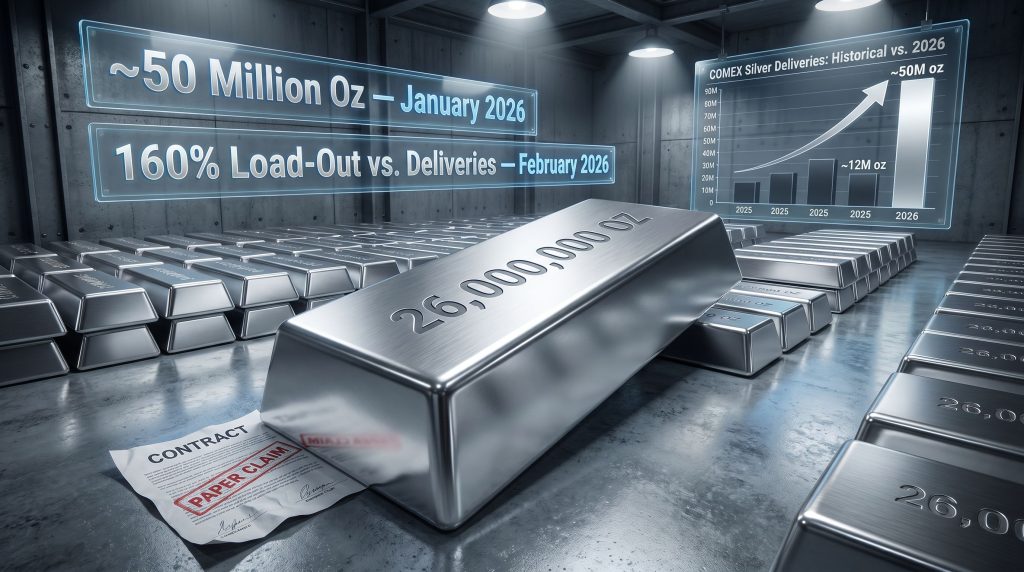
That historical norm has been comprehensively broken. For 18 consecutive months, COMEX silver delivery volumes have remained at historically unprecedented levels. The data points are striking:
| Period | Delivery Volume | Load-Out Volume | Context |
|---|---|---|---|
| Pre-2024 historical norm | ~5-10% of open contracts | Minimal | Roll-forward dominant |
| January 2026 | ~50 million oz | Elevated | vs. ~12M oz same period 2025 |
| February 2026 | ~26 million oz | ~39 million oz (160% of deliveries) | ~2.9M lbs physically transported |
| Mid-2026 (Gold) | ~$13 billion equivalent | Not disclosed | Unprecedented single-month figure |
The February 2026 figure is particularly striking. Approximately 39 million ounces, representing roughly 160% of the volume delivered under futures contracts, was physically loaded onto trucks and transported away from COMEX vaults. That is approximately 2.9 million pounds of silver removed from the system in a single month, at a time when the paper price was being aggressively sold down.
During the same period, China imported more silver in Q1 2026 than in any prior quarter in its recorded history, while simultaneously benefiting from suppressed paper prices. These gold and silver price impacts have been further amplified by ongoing trade tensions reshaping global commodity flows.
Is COMEX Silver Price Being Used as a Strategic Tool of Misdirection?
The Paper Market Pricing Paradox
The global silver price is not set by physical supply and demand. It is set by COMEX futures contracts, a derivative instrument representing promises to buy or sell silver at future dates. This creates a structural paradox: the underlying physical commodity does not set its own price. Instead, a paper market built on leverage and speculation determines the benchmark reference price for physical transactions worldwide.
Some analysts estimate that paper derivative claims against silver exceed 300 claims per single ounce of eligible physical silver held in COMEX vaults. If accurate, this concentration of synthetic exposure creates enormous structural fragility and significant potential for price signals to diverge from physical market realities.
The Arbitrage Signal
One of the clearest indicators of this divergence has been a persistent arbitrage gap of approximately $5 per ounce between COMEX and LBMA paper prices and physical silver prices in Shanghai. Examining LBMA and COMEX markets reveals how deeply this structural disconnection has embedded itself across international trading venues.
When arbitrage of this magnitude persists across international markets over extended periods, it does not represent a temporary inefficiency. It reflects a structural disconnection between derivative pricing and physical scarcity.
Price Suppression as an Accumulation Strategy
If a well-capitalised institutional actor wished to accumulate large quantities of physical silver at minimum cost, suppressing the paper price while simultaneously standing for physical delivery would represent the optimal strategy. Lower prices function as a subsidy for the buyer. The paper market absorbs the signal of weakness while the physical market absorbs the metal itself.
This is a structural hypothesis, not a confirmed fact. However, it becomes increasingly difficult to dismiss when delivery volumes are running at record levels, load-out data confirms physical removal of metal, and simultaneous record buying is occurring in Asia at depressed prices.
What Is Spoofing and How Has It Been Used to Manipulate Silver Prices?
Defining Spoofing in Commodity Markets
Spoofing involves placing large buy or sell orders in a futures market with no intention of executing them. These orders create a false impression of supply or demand, moving prices in a desired direction before the orders are withdrawn. It is explicitly prohibited under the Commodity Exchange Act.
In the silver futures market, large sell-side spoofing artificially depresses prices by creating the appearance of overwhelming supply. Large buy-side spoofing temporarily inflates prices. The technique is particularly effective in thinly traded markets or during low-liquidity periods. Broader silver squeeze dynamics have, in turn, been shaped by these very mechanisms playing out over years.
The JPMorgan Precedent
For years, allegations of systematic precious metals manipulation were dismissed as fringe speculation. The legal record has since reframed that narrative. JPMorgan traders were found to have engaged in systematic spoofing of precious metals futures markets over an extended period. The bank paid a $920 million fine to resolve charges, representing the largest spoofing settlement in CFTC history at the time. Multiple individual traders faced criminal prosecution and conviction through the U.S. Department of Justice.
The JPMorgan spoofing case is fully documented through CFTC enforcement actions and U.S. Department of Justice criminal proceedings. What was once dismissed as conspiracy theory became established legal fact.
Regulatory Limitations
The CFTC conducted an investigation into silver market concentration beginning in 2008, ultimately concluding that futures prices tracked physical markets without evidence of manipulation. The tension with subsequent enforcement actions that confirmed spoofing had occurred raises important questions about the adequacy of earlier investigative frameworks.
Proving individual spoofing incidents is structurally different from proving coordinated, systemic price suppression at an institutional level. Regulatory tools designed for the former may be inadequate for identifying the latter. For a deeper examination of these mechanics, detailed analysis of COMEX silver manipulation provides further context on how futures price discovery has been distorted.
Who Is Standing for Delivery? Mapping the Institutional Actors
Central Banks: The Most Documented Large-Scale Buyers
Central banks recorded their highest-ever quarterly gold purchases in Q1 2026. This is not a speculative claim. It is documented through World Gold Council data and central bank reserve disclosures. The strategic logic is clear: institutions managing national reserve assets are diversifying away from USD-denominated holdings, and both gold and silver offer non-sovereign stores of value that cannot be printed, sanctioned, or frozen.
Hypothetical Actor Profiles
The identities of entities standing for delivery on COMEX are not publicly disclosed. The following represents a structured analysis of structurally plausible candidates based on observable market behaviour.
| Actor Type | Evidence Basis | Structural Capacity | Verification Status |
|---|---|---|---|
| Central banks (global) | Documented record Q1 2026 purchases | Very high | Confirmed (gold) |
| U.S. Exchange Stabilisation Fund | Critical mineral reclassification of silver | High (if authorised) | Speculative |
| Tether / crypto treasury operators | Documented large-scale gold buying | Moderate-High | Partially documented |
| Sovereign wealth funds | Consistent with de-dollarisation trend | High | Unconfirmed |
| Large commercial banks (proprietary) | Net long positioning shift in COT data | Moderate | Partially documented |
One structurally plausible scenario involves the U.S. Exchange Stabilisation Fund, a Treasury instrument with broad authority to intervene in currency and financial markets. Following silver's reclassification as a critical mineral, a theoretical argument exists that strategic accumulation could proceed without requiring Congressional approval. This scenario remains entirely speculative and unverified.
Tether's documented gold purchasing activity has placed it among the largest institutional gold buyers globally over recent years. Whether any coordinated arrangement exists between sovereign interests and large crypto treasury operators is speculative inference only, not established fact.
The next major ASX story will hit our subscribers first
What Caused the 2025-2026 Silver Market Structural Dislocation?
Four Simultaneous Pressures
The Bank for International Settlements characterised the metals price move as structural rather than fundamental. This distinction matters enormously. Structural price moves are driven by mechanical forces within the financial system itself, not by genuine shifts in physical supply and demand economics. Four separate forces converged simultaneously:
- ETF Rebalancing: Commodity-backed ETFs rebalanced prospectus allocations in the first week of January, generating large-scale silver and gold selling into a volatile market.
- CME Margin Escalation: CME Group raised margin requirements by more than $300 per contract within a four-week window, moving from approximately $15,000 to $54,000 per 5,000-ounce silver lot and forcing leveraged position liquidations across the industry.
- Refinery Shutdown Cascade: U.S. silver refiners, unable to sustain short hedges as prices rose rapidly while margin costs simultaneously escalated, halted operations. The industry ran approximately 16 weeks backlogged at peak dislocation.
- Retail Capitulation Selling: Long-term retail holders, some dating back to the 2021 silver squeeze, liquidated positions under duress, generating net selling pressure that exceeded buying demand.
The Refinery Margin Spiral Explained
The hedging mechanics of physical silver dealers create a specific vulnerability that most investors do not appreciate. When a refiner purchases physical silver, it must simultaneously establish an offsetting short position in futures to remain market-neutral. If silver prices rise sharply, the short hedge generates margin calls. When CME simultaneously raises margin requirements, those calls compound.
A mid-sized U.S. silver refiner accepting $50 million in mixed silver feedstock faces a processing window measured in weeks. If silver prices spike during that window, the refiner faces escalating margin calls on its short hedge. If CME simultaneously raises margin requirements, the capital demand becomes insurmountable. Most refiners responded by stopping new feedstock acceptance entirely.
For a dealer holding 2 million ounces of silver inventory at $54,000 margin per 5,000-ounce contract, the required margin account collateral reaches approximately $21.6 million, sitting idle as collateral rather than deployed productively.
How the Commitment of Traders Report Reflects Current Market Structure
Reading the COT Report for Silver
The Commitment of Traders report published by the CFTC disaggregates futures positioning across three primary categories:
- Commercials (producers, processors, and dealers hedging physical exposure)
- Large Speculators (managed money funds and hedge funds taking directional bets)
- Small Speculators (retail participants and smaller accounts)
Net positioning within each category signals the aggregate directional bet of each participant class at any given moment.
Current COT Configuration
The current COT positioning for silver presents a historically unusual configuration. Open interest on COMEX silver has fallen to historically low levels, meaning fewer participants are willing to take either side of the market. U.S. commercial banks have moved toward net-long positioning, representing a structural reversal from their traditional net-short hedging posture. European banks retain comparatively larger net-short exposure, creating a geographic divergence worth monitoring.
The practical implication of low open interest is significant. When fewer short positions exist to absorb buying demand, even modest increases in purchasing pressure can produce disproportionately large price moves. Consequently, the structural resistance to upside has been substantially reduced.
Deconstructing the Federal Reserve Narrative Around Gold and Silver
Challenging the Rates-Down-Equals-Gold-Up Framework
A widely accepted market narrative holds that gold and silver can only sustain meaningful rallies when the Federal Reserve is cutting interest rates. The empirical record challenges this assumption directly. During the most aggressive rate-hiking cycle in modern U.S. history, approximately 400 basis points in 12 months between 2022 and 2023, gold prices continued to rise.
The more analytically rigorous framework focuses on real returns rather than nominal rates. With the 10-year U.S. Treasury yielding approximately 4% against official inflation running above 3%, the real return on sovereign debt is less than 100 basis points. When gold's opportunity cost approaches zero, the investment case requires no rate cut catalyst. Furthermore, the gold-silver ratio analysis for 2025 suggests silver remains significantly undervalued relative to gold on a historical basis.
The Labour Market Data Reliability Question
Markets regularly react sharply to headline employment data, but a consistent pattern of significant downward revisions to initial payroll figures raises questions about the signal quality of those reactions. The divergence between establishment survey data and household survey data has been particularly pronounced in recent reporting periods.
Markets reacting to this headline noise rather than underlying economic signal are responding to misdirection, not information.
What Are the Global Structural Forces Driving Physical Demand?
De-Dollarisation and the Global South
China's strategic commodity accumulation represents one of the most significant structural shifts in global resource economics. Chinese entities have been systematically acquiring oil refinery assets, agricultural land, rare earth supply chains, and striking bilateral commodity agreements across Brazil, the UAE, and numerous other markets.
Meanwhile, China's holdings of U.S. Treasury securities have declined from approximately $1.45 trillion to approximately $650 billion, with that capital redirected toward tangible assets. This is not a short-term trade. It is a multi-year strategic repositioning by the world's largest manufacturing economy away from dollar-denominated paper claims and toward physical ownership of productive resources.
The Emerging Challenge to COMEX and LBMA Price Discovery
The Hong Kong exchange launched a price-setting gold futures platform in December 2024, offering one year of free dollar-denominated lending to attract participants. Singapore and other Asian exchanges are pursuing similar ambitions. The strategic intent is clear: multiple sovereign-adjacent institutions are attempting to relocate gold and silver price discovery authority away from London and New York.
COMEX and LBMA currently retain dominant price-setting authority. However, as open interest on COMEX declines and physical metal continues to migrate toward Asia, the structural foundation of Western price dominance is being gradually eroded.
Triffin's Dilemma and the Strategic Case for Dollar Devaluation
Triffin's Dilemma describes the fundamental contradiction facing any reserve currency nation. To supply global liquidity, the issuing country must run persistent trade deficits, which ultimately undermines the currency's value. The United States cannot simultaneously maintain reserve currency status and rebuild domestic manufacturing competitiveness.
One scenario resolution involves allowing gold to appreciate substantially, effectively enabling a soft default on dollar-denominated obligations by devaluing the currency without formal default declaration. Under this framework, higher gold prices are not an accidental outcome but a strategic policy tool.
What Would Trigger the Next Major Silver and Gold Price Breakout?
Three Scenarios Worth Monitoring
Scenario 1: Bond Market Stress Event
Long-duration U.S. Treasury bonds represent the most structurally vulnerable catalyst. Buyers of 10-year or 30-year Treasuries at current yields face negative real returns if inflation persists above 3%. A sustained loss of confidence in long-duration sovereign debt would redirect capital flows into non-sovereign stores of value at scale.
Scenario 2: COMEX Physical Delivery Stress
If standing-for-delivery demand exceeds available registered inventory, COMEX retains the right to invoke cash settlement rather than deliver physical metal. If triggered at scale, this mechanism would expose the structural gap between paper claims and physical supply, potentially catalysing a repricing event of significant magnitude. This is precisely why concerns around COMEX silver delivery and price manipulation have intensified among institutional observers.
Scenario 3: Retail Investor Re-Entry
Approximately 0.5% of U.S. retail investors currently have any exposure to gold or gold-related equities. If that figure increased to even 5%, the incremental demand would represent a tenfold increase against a physical market that is already absorbing record institutional delivery volumes. Major institutional voices including senior strategists at Morgan Stanley and Bank of America have recently recommended allocations of 20% to 25% gold in diversified portfolios.
The Broader Investor Psychology Dynamic
The public currently maintains near-record equity exposure, concentrated in a small number of large-cap technology stocks, while simultaneously carrying elevated margin debt and options exposure. Meanwhile, the most well-capitalised and informed buyers on the planet, central banks and whoever is standing for delivery on COMEX month after month, are moving in a different direction.
The entities standing for delivery every month for billions of dollars are not reacting to Federal Reserve meeting outcomes or headline employment prints. They are positioning for a structural outcome that is measured in years, not quarters.
Whether that outcome arrives through a bond market dislocation, a COMEX delivery stress event, or a gradual retail awakening, the physical market data suggests the foundation for a significant repricing of silver is being quietly constructed, one warrant exchange at a time. The full picture of COMEX silver delivery and price manipulation may only become clear in retrospect, but the structural signals are accumulating in plain sight.
Disclaimer: This article is for informational and educational purposes only and does not constitute financial advice. All projections, scenarios, and speculative frameworks are presented for analytical purposes and do not represent predictions of future market outcomes. Past market behaviour is not indicative of future results. Readers should conduct their own due diligence and consult qualified financial advisers before making investment decisions.
Want to Track the Next Major Silver or Commodity Discovery the Moment It Hits the ASX?
Discovery Alert's proprietary Discovery IQ model scans ASX announcements in real time, instantly converting complex mineral data across more than 30 commodities into clear, actionable insights — so subscribers are positioned ahead of the broader market the moment a significant discovery is announced. Explore historic discoveries and their exceptional returns to understand what's at stake, then begin your 14-day free trial today.