May 19, 2026
Nuclear fuel cycles worldwide face an unprecedented transformation as traditional linear consumption models prove increasingly unsustainable. The accumulation of radioactive waste materials represents one of the most complex technological and policy challenges in modern energy systems. Commercial nuclear fuel recycling offers a promising solution, transforming radioactive waste into valuable energy resources through sophisticated chemical separation processes. Furthermore, emerging approaches suggest a fundamental shift toward circular resource utilisation may be necessary for long-term nuclear sustainability, particularly given the uranium market volatility affecting global supply chains.
Understanding the Fundamentals of Nuclear Fuel Recovery Systems
Commercial nuclear fuel recycling fundamentally alters nuclear fuel cycles from linear consumption patterns to closed-loop systems where spent materials become feedstock for future reactor operations. However, this approach requires sophisticated chemical separation processes that can recover valuable materials while maintaining strict safety and security standards.
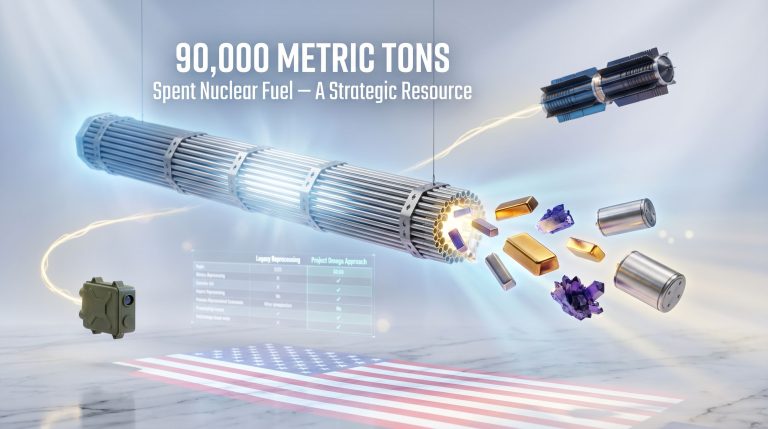
The United States has accumulated approximately 94,000 metric tonnes of spent nuclear fuel since commercial nuclear power began, with 2,000 metric tonnes added annually to existing stockpiles. Traditional approaches designate this material for permanent geological storage, but recycling technologies can recover up to 96% of valuable materials for continued energy production.
Current U.S. Nuclear Waste Inventory:
- 94,000 tonnes total accumulated spent fuel
- 77,000 tonnes designated capacity at proposed Yucca Mountain repository
- 2,000 tonnes annual generation rate
- 10,000+ years required storage duration under current approach
Chemical Composition and Recovery Potential
Spent nuclear fuel contains multiple components with varying energy and commercial value. Fresh reactor fuel typically contains 3-5% uranium-235 and 95-97% uranium-238. After reactor operation, this composition shifts dramatically, creating opportunities for selective recovery.
Spent Fuel Component Analysis:
| Material | Fresh Fuel % | Spent Fuel % | Recovery Value |
|---|---|---|---|
| Uranium-235 | 3-5% | 0.7-0.9% | Re-enrichable for reactor use |
| Uranium-238 | 95-97% | 94-95% | Direct fuel application |
| Plutonium-239 | 0% | 0.8-1.2% | High-energy density fuel |
| Fission Products | 0% | 3-4% | Medical/industrial isotopes |
The majority of spent fuel mass consists of uranium isotopes that retain significant energy potential. Traditional disposal approaches waste this resource, while recycling systems can extract and purify materials for continued reactor operation or alternative applications. Consequently, understanding these uranium market trends becomes crucial for evaluating recycling economics.
When big ASX news breaks, our subscribers know first
Advanced Separation Technologies and Process Methods
Aqueous Reprocessing Through PUREX Technology
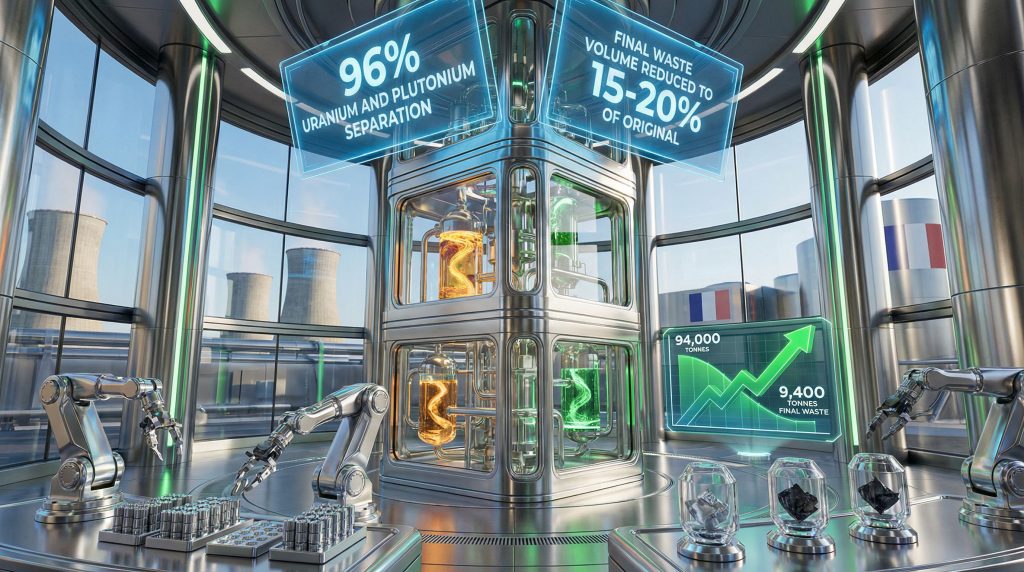
The Plutonium Uranium Redox Extraction (PUREX) process represents the most operationally mature commercial recycling technology. France's Orano operates the world's largest facility using this approach, processing 1,700 tonnes annually with 96% recovery efficiency for uranium and plutonium.
PUREX operations involve multiple sophisticated stages. Firstly, mechanical preparation and dissolution occurs where spent fuel assemblies undergo mechanical shearing into small segments. The material then dissolves in concentrated nitric acid solutions, converting uranium dioxide and plutonium dioxide to soluble nitrate forms.
Subsequently, selective solvent extraction takes place through tributyl phosphate in kerosene, which preferentially extracts uranium and plutonium. Actinide materials migrate to organic phase separation while fission products remain concentrated in aqueous waste streams. Multiple extraction cycles achieve progressive purification through this sophisticated process.
Finally, product purification and recovery involves counter-current extraction stages that separate uranium from plutonium. 99.9% purity levels are achieved through repeated processing, with recovered materials undergoing conversion for reactor fuel fabrication. The final products meet strict nuclear fuel specifications for commercial use.
France's La Hague facility demonstrates commercial viability through contracts with 30+ countries for spent fuel processing services. This operational experience spans over 70 years, establishing PUREX as proven technology rather than experimental methodology. Moreover, the facility processes spent fuel according to the World Nuclear Association's fuel cycle guidelines.
Next-Generation Pyroprocessing Methods
Electrochemical pyroprocessing offers enhanced proliferation resistance compared to traditional aqueous methods. These systems operate at 500°C in molten salt environments and cannot produce weapons-grade plutonium, addressing key security concerns that have limited U.S. recycling development.
Pyroprocessing Advantages:
- Inherent proliferation resistance through mixed product streams
- 90-95% waste volume reduction compared to original fuel mass
- Metallic fuel production compatible with advanced reactor designs
- Simplified waste management with concentrated fission product streams
The electrochemical process dissolves metallic fuel in molten salt electrolytes, then uses electrical potential differences to selectively recover uranium and plutonium. Product composition can be controlled to remain below weapons-usable purity levels while maintaining energy value for reactor applications.
Oklo Inc. has announced plans for a pyroprocessing facility in Tennessee with potential investment of $1.68 billion, specifically designed to produce metallic fuel for their Aurora fast reactor technology. This represents the first major U.S. commercial commitment to advanced recycling methods, highlighting the growing importance of sustainable fuel cycle technologies.
Global Nuclear Recycling Operations and Market Leadership
France's Commercial Dominance in Fuel Recycling
France established global leadership in commercial nuclear fuel recycling through sustained investment in PUREX technology development. Orano's La Hague facility processes spent fuel from French, Belgian, German, Italian, Spanish, Swiss, and Japanese nuclear programs, demonstrating international market viability.
La Hague Operational Metrics:
- 1,700 tonnes per year processing capacity
- 96% recovery efficiency for valuable actinides
- 15-20% final waste volume after processing
- Multi-decade operational experience with proven safety record
This facility generates revenue through contract reprocessing services while supporting France's domestic nuclear program. Mixed oxide (MOX) fuel production utilises recovered plutonium, creating closed fuel cycles that reduce uranium mining requirements and waste generation. Additionally, these operations provide valuable insights for commercial nuclear fuel recycling implementation in other regions.
Japan's Strategic Recycling Infrastructure
Japan's Rokkasho facility represents Asia's largest recycling investment, with $20+ billion committed to establishing regional processing capabilities. The 800-tonne annual capacity facility adapts French PUREX technology for Japanese operational requirements and potential regional service provision.
Strategic objectives include uranium import dependence reduction through domestic recycling, regional processing hub development for Asian nuclear programs, technology transfer from French operational experience, and waste management integration with national disposal strategies. Commercial operation timelines target the late 2020s, pending regulatory approvals and technical commissioning completion.
U.S. Policy Evolution and Commercial Development Barriers
Historical Proliferation Concerns and Regulatory Framework
The 1977 U.S. moratorium on commercial reprocessing stemmed from weapons proliferation fears during the Carter Administration. Traditional PUREX processes separate pure plutonium streams, creating materials directly applicable to nuclear weapons production. This policy position influenced international nuclear development and limited domestic recycling infrastructure.
Key Policy Barriers:
- Proliferation resistance requirements for commercial operations
- Regulatory licensing pathways absent for recycling facilities
- Economic calculations favouring abundant domestic uranium resources
- International precedent concerns regarding global recycling expansion
Emerging Commercial Renaissance
Recent developments indicate potential U.S. policy reversal supporting commercial recycling development. The Russian uranium import ban creates supply constraints beginning in 2028, while advanced reactor technologies specifically require recycled fuel feedstock.
Market Drivers Supporting Recycling:
- Supply chain security concerns following geopolitical tensions
- Advanced reactor deployment requiring specialised fuel forms
- Repository cost avoidance through waste volume reduction
- Technology competitiveness with international recycling capabilities
The Energy Innovation Reform Project's April 2026 report advocates for comprehensive federal recycling program development. In addition, this emphasises integration with advanced reactor deployment strategies and international competitiveness considerations, particularly given the US uranium production challenges.
Quantifying Environmental and Resource Benefits
Waste Volume and Radiotoxicity Reduction
Comprehensive recycling programs can dramatically reduce both waste volumes and long-term radiation hazards. Current U.S. spent fuel inventory could be reduced from 94,000 tonnes to approximately 9,400 tonnes of final waste through complete processing.
Waste Reduction Impact Analysis:
| Metric | Current Approach | With Recycling | Improvement |
|---|---|---|---|
| Total Waste Volume | 94,000 tonnes | 9,400 tonnes | 90% reduction |
| Annual Generation | 2,000 tonnes | 200 tonnes | 90% reduction |
| Storage Duration | 10,000+ years | 300-500 years | 95% reduction |
| Repository Capacity | 77,000 tonnes | 7,700 tonnes | 90% reduction |
According to the Organisation for Economic Co-operation and Development's Nuclear Energy Agency, multistage recycling paired with fast reactor technology can greatly reduce waste volume and radiotoxicity. Furthermore, this approach minimises additional uranium mining requirements, addressing broader energy security implications.
Energy Resource Extension Calculations
Closed fuel cycles utilising comprehensive recycling can extend uranium resources by factors of 25-30 compared to traditional once-through fuel cycles. Current U.S. spent fuel inventory contains sufficient energy to power the country for 150+ years through complete utilisation.
Resource Multiplication Factors:
- Energy extraction efficiency increases from 1% to 99% of uranium content
- Mining requirement reduction by 95% through fuel recycling
- Global uranium reserves effectively extended from 90 years to 2,000+ years
- Strategic resource independence through domestic fuel cycle closure
Advanced Reactor Integration and Future Applications
Fast Reactor Fuel Requirements
Next-generation reactor technologies specifically require recycled materials for optimal operation. Fast reactors can consume long-lived actinides from conventional reactor spent fuel while generating additional energy from materials traditionally considered waste.
Oklo Aurora Reactor Integration:
- Metallic uranium fuel from electrorefining processes
- 20-year refueling cycles reducing operational complexity
- Closed-loop fuel system where spent fuel becomes subsequent feedstock
- Waste burning capability consuming problematic isotopes
TerraPower's Natrium reactor design requires high-assay low-enriched uranium (HALEU) that can be produced through recycling operations. These systems integrate breeding capabilities that extend fuel resources while consuming existing waste materials.
Medical and Industrial Isotope Co-Production
Recycling operations can recover valuable isotopes for medical and industrial applications. Cesium-137 and strontium-90 separated during processing have established markets for medical device sterilisation and industrial radiography applications.
Commercial Isotope Recovery:
- Cesium-137 for medical device sterilisation
- Strontium-90 for industrial measurement systems
- Technetium-99m precursors for medical imaging
- Cobalt-60 for cancer treatment applications
These co-products provide additional revenue streams that improve recycling economics whilst supporting critical medical and industrial applications.
The next major ASX story will hit our subscribers first
Economic Analysis and Market Viability
Cost-Benefit Framework for Commercial Operations
Recycling economics depend on multiple factors including facility capital costs, operating expenses, waste management savings, and recovered material values. Recent analysis suggests improving economic viability as uranium prices increase and repository costs escalate.
Economic Component Analysis (per tonne processed):
| Cost Factor | Aqueous Process | Pyroprocessing |
|---|---|---|
| Capital Investment | $15-20 million | $8-12 million |
| Operating Expenses | $1-2 million | $0.8-1.5 million |
| Waste Management Savings | $2-3 million | $2-3 million |
| Recovered Material Value | $0.5-1 million | $0.5-1 million |
Market Drivers and Economic Tailwinds
Several converging factors increasingly favour commercial recycling development. Supply security considerations include Russian uranium ban creating domestic supply gaps beginning 2028, advanced reactor fuel requirements for specialised materials not available through mining, strategic mineral independence reducing dependence on foreign uranium sources, and international competitiveness in nuclear technology exports.
Cost Avoidance Benefits:
- Repository construction costs estimated at $100+ billion for Yucca Mountain-scale facilities
- Perpetual monitoring requirements eliminated through waste volume reduction
- Transportation cost reduction through centralised processing
- Storage infrastructure minimisation reducing long-term facility requirements
Safety, Security, and Regulatory Considerations
Proliferation Resistance Comparison
Different recycling technologies offer varying levels of proliferation resistance, influencing regulatory acceptance and international deployment potential.
Technology Security Assessment:
| Method | Plutonium Purity | Diversion Risk | Monitoring Complexity |
|---|---|---|---|
| Traditional PUREX | 99.5% pure | High | Extensive safeguards required |
| Co-extraction (COEX) | 15% plutonium mix | Medium | Moderate oversight |
| Pyroprocessing | <5% plutonium | Low | Simplified verification |
Advanced pyroprocessing methods inherently prevent weapons-grade material production whilst maintaining energy recovery capabilities. This characteristic addresses fundamental security concerns that have limited U.S. commercial development.
Worker Safety and Environmental Protection
Decades of operational experience in France and other countries demonstrate manageable safety profiles for commercial recycling operations. Occupational exposure metrics remain within regulatory limits through engineering controls and operational procedures.
Safety Performance Indicators:
- Worker radiation exposure typically below 10% of regulatory limits
- Environmental releases meet stringent discharge standards
- Accident prevention through multiple containment barriers
- Emergency preparedness protocols for facility protection
Technology Innovation and Future Developments
Artificial Intelligence Integration
Advanced process control systems incorporating artificial intelligence can optimise separation efficiency whilst enhancing safety monitoring. Real-time chemistry adjustments based on AI algorithms improve product purity and reduce waste generation.
AI Applications in Recycling:
- Process optimisation through predictive analytics
- Equipment maintenance scheduling based on operational patterns
- Quality control automation for product specifications
- Safety monitoring with anomaly detection capabilities
Next-Generation Separation Methods
Emerging technologies offer potential improvements over conventional PUREX and pyroprocessing approaches. Supercritical fluid extraction and molecular recognition systems promise enhanced selectivity with reduced chemical waste generation.
Advanced Separation Technologies:
- Supercritical fluid extraction operating at 80-150°C
- Membrane separation systems with selective ion recovery
- Continuous processing eliminating batch operation delays
- Reduced solvent consumption minimising secondary waste streams
Regulatory Framework Evolution Requirements
U.S. Licensing Pathway Development
Commercial recycling deployment requires comprehensive regulatory framework updates addressing facility licensing, safety standards, and environmental protection requirements.
Required Regulatory Modifications:
- NRC licensing categories specifically for recycling facilities
- Performance-based standards replacing prescriptive regulations
- Environmental review streamlining for commercial operations
- International cooperation agreements for technology sharing
Global Standards Harmonisation
International cooperation in recycling development requires harmonised safety standards, safeguards protocols, and operational requirements. The International Atomic Energy Agency provides frameworks for multinational collaboration.
International Cooperation Elements:
- IAEA safeguards integration with commercial operations
- Bilateral technology agreements between allied nations
- Regional recycling centres serving multiple countries
- Common safety standards facilitating technology transfer
Strategic Implications for Nuclear Energy Future
Commercial nuclear fuel recycling represents essential infrastructure for sustainable nuclear energy expansion. As reactor fleets grow globally and uranium resources face increasing demand, closed fuel cycles transition from optional efficiency measures to necessary strategic capabilities.
The convergence of supply security concerns, advanced reactor requirements, and environmental objectives creates unprecedented momentum for recycling program development. Countries establishing recycling capabilities gain competitive advantages in nuclear technology markets whilst achieving greater energy security.
Success requires coordinated policy support, international cooperation, and continued technological innovation. The United States faces strategic decisions regarding participation in global recycling markets versus continued reliance on foreign capabilities for critical nuclear fuel cycle services.
For nuclear energy to achieve its potential as a climate solution, the industry must embrace circular fuel cycles that maximise resource utilisation whilst minimising waste generation. However, commercial nuclear fuel recycling provides the technological foundation for this essential transformation, enabling sustainable nuclear energy systems capable of supporting long-term global decarbonisation objectives.
Investment Disclaimer: This article contains information about nuclear fuel recycling technologies and market developments for educational purposes. Any investment decisions should be based on thorough due diligence and professional financial advice. Nuclear energy markets involve significant regulatory, technical, and market risks that may affect investment outcomes.
Looking for Investment Opportunities in Nuclear Fuel Technologies?
Discovery Alert's proprietary Discovery IQ model delivers real-time alerts on significant ASX mineral discoveries, including uranium and critical minerals essential for nuclear energy systems. Discover why major mineral discoveries can lead to substantial market returns by exploring Discovery Alert's dedicated discoveries page, showcasing historic examples of exceptional outcomes. Begin your 14-day free trial today to position yourself ahead of the market with instant notifications on actionable investment opportunities.