June 7, 2026
Understanding Commodity Cycles and Market Sensitivity
The intricate dynamics between resource-dependent nations and global commodity markets create feedback loops that can amplify price volatility across entire industry sectors. When examining recent developments in critical battery metals markets, the relationship between policy uncertainty and investor behavior reveals fundamental patterns about how concentrated supply sources influence pricing mechanisms across global trading networks.
Indonesia's position as the world's dominant nickel supplier places extraordinary pressure on government officials tasked with balancing domestic economic objectives against international market stability. The recent nickel price decline due to Indonesia's withheld production cuts demonstrates how policy communication strategies can either stabilise or destabilise commodity pricing structures, particularly when market participants rely heavily on concentrated supply sources for critical industrial inputs.
When big ASX news breaks, our subscribers know first
How Indonesian Production Policies Trigger Global Market Reactions
The mechanism through which Indonesian nickel production decisions influence global markets operates through several interconnected channels that extend far beyond simple supply and demand calculations. Market participants monitor Indonesian policy signals with heightened sensitivity due to the nation's overwhelming market share and the limited availability of alternative supply sources capable of rapid production scaling.
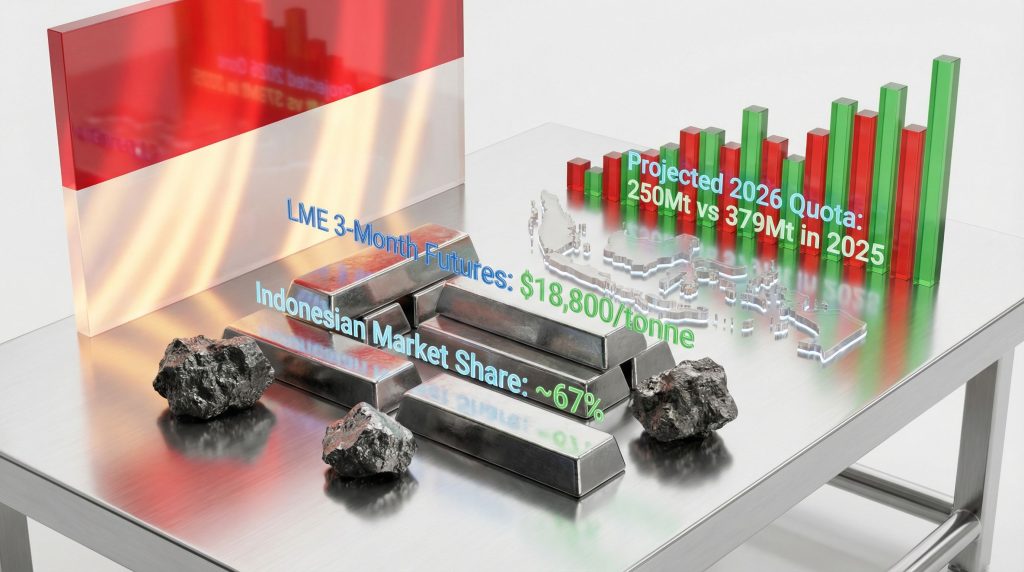
According to MiningMX reporting from January 8, 2026, three-month nickel futures on the London Metal Exchange experienced a dramatic 4.4% decline following Indonesia's failure to provide specific details regarding anticipated production reductions. This price movement occurred after the metal had reached $18,800 per tonne on an intraday basis, representing the highest level since June 2024, before declining 3.4% the previous day.
The broader price rally that began in mid-December 2025 had generated nearly 30% appreciation across the nickel complex, driven by substantial purchasing activity from Chinese traders combined with heightened geopolitical tensions affecting multiple commodity markets. By the time Energy and Mineral Resources Minister Bahlil Lahadalia conducted the January 8, 2026 press briefing, nickel had retreated to $17,285 per tonne on the LME.
Policy Communication Impact on Price Discovery
The withholding of concrete policy parameters creates challenging conditions for market participants attempting to establish fair value assessments. When Indonesian authorities declined to provide specific numerical quota details during the January press briefing, traders and investors were forced to reassess their positions without clear implementation timelines or reduction magnitudes.
Furthermore, the nickel price decline due to Indonesia's withheld production cuts reflects broader challenges in commodity price discovery mechanisms. UOB-Kay Hian Holdings analyst Benyamin Mikael provided critical market perspective, noting that price sustainability remains questionable unless quota reductions receive meaningful and consistent implementation. His analysis highlighted a fundamental disconnect between short-term market positioning and longer-term policy realities, particularly given that most existing investment commitments carry exemptions extending one to two years following quota announcements.
Chinese Market Participation and Volatility Amplification
The substantial involvement of Chinese trading entities in nickel markets creates additional layers of complexity during periods of Indonesian policy uncertainty. Chinese stainless steel and battery manufacturing supply chains depend heavily on Indonesian nickel feedstock, creating concentrated demand patterns that can amplify price movements during supply uncertainty periods.
In addition, these market volatility hedging strategies become increasingly important as traders navigate the uncertain landscape created by policy communication gaps.
Economic Drivers Behind Indonesian Production Strategy
Indonesia's approach to nickel production management reflects a sophisticated balancing act between multiple economic objectives, including export revenue optimisation, domestic value-added processing development, and infrastructure investment protection. The nation's substantial commitments to downstream processing facilities require careful coordination between mining quotas and smelting capacity utilisation rates.
Domestic Processing Infrastructure Considerations
The development of Indonesia's nickel pig iron (NPI) and high-pressure acid leaching (HPAL) facilities represents billions of dollars in capital investment that requires predictable ore supply streams for optimal utilisation. Production quota decisions must account for these processing capacity constraints while maintaining competitive positioning in global stainless steel and battery precursor markets.
Government revenue optimisation strategies involve managing output levels to influence global pricing dynamics while ensuring domestic processing facilities maintain adequate feedstock supplies. This approach requires sophisticated forecasting of both international demand patterns and domestic production capacity expansion timelines.
Infrastructure Investment Protection Mechanisms
The protection of significant capital investments in processing infrastructure drives conservative approaches to quota management. Ensuring consistent utilisation rates for smelting facilities requires predictable ore supply availability, which influences how aggressively production ceilings can be adjusted in response to market conditions.
Strategic planning must account for the multi-year development timelines associated with major processing facility expansions, creating tension between short-term market response capabilities and long-term industrial development objectives. Moreover, this connects to broader critical minerals strategy considerations that influence long-term policy decisions.
Market Structure Vulnerabilities and Supply Concentration
The extreme concentration of global nickel production in Indonesian operations creates systemic vulnerabilities that extend throughout international supply chains serving multiple industrial sectors. Limited elasticity of alternative supply sources means that even modest production adjustments can trigger disproportionate price movements across global commodity markets.
Supply Chain Dependencies Across Industries
Stainless steel production represents the largest segment of global nickel consumption, creating direct exposure to Indonesian production decisions across manufacturing facilities worldwide. Battery manufacturing supply chains face similar vulnerabilities, with electric vehicle producers monitoring Indonesian policy developments due to limited alternative sources for high-grade nickel feedstock.
The integration of Indonesian nickel into Chinese manufacturing supply chains creates additional complexity, as purchasing decisions by Chinese entities can amplify market movements during periods of production uncertainty. This concentration of demand sources parallels the concentration of supply sources, creating potential for synchronised market reactions.
Alternative Supply Source Limitations
Analysis of global nickel production capacity reveals significant constraints on the ability of alternative suppliers to rapidly scale output in response to Indonesian production adjustments. Technical, political, and financial barriers limit the responsiveness of other major producing regions, including operations in New Caledonia, Russia, Philippines, and emerging projects across Africa.
These supply constraints mean that market participants cannot easily substitute Indonesian production with alternative sources, creating price inelasticity that amplifies the impact of Indonesian policy decisions on global commodity markets. Understanding nickel: importance & uses becomes crucial for appreciating why this concentration creates such market sensitivity.
Investment and Trading Strategy Implications
The uncertainty surrounding Indonesian production quotas creates complex challenges for multiple categories of market participants, from industrial consumers managing procurement strategies to professional commodity traders adjusting risk management approaches. Investment flows across the nickel value chain respond directly to clarity levels regarding production parameters and implementation timelines.
Portfolio Risk Management Considerations
Professional investors must incorporate Indonesian policy risk assessments into portfolio construction and risk management frameworks. The concentration of global production in a single jurisdiction creates systematic risk exposures that require sophisticated hedging strategies and position sizing approaches.
However, commodity trading entities adjust their risk parameters based on policy uncertainty levels, with extended periods of ambiguity leading to reduced position sizes and increased hedging costs. The January 2026 policy communication episode demonstrates how quickly risk premiums can dissipate when expected policy actions fail to materialise with concrete specifications.
Long-term Capital Allocation Effects
Investment decisions across mining project development, processing facility expansion, and exploration activities respond to Indonesian policy clarity and consistency. Uncertainty regarding future production levels influences capital allocation decisions throughout the global nickel value chain, potentially affecting supply availability in future market cycles.
The interaction between short-term policy uncertainty and long-term investment planning creates feedback mechanisms that can perpetuate supply concentration issues over extended periods. Consequently, investors may avoid developing alternative supply sources during periods of Indonesian policy ambiguity.
Geopolitical Dimensions of Resource Management
Indonesian nickel production policies operate within broader frameworks of resource nationalism and international trade relationship management. The nation's approach to production quota implementation must balance domestic economic objectives with diplomatic considerations, particularly regarding relationships with major consuming nations like China.
Resource Sovereignty and Value-Added Processing
Indonesia's emphasis on domestic value-added processing reflects broader emerging market trends toward maximising local economic benefits from natural resource extraction. This approach requires careful coordination between raw material availability and processing capacity development timelines.
Environmental policy integration adds additional complexity to production planning, as sustainability commitments and environmental regulations influence quota determination processes. For instance, balancing economic objectives with environmental protection requirements creates multi-dimensional policy challenges that extend beyond simple market supply management.
International Trade Relationship Management
Production decisions must consider impacts on key trading partners and the broader stability of international commodity markets. Diplomatic considerations influence the timing and communication strategies associated with quota announcements, as evidenced by the measured approach Indonesian officials have taken toward providing specific policy details.
These decisions also connect to broader US‑China trade impacts and how regional tensions affect commodity market dynamics.
The next major ASX story will hit our subscribers first
Future Market Evolution and Policy Adaptation
The development of more sophisticated production management frameworks could provide enhanced market stability while preserving Indonesian policy flexibility. Technology integration opportunities include advanced monitoring systems and real-time market feedback mechanisms that could support more responsive quota adjustment processes.
Technology-Enhanced Policy Implementation
Future production management approaches might incorporate real-time market data integration and automated adjustment mechanisms that could reduce the policy uncertainty periods that create market volatility. Enhanced transparency regarding decision-making frameworks could improve market participants' ability to anticipate and prepare for production adjustments.
Regional cooperation frameworks involving coordination with other nickel-producing nations could provide more stable global supply management approaches while reducing the market impact of individual country policy decisions.
Sustainability and Governance Evolution
Future production policies will likely incorporate enhanced environmental and social governance criteria, with sustainable mining practices influencing quota allocation methodologies. The integration of climate considerations and biodiversity protection requirements into production planning represents an evolving dimension of resource management policy.
The development of more sophisticated stakeholder consultation frameworks could reduce market uncertainty by providing clearer communication regarding policy development timelines and decision-making processes.
Key Performance Metrics and Market Indicators
| Metric | Performance Data | Market Significance |
|---|---|---|
| Peak LME Price | $18,800/tonne | 19-month high achievement |
| Policy Decline | 8.3% from peak | Two-day adjustment period |
| Rally Duration | Mid-December to January | 30% appreciation cycle |
| Current Trading Level | $17,285/tonne | Post-disappointment stabilisation |
| Chinese Demand Impact | Substantial purchasing | Volatility amplification factor |
Strategic Recommendations for Market Participants
Industrial Consumer Strategies
• Develop scenario-based procurement frameworks accounting for various Indonesian policy implementation timelines
• Consider strategic inventory adjustments to buffer against potential supply constraint periods
• Evaluate alternative supplier relationships to reduce dependency on Indonesian production
• Implement risk management protocols for extended policy uncertainty periods
Investment Portfolio Considerations
• Monitor Indonesian policy announcement schedules for tactical trading opportunities
• Assess portfolio exposure to nickel price volatility through Indonesian production dependencies
• Consider geographic diversification across multiple nickel-producing regions
• Evaluate sector exposure across stainless steel, battery manufacturing, and other nickel-consuming industries
Risk Management Protocols
The sustainability of current nickel price levels depends fundamentally on the implementation of meaningful production adjustments with consistent policy follow-through, according to market analysis following Indonesia's recent policy communications.
Market participants should prepare for continued volatility periods until Indonesian authorities provide concrete implementation details regarding production quota adjustments. The nickel price decline due to Indonesia's withheld production cuts demonstrates that concentration of global supply in Indonesian operations means policy uncertainty will likely continue generating significant price movements across nickel-dependent supply chains.
Additionally, understanding tariff policy effects becomes essential for investors seeking to navigate the complex interplay between trade policy and commodity markets. According to S&P Global analysis, Indonesia continues to navigate nickel market dynamics through careful policy implementation that balances domestic economic objectives with global market stability requirements.
Disclaimer: This analysis contains forward-looking assessments regarding commodity markets, policy implementations, and investment considerations. Market conditions can change rapidly, and past performance does not guarantee future results. Readers should conduct independent research and consult qualified professionals before making investment decisions. Commodity trading involves substantial risk and may not be suitable for all investors.
Ready to Capitalise on Commodity Market Volatility?
Discovery Alert's proprietary Discovery IQ model delivers real-time alerts on significant ASX mineral discoveries, including critical battery metals opportunities, instantly empowering subscribers to identify actionable opportunities ahead of the broader market. Understand why major mineral discoveries can generate substantial returns by exploring historic examples of exceptional market outcomes, then begin your 30-day free trial today to position yourself ahead of volatile commodity cycles.