June 19, 2026
The Commodity Price Volatility Revolution: How Extreme Market Swings Are Reshaping Global Agricultural Systems
Agricultural commodity markets worldwide face an unprecedented era of price volatility that challenges traditional business models, financial structures, and policy frameworks. The magnitude of recent price corrections across key commodities has exposed fundamental weaknesses in established trading mechanisms while revealing the urgent need for comprehensive structural reforms in cocoa market dynamics and broader agricultural systems.
Modern commodity markets operate within increasingly complex global networks where traditional supply-demand relationships interact with financial speculation, climate variability, and geopolitical tensions. When price movements exceed 75% corrections within quarterly periods, as witnessed across multiple agricultural sectors, the impacts cascade through entire value chains, affecting everything from smallholder farmer incomes to multinational processor margins.
Understanding these market transformations requires examining both immediate price dynamics and the underlying structural factors driving volatility. The cocoa sector provides a particularly instructive case study, having experienced one of the most dramatic market cycles in recent commodity history. Furthermore, these developments align with broader patterns of commodity volatility hedging strategies emerging across global markets.
When big ASX news breaks, our subscribers know first
Understanding Current Global Commodity Market Transformation
The global cocoa market experienced unprecedented volatility between December 2024 and March 2026, with prices declining from $12,906 per metric ton to approximately $3,000 per metric ton on the New York exchange, representing a 76.8% correction within just three months. This dramatic price movement illustrates the extreme market conditions now characterising agricultural commodity sectors.
According to analysis from Edward George, founder of Kleos Advisory, the market has transitioned from supply scarcity to a projected global surplus of approximately 200,000 metric tons or potentially higher. This fundamental shift from supply-constrained to demand-constrained conditions represents what George describes as the cocoa market having clearly entered a new cycle.
The rapidity of this transformation challenges conventional market analysis frameworks. Traditional commodity price models typically anticipate gradual adjustments over extended periods, yet current market dynamics demonstrate how quickly fundamental conditions can reverse. George notes that similar cycles occur roughly every 10 to 15 years, but emphasises that current conditions involve a very heavy impact due to concurrent demand-side pressures.
Demand-Side Structural Changes
Beyond supply fluctuations, fundamental demand patterns are experiencing significant shifts across major consuming regions. George's analysis identifies clear declines in cocoa grinding and usage across Europe, North America, and Asia, creating dual pressure on market fundamentals.
Chocolate manufacturers are simultaneously reducing cocoa usage while developing alternative formulations, while cost-of-living pressures drive household reductions in confectionery purchases and restaurant consumption. This combination creates structural demand challenges that extend beyond cyclical market patterns.
The development of alternative formulations incorporating cocoa fruit waste and non-cocoa ingredients potentially represents permanent shifts in chocolate composition, fundamentally altering long-term cocoa demand projections. In addition, these trends reflect broader concerns about global recession risks affecting consumer spending patterns.
Core Structural Challenges Requiring Market Reform
Price Volatility and Business Model Sustainability
The magnitude of recent price corrections creates sustainability challenges across all value chain participants. When commodity prices experience corrections exceeding 75% within quarterly periods, traditional business planning horizons become inadequate for operational stability.
Farmgate price adjustments reflect the immediate impact of volatility on producer economies. Côte d'Ivoire implemented a 57% reduction in farmgate prices, while Ghana implemented a 28.6% reduction to address accumulated bean inventory and restart purchasing mechanisms. These divergent adjustment magnitudes suggest differential vulnerability to price volatility across producing regions.
The extreme nature of these adjustments indicates that traditional fixed-pricing and forward-sales mechanisms struggle to accommodate rapid price movements within operational planning horizons. George's analysis suggests that current market volatility creates unsustainable conditions for stakeholders from smallholder farmers to multinational processors.
Geographic Concentration Vulnerabilities
Heavy reliance on concentrated producing regions creates systemic vulnerabilities throughout global supply chains. Côte d'Ivoire and Ghana, as the world's largest cocoa producers, dominate global supply, creating exposure to weather-related disruptions, political instability, and economic shocks within limited geographic areas.
George emphasises that cocoa governance requires rethinking not only in Ghana and Côte d'Ivoire but also in Cameroon and Nigeria, where markets operate with more open structures. This geographic diversification represents a potential pathway toward reduced concentration risk.
The concentration challenge extends beyond production to processing and trading infrastructure, where traditional systems were designed for relatively stable supply-demand relationships rather than rapid market transitions. These challenges mirror broader concerns about trading giants' asset focus in managing portfolio risks.
Outdated Marketing System Architecture
Traditional marketing board systems in major producing countries operate through government-controlled forward contracting mechanisms that require fundamental redesign to accommodate rapid price movements and changing global demand patterns.
Rigid forward-sales contracts and fixed pricing structures created during periods of more stable market conditions now prove inadequate for managing extreme volatility. The traditional approach of predetermined pricing arrangements conflicts with market realities requiring real-time price responsiveness.
These structural limitations necessitate comprehensive reforms in marketing system architecture to balance producer price stability with market responsiveness.
Leading Countries Implementing Market Reforms
West African Producer Adaptations
Côte d'Ivoire's Marketing System Revolution
As the world's largest cocoa producer, Côte d'Ivoire is implementing comprehensive reforms to its marketing board system, moving away from rigid forward-sales contracts toward more flexible pricing mechanisms designed to better reflect real-time market conditions.
The country's 57% farmgate price reduction represents part of broader market stabilisation efforts addressing accumulated cocoa inventory. These adjustments indicate recognition that traditional pricing mechanisms require fundamental overhaul to manage contemporary market dynamics.
Reform initiatives aim to create more responsive pricing systems while maintaining sufficient stability for producer planning. This balance represents a critical challenge in designing effective marketing reforms.
Ghana's Financial Innovation Framework
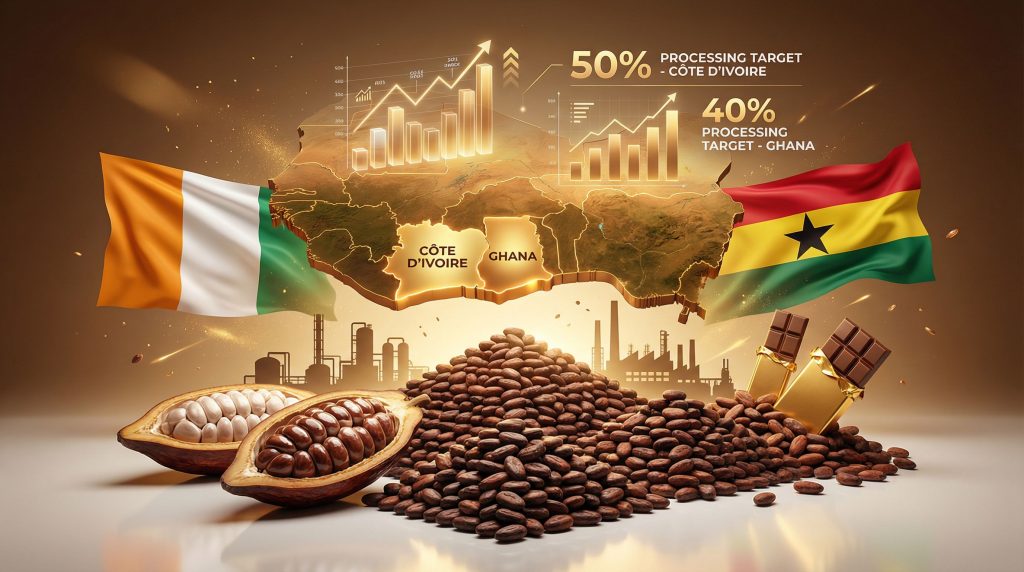
Ghana's Cocobod is exploring domestic cocoa-backed bond financing to reduce dependence on international credit markets while maintaining price stability for farmers during volatile periods. The country has announced a target to process 50% of the harvest by the 2026/2027 season.
Edward George emphasises significant political-economy considerations affecting Ghana's financial innovations. Implementation of new financing systems depends on coordination between the central bank, Ministry of Finance, and Parliament. Historical legacy issues with poorly managed fundraising operations create market wariness that must be addressed through reform implementation.
Ghana's 28.6% farmgate price reduction represents a more modest adjustment than Côte d'Ivoire's approach, potentially reflecting different stabilisation philosophies or structural differences in farmer dependency on government price support mechanisms.
The proposed domestic cocoa-backed bond financing model represents innovative commodity stabilisation financing. Rather than accessing international credit markets subject to broader economic volatility, this model would create domestic debt instruments secured by cocoa revenues, theoretically providing more stable long-term financing for marketing operations.
Emerging Producer Market Positioning
Ecuador's Premium Differentiation Strategy
Ecuador has capitalised on supply diversification trends by positioning itself as a premium origin, attracting buyers seeking alternatives to traditional West African sources. This market differentiation strategy focuses on quality premiums and supply reliability rather than volume expansion.
Premium positioning allows Ecuador to capture value through product differentiation while benefiting from buyer interest in supply source diversification. This approach demonstrates how smaller producers can leverage market uncertainty to establish competitive advantages.
Indonesia's Value-Addition Success
Indonesia has achieved 80% value-added processing targets through post-2011 export tax policies that shifted production toward processed cocoa products rather than raw beans. This policy intervention demonstrates how strategic government action can drive value chain transformation.
Indonesia's approach illustrates successful value-addition strategies that capture downstream processing value rather than exporting raw commodities. The policy framework created incentives for domestic processing capacity development while generating government revenue through tax mechanisms.
Processing and Manufacturing Sector Adaptations
Industry Restructuring Responses
Major cocoa processors are considering operational separations between trading and manufacturing divisions to better manage price volatility and risk exposure. This structural reorganisation reflects strategic recognition that integrated trading-manufacturing models may create conflicting incentives and risk exposures during volatile market periods.
Separated organisational structures potentially allow more specialised risk management approaches, with trading divisions focused on commodity price management while manufacturing operations concentrate on processing efficiency and product development.
Alternative Product Development
Manufacturers are developing alternative formulations incorporating cocoa fruit waste and non-cocoa ingredients, potentially creating permanent shifts in chocolate composition and reducing dependence on traditional cocoa beans.
George's analysis emphasises dual demand-side pressures driving these innovations. Chocolate manufacturers use less cocoa while developing alternative formulations, simultaneously responding to ingredient cost pressures and consumer preference evolution.
These product innovations may represent structural changes in chocolate manufacturing that reduce traditional cocoa dependency regardless of future price movements. However, trade tensions continue to create additional uncertainties, as highlighted by recent US‑China trade impact assessments.
Trading Mechanism Reform Initiatives
African Cocoa Exchange Development
The proposed African Cocoa Exchange (AfCX) represents a fundamental shift toward regional price discovery and local market integration, potentially reducing dependence on international commodity exchanges.
Edward George advocates for the AfCX as allowing prices paid to producers to better reflect local market conditions. The International Cocoa Organisation's project to create an African Cocoa Exchange could play a key role in this transformation.
Key Benefits of Regional Exchange Development:
• Enhanced price transparency for local producers
• Improved access for regional processors
• Reduced reliance on multinational trading houses
• Better alignment between local supply and demand
George notes that processors could turn to the platform to source beans when they cannot obtain them through traditional supply chains dominated by trading houses and multinational chocolate companies.
An African Cocoa Exchange would function as a regional commodities platform, enabling price discovery based on African supply-demand dynamics rather than exclusively through internationally-traded exchanges where African market conditions represent one input among global factors.
Direct Trading Relationship Development
Structural reforms in cocoa market mechanisms are facilitating direct relationships between producers and chocolate manufacturers, bypassing traditional intermediaries and creating more equitable value distribution.
Direct trading arrangements potentially eliminate multiple intermediary margins while providing producers with better market information and chocolate manufacturers with more reliable supply relationships.
The next major ASX story will hit our subscribers first
Local Processing Capacity Enhancement Strategies
Value-Addition Policy Frameworks
Producing countries are implementing comprehensive policies to boost local processing capacity, moving beyond raw bean exports to capture higher-value manufacturing activities.
Processing Capacity Expansion Targets:
| Country | Processing Target | Policy Mechanism | Timeline |
|---|---|---|---|
| Côte d'Ivoire | 50% of production | Investment incentives | 2026-2027 |
| Ghana | 40% of harvest | Cocobod processing | 2026-2027 |
| Indonesia | 80% value-added | Export taxes on beans | Ongoing |
| Ecuador | Premium processing | Quality certification | 2025-2026 |
These targets represent significant shifts from traditional raw commodity export models toward domestic value-addition strategies. Success requires substantial infrastructure investments, technical capacity building, and market development initiatives.
Infrastructure Development Requirements
Structural reforms in cocoa market processing include significant investments in processing infrastructure, quality control systems, and logistics networks to support expanded local value addition.
Infrastructure development encompasses:
• Processing facility construction and equipment installation
• Quality control laboratory establishment
• Transportation and logistics network enhancement
• Technical training programme implementation
• Market information system development
Demand-Side Reform Implications
Consumer Market Evolution
Changing consumption patterns, influenced by health consciousness and economic pressures, are driving manufacturers to reconsider traditional chocolate formulations and pricing strategies.
Cost-of-living pressures create household reductions in confectionery purchases and restaurant consumption, generating structural demand challenges beyond cyclical market fluctuations.
Regulatory Compliance Requirements
The EU Deforestation Regulation and similar sustainability mandates are forcing structural reforms in cocoa market sourcing practices, traceability systems, and supply chain documentation. These regulatory pressures coincide with broader tariff impact insights affecting global trade flows.
Regulatory compliance requirements create additional operational costs while potentially providing market differentiation opportunities for producers meeting sustainability standards.
Alternative Financing Models for Market Reform Support
Domestic Bond Market Development
Countries are exploring cocoa-backed domestic bonds to finance marketing operations and reduce exposure to international credit volatility. These instruments represent innovative approaches to commodity stabilisation financing.
Domestic Bond Financing Benefits:
• Reduced dependence on international credit markets
• Local currency denomination reducing exchange rate risk
• Domestic investor base development
• Enhanced market stability during volatile periods
Cooperative Financing Enhancement
Enhanced cooperative structures are being developed to provide farmers with better access to credit, inputs, and market information while strengthening collective bargaining capabilities.
Cooperative financing models can provide farmers with:
• Improved credit access at reasonable rates
• Bulk input purchasing arrangements
• Collective marketing capabilities
• Technical assistance and training programmes
Long-Term Structural Transformation Outcomes
Market Diversification Achievements
Structural reforms in cocoa market systems are expected to create more geographically diverse supply bases, reducing systemic risks associated with concentration in traditional producing regions.
Diversification benefits include enhanced supply security, reduced weather-related risk exposure, and improved bargaining power for producing countries through reduced dependence on concentrated trading relationships.
Value Chain Rebalancing
Reform initiatives aim to redistribute value more equitably across cocoa chains, from farmers to final consumers, through enhanced local processing and direct trading relationships.
Rebalancing involves:
• Increased producer capture of processing margins
• Reduced intermediary value capture
• Enhanced market information access for producers
• Improved price responsiveness throughout value chains
Sustainability Integration
Reform initiatives increasingly incorporate environmental and social sustainability requirements, creating long-term structural changes in production practices and supply chain management.
Sustainability integration creates additional compliance costs while potentially providing market access and premium pricing opportunities for certified producers.
Implementation Challenges and Success Factors
Political Economy Coordination Requirements
Successful reform initiatives require coordination between government agencies, central banks, and parliamentary bodies, particularly in countries with complex political structures.
Edward George emphasises that implementation of new financing systems depends on positions taken by central banks, finance ministries, and parliamentary leadership. Historical legacy issues with poorly managed fundraising operations create market wariness requiring careful reform implementation.
Market Acceptance Balance
Reform initiatives must balance producer interests with buyer requirements, ensuring that structural changes do not disrupt established commercial relationships while achieving reform objectives.
Technical Capacity Building
Effective implementation requires significant investments in human capital, technology infrastructure, and institutional capacity across producing countries.
Technical Capacity Requirements:
• Training programmes for marketing board staff
• Technology system implementation
• Quality control system establishment
• Market information system development
• Financial management capability enhancement
Measuring Reform Effectiveness and Future Scenarios
Reform success measurement requires comprehensive indicator frameworks addressing multiple stakeholder interests and market functionality dimensions. According to industry analysis from J.P. Morgan's commodity research, effective monitoring systems must track both immediate market stabilisation effects and longer-term structural improvements.
Critical Performance Metrics:
• Price stability indicators for farmers
• Processing capacity utilisation rates
• Market share distribution among trading entities
• Supply chain resilience measurements
• Sustainability compliance achievement levels
Long-term evaluation must consider both market functionality improvements and social-economic outcomes for producing communities. Furthermore, cocoa market reform initiatives continue to reshape traditional trading relationships across global supply chains.
The transformation of global cocoa markets illustrates broader challenges facing agricultural commodity systems worldwide. As traditional market mechanisms prove inadequate for managing extreme volatility, comprehensive structural reforms become essential for sustainable industry development. Success requires coordination across multiple stakeholders, innovative financing mechanisms, and adaptive policy frameworks capable of responding to rapidly changing market conditions.
These reform initiatives represent fundamental shifts in how agricultural commodities are produced, traded, and consumed globally. Their outcomes will influence not only cocoa market stability but also serve as models for addressing similar challenges across other agricultural sectors facing comparable structural transformation pressures.
Investment Disclaimer: This analysis is for informational purposes only and does not constitute investment advice. Commodity markets involve significant risk, and past performance does not guarantee future results. Investors should conduct their own research and consult with qualified financial advisors before making investment decisions.
Looking to Capitalise on Commodity Market Volatility?
Discovery Alert's proprietary Discovery IQ model delivers real-time alerts on significant ASX mineral discoveries, instantly empowering subscribers to identify actionable opportunities ahead of the broader market during these periods of extreme commodity volatility. Begin your 14-day free trial at Discovery Alert today and secure your market-leading advantage whilst traditional agricultural commodities face unprecedented structural challenges.