June 19, 2026
The Architecture of Global Oil Vulnerability: Understanding the Strait of Hormuz Crisis
Every decade or so, global energy markets are forced to confront an uncomfortable truth: the modern industrial economy's dependence on oil flows through a handful of geographic pinch points makes it structurally fragile in ways that no amount of diplomatic engineering has yet resolved. The Persian Gulf's Strait of Hormuz sits at the apex of this vulnerability, and recent events involving the US Iran oil deal and Strait of Hormuz oil flow have brought that fragility into sharp focus for traders, policymakers, and supply chain planners alike.
Understanding what actually happened, what it means operationally, and why the deal's durability remains genuinely uncertain requires moving well beyond headline-level analysis. Furthermore, the current crude oil prices reflect just how sensitive markets are to developments at this critical chokepoint.
When big ASX news breaks, our subscribers know first
Why the Strait of Hormuz Is Unlike Any Other Energy Chokepoint
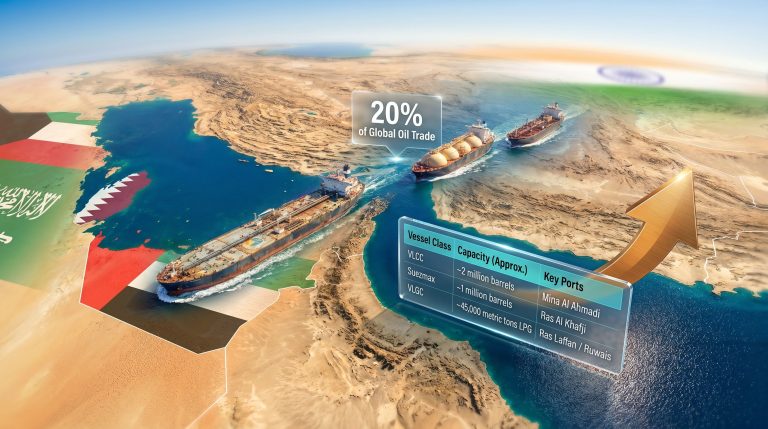
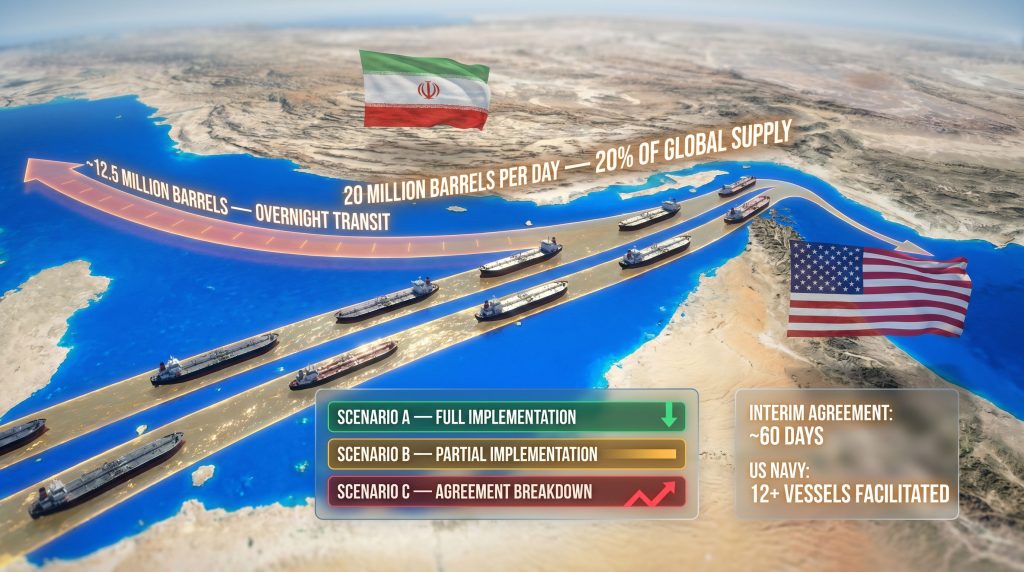
The Strait of Hormuz occupies a category of its own among global energy transit corridors. According to the U.S. Energy Information Administration, approximately 20 million barrels per day (bpd) of petroleum liquids transited the strait in 2024, representing roughly 20% of total global petroleum liquids consumption. No other single transit point comes close to that concentration.
By comparison:
- The Suez Canal handles a significantly smaller share of global oil trade
- The Strait of Malacca, critical for Asian energy imports, carries a lower proportion of total global petroleum
- The Bab-el-Mandeb strait, disrupted by Houthi activity in the Red Sea crisis, handles a fraction of Hormuz volumes
The consequence of this concentration is severe. Market analyses estimate that a full functional closure of the strait, whether through military blockade, commercial insurance withdrawal, or active vessel interdiction, could remove approximately 11 million bpd from accessible global supply flows. That is not a price shock. That is a civilisational infrastructure event.
The Physical Bottleneck That Cannot Be Engineered Away
What makes Hormuz especially problematic from an energy security standpoint is the absence of scalable alternatives. The navigable channel measures roughly 2 miles wide in each direction, a constraint that no amount of geopolitical goodwill can alter. Bypass infrastructure exists, including the Abu Dhabi Crude Oil Pipeline and Saudi Arabia's East-West Pipeline, but these can collectively offset only a fraction of normal strait throughput.
There is also a second, less discussed chokepoint that operates in parallel with the physical geography: war-risk insurance markets. When Lloyd's of London and comparable underwriters withdraw coverage or spike premiums to punitive levels, commercial tanker operators halt transits regardless of what any political agreement says on paper. The insurance market, consequently, functions as an autonomous commercial veto over whether oil physically moves, independent of diplomatic frameworks.
Critical Insight: The Strait of Hormuz cannot be understood purely as a geographic feature. It is a system where military posture, diplomatic status, and commercial insurance decisions interact simultaneously. All three must align for oil to flow at normal volumes.
Breaking Down the US-Iran Interim Agreement
The framework reached between Washington and Tehran is structured as an interim memorandum with a reported operational window of approximately 60 days. Its core provisions include:
- A negotiated ceasefire framework
- Targeted sanctions relief or export waivers enabling Iranian crude re-entry into global markets
- A commitment to restore commercial transit access through the Strait of Hormuz
- A phased U.S. military drawdown toward pre-conflict troop deployment levels
- A defined pathway to direct diplomatic negotiations between the two governments
Vice President JD Vance confirmed that the U.S. Navy facilitated the passage of more than a dozen vessels toward Iranian ports as part of the agreement's early implementation. In the overnight period following the deal's announcement, an estimated 12.5 million barrels of crude oil moved through the Strait of Hormuz, representing the first material normalisation of traffic since the conflict disrupted global energy supply chains.
The Khamenei Dimension: Approval With Reservation
Iran's Supreme Leader Ayatollah Khamenei publicly approved the agreement, but his framing introduced a layer of implementation risk that markets and policymakers cannot responsibly ignore. His approval was conditional, anchored in commitments from Iran's president and security council members to protect national rights and what he described as obligations to the resistance front.
Critically, Khamenei signalled that Iran's willingness to engage in future direct talks with the United States would not constitute any acceptance of American positions or frameworks. This dual-track posture, formal approval combined with ideological distance, is a well-documented feature of Iranian diplomatic strategy. Historically, it has frequently preceded renegotiation pressure during or after the implementation window.
Analytical Warning: When a head of state approves an agreement while publicly distancing himself from its terms, the diplomatic signal is not stability. It is a reservation of the right to reinterpret or exit. Investors and supply chain planners should model this as elevated implementation risk, not confirmed resolution.
How Oil Markets Responded and Why the Move Was Incomplete
Oil price movements fell toward pre-war lows in the hours following the deal's announcement. The price movement was driven primarily by supply expectation repricing rather than any verified physical delivery change. Markets responded to three converging signals:
- The U.S. Navy's active facilitation of vessel transit through the strait
- The public release of the interim agreement text by both governments
- Vice President Vance's statement that technical implementation talks could begin within days
However, the price decline did not fully reflect the scale of supply that would theoretically be restored if the deal held. That gap reflects the distinction between diplomatic reality and operational reality.
The Operational Gap: What the Tables Show
| Factor | Status at Time of Announcement |
|---|---|
| Formal agreement signed | Confirmed |
| U.S. Navy vessel facilitation | Confirmed (12+ ships) |
| Commercial shipping normalised | Not yet confirmed |
| War-risk insurance reinstated | Unconfirmed |
| Iranian export volumes rising | Not yet materially verified |
| Full strait traffic restoration | Partial and limited in practice |
Multiple shipping trackers noted that actual vessel traffic remained well below normal levels despite the diplomatic breakthrough. The critical mechanism at work here is that political agreements establish the framework, but insurance market decisions determine whether tankers actually sail. War-risk premium normalisation typically lags political agreements by days to weeks, depending on on-the-ground verification and active claims history. As reported by the Wall Street Journal, even with the deal in place, full commercial shipping restoration could take considerably longer than the headlines suggest.
Three Scenarios for Oil Price Trajectories
Scenario A: Full Implementation
Iranian exports ramp toward pre-sanctions levels of approximately 2.5 to 3 million bpd within the 60-day window. Commercial shipping resumes fully, and war-risk premiums normalise. Global oil prices face sustained downward pressure as supply surplus builds. This is bullish for supply, bearish for price.
Scenario B: Partial Implementation
Technical talks proceed but sanctions waivers face administrative delays. Shipping resumes partially while insurance markets remain cautious. Oil prices stabilise in a mid-range band, with volatility tied to compliance reporting cycles.
Scenario C: Agreement Breakdown
Iran fails to meet commitments or the U.S. resumes pressure, which President Trump explicitly threatened if Tehran did not honour its obligations. Blockade conditions return, war-risk premiums spike, and oil prices surge back above pre-deal levels with amplified volatility.
Investor Note: Scenario B is arguably the most underappreciated by markets. A partial implementation outcome that drags through the full 60-day window would generate chronic uncertainty rather than resolution, forcing oil traders to price risk continuously rather than decisively in either direction. This analysis represents a forward-looking assessment and should not be treated as financial advice. Oil market outcomes depend on geopolitical variables that are inherently unpredictable.
The Regional Complexity: Why This Is Not a Bilateral Story
The US-Iran framework sits inside a much larger regional conflict architecture that resists bilateral containment. President Trump publicly indicated his expectation of a comprehensive ceasefire across all active fronts, explicitly naming Lebanon, Hezbollah, and Israel. Yet Israeli forces conducted fresh airstrikes on Lebanon during the same period the deal was being finalised, illustrating the gap between Washington's ceasefire ambitions and ground-level realities.
The Iran-Hezbollah supply chain relationship is a material variable here. Any sanctions relief granted to Iran has downstream implications for the financial and weapons flows that sustain non-state actors in Lebanon and elsewhere. Khamenei's insistence on protecting obligations to the resistance front signals that Iran views its regional proxy network as structurally non-negotiable, not a bargaining chip for future talks.
Historical precedent from the 2015 Joint Comprehensive Plan of Action (JCPOA) negotiations is instructive. Attempts to decouple nuclear agreements from Iran's regional security posture consistently generated the most friction and ultimately contributed to the framework's instability. The 2026 interim deal is likely to encounter the same structural fault line if and when direct US-Iran talks move beyond the 60-day window. In addition, the geopolitical oil price factors at play here extend well beyond any single bilateral agreement.
Global Supply Chain Implications Beyond the Strait
OPEC+ Under Pressure From Iranian Re-entry
The potential return of Iranian crude barrels to global markets at scale creates a structural headache for OPEC+ members who maintained or expanded production during the disruption period. OPEC's market influence is already being tested, as Saudi Arabia and the UAE face a strategic dilemma that does not resolve cleanly: absorb Iranian re-entry at the cost of lower prices, or accelerate production cuts to defend price floors while ceding market share.
The compressed 60-day interim timeline gives OPEC+ very little runway to formulate and coordinate a coherent response before market expectations are already shifting.
Asian Demand Centres and the Rerouting Premium
China, India, Japan, and South Korea collectively represent the dominant buyer base for Persian Gulf crude. During the disruption period, these refiners absorbed elevated freight costs, insurance premiums, and supply substitution costs. A genuine normalisation of Strait of Hormuz transit would directly reduce the landed cost of crude for Asian refiners, with downstream effects on refined product pricing across the region.
For Indian refiners in particular, who have become significant buyers of discounted Iranian crude during various sanctions periods historically, any restoration of normalised Iranian export volumes carries both commercial opportunity and sanctions compliance complexity. Furthermore, the trade war impact on oil adds another layer of complexity for Asian buyers already navigating shifting supply relationships.
The next major ASX story will hit our subscribers first
Five Indicators That Will Determine Whether the Deal Holds
- Full agreement text publication and ratification: Partial releases create interpretive ambiguity that markets automatically price as risk premium
- Commercial insurance market response: War-risk premium trajectories are the single most operationally meaningful signal available in near real time
- Iranian crude export volume data: Tanker tracking services provide near-real-time verification of whether barrels are physically moving, independent of diplomatic statements
- U.S. troop drawdown progress: The pace of military repositioning signals Washington's actual commitment to the deal's terms beyond public statements
- Regional ceasefire compliance: Any resumption of active Israeli-Lebanese hostilities or renewed Houthi maritime interdiction activity could destabilise the broader framework regardless of bilateral US-Iran progress
Summary Data Table: Key Metrics at a Glance
| Metric | Value or Status |
|---|---|
| Normal Strait of Hormuz daily throughput | ~20 million bpd (EIA, 2024) |
| Share of global petroleum consumption | ~20% |
| Estimated disruption impact (full closure) | ~11 million bpd removed |
| Crude transiting strait post-deal (overnight) | ~12.5 million barrels |
| U.S. Navy vessels permitted through | 12+ ships |
| Interim agreement duration | ~60 days |
| Oil price direction post-announcement | Fell toward pre-war lows |
| Commercial shipping normalisation | Partial, not yet fully restored |
| Insurance market status | Unconfirmed normalisation |
Frequently Asked Questions
How much oil normally flows through the Strait of Hormuz?
According to the U.S. Energy Information Administration, approximately 20 million barrels per day of petroleum liquids transited the Strait of Hormuz in 2024, representing around 20% of global petroleum liquids consumption. This makes it the world's single highest-volume oil transit chokepoint by a substantial margin.
Why didn't oil prices fall more dramatically if the deal was signed?
Markets are pricing the gap between diplomatic agreement and operational reality. Commercial shipping normalisation depends on war-risk insurance reinstatement, independent decisions by port operators and tanker owners, and verified increases in Iranian export volumes. None of these occur automatically following a political announcement. For context, current crude oil prices continue to reflect this uncertainty even in the post-announcement period.
What happens if Iran does not comply?
President Trump explicitly stated that the United States would resume military operations if Iran failed to honour its commitments under the deal. This threat functions as the primary enforcement mechanism in the absence of formal multilateral verification infrastructure.
Is the Strait of Hormuz fully open again?
As of the deal's announcement, the strait was partially reopened with U.S. Navy facilitation confirmed. However, commercial shipping had not yet fully normalised, and insurance market conditions remained a practical constraint on complete operational restoration.
The Structural Problem That One Deal Cannot Solve
The US Iran oil deal and Strait of Hormuz oil flow normalisation represent a de-escalation event, not a structural solution. The conditions that transformed the strait into a crisis flashpoint, including Iran's geographic leverage, the region's interlocking proxy conflict architecture, and the deep-seated sanctions dispute, remain fully intact beneath the diplomatic surface.
A 60-day interim framework with unresolved implementation risks establishes a precedent for repeated negotiation cycles rather than durable resolution. For energy markets and supply chain planners, the practical implication is that chronic uncertainty around Persian Gulf oil exposure must be priced in even during periods of apparent diplomatic stability.
The Strait of Hormuz has never been just a waterway. It is the most consequential leverage point in global energy geopolitics, and one interim memorandum has not changed that underlying reality.
This article is intended for informational purposes only and does not constitute financial or investment advice. Forward-looking scenarios and market projections involve inherent uncertainty and should not be relied upon as predictions of specific outcomes. Readers are encouraged to consult the U.S. Energy Information Administration's publicly available analysis of international energy transit infrastructure for additional context.
Want to Stay Ahead of ASX Mineral Discoveries Linked to Global Commodity Shifts?
When geopolitical events like Strait of Hormuz disruptions reshape commodity markets, the ripple effects extend well beyond oil — and Discovery Alert's proprietary Discovery IQ model instantly identifies significant ASX mineral discoveries across 30+ commodities, translating complex market signals into actionable investment insights. Explore how historic discoveries have generated substantial returns and begin your 14-day free trial at Discovery Alert to position yourself ahead of the next major market-moving announcement.