June 19, 2026
The Strait of Hormuz as a Barometer for Global Energy Risk
Few geographic features carry as much weight in global energy markets as a narrow stretch of water between the Arabian Peninsula and Iran. The Strait of Hormuz, at its narrowest point roughly 33 kilometres wide, functions as the circulatory system of global oil and gas trade. When it flows freely, markets operate with quiet efficiency. When it does not, the consequences ripple across every refinery, every fuel pump, and every household cooking stove from Mumbai to Manila.
Understanding why Indian Oil Corp Hormuz oil and LPG tenders matter requires stepping back from the transactional detail and examining what this procurement activity reveals about the structural architecture of Asian energy security, the sensitivity of global freight markets to geopolitical signalling, and the domestic stakes for one of the world's most energy-hungry economies.
Why India's Hormuz Exposure Is Structurally Unique
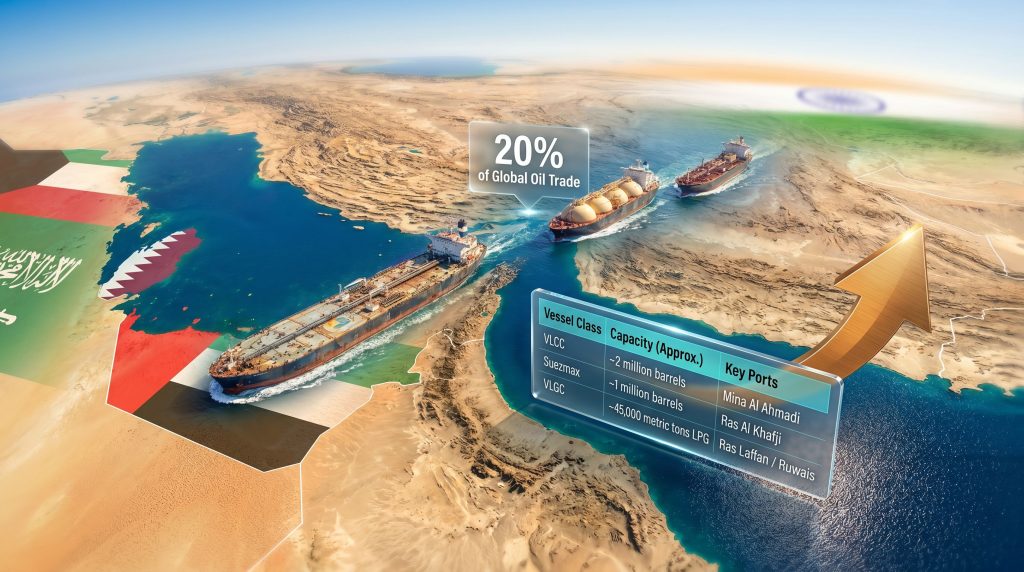
The Strait of Hormuz handles approximately 20% of global oil trade by volume, along with a substantial share of the world's seaborne LPG flows. For India, ranked as the world's third-largest oil importer, this single chokepoint represents a concentration of supply risk that no other geography can replicate at equivalent scale. The country's refining system is calibrated around Gulf crude grades, its LPG import infrastructure is built for Gulf tanker sizes, and its pricing benchmarks are tethered to Middle Eastern spot markets.
This is not merely a logistics dependency. It is a structural condition embedded in decades of infrastructure investment, bilateral supply agreements, and refinery configuration decisions. Replacing Gulf supply at short notice with alternative origins from West Africa or the Americas carries significant logistical cost premiums and blending complexity that constrained buyers like state-owned refiners cannot absorb easily. Furthermore, oil price movements in these alternative markets add another layer of uncertainty for procurement planners.
When big ASX news breaks, our subscribers know first
What the US-Iran Interim Agreement Unlocked for Procurement
A diplomatic agreement between the United States and Iran aimed at de-escalating conflict and restoring navigational freedom through the strait created an immediate operational window that energy procurement teams had been waiting for. The agreement functioned as a trigger event rather than a permanent resolution, prompting state-owned energy companies to re-engage Gulf loading ports that had been operationally constrained during the preceding period of heightened tension.
Market Signal: When a buyer of IOC's scale re-enters Hormuz-linked procurement activity with short loading windows, it is not making a casual commercial decision. It is communicating an institutional risk assessment that the corridor is sufficiently stable for near-term operational planning.
The speed of IOC's response following the agreement is itself informative. Rather than adopting a wait-and-see posture, the company moved to issue simultaneous tenders across multiple vessel classes and multiple loading ports. This indicated that buffer inventories had been managed conservatively during the disruption period and that replenishment had become urgent.
Breaking Down IOC's Three-Vessel Chartering Activity
Indian Oil Corporation, India's largest refiner by throughput, issued simultaneous tenders for three distinct vessel classes following the easing of Hormuz transit restrictions. This multi-vessel approach reflects both the scale of India's supply requirements and the strategic logic of moving across different cargo types and loading origins simultaneously. According to Reuters, IOC's coordinated chartering across vessel classes signals a level of operational urgency consistent with tightened inventory positions.
| Vessel Type | Cargo | Approximate Capacity | Loading Window |
|---|---|---|---|
| Very Large Gas Carrier (VLGC) | Liquefied Petroleum Gas | ~45,000 metric tons | June 30 – July 4 |
| Very Large Crude Carrier (VLCC) | Crude Oil | ~2 million barrels | June 28–29 |
| Suezmax Tanker | Crude Oil | ~1 million barrels | June 29–30 |
LPG Loading Ports: Multi-Country Optionality as Risk Architecture
IOC's VLGC tender covers three potential loading locations across different Gulf jurisdictions, a design feature that reflects sophisticated procurement logic rather than indecision:
-
Ras Laffan, Qatar is a major LPG export hub integrated into Qatar's expansive gas infrastructure, offering high-volume, consistent supply tied to Qatar's dominant position in global LNG and associated liquids.
-
Mina Al Ahmadi, Kuwait is one of the Gulf's oldest and most established petroleum export terminals, with deep operational history and reliable throughput capacity.
-
Ruwais, UAE represents a growing petrochemical and LPG export complex within Abu Dhabi's industrial corridor, reflecting the UAE's ongoing effort to diversify its downstream export base beyond crude oil.
By preserving optionality across all three jurisdictions, IOC creates competitive tension between port operators and sovereign suppliers, driving pricing outcomes that favour the buyer. This is a deliberate feature of state-refiner procurement strategy, not an administrative convenience. In addition, the LNG supply outlook for the broader region adds further context to why multi-port flexibility has become a standard tool for major Asian importers.
Crude Oil Liftings: Layered Volume Across Two Origins
The crude oil component of the tender adds further complexity and scale:
-
The VLCC is designated to lift crude from Mina Al Ahmadi, Kuwait, with a loading window of June 28–29.
-
The Suezmax targets Ras Al Khafji, Saudi Arabia, with a loading window of June 29–30.
Together, these two crude cargoes represent a combined lifting capacity of approximately 3 million barrels, constituting a significant single-cycle procurement event. The use of both a VLCC and a Suezmax rather than two identical vessel classes provides flexibility in delivery scheduling and port allocation across Indian refineries with different draft and berthing constraints.
Understanding LPG's Role in India's Energy Economy
LPG is a blend of propane and butane, hydrocarbon gases that transition from gas to liquid under moderate pressure. This property makes them practical to store in cylinders and transport in pressurised tankers, enabling large-scale distribution to households that lack access to piped natural gas networks.
In India, LPG functions primarily as a cooking fuel for hundreds of millions of households. Its social and political significance extends well beyond its energy content. Government-subsidised cylinder programmes have driven LPG penetration into rural and semi-urban populations, creating a supply dependency that is both economically essential and politically sensitive. Any disruption to LPG supply chains translates almost immediately into visible domestic consequences, making it a non-negotiable procurement priority for state energy companies.
Why VLGC-Scale Procurement Signals Confidence, Not Caution
A Very Large Gas Carrier is the largest class of LPG tanker in commercial operation, with a single voyage capacity of approximately 45,000 metric tons. To put this in practical terms, a single VLGC cargo can supply tens of millions of household cooking cylinders depending on cylinder size and fill specifications.
Crucially, IOC's decision to charter at VLGC scale rather than using smaller gas carriers signals bulk procurement confidence. When supply chains are uncertain, buyers tend to reduce order sizes and shorten commitment horizons. The issuance of a full VLGC charter in the immediate aftermath of the Hormuz agreement communicates institutional conviction that the diplomatic window is operational and durable enough to justify large-volume commitment.
Tanker Market Dynamics: What Hormuz Confidence Does to Freight Rates
The relationship between Hormuz geopolitical conditions and tanker freight rates is more nuanced than most market participants appreciate. During periods of elevated tension in the strait, shipping operators face several compounding cost pressures:
-
War-risk insurance premiums applied to vessels transiting the Gulf corridor increase operating costs substantially, with some insurers withdrawing coverage entirely during peak conflict periods.
-
Route diversion requirements imposed by vessel owners or charterers can add days to voyage times, increasing bunker fuel consumption and reducing fleet utilisation efficiency.
-
Crew risk premiums negotiated into collective bargaining agreements apply additional per-voyage costs when transit zones are classified as hazardous areas.
When a major buyer like IOC resumes normal chartering activity with short loading windows, it signals to the tanker market that these cost overlays are dissipating. This typically triggers a compression of spot freight rates on Middle East Gulf to India routes, benefiting not only IOC but also other Asian buyers who operate in the same trade lanes. Consequently, the crude oil market update for these corridors shifts materially within days of a confirmed diplomatic development.
The VLCC and Suezmax Rate Sensitivity Dynamic
VLCC and Suezmax rates on the AG-India corridor are among the most rate-sensitive routes in the global tanker market, reflecting the corridor's volume concentration and the relatively limited number of import berths capable of receiving the largest crude carriers. Even modest changes in Hormuz confidence can produce outsized freight rate movements on this specific route, creating significant refinery margin implications for Indian buyers.
A reduction of even $1 to $2 per barrel in freight costs on a combined 3-million-barrel lifting translates into a $3 to $6 million direct cost benefit per procurement cycle, illustrating why the geopolitical risk premium embedded in freight is financially material, not merely academic. However, an oil price rally driven by renewed geopolitical disruption could quickly erode these gains.
How Indian Refiners Manage Supply Disruption Risk
India's strategic response to Hormuz vulnerability operates across several layers of risk mitigation:
Strategic Petroleum Reserves as a Buffer Layer
India has been progressively building its Strategic Petroleum Reserve (SPR) capacity, with underground cavern storage facilities at Visakhapatnam, Mangaluru, and Padur. These facilities provide a short-term crude buffer during supply disruptions, allowing refineries to maintain throughput while procurement chains are reconfigured. The rapid return to Gulf procurement following the interim agreement suggests that SPR drawdowns had not yet reached alarm levels, but that inventories were tight enough to justify immediate re-engagement with Gulf loading ports.
Geographic Diversification Within the Gulf
By issuing tenders simultaneously across Qatar, Kuwait, UAE, and Saudi Arabia, IOC avoids over-reliance on any single sovereign supplier. This multi-jurisdictional sourcing approach reflects India's broader strategic autonomy doctrine in energy policy, which prioritises avoiding dependency on any single bilateral supply relationship. Each additional port option in a tender increases the competitive pressure on incumbent suppliers and reduces the leverage of any individual sovereign over pricing terms. OPEC's market influence over Gulf production levels, furthermore, remains a persistent variable that Indian procurement teams must account for in every chartering cycle.
The Limits of Non-Gulf Diversification for LPG
India has expanded crude imports from Russia, the United States, and West Africa as part of a deliberate diversification effort that accelerated following 2022. However, Gulf LPG remains structurally difficult to replace at scale. The volume concentration, proximity advantage, and pricing efficiency of Gulf LPG exports from Qatar and Kuwait cannot be matched by alternative origins at equivalent cost. This means the Hormuz corridor retains irreplaceable structural significance for India's domestic energy security in the near-to-medium term, regardless of how aggressively India diversifies its crude sources.
The next major ASX story will hit our subscribers first
Scenario Analysis: What a Breakdown of the Interim Agreement Would Mean
Hypothetical Scenario: If the US-Iran interim framework were to collapse within 90 days of implementation, Indian refiners would face three immediate and compounding operational challenges:
Re-routing costs would emerge as tankers navigated alternative corridors, adding voyage time, bunker fuel consumption, and war-risk insurance reinstatement across the fleet.
LPG supply gaps could develop within 4 to 6 weeks of a Hormuz closure event, given the time required to source alternative cargoes from more distant origins and the logistical constraints on redirecting VLGC-class vessels.
Crude price escalation driven by a renewed Hormuz risk premium could add $5 to $15 per barrel to Indian refinery input costs depending on conflict severity, compressing refining margins across the system.
Disclaimer: The above scenario is hypothetical and intended for analytical purposes only. It does not constitute a prediction of future geopolitical outcomes. Energy market conditions are subject to rapid change, and investors and market participants should conduct independent risk assessments.
Frequently Asked Questions
What triggered IOC's Hormuz oil and LPG tender activity?
IOC's tender activity followed an interim diplomatic agreement between the United States and Iran that reduced navigational risk through the Strait of Hormuz, creating a viable operational window for Gulf cargo liftings that had been constrained during the preceding period of conflict. Reports from the Economic Times confirm that Indian Oil Corp Hormuz oil and LPG tenders represented the company's first such procurement activity following the diplomatic development.
What is the difference between a VLCC, Suezmax, and VLGC?
-
A VLCC (Very Large Crude Carrier) transports approximately 2 million barrels of crude oil per voyage and represents the second-largest class of crude tanker.
-
A Suezmax carries roughly 1 million barrels, sized to transit the Suez Canal when fully laden, offering flexibility for Indian Ocean routing.
-
A VLGC (Very Large Gas Carrier) is the largest commercial LPG tanker class, capable of carrying approximately 45,000 metric tons of liquefied petroleum gas under pressurised conditions.
Why does India import LPG from the Gulf rather than producing it domestically?
India's domestic LPG production falls well short of demand driven by large-scale household cooking fuel programmes. Gulf exporters, particularly Qatar and Kuwait, offer high-volume, competitively priced LPG that India's domestic upstream sector cannot replicate at equivalent scale or cost. The geographic proximity of Gulf supply further reduces freight costs relative to alternative import origins.
Which loading ports are referenced in IOC's current tender activity?
The tenders reference Ras Laffan in Qatar, Mina Al Ahmadi in Kuwait, Ruwais in the UAE, and Ras Al Khafji in Saudi Arabia as loading origins across the LPG and crude oil components of the procurement exercise.
Key Takeaways for Energy Market Participants
The Indian Oil Corp Hormuz oil and LPG tenders issued in the wake of the US-Iran interim agreement carry significance well beyond their face value as routine chartering decisions. Consider the broader implications:
-
IOC's simultaneous chartering of a VLGC, VLCC, and Suezmax represents a concentrated, high-confidence procurement event that signals institutional assessment of reduced near-term Hormuz risk.
-
The combined crude lifting of approximately 3 million barrels across two origins in a narrow two-day window is logistically demanding, reflecting urgency in inventory replenishment.
-
LPG supply security remains a socially and politically non-negotiable priority for India given the scale of household dependency on subsidised cooking gas programmes.
-
Multi-port, multi-vessel tendering across four Gulf jurisdictions simultaneously is a mature risk architecture that reduces concentration risk while maximising commercial leverage.
-
The tanker market implications of restored Hormuz confidence are financially material, with freight rate compression on the AG-India corridor translating into measurable refinery cost benefits.
-
Structural Hormuz dependency for Indian LPG supply cannot be resolved through diversification alone in the near-to-medium term, making diplomatic stability in the Persian Gulf corridor a persistent strategic variable for Indian energy planners.
Readers seeking ongoing coverage of Indian energy procurement strategy, tanker market dynamics, and geopolitical risk in the Middle East energy corridor can explore reporting at ET EnergyWorld via energy.economictimes.indiatimes.com. This platform provides continuous analysis of Indian refinery operations and Gulf shipping developments.
Want to Invest in the Commodities Driving Global Energy Markets?
Discovery Alert's proprietary Discovery IQ model delivers real-time alerts on significant ASX mineral discoveries — including energy commodities exposed to the same geopolitical forces shaping Gulf supply chains — instantly translating complex market data into actionable investment insights. Explore how major discoveries have historically generated substantial returns on Discovery Alert's dedicated discoveries page, and begin your 14-day free trial today to position yourself ahead of the market.