July 10, 2026
The Architecture of a Chokepoint: Why Hormuz Controls More Than Just Oil
Few geographic features carry the concentrated weight of global commerce that the Strait of Hormuz does. At its narrowest navigable point, the waterway measures roughly 21 miles across, yet under normal operating conditions it facilitates the movement of approximately 20% of all globally traded oil and a substantial share of the world's liquefied natural gas. More than 100 commercial vessels transited the strait daily before hostilities disrupted this flow, making it a linchpin not just for energy exporters, but for refinery feedstock schedules, LNG delivery contracts, and downstream supply chains stretching across Asia and Europe.
When that flow is interrupted, the consequences compound quickly. Refiners that rely on Gulf crude grades cannot simply substitute barrels from elsewhere without operational adjustments. LNG buyers with long-term offtake agreements face contractual exposure. Shipping insurers reprice war-risk premiums across entire vessel categories. The Strait of Hormuz is, in this sense, a system node whose disruption does not produce linear effects, but cascading ones.
Understanding this architecture is essential context before interpreting the signals that emerged on June 18, 2026, when Strait of Hormuz shipping activity accelerates headlines began circulating across energy markets. Furthermore, the broader dynamics at play here — from oil market volatility to structural shifts in tanker routing — demand careful and nuanced analysis.
When big ASX news breaks, our subscribers know first
From 100 Transits a Day to Near-Zero: How the Conflict Reshaped Maritime Behaviour
The collapse in Hormuz transit volumes following the outbreak of conflict in early 2026 was not gradual. Commercial transits fell to an estimated 5 to 10% of pre-February 2026 baseline levels, with daily vessel movements at the lowest point dropping to fewer than 10. For a waterway that once processed more than a hundred commercial ships daily, this represented a near-total shutdown of visible maritime activity.
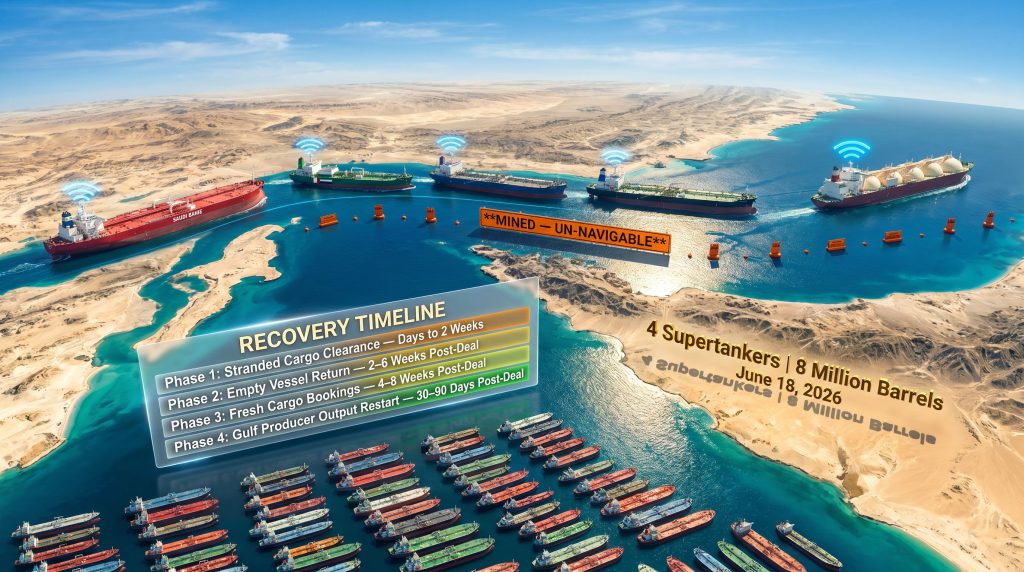
Two informal routing corridors emerged in response. A northern inshore lane developed along Iranian territorial waters, while a southern path hugging Oman's coastline served as an alternative. The central strait channel, which under normal operations handles the bulk of deep-draft tanker traffic, became effectively impassable following reported mine placement. BIMCO confirmed on June 18, 2026 that the central portion of the strait is mined and not navigable, with only the inshore traffic zones near Oman and Iran reportedly clear of mines.
Perhaps the most consequential adaptation was the proliferation of AIS signal suppression. Tankers began operating without active transponders, transiting the waterway as invisible data points. In the weeks immediately preceding the U.S.-Iran interim peace deal, millions of barrels per day were reportedly moving through Hormuz via dark transits, meaning official tracking data dramatically understated actual throughput.
The Dark Fleet Phenomenon and Why It Distorted Market Readings
The concept of a vessel going dark — meaning operating without a functioning Automatic Identification System transponder — is not new to energy markets. Sanctioned crude from Iran, Russia, and Venezuela had already normalised shadow fleet operations in the years prior to 2026. However, what changed during the conflict was the scale and the motivation: vessels from non-sanctioned nations, including those owned by major Western operators, began suppressing signals not to evade sanctions but to avoid targeting.
This created a significant analytical problem. Energy market participants relying on vessel tracking data to estimate Hormuz throughput were working with incomplete datasets. The dark transit volume likely meant the supply disruption was less severe than headline traffic figures implied, which contributed to crude prices retreating even before the peace deal was formalised. Three concurrent forces drove this price correction: reduced Chinese demand, a surge in U.S. crude exports filling market gaps, and the growing dark transit volume from Gulf producers willing to accept the security risk.
The crude price downside observed in the months prior was, consequently, a product of multiple overlapping pressures rather than a single catalyst.
Breaking Down the U.S.-Iran Memorandum of Understanding
The interim peace deal between Washington and Tehran established several concrete commitments, alongside several notable ambiguities that industry bodies were quick to identify.
Key provisions of the MoU include:
- Iran's commitment to facilitate a return of Hormuz traffic to prewar levels within 30 days of the agreement
- A 60-day toll-free passage window for commercial vessels transiting the waterway
- Washington's agreement to lift its blockade of Iranian ports, enabling Iranian export vessels to resume outbound operations
- A shared acknowledgment that the waterway would be fully opened without tolls during the MoU's covered period
What the agreement did not resolve:
- No confirmed operational timeline or framework for mine clearance was publicly established by either government
- No formal vessel traffic management system was agreed upon, despite Intertanko identifying this as a prerequisite for normality
- Tehran's repeated signalling that it intends to retain some degree of management authority over the waterway introduces an unresolved governance ambiguity
- The Joint Maritime Information Center downgraded its threat level for Hormuz from severe to substantial, which represents an improvement but still places it two classifications below a safe operating designation
A peace announcement and an operational reopening are structurally different events. Industry bodies representing shipowners and insurers are treating them accordingly. The MoU creates conditions under which recovery becomes possible, not conditions under which recovery is guaranteed.
Lloyd's Market Association stated on June 18 that the memorandum does not provide shipowners and their insurers with the full assurance required to restore normal traffic flows through Hormuz. The association noted that the primary requirement for recovery is stability and certainty, and indicated that some form of normality returning to international shipping could take months, given vessels positioned in the wrong locations and supply chains in a distorted state.
What the Vessel Data Actually Showed on June 18, 2026
The single-day traffic snapshot on June 18 represented the largest visible movement of vessels since conflict began. The following table summarises the key tracked movements:
| Vessel Category | Status on June 18, 2026 | Signal Activity |
|---|---|---|
| Saudi Bahri Supertankers (3) | Exiting via Gulf of Oman | AIS Active |
| UAE Crude Carrier (1) | Transiting the Strait | AIS Active |
| Qatari LNG Vessel (1) | Transiting the Strait | AIS Active |
| Second LNG Vessel | Arrived at Qatari Berth | AIS Active |
| Iranian Supertankers (2) | Entering Strait (inbound) | AIS Active |
| Other Iran-linked Vessels (3) | Entering Waterway | AIS Active |
All outbound transits on that date followed the northern corridor along Iranian territorial waters, not the central channel, which remains mined. The total cargo represented by the four outbound supertankers amounted to approximately 8 million barrels of oil, a figure that captures the scale of suppressed inventory beginning to move. According to Rigzone's coverage of Hormuz shipping developments, this represented a historically significant single-day movement in the context of the crisis.
The Bahri Signal: Conservative Operators as Confidence Indicators
Among the most analytically significant developments was the activation of AIS transponders by three supertankers owned by Bahri, Saudi Arabia's national shipping company. Bahri is widely recognised within the tanker industry as among the most risk-conservative operators in the market. Throughout the conflict, even as a growing number of more risk-tolerant owners moved vessels through the strait under cover of darkness, Bahri kept its fleet stationary inside the Persian Gulf.
That distinction matters enormously as a market signal. When the most cautious major operator begins moving, it reflects an institutional judgement that minimum safety thresholds have been crossed, not merely that political optimism is running high. However, the critical caveat is that these vessels were clearing stranded cargo, not committing to routine operations. One prominent Western tanker owner, speaking privately, indicated an expectation that their vessels would begin moving out in the coming days.
The Stranded Tanker Backlog: A Supply Overhang With Price Implications
At the time the peace deal was signed, more than 100 tankers were estimated to be stranded inside the Persian Gulf, many having been anchored for months. The concentrated release of this inventory creates a supply dynamic that energy markets need to absorb carefully. In addition, this backlog has direct consequences for global LNG supply chains and broader energy security planning.
The recovery process is likely to unfold across several distinct phases:
| Recovery Phase | Trigger Conditions | Estimated Timeline |
|---|---|---|
| Phase 1: Stranded Cargo Clearance | AIS-on exits by previously stuck tankers | Days to 2 weeks |
| Phase 2: Empty Vessel Return | Owner confidence and insurer clarity | 2 to 6 weeks post-deal |
| Phase 3: Fresh Cargo Bookings | Commercial normality and mine clearance | 4 to 8 weeks post-deal |
| Phase 4: Gulf Producer Output Restart | Infrastructure readiness and sustained security | 30 to 90 days post-deal |
As of June 18, the market was operating squarely within Phase 1. Multiple shipbrokers and owners confirmed at that time that there was little sign of fresh cargo bookings being placed for loading inside the Gulf. The inward journeys on that date appeared predominantly linked to Iranian vessels, consistent with positioning for export resumption rather than confirmed commercial loading activity.
How Gulf Producers Adapted During the Closure
Saudi Arabia, typically the world's largest crude exporter, maintained meaningful export volumes during the conflict by rerouting oil through its East-West Pipeline to Red Sea terminals, bypassing Hormuz entirely. This workaround preserved revenue continuity but introduced logistical cost, volume constraints, and inflexibility that direct Gulf exports do not carry.
The emergence of Bahri supertankers heading toward the Gulf of Oman signals Riyadh's readiness to transition back toward direct export operations, though any sustained resumption depends on security confirmation that goes beyond the current MoU framework.
Qatar's position is structurally different. As one of the world's largest LNG exporters, any prolonged Hormuz disruption has direct consequences for European and Asian gas supply security. The ongoing shift in global LNG supply dynamics makes the June 18 transit of a Qatari LNG cargo with an active AIS signal particularly significant as an indicator of QatarEnergy's directional intent, though the company did not immediately confirm a broader operational resumption.
Iran's position is the most commercially significant wildcard. Iranian oil exports were materially constrained by the U.S. port blockade, which was lifted under the MoU. If Iranian production and exports resume at scale simultaneously with Gulf producers restarting shut-in output, the combined supply addition to global markets would represent substantial downward pressure on crude prices.
The next major ASX story will hit our subscribers first
The Three Gating Factors for Full Hormuz Normalisation
Mine Clearance: The Physical Bottleneck
BIMCO's confirmation that only the inshore traffic zones near Oman and Iran are reportedly mine-free creates a hard physical constraint on traffic capacity recovery. Mine-clearance operations in contested maritime zones are logistically complex under any circumstances, typically requiring multi-party coordination and taking weeks to months even when conditions are cooperative.
No public timeline for central channel clearance has been announced. Until that work is complete, traffic capacity is structurally limited to the two inshore corridors, which cannot accommodate the full volume of pre-war Hormuz transit activity.
Insurance Market Stabilisation
War-risk insurance remains the commercial gating mechanism for owner decision-making. Elevated premiums and restricted coverage terms make Hormuz transits economically prohibitive for many operators regardless of political signals. Lloyd's Market Association's cautionary posture reflects a practical reality: until the insurance market stabilises, willing owners face cost structures that make routine operations financially unworkable.
Traffic Management Architecture
Intertanko's call for a formal command-and-control system addresses an operational gap that becomes increasingly critical as transit volumes recover. The two-lane informal routing system that emerged during the conflict was functional at low volumes but is insufficient for managing the density of traffic that pre-war Hormuz conditions required. Establishing a formal vessel traffic service framework would require coordination between Iranian maritime authorities, Omani counterparts, and international naval forces — a process with no confirmed timeline.
Scenario Analysis: What Hormuz Recovery Means for Energy Prices
Scenario A: Rapid Normalisation within 30 Days. Gulf producers restart shut-in output, the stranded tanker backlog clears within weeks, and fresh cargo bookings resume. The net effect would be meaningful downward pressure on crude prices as months of suppressed supply simultaneously reaches markets.
Scenario B: Slow Reopening over 60 to 90 Days. Mine clearance delays, sustained insurer caution, and owner hesitancy limit activity to stranded cargo clearance only. The net effect would be modest price relief without a structural supply surge.
Scenario C: Partial Reopening with Security Incidents. A mine strike, disputed management action, or political deterioration disrupts the fragile confidence environment. The net effect would be renewed price volatility and potential re-escalation of war-risk premiums across the tanker market.
A key analytical nuance for energy investors is that the pre-deal market had already partially priced in Hormuz workarounds. The combination of dark transits, U.S. export growth, and reduced Chinese demand meant crude prices had retreated before the MoU was signed. A full Hormuz reopening therefore does not mechanically produce a price spike. The more likely directional pressure, assuming Scenario A, is downward as suppressed Gulf supply re-enters a market that had already adapted. Furthermore, the oil price shock dynamics experienced by producers throughout the crisis period underscore how swiftly sentiment can shift when physical supply signals change.
Frequently Asked Questions: Strait of Hormuz Shipping Recovery
How much oil passes through the Strait of Hormuz under normal conditions?
Under pre-conflict conditions, the strait facilitated passage of approximately 20% of globally traded oil and a substantial portion of global LNG volumes, supported by more than 100 commercial vessel transits daily.
Why haven't ships immediately resumed normal transits after the peace deal?
Structural barriers remain in place: uncleared mines in the central channel, elevated war-risk insurance premiums, the absence of a formal traffic management system, and the need for shipowners to receive operational clarity before committing vessels to the route.
What is the significance of Saudi Bahri tankers moving again?
Bahri's conservative approach throughout the conflict makes its return to AIS-on operations a meaningful confidence indicator. However, the initial movements reflect stranded cargo clearance, not a commitment to routine commercial scheduling.
How long could full normalisation take?
Industry bodies including Lloyd's Market Association and Intertanko have indicated that a return to full operational normality could take several months, contingent on mine clearance progress, insurance market stabilisation, and the establishment of formal traffic management protocols.
What happens to global oil prices if Hormuz fully reopens?
A full reopening enabling Gulf producers to restart shut-in output would likely introduce significant additional supply, creating downward price pressure — particularly if Iranian exports resume simultaneously. The geopolitical trade tensions that preceded the conflict will, however, continue to shape how markets interpret any supply normalisation. The UNCTAD analysis of Hormuz disruption implications further reinforces how profoundly these closures ripple through global trade and development.
Key Takeaways for Analysts and Investors Watching Hormuz
The acceleration in Strait of Hormuz shipping activity on June 18, 2026 warrants careful interpretation rather than straightforward optimism. Several structural realities frame the outlook:
- The June 18 movements represent a first-movement signal, not a structural reopening of commercial operations
- The distinction between dark transits already occurring and newly visible AIS-on transits is critical for accurately interpreting traffic volume data
- Fresh cargo bookings — the true leading indicator of commercial confidence — had not materially increased as of the initial acceleration reports
- Mine clearance, insurance normalisation, and formal traffic management architecture remain the three gating conditions for sustained recovery
- The stranded tanker backlog of more than 100 vessels creates a near-term supply release that markets will need to absorb, with potential bearish price implications at scale
- The peace deal creates a framework within which recovery becomes achievable, but the operational, commercial, and physical conditions for full normalisation remain works in progress
Readers seeking further context on Strait of Hormuz geopolitics and global energy security dynamics can explore ongoing coverage at Rigzone.com. This article contains forward-looking analysis and scenario projections that are inherently speculative. Nothing in this article should be construed as financial or investment advice.
Want to Identify the Next Major Commodity Opportunity Before the Market Moves?
Geopolitical disruptions like the Strait of Hormuz crisis demonstrate how rapidly energy and commodity markets can shift, creating significant opportunities for investors who act on real-time intelligence. Discovery Alert's proprietary Discovery IQ model scans ASX announcements daily, delivering instant alerts on significant mineral discoveries across more than 30 commodities — explore historic examples of exceptional discovery returns and begin your 14-day free trial today to position yourself ahead of the broader market.