
June 19, 2026
The Quiet Transformation Reshaping One of the World's Largest Energy Economies
For most of the past two decades, the trajectory of global seaborne thermal coal demand could be read, in large part, by watching what India imported. As the world's second-largest buyer of thermal coal, India's purchasing decisions have moved freight rates, shaped contract negotiations between miners and utilities, and influenced investment decisions from the coalfields of Kalimantan to the Bowen Basin. That dynamic is now shifting in ways that carry consequences well beyond the subcontinent.
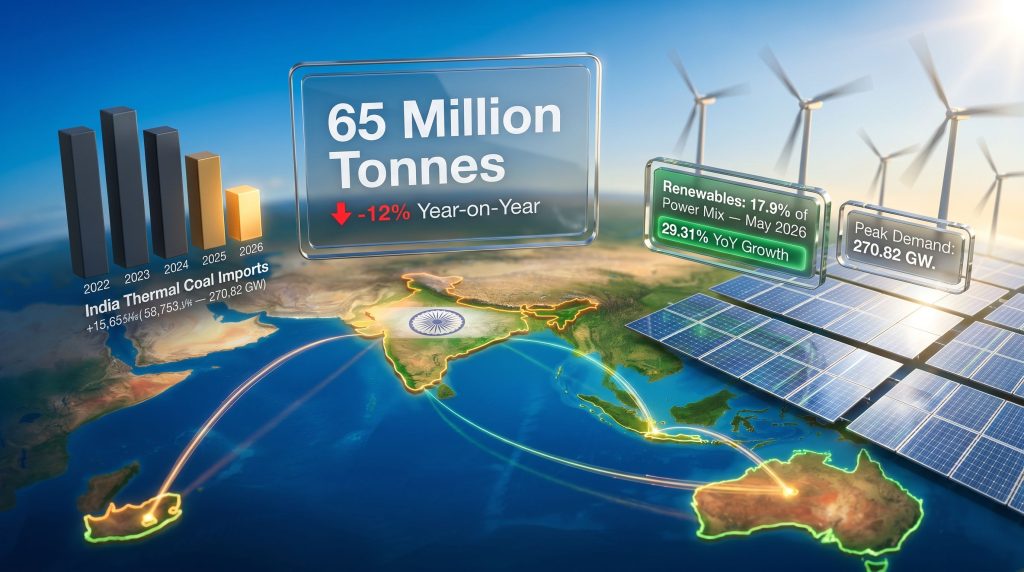
The January to May 2026 period delivered a data point that commodity analysts and energy policy researchers had been anticipating but perhaps not expecting quite so decisively: India thermal coal imports four-year low became official, with volumes falling to 65 million tonnes, marking a 12% year-on-year contraction. This is not a single-variable story about renewables or a temporary correction driven by weather. It reflects the simultaneous maturation of three independently powerful forces that have converged at precisely the same moment.
When big ASX news breaks, our subscribers know first
Three Forces Converging: Why the Four-Year Low Is Structural, Not Cyclical
Understanding why India's thermal coal imports have hit a four-year low requires separating the signal from the noise. Single-factor explanations — such as attributing the decline purely to renewable growth or solely to Coal India's production push — miss the more important point: these forces are operating in parallel and reinforcing each other.
Domestic Production Scaling With Strategic Intent
Coal India, the state-controlled producer that accounts for the overwhelming majority of India's domestic coal output, directed its subsidiary operations to significantly accelerate production in response to surging electricity demand driven by extreme heat linked to El Niño weather patterns. The rationale was both strategic and economic: by filling the baseload gap with domestically mined coal, India could simultaneously reduce foreign exchange exposure on energy imports and insulate its power grid from the volatility of internationally priced seaborne coal.
This is a deliberate model of energy security, one that uses a country's own resource endowment as a price buffer against global commodity cycles. Comparable frameworks have been deployed by other large emerging economies seeking to reduce dependence on imported energy during periods of elevated global prices. Furthermore, proposals such as the India coal trading exchange reflect the broader ambition to institutionalise domestic market mechanisms that reduce reliance on international pricing benchmarks.
Renewable Generation Crossing a Meaningful Threshold
The renewable energy numbers from this period are striking not just in absolute terms but in their rate of acceleration. According to data reported by Reuters via ET EnergyWorld on June 19, 2026, drawing on analysis by commodities consultancy BigMint and daily government data:
- Total power generation in India grew 5% year-on-year during January to May 2026
- Renewable generation expanded at 22% year-on-year over the same period, a rate more than four times faster than overall electricity output growth
- In May 2026 alone, renewable output surged 29.31% year-on-year, reaching 27.58 billion kilowatt-hours
- Renewables accounted for a record 17.9% of India's monthly power mix in May, the highest share ever recorded
That final figure matters enormously from a structural perspective. When renewables cross the threshold of contributing roughly one-fifth of monthly generation, their output begins to materially suppress the marginal call on thermal generation during daylight hours, particularly as solar capacity increasingly shapes intraday dispatch curves. Indeed, renewables reshaping mining and energy procurement patterns across Asia is a trend that is now clearly visible in the import data.
Import Cost Economics Turning Against Seaborne Coal
The third factor is less discussed but equally consequential. Elevated global prices for seaborne thermal coal, combined with higher freight rates linked to ongoing disruptions in West Asian shipping corridors, widened the cost differential between landed imported coal and domestically produced alternatives. When the economics of importing coal deteriorate to the point where domestic supply becomes structurally cheaper on a delivered-to-plant basis, utilities naturally shift procurement toward local sources. This pricing dynamic operated throughout the January to May window, compounding the effect of both increased domestic supply and renewable displacement.
The Central Paradox: Record Power Demand Alongside Falling Imports
Perhaps the most analytically interesting feature of this period is the apparent contradiction at its core. India did not experience a demand-side contraction. Quite the opposite: peak power demand exceeded 270.82 GW on May 21, 2026, surpassing expectations, while power demand overall climbed 11.2% year-on-year in May to reach a two-year high. Thermal power generation itself rose 10% from a year earlier in May, the strongest growth since May 2024, as utilities pushed output to meet round-the-clock electricity requirements.
| Metric | Value | Period |
|---|---|---|
| Thermal coal imports | 65 million tonnes | Jan–May 2026 |
| Year-on-year import change | –12% | Jan–May 2026 |
| Total power generation growth | +5% YoY | Jan–May 2026 |
| Renewable generation growth | +22% YoY | Jan–May 2026 |
| Peak power demand recorded | 270.82 GW | May 21, 2026 |
| Power demand growth (May) | +11.2% YoY | May 2026 |
| Renewable share of power mix | 17.9% (record) | May 2026 |
| Renewable output (May) | 27.58 billion kWh | May 2026 |
| Thermal power generation growth | +10% YoY | May 2026 |
Source: BigMint, Grid-India, Reuters analysis of daily government data, as reported by ET EnergyWorld, June 19, 2026.
The resolution to this paradox lies in understanding the supply substitution dynamic operating beneath the headline numbers. Thermal power generation did rise, but it was fuelled predominantly by domestically produced coal rather than seaborne imports. Simultaneously, renewable energy absorbed the incremental demand growth that would historically have required additional fossil fuel generation. The result: a grid consuming more electricity than ever, yet recording India thermal coal imports four-year low volumes for the January to May window.
Structural insight: The coexistence of record peak demand and a four-year import low is not a contradiction. It is evidence that India's domestic supply chain and renewable capacity have scaled to a point where the country can satisfy growing electricity needs without proportional growth in seaborne coal procurement.
India's Formal Import Reduction Mandate: Context and Execution Risk
India has set a formal objective to reduce thermal coal usage for power generation by at least 30% in 2026 relative to prior-year import levels. The January to May trajectory suggests meaningful progress toward this target, and the convergence of forces described above provides a credible mechanism for achieving it.
However, several execution risks deserve careful consideration:
- Monsoon variability: A weaker-than-expected monsoon season could depress hydropower output during the second half of 2026, increasing pressure on thermal generation and potentially requiring incremental coal volumes from seaborne markets.
- Domestic logistics constraints: Rail capacity bottlenecks and mine-to-plant transportation infrastructure remain genuine limitations on Coal India's ability to consistently deliver volumes to power plants at the pace required. These constraints have historically forced short-term import resumption during demand spikes, even when domestic coal was theoretically available.
- Climate-driven demand surges: India's heat wave intensity is intensifying as a structural feature of its climate trajectory. Periods of extreme heat can push peak demand beyond grid management thresholds faster than renewable and domestic coal capacity can respond.
- Grid integration complexity: As renewable penetration approaches and exceeds 20% of the monthly mix, grid stability and frequency management challenges become more pronounced, particularly in the absence of adequate battery storage capacity at scale.
What This Means for Global Thermal Coal Markets
India's position as the world's second-largest thermal coal importer means its structural demand reduction carries direct implications for seaborne markets, freight benchmarks, and exporter economies. Consequently, the ripple effects extend well beyond the subcontinent, touching exporters, shippers, and competing import markets simultaneously.
Indonesian and Australian Exporters Face a Demand Headwind
Indonesian coal exporters, who supply the majority of India's sub-bituminous coal requirements given their geographic proximity and the calorific value profile of their product, face reduced offtake at a moment when China steel and commodity demand also remains volatile. The combination creates a challenging commercial environment for Indonesian producers who have built export strategies around Indian demand as a volume anchor.
Australian producers supplying higher-calorific-value coal to Indian industrial and power users may experience medium-term pricing pressure if Indian utilities continue their preference for domestic supply. In addition, Australia's energy export challenges are compounding this dynamic, as multiple demand headwinds converge on key trade routes simultaneously. South African exporters, who have historically served as swing suppliers into the Indian market, similarly face a structurally smaller addressable market.
| Exporter | Primary Coal Type Supplied | Exposure to India Import Decline |
|---|---|---|
| Indonesia | Sub-bituminous, lower-rank | High (largest volume supplier) |
| Australia | High-CV bituminous | Medium (premium quality segments) |
| South Africa | Bituminous, variable CV | Medium (swing supplier role) |
Freight Market Implications
Reduced Indian import volumes also exert downward pressure on bulk carrier demand for Panamax and Supramax vessels operating on key Pacific and Indian Ocean trade routes. With Indian power utilities reducing seaborne procurement, the utilisation rates of the coal freight fleet on routes from Kalimantan and the Hunter Valley face incremental softening.
Long-Term Trajectory: Scenarios Through 2030
India's record 17.9% renewable share in May 2026 represents a structural inflection, not a statistical outlier. Solar and wind capacity additions are now large enough to suppress import demand even during high-consumption months. As battery storage deployment matures, renewables will increasingly displace thermal generation during evening peak hours, the last major temporal gap in the renewable coverage profile.
The broader context of energy transition and security is reshaping how policymakers in India and across Asia balance the competing imperatives of affordability, reliability, and decarbonisation. For India specifically, this balance is increasingly tilting toward domestic energy self-sufficiency underpinned by both coal and renewables.
| Scenario | Key Assumptions | Import Trajectory |
|---|---|---|
| Accelerated Transition | Renewable additions exceed targets; domestic coal logistics improve | Imports fall to 50–55 MT/year by 2028 |
| Base Case | Current policy maintained; moderate renewable growth | Imports stabilise at 60–70 MT/year through 2028 |
| Demand Shock Reversal | Extreme weather strains domestic supply; monsoon failure reduces hydro | Imports rebound to 75–80 MT/year in 2027 |
Note: Scenario projections are forward-looking estimates and involve inherent uncertainty. They should not be interpreted as forecasts or relied upon for investment decisions.
One underappreciated dynamic in medium-term forecasting for India's coal import trajectory is the calorific value substitution effect. Domestic Indian coal is predominantly lower-rank material with a higher ash content and lower energy density than the sub-bituminous imports from Indonesia. As coal-fired power plants blend higher volumes of domestic coal to meet national mandates, there is a technical ceiling on how far substitution can proceed before thermal efficiency losses and boiler compatibility constraints require a minimum floor of imported higher-quality coal.
This blending dynamic is not reflected in simple import volume projections and introduces a degree of structural inelasticity into the import floor that analysts focused purely on policy targets sometimes overlook.
Industry note: The practical limit on domestic coal substitution due to calorific value and ash content compatibility is a technical constraint that is rarely discussed in mainstream energy transition commentary but is well understood by power plant operators and coal procurement specialists.
The next major ASX story will hit our subscribers first
Frequently Asked Questions
Why did India's thermal coal imports fall to a four-year low in 2026?
India thermal coal imports four-year low was confirmed with volumes dropping to 65 million tonnes in January to May 2026, a 12% year-on-year decline, due to three concurrent factors: a significant ramp-up in domestic coal production directed by Coal India, a record expansion in renewable energy generation growing at 22% year-on-year, and elevated landed costs for imported coal driven by high global seaborne prices and elevated freight rates. Data was compiled by commodities consultancy BigMint and reported by S&P Global.
What is India's target for reducing thermal coal imports?
India has set a formal objective to reduce thermal coal consumption for power generation by at least 30% in 2026 compared to prior-year import levels, as part of a broader energy security and foreign exchange cost reduction strategy.
Did India's electricity demand fall alongside its imports?
No. Peak power demand hit a record 270.82 GW on May 21, 2026, and overall power demand grew 11.2% year-on-year in May. The import decline occurred despite rising electricity consumption because domestically produced coal and renewable generation collectively absorbed incremental demand.
What share of India's power came from renewables in May 2026?
Renewables accounted for a record 17.9% of India's power generation mix in May 2026, with output growing 29.31% year-on-year to reach 27.58 billion kilowatt-hours, according to a Reuters analysis of daily government data.
How does this affect global coal markets?
As the world's second-largest thermal coal importer, India's sustained reduction in seaborne procurement places downward pressure on coal prices and freight demand, with the most direct commercial impact on Indonesian and Australian exporters who have historically treated Indian demand as a structural volume anchor.
Key Takeaways
- India's thermal coal import decline reflects structural, not cyclical forces: deliberate domestic supply expansion, renewable capacity growth, and unfavourable import cost economics are operating simultaneously
- The 12% contraction in January to May 2026 is the steepest year-on-year decline for that seasonal window in recent memory, based on data from BigMint as reported by Reuters
- Renewables reaching a record 17.9% monthly share confirms India's energy transition has moved from aspirational targets to measurable market displacement
- A technically underappreciated constraint on full import substitution is the calorific value and ash content incompatibility between domestic and imported coal, which sets a practical floor beneath import volumes that policy-level analysis often omits
- Global thermal coal exporters face a medium-term structural headwind from India that is unlikely to reverse without a significant domestic supply disruption or adverse weather event in the second half of 2026
- The 30% import reduction target appears achievable based on the January to May trajectory, but monsoon variability, logistics constraints, and extreme heat events introduce genuine uncertainty in the second half of the year
Disclaimer: Forward-looking statements, scenario projections, and market trajectory estimates contained in this article involve inherent uncertainty and are presented for analytical and informational purposes only. They do not constitute investment advice or financial recommendations. Readers should conduct independent research and seek professional guidance before making any investment or commercial decisions related to the subjects discussed.
Want to Track the Commodity Shifts Reshaping ASX Mining Stocks?
As India's structural retreat from seaborne thermal coal reshapes global energy markets, the ripple effects across ASX-listed miners and explorers are becoming increasingly material — and Discovery Alert's proprietary Discovery IQ model delivers real-time alerts the moment significant mineral discoveries hit the ASX, turning complex market signals into actionable opportunities. Explore historic examples of major discovery returns or start your 14-day free trial today to position yourself ahead of the market.