July 13, 2026
The Quiet Restructuring of Commodity Trade Finance
Global metals markets have spent the better part of three years absorbing a slow-moving crisis in trade finance availability. The withdrawal of several European banks from commodity lending desks, accelerated by regulatory capital pressures and reputational caution following high-profile trading scandals, left a measurable gap in the credit infrastructure that independent traders depend on. What is now filling that gap is neither a market recovery nor a new wave of bank entrants. It is something structurally different: sovereign export credit agencies stepping into roles that commercial lenders once monopolised.
This shift carries implications that extend well beyond individual transactions. When a federal export credit agency anchors a committed, multi-year financing facility for one of the world's leading independent metals traders, it signals a fundamental reconfiguration of how physical commodity flows get funded. The Gerald Group ECI $50M facility, closed in July 2026, is one of the clearest expressions of this reconfiguration yet seen in the base metals trading sector.
When big ASX news breaks, our subscribers know first
Breaking Down the Gerald Group ECI $50M Facility
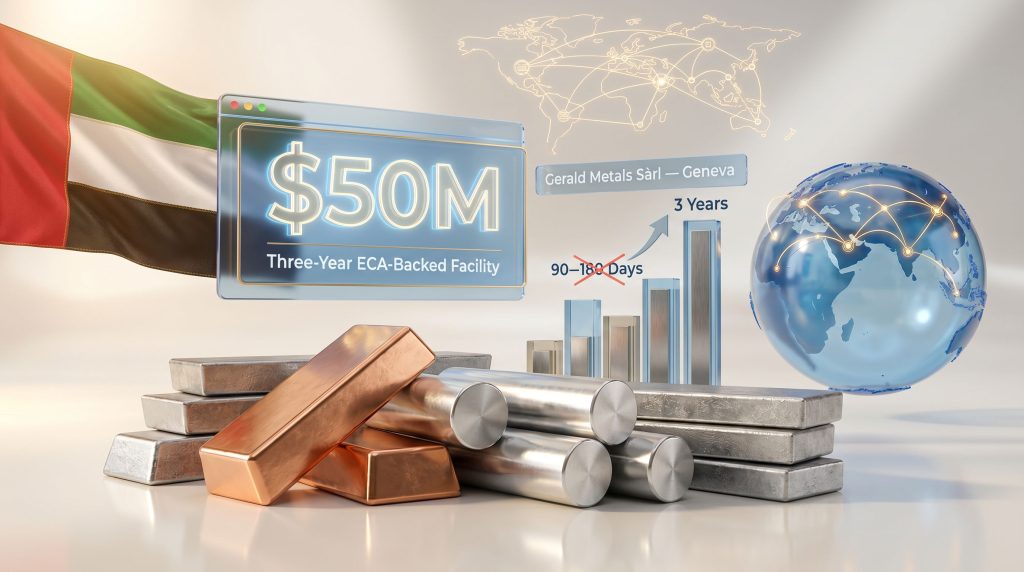
The transaction pairs Gerald Metals Sàrl, the Geneva-based subsidiary of Gerald Group, with Etihad Credit Insurance (ECI), the United Arab Emirates' federal export credit agency, and Abu Dhabi Commercial Bank (ADCB), which acts as the direct lender. The result is a three-year, $50-million committed financing facility designed to support UAE-origin metals trade flows across energy transition, technology, and industrial supply chains.
| Parameter | Detail |
|---|---|
| Facility Size | USD $50 million |
| Tenor | Three years |
| Borrowing Entity | Gerald Metals Sàrl |
| Parent Company | Gerald Group |
| Export Credit Agency | Etihad Credit Insurance (ECI) |
| Lending Bank | Abu Dhabi Commercial Bank (ADCB) |
| Transaction Type | ECA-supported export-backed financing |
| Announced | July 2026 |
This is Gerald Group's first financing arrangement backed by an export credit agency of any kind, making it a category-defining addition to the group's existing funding architecture. Rather than supplementing a revolving credit line or extending a bilateral bank relationship, the facility introduces an entirely new layer of sovereign credit into Gerald Group's liquidity platform.
Why Committed Tenor Is the Real Story
Most commodity trade finance instruments operate on rolling 90-to-180-day cycles. Banks review, renew, and occasionally withdraw these lines based on internal credit appetite, regulatory capital allocations, and market conditions. For an independent trader managing complex, multi-leg physical transactions, this creates a structural vulnerability: the financing infrastructure can compress precisely when market conditions demand the most operational flexibility.
A three-year committed facility eliminates that vulnerability for its duration. The borrower knows with legal certainty that drawdown capacity exists, regardless of short-term credit market movements. This distinction matters considerably more than the headline dollar figure, because it changes the planning horizon across which Gerald Group can structure its supply chain commitments.
Committed ECA-backed facilities provide independent commodity traders with something conventional bank credit cannot: legally binding drawdown certainty over a multi-year period, insulating operational capacity from the credit market cycles that periodically squeeze bilateral lending availability.
How ECA-Backed Structures Actually Work in Metals Trade Finance
Understanding the mechanics of this transaction requires separating the roles of each party in the credit chain. Export credit agency-backed facilities in commodity contexts are not straightforward bank loans with a government stamp. They operate through a layered guarantee and risk-transfer architecture.
The structural sequence works as follows:
-
ECI assesses and issues a credit guarantee or insurance instrument covering a defined portion of the lending exposure associated with the facility.
-
ADCB, with its net credit exposure reduced by ECI's sovereign backing, extends the $50-million facility to Gerald Metals Sàrl under commercially agreed terms.
-
Drawdowns under the facility are linked to qualifying UAE-origin trade flows, ensuring the instrument serves its stated export promotion mandate rather than functioning as general corporate liquidity.
-
The three-year committed tenor provides Gerald Group with a planning horizon that rolling revolving credit structures cannot replicate.
Comparing Instrument Types
| Instrument Type | Typical Tenor | Committed? | Sovereign Backing | Rollover Risk |
|---|---|---|---|---|
| Revolving bank credit line | 90-180 days | No | No | High |
| Bilateral term loan | 1-2 years | Yes | No | Moderate |
| ECA-backed committed facility | 3-5 years | Yes | Yes | Low |
| Syndicated trade finance | 1-3 years | Partial | No | Variable |
The structuring cost of ECA-backed instruments is typically higher than vanilla bilateral lending, reflecting the guarantee fees, documentation complexity, and trade flow verification requirements. However, the risk-adjusted benefit — measured in reduced rollover exposure and improved funding resilience — more than compensates for this cost premium during periods of elevated market stress. Institutional investors increasingly recognise this dynamic, as reflected in long-range acquisition estimates from major procurement bodies that factor sovereign-backed instruments into multi-year capital planning.
The Four Macro Forces Driving This Deal
The Gerald Group ECI $50M facility did not emerge from a vacuum. Four converging structural forces made this transaction not just attractive but arguably necessary for a trader of Gerald Group's scale and ambition.
1. Basel IV capital requirements compressing bank appetite
Regulatory capital frameworks introduced under Basel IV have materially increased the risk-weighting of short-tenor commodity trade exposures on bank balance sheets. This has made revolving commodity trade lending less economically attractive for major banks, steadily reducing the availability of traditional bilateral credit lines for independent traders.
2. Geopolitical fragmentation elevating counterparty risk
Since 2022, the restructuring of global trade relationships has introduced significant counterparty risk uncertainty into commodity supply chains. The evolving geopolitical metals landscape has driven sanctions-driven exclusions, trade route disruptions, and the fragmentation of established financing relationships, collectively elevating the premium placed on committed, sovereign-backed liquidity insulated from political risk fluctuations.
3. Energy transition demand acceleration
Base and specialty metals linked to electrification infrastructure, battery manufacturing, and renewable energy deployment are experiencing structural demand growth that extends well beyond conventional commodity cycles. The broader energy transition metals demand picture creates a need for financing instruments with tenors long enough to support the multi-year supply chain contracts that energy transition customers require.
4. Tenor mismatch between markets and finance
Supply chain contracts in energy transition sectors increasingly run for two to five years. Traditional revolving trade finance structures, designed around single-shipment or quarterly cycles, cannot efficiently support these longer-duration commercial relationships. ECA-backed committed facilities address this mismatch directly.
The UAE's Strategic Positioning in Global Metals Trade
ECI's participation in this transaction reflects more than institutional deal-making. It is an expression of the UAE's deliberate strategy to reposition itself as a hub for non-hydrocarbon commerce, articulated formally through the We the UAE 2031 national economic vision.
The UAE's geographic position is a structural asset that is frequently underestimated in conventional trade finance analysis. Sitting at the intersection of East-West and North-South trade corridors, the UAE connects producing regions across sub-Saharan Africa, South America, and Central Asia with consuming markets in Europe, South Asia, and East Asia. For a metals trader seeking to diversify trade flow geography, UAE-origin financing creates corridor access that European or North American banking relationships cannot replicate.
Competitive Positioning Against Established Hubs
| Trade Finance Hub | Core Strengths | UAE Differentiation |
|---|---|---|
| Geneva | Commodity trader concentration, legal infrastructure | Sovereign ECA liquidity, corridor diversification |
| Singapore | Asian proximity, regulatory maturity | Gulf and African corridor access |
| London | Deep capital markets, legal expertise | ECA-backed committed structures |
| Dubai/Abu Dhabi | Growing hub capacity | We the UAE 2031 institutional mandate |
ECI's mandate under the We the UAE 2031 framework is to expand the volume of UAE-origin trade flows supported by structured finance instruments, build institutional expertise in complex commodity finance, and attract leading international trading houses to route trade through UAE-origin channels. Furthermore, considerations around critical minerals and energy security increasingly inform how sovereign agencies like ECI prioritise which trade flows to support. The Gerald Group transaction advances all three objectives simultaneously.
Metals Categories and Energy Transition Relevance
The facility's explicit linkage to energy transition, technology, and industrial supply chains is commercially significant because it aligns Gerald Group's financing structure with the sectors generating the most durable long-term demand growth across base metals markets.
| Metal Category | Energy Transition Application | Demand Growth Driver |
|---|---|---|
| Zinc | Galvanised steel for wind towers, EV infrastructure | Grid expansion, renewable construction |
| Copper | Electrical wiring, motors, grid infrastructure | Electrification, EV manufacturing |
| Aluminium | Lightweight structures, battery housings | Transport decarbonisation |
| Specialty metals | Battery chemistries, electronics manufacturing | Technology sector supply chains |
Gerald Group's established position as a leading zinc trader is particularly relevant here. Zinc demand linked to renewable energy infrastructure — specifically galvanised steel for wind tower construction and grid-supporting structures — is projected to grow materially through the 2030s. Securing committed, long-tenor financing that explicitly covers this trade flow category positions Gerald Group advantageously for supply chain contracts that energy transition developers are increasingly seeking to lock in years in advance.
The next major ASX story will hit our subscribers first
Strategic Lessons for Independent Commodity Traders
The Gerald Group ECI $50M facility offers a replicable template for independent traders navigating a trade finance environment characterised by reduced bank appetite, elevated counterparty risk, and growing demand for longer-duration instruments. In addition, the commodity price impacts on trader margins make funding resilience even more critical across the cycle. Several strategic lessons emerge from the transaction's structure.
-
ECA relationships function as competitive moats. Traders that build early institutional relationships with sovereign export credit agencies access committed liquidity unavailable through commercial bank channels.
-
Geographic funding diversification is a risk management tool. Reducing concentration in European or North American banking relationships by incorporating Middle Eastern or Asian sovereign credit instruments improves funding resilience against regional credit cycle disruptions.
-
Trade flow alignment unlocks financing advantages. Structuring trade flows to qualify for ECA support — by routing through or sourcing from ECA-eligible jurisdictions — creates measurable cost and availability benefits that compound over time.
-
Tenor management is an operational risk tool, not just a financing preference. Extending the average tenor of a funding book reduces rollover risk during periods of credit market stress, directly improving operational continuity for physical trading businesses.
Consequently, the global commodity tariff impacts reshaping trade economics in 2025 and beyond further reinforce the case for ECA-backed structures that provide insulation from externally driven cost shocks. As noted in recent institutional investment board materials, sovereign-backed credit instruments are attracting growing attention from long-horizon allocators seeking stable counterparty exposure within commodity-linked portfolios.
As Basel IV implementation continues and geopolitical fragmentation persists, ECA-backed committed facilities are likely to evolve from a niche financing instrument into a standard component of sophisticated independent trader funding platforms. The Gerald Group ECI $50M facility may prove to be one of the earlier reference transactions in what becomes a much broader structural shift.
Frequently Asked Questions
What is the Gerald Group ECI $50M facility?
It is a three-year, $50-million export credit agency-backed financing arrangement between Gerald Metals Sàrl, Etihad Credit Insurance, and Abu Dhabi Commercial Bank, designed to support UAE-origin metals trade flows across energy transition, technology, and industrial supply chains. It represents Gerald Group's first ECA-backed financing of any kind.
Who is Etihad Credit Insurance?
Etihad Credit Insurance is the UAE's federal export credit agency, tasked with supporting the country's non-oil export growth agenda and expanding the volume of UAE-origin trade flows supported by structured finance instruments, in alignment with the We the UAE 2031 national economic vision.
Why does a three-year tenor matter in commodity trade finance?
The overwhelming majority of commodity trade finance instruments run on 90-to-180-day revolving cycles. A three-year committed facility eliminates annual rollover risk, provides planning certainty for longer-duration supply chain contracts, and maintains drawdown availability regardless of short-term bank credit appetite fluctuations.
Does this mean Gerald Group is shifting away from conventional bank financing?
Not entirely. ECA-backed facilities complement rather than replace existing revolving credit lines and bilateral bank relationships. Their value lies in portfolio diversification across tenor, geography, and credit type, rather than substitution of existing instruments.
Disclaimer: This article is intended for informational purposes only and does not constitute financial advice. Forecasts, projections, and scenario analyses presented represent analytical perspectives and are subject to material uncertainty. Readers should conduct their own due diligence before making any investment or financing decisions.
Want to Identify the Next Major Mineral Discovery Before the Broader Market Does?
Discovery Alert's proprietary Discovery IQ model delivers real-time alerts on significant ASX mineral discoveries, instantly translating complex mineral data into actionable investment insights for traders and investors at every experience level — explore historic discoveries and their returns to understand the opportunity, then begin your 14-day free trial at Discovery Alert to position yourself ahead of the market.