June 4, 2026
Complex reservoir development represents one of the most resource-intensive and time-consuming endeavours in modern energy infrastructure. As the industry transitions from conventional shallow formations to technically demanding environments, the engineering and operational challenges have fundamentally transformed project execution timelines. Understanding these systemic factors provides crucial insight into why contemporary energy projects require such extensive development periods and capital commitments, particularly given the us oil production decline affecting global supply dynamics.
What Drives the 15-Year Development Cycle in Modern Oil and Gas Projects?
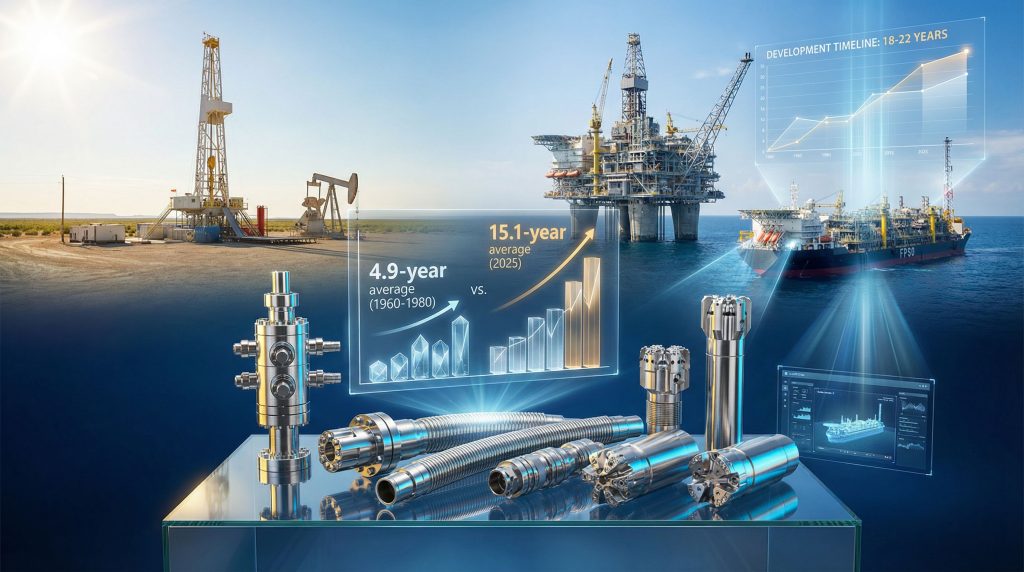
Contemporary upstream development cycles have undergone a dramatic transformation compared to historical industry benchmarks. Projects entering production in 2025 required an average of 15.1 years from initial discovery to first commercial output, representing a substantial increase from the 4.9-year average recorded between 1960 and 1980. This timeline extension reflects a 208% increase over the industry's historical peak efficiency period.
The most extreme development delays occurred during the 2010-2020 decade, when projects averaged nearly 16 years to reach production. Furthermore, the 2019 cohort experienced particularly extended timelines, with some developments requiring over 20 years from discovery to commercial operation, partially attributed to complex geopolitical and regulatory environments affecting major resource developments.
The Evolution from Simple to Complex Reservoir Development
The fundamental shift from accessible to technically challenging resource extraction drives much of the timeline extension observed in modern developments. Historical projects predominantly targeted shallow, high-permeability reservoirs with straightforward production characteristics and minimal technical complexity. These formations allowed for rapid development using conventional drilling and completion techniques.
Today's development pipeline increasingly consists of:
- Deep-water formations requiring specialised marine logistics and weather-dependent operations
- High-pressure, high-temperature (HPHT) reservoirs demanding advanced materials and engineering protocols
- Unconventional resources with low natural permeability requiring enhanced recovery technologies
- Ultra-deepwater projects in water depths exceeding 5,000 feet with complex subsea infrastructure requirements
Offshore vs. Onshore Development Timeline Analysis
Marine developments consistently require approximately three years longer than onshore projects, representing a 20-25% timeline extension for offshore developments. Consequently, this differential reflects the additional complexities inherent in marine operations, including specialised vessel requirements, weather window constraints, and extended supply chain logistics.
| Project Type | Average Timeline | Key Complexity Factors |
|---|---|---|
| Onshore Conventional | 12-14 years | Regulatory frameworks, surface infrastructure |
| Offshore Shallow Water | 15-17 years | Marine logistics, seasonal operations |
| Deepwater/Ultra-deepwater | 18-22 years | Technical risk, specialised equipment |
The International Energy Agency attributes these prolonged development timelines to systematic resource depletion patterns. As easily accessible reservoirs become depleted, the industry progressively shifts toward smaller, deeper, and more technically challenging fields, creating inherent structural timeline extensions independent of operational efficiency improvements. This shift has contributed significantly to the broader challenges in oil and gas project timelines across the industry.
When big ASX news breaks, our subscribers know first
How Do Technical Complexities Impact Project Scheduling?
Advanced technical requirements create cascading effects throughout project development phases, with each engineering challenge contributing to overall timeline extensions. The transition to complex reservoir environments demands specialised expertise, extended testing protocols, and sophisticated equipment integration that cannot be compressed without compromising safety or operational integrity.
Reservoir Engineering Challenges in Deep Formation Development
High-pressure, high-temperature reservoir environments present engineering challenges that materially extend development timelines beyond conventional project schedules. These formations require specialised wellbore designs capable of managing formation pressures exceeding 10,000 psi and temperatures above 350°F, necessitating extensive design validation and testing protocols.
The development of HPHT reservoirs involves:
- Extended materials testing for specialised alloys and elastomers capable of maintaining integrity under extreme conditions
- Comprehensive pressure testing protocols requiring validation at 150% of design limits
- Specialised completion systems designed for unique downhole conditions
- Enhanced safety systems with redundant pressure control mechanisms
Advanced Technology Integration Bottlenecks
Modern project development increasingly relies on digital technologies and automated systems that require extensive integration and validation periods. Digital twin development and validation typically span 18-24 months, encompassing reservoir modelling, facility simulation, and operational optimisation protocols.
In addition, subsea production systems represent particularly complex integration challenges, requiring:
- Component design optimisation tailored to specific reservoir conditions
- Integrated system testing in simulated operational environments
- Deep-sea validation protocols using specialised testing facilities
- Control system integration with surface facilities and monitoring systems
The implementation of ai in drilling innovation has begun to address some of these complexities, though adoption remains gradual across the industry.
Supply Chain Dependencies for Specialised Equipment
Critical equipment like subsea trees, risers, and specialised drilling equipment often require 3-4 year manufacturing lead times, creating unavoidable sequential bottlenecks in project development.
The specialised nature of deepwater and complex reservoir equipment creates fundamental constraints on project scheduling. Manufacturing capacity for subsea production systems, floating production storage and offloading vessels, and advanced drilling equipment remains limited globally, forcing projects into extended procurement queues.
Key equipment manufacturing timelines include:
- Subsea production trees: 24-36 months
- FPSO vessel construction: 48-72 months
- Specialised drilling equipment: 30-42 months
- Subsea risers and umbilicals: 18-30 months
What Role Do Regulatory and Environmental Factors Play in Timeline Extensions?
Regulatory frameworks have evolved significantly since 2010, introducing comprehensive safety, environmental, and operational requirements that extend project approval timelines. The Deepwater Horizon incident catalysed substantial regulatory reforms affecting offshore drilling protocols, well design requirements, and safety management systems across international jurisdictions.
Environmental Impact Assessment Evolution
Contemporary environmental impact assessments require comprehensive baseline studies spanning 2-3 years minimum for complex developments. These studies encompass marine ecosystem analysis, migratory species impact evaluation, and long-term environmental monitoring protocol development.
Environmental assessment requirements have expanded to include:
- Climate impact modelling for project lifecycle emissions
- Marine protected area interaction analysis for offshore developments
- Cumulative impact assessments considering other regional industrial activities
- Biodiversity offset planning for unavoidable environmental impacts
Stakeholder Engagement and Community Relations
Social licence development represents an increasingly critical component of project timeline management. Indigenous consultation processes in frontier regions typically require 24-36 months of structured engagement, encompassing traditional knowledge integration, benefit-sharing negotiations, and cultural impact mitigation planning.
Stakeholder engagement components include:
- Traditional territory consultation protocols
- Local workforce development programmes
- Community infrastructure benefit agreements
- Cultural heritage site protection planning
Regulatory Framework Adaptation Challenges
Post-2010 regulatory evolution introduced enhanced safety standards significantly impacting development timelines. Enhanced blowout preventer inspection protocols, expanded well design review cycles, and comprehensive safety culture documentation requirements create additional approval phases throughout project development.
Climate policy integration requirements further complicate regulatory compliance, with carbon intensity reporting, methane emissions monitoring, and renewable energy integration mandates requiring specialised compliance planning and regulatory coordination. However, these regulatory adaptations intersect with broader energy transition challenges affecting the entire sector.
How Do Financial and Investment Dynamics Affect Development Timelines?
Extended development cycles create compounding financial uncertainties that influence capital allocation decisions throughout project lifecycles. Companies making 15-year development commitments face substantial exposure to commodity price volatility, regulatory evolution, and energy transition policy changes that may fundamentally alter project economics during development phases.
Capital Allocation Decision Points Throughout Development
Final investment decision processes have become increasingly complex as extended timelines introduce multiple decision gates and approval requirements. Joint venture partnerships typical in major developments require coordinated decision-making among multiple parties, often extending approval processes by 6-12 months per major milestone.
Capital allocation complexity factors include:
- Multi-party joint venture coordination requirements
- Staged development capital profiling across extended timelines
- Risk mitigation through phased investment approaches
- Technology selection decisions under uncertain long-term conditions
Market Volatility Impact on Project Continuity
Oil price cycle influences on project sanctioning create fundamental timeline uncertainties, particularly for marginal developments requiring sustained commodity prices for economic viability. The recent oil price rally dynamics illustrate how market volatility can dramatically alter project economics during extended development phases.
The challenges in oil and gas project timelines intensify when considering that projects discovered today may enter production in significantly different policy environments, particularly under scenarios projecting upstream investment declines over time.
Cost Escalation Management Strategies
| Strategy | Timeline Effect | Risk Mitigation |
|---|---|---|
| Fast-track execution | -2 to -3 years | Higher technical risk exposure |
| Phased development | +1 to +2 years | Lower financial exposure |
| Standardised design | -1 to -2 years | Reduced customisation flexibility |
What Are the Operational Execution Challenges Extending Project Delivery?
Complex project execution requires coordination among multiple specialised contractors, sophisticated logistics management, and extensive quality assurance protocols. The sequential nature of many critical activities creates dependencies that cannot be compressed without compromising safety or technical integrity.
Engineering, Procurement, and Construction (EPC) Coordination
Large-scale developments typically involve 10-15 major contractors executing specialised work packages with complex interface requirements. Coordination challenges multiply when managing:
- Multi-disciplinary engineering integration across subsurface, facilities, and marine systems
- Procurement timing optimisation for long-lead equipment items
- Construction sequencing to minimise weather and seasonal constraints
- Quality assurance protocols ensuring system integration compatibility
Furthermore, these coordination challenges are becoming increasingly complex as projects incorporate new technologies and materials designed to address modern operational requirements.
Remote Location Infrastructure Development
Projects in frontier regions require substantial infrastructure investment before primary development activities can commence. Infrastructure development typically spans 24-36 months and encompasses:
- Access transportation systems including ports, airfields, and supply bases
- Accommodation facilities for peak construction workforces exceeding 2,000 personnel
- Utilities infrastructure including power generation, water treatment, and telecommunications
- Environmental monitoring systems for ongoing operational compliance
Commissioning and Startup Complexity
System commissioning represents the final critical path activity, requiring 12-18 months for complex developments. Commissioning protocols encompass progressive system activation, performance optimisation, and regulatory approval for commercial operations.
Commissioning phases include:
- Individual system functional testing
- Integrated system performance validation
- Process optimisation and fine-tuning
- Regulatory inspection and operational approval
However, the industry has been exploring ways to address these engineering and construction challenges through innovative approaches and smart engineering solutions.
How Can the Industry Optimise Development Timelines?
Timeline optimisation requires systematic approaches addressing technical complexity, supply chain constraints, and regulatory coordination challenges. Successful optimisation strategies focus on front-end engineering enhancement, modular construction approaches, and digital technology integration.
Front-End Engineering Design (FEED) Enhancement Strategies
Early contractor involvement implementation allows specialised expertise integration during conceptual design phases, reducing downstream engineering modifications and change orders. Standardised facility design adoption across multiple projects enables supply chain optimisation and construction learning curve benefits.
FEED optimisation approaches include:
- Integrated project team formation during conceptual phases
- Digital engineering platform utilisation for collaborative design
- Standardised equipment specifications across project portfolios
- Advanced simulation and modelling for design validation
Modular Construction and Assembly Approaches
Fabrication yard optimisation enables parallel construction activities reducing overall project timelines. Pre-fabricated modules allow construction in controlled environments with higher quality outcomes and reduced weather exposure compared to field construction approaches.
Modular construction benefits:
- Parallel execution: Multiple modules constructed simultaneously
- Quality control: Controlled environment fabrication conditions
- Weather independence: Reduced exposure to seasonal construction constraints
- Transportation optimisation: Standardised module sizing for efficient logistics
Technology and Digitalisation Solutions
Digital project management platforms can reduce coordination delays by 15-20% through real-time progress tracking, predictive analytics for bottleneck identification, and automated reporting systems.
Advanced analytics and artificial intelligence applications enable predictive maintenance, supply chain optimisation, and construction progress monitoring that minimise delays and improve execution efficiency. Additionally, effective pipeline construction solutions are becoming increasingly important for overall project success.
The next major ASX story will hit our subscribers first
What Does the Future Hold for Oil and Gas Development Timelines?
Future timeline trends will likely reflect continued technical complexity increases balanced against technology innovation and process optimisation improvements. Industry consolidation and standardisation efforts may partially offset complexity-driven timeline extensions.
Technology Innovation Impact on Development Speed
Artificial intelligence applications in reservoir modelling and drilling optimisation show promise for reducing appraisal drilling requirements and improving subsurface characterisation efficiency. Autonomous systems reducing offshore personnel requirements may enable continuous operations independent of personnel rotation constraints.
Emerging technology applications:
- Machine learning for predictive equipment maintenance
- Advanced materials extending equipment operational life
- Automation reducing human intervention requirements
- Digital twin technologies for real-time optimisation
Industry Consolidation and Standardisation Effects
Operator experience sharing and best practice adoption across industry participants may reduce project-specific learning curves. Supplier ecosystem optimisation and capacity building could alleviate equipment manufacturing bottlenecks currently extending procurement timelines.
Energy Transition Considerations for Project Planning
Carbon intensity requirements increasingly influence facility design decisions, with renewable energy integration and emissions reduction systems adding complexity to traditional development approaches. End-of-life planning and decommissioning preparation requirements introduce additional design considerations throughout project development phases.
Consequently, the importance of critical minerals & energy security becomes increasingly relevant as projects must account for material availability and supply chain reliability over extended development periods.
Strategic Implications for Industry Stakeholders
Extended development timelines fundamentally alter investment risk profiles and capital allocation strategies across the energy sector. Understanding these implications enables more effective portfolio management and strategic planning approaches.
Investment Decision Framework Adaptation
Risk-adjusted return calculations must account for extended capital recovery periods and increased exposure to policy and market volatility. Portfolio optimisation strategies need to balance short-term cash flow generation with long-term development commitments spanning multiple commodity cycles.
Strategic considerations include:
- Diversification across development timeline profiles
- Risk mitigation through phased investment approaches
- Technology investment for timeline optimisation
- Strategic partnership formation for capability sharing
Operational Excellence Implementation
Lessons learned integration across project portfolios enables continuous improvement in timeline management. Performance benchmarking against industry standards provides objective measures for timeline optimisation progress and identifies specific improvement opportunities.
For instance, companies are increasingly adopting systematic approaches to manage the various challenges in oil and gas project timelines through enhanced project management methodologies and technology integration. Industry stakeholders increasingly recognise that mastering these challenges requires comprehensive approaches encompassing technical innovation, supply chain optimisation, regulatory coordination, and strategic capital allocation.
Success in this environment demands sophisticated project management capabilities and adaptive strategies that can navigate extended development cycles while maintaining economic viability. The challenges in oil and gas project timelines will continue to evolve as the industry adapts to changing technical, regulatory, and market conditions.
Disclaimer: This analysis is based on industry data and expert observations. Project timelines vary significantly based on specific technical, regulatory, and market conditions. Investment decisions should consider comprehensive due diligence and professional advisory services.
Looking to Capitalise on Energy Sector Developments?
Discovery Alert's proprietary Discovery IQ model delivers real-time alerts on significant mineral discoveries across the Australian Stock Exchange, helping investors identify actionable opportunities in the critical minerals sector that supports energy infrastructure development. Begin your 14-day free trial today and gain the market-leading advantage needed to navigate complex investment landscapes with confidence.