August 4, 2026
India's LPG Supply Chain Has a Single Point of Failure — And It Just Broke
Few energy dependencies carry the concentrated risk that India accepts every time a liquefied petroleum gas cargo departs a Gulf terminal. The arithmetic is stark: roughly 60% of India's total LPG consumption relies on imports, and under normal conditions, approximately 90% of those imports pass through a maritime corridor barely 33 kilometres wide at its narrowest point. When that corridor becomes contested, the consequences ripple from industrial boiler rooms to household kitchens within weeks.
That fragility moved from theoretical to operational reality as tensions between the United States and Iran intensified across the West Asia region, transforming one of the world's busiest energy shipping lanes into an active risk zone. The Confidence Petroleum LPG supply Strait of Hormuz situation that emerged illustrates precisely how exposed India's private energy importers are when geopolitical events compress the margin between replenishment cycles and reserve inventories.
When big ASX news breaks, our subscribers know first
The Strait of Hormuz: More Than a Chokepoint
The Strait of Hormuz connects the Persian Gulf to the Gulf of Oman, functioning as the exit valve for LPG and crude oil produced across Saudi Arabia, the UAE, Kuwait, Iraq, and Qatar. For India specifically, its significance is disproportionate compared to almost any other major importing nation.
Unlike European or East Asian importers who have cultivated more diversified sourcing geographies over decades, India's LPG import infrastructure evolved around the assumption of stable Gulf access. Terminal infrastructure, shipping contracts, and pricing benchmarks were all calibrated to a world where Hormuz remained open. The India LNG import structure illustrates how deeply embedded these assumptions are across India's broader energy import architecture. That assumption is now being stress-tested.
What makes the current disruption particularly difficult to absorb is the simultaneous nature of the pressures involved. Hormuz tensions have not emerged in isolation — they have compounded on top of access restrictions affecting the Suez Canal. When both corridors face constraints simultaneously, the entire import logistics architecture must be redesigned in real time.
The Crisis Before the Solution: Vessels Stranded, Inventories Strained
Before Confidence Petroleum arrived at its revised delivery model, the company endured a period of acute supply disruption that illustrated the fragility of conventional port-to-port logistics in a contested maritime environment.
During an earlier phase of the escalation, approximately two vessels carrying around 11,200 MT of LPG were stranded at the Strait for roughly 15 days, unable to complete their voyages under acceptable risk parameters. Subsequent reports identified two additional Confidence Petroleum vessels still held in the zone, while one ship carrying approximately 16,000 MT eventually reached a Maharashtra port after transiting under naval escort — an extraordinary measure that underscores how severe the operational disruption became.
The scale of the inventory impact is significant when set against the company's normal operating rhythm. Confidence Petroleum, headquartered in Nagpur and recognised as India's largest private LPG bottler, typically replenishes its stock on a monthly cycle with volumes ranging between 40,000 and 50,000 MT per month. Cargoes stranded for two weeks represent a meaningful share of that cycle, creating supply gaps that cannot easily be bridged through spot market purchases when freight markets are simultaneously stressed.
Emergency Sourcing From the United States: A Historic First
With Middle Eastern supply routes effectively compromised, Confidence Petroleum executed what industry sources described as its first-ever LPG procurement from the United States, securing approximately 12,000 MT as an emergency alternative. This decision marked a meaningful shift in the company's sourcing geography, driven by necessity rather than strategy.
The US LPG market, centred on export terminals along the Gulf Coast in Texas and Louisiana, has expanded rapidly over the past decade as shale gas production created surplus propane and butane volumes seeking international buyers. However, the logistics of routing US LPG to India are fundamentally different from Gulf sourcing.
Under normal conditions, the Suez Canal shortens US-to-India transit times considerably. With Suez access restricted, vessels carrying US-origin LPG have been rerouted around the African continent, nearly doubling the transit time to Indian ports. For a company operating on monthly replenishment cycles, an extended voyage duration transforms a workable emergency solution into a logistically complex and financially costly one. Furthermore, these energy export challenges compound the already significant pressure on private importers managing thin inventory buffers against unpredictable delivery timelines.
The New Delivery Architecture: How the Exit-Point Model Works
Facing unsustainable risk exposure under conventional delivery terms, Confidence Petroleum restructured its logistics arrangement around a fundamentally different principle: rather than sending its own vessels into the conflict zone, the company negotiated for suppliers to assume responsibility for cargo movement within the Strait.
The mechanics of the revised model operate as follows:
- The supplier's vessel loads LPG at a Gulf terminal and transits the Strait of Hormuz under the supplier's commercial and operational risk.
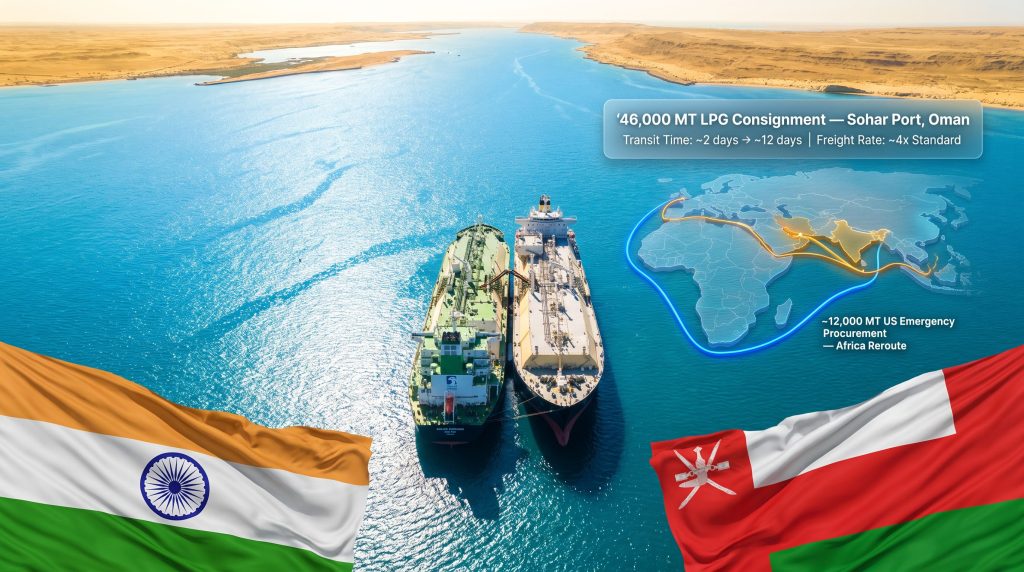
- The cargo is delivered to Sohar Port in Oman, positioned at the mouth of the Strait outside the contested zone.
- A ship-to-ship (STS) transfer takes place at Sohar, moving the cargo from the supplier's vessel directly to Confidence Petroleum's receiving ship.
- The Indian company's vessel completes the final leg of the voyage to an Indian port without ever entering the conflict zone.
This structure effectively transfers geopolitical transit risk from buyer to seller, with the supplier assuming the operational and insurance burden of moving cargo through the Strait. It is a meaningful commercial concession from suppliers, and it comes with a corresponding price.
ADNOC as Logistics Backbone: Why a State Energy Giant Was the Right Partner
The carrier chosen to execute Confidence Petroleum's 46,000 MT LPG consignment through this revised arrangement was Abu Dhabi National Oil Company (ADNOC), the UAE's state energy producer. The selection reflects a practical reality of conflict-zone logistics: state-affiliated entities possess diplomatic relationships, security coordination channels, and sovereign risk buffers that commercial shipping companies cannot replicate.
ADNOC's ability to coordinate safe passage through contested waters draws on institutional relationships with regional security actors that fall outside the commercial toolkit of private freight operators. That positioning makes it a natural logistics backbone for arrangements requiring reliable transit through geopolitically sensitive corridors.
Industry sources note that ADNOC's transit of Confidence Petroleum's cargo took approximately 12 days to complete a Gulf-to-Sohar journey that would typically require around two days under normal security conditions. The extended timeline reflects the heightened security protocols, route adjustments, and risk management procedures required to navigate the current environment safely.
The Cost Premium: Quantifying the Economics of Conflict-Zone Logistics
The operational advantages of the exit-point delivery model are real, but they are not free. The cost structure under conflict-period conditions diverges sharply from standard logistics economics.
| Logistics Parameter | Standard Conditions | Conflict-Period Conditions |
|---|---|---|
| Gulf-to-Sohar Transit Time | ~2 days | ~12 days |
| Time-Charter Freight Rate | Baseline | ~4x higher per day |
| Cargo Route | Direct Gulf port delivery | Exit-point handover + STS transfer |
| Vessel Risk Exposure | Importer's vessel enters Gulf | Supplier transits; importer receives at Sohar |
| Suez Canal Routing | Available for non-Gulf sources | Restricted; Africa reroute required |
Time-charter freight rates under the current arrangement are estimated at approximately four times higher on a per-day basis compared to standard conditions. Combined with the extended transit duration, the compounding effect on per-tonne procurement costs is substantial. For a private importer operating in a market where retail LPG prices carry social sensitivity, absorbing these cost increases without passing them downstream creates significant margin pressure. In addition, oil price volatility driven by regional tensions further erodes the already compressed margins private importers are managing.
Public Sector vs. Private Sector: Who Bears the Greater Risk?
An important and frequently overlooked dimension of the Hormuz disruption is the differential vulnerability between India's public sector oil companies and private importers like Confidence Petroleum.
Public sector entities operate on more frequent replenishment cycles than monthly importers, which means their inventory buffers are structurally thinner relative to their daily consumption rate. A delay of even a week or ten days in cargo delivery can create supply gaps that are genuinely difficult to bridge through spot purchases when freight markets are simultaneously under stress.
This creates a counterintuitive risk profile: while public sector companies may benefit from sovereign relationships and government coordination in some circumstances, their operational model leaves them more exposed to short-duration disruptions than private importers with monthly cycles. Confidence Petroleum's monthly replenishment rhythm, while requiring large individual cargo volumes, provides a modest buffer that daily or weekly cycle operators cannot access.
It is also worth noting that at least one public sector entity received a shipment through a comparable exit-point delivery arrangement during the same period, suggesting that the logistics model pioneered under commercial necessity is being replicated across the industry.
Scenario Analysis: India's LPG Supply Under Sustained Hormuz Pressure
The trajectory of supply security depends heavily on how long current conditions persist. The following framework maps projected impacts against disruption duration.
| Scenario | Duration | Projected Impact on India's LPG Supply |
|---|---|---|
| Short-term disruption | 1 to 4 weeks | Manageable with inventory buffers and spot purchases; moderate price pressure |
| Medium-term disruption | 1 to 3 months | Private importer inventories strained; government allocation reviews likely; significant cost escalation |
| Extended closure | 3+ months | Structural supply crisis; full rerouting via Africa or US sourcing required; severe cost inflation |
Disclaimer: The scenario projections above are analytical frameworks based on structural supply chain dependencies and are not forecasts or guarantees of outcomes. Actual impacts will depend on the evolving geopolitical situation, government policy responses, and market dynamics.
The next major ASX story will hit our subscribers first
Structural Vulnerabilities That Cannot Be Hedged Away Quickly
The Hormuz disruption has forced a reckoning with structural dependencies that India's LPG sector has carried for years without being forced to confront. Domestic production capacity cannot substitute meaningfully for import volumes in the near term. Indian refineries produce LPG as a byproduct of crude processing, and output volumes are constrained by refinery throughput and crude slate decisions rather than by demand signals alone.
The policy tension this creates is tangible. Directing increased domestic LPG production toward household consumers, as the government has done during the disruption, comes at the cost of commercial and industrial sector allocations. Those trade-offs become harder to manage the longer the disruption extends.
The Confidence Petroleum LPG supply Strait of Hormuz episode also raises broader questions about strategic reserve adequacy. India has developed strategic petroleum reserves for crude oil, but LPG-specific strategic storage infrastructure remains limited. The geopolitical trade disruption playing out across global energy markets may well accelerate policy conversations around dedicated LPG reserve development, though infrastructure investment at the required scale would take years to materialise.
Emerging Supply Chain Adaptations Worth Watching
The crisis has accelerated several operational innovations that are likely to persist beyond the current disruption period. However, trade war supply risks intersecting with physical maritime threats create a uniquely complex environment for energy importers to navigate simultaneously.
The key adaptations emerging from the Confidence Petroleum LPG supply Strait of Hormuz experience include:
- Ship-to-ship transfer hubs at neutral ports like Sohar are being recognised as replicable tools for conflict-zone cargo management, and investment in STS infrastructure at strategically positioned ports may grow.
- Supplier-side risk assumption in delivery contracts is likely to become a more explicit negotiating point in future LPG import agreements, with buyers seeking exit-point delivery terms as standard practice for Gulf sourcing.
- US LPG as a structural diversification option has now been validated at an operational level by Confidence Petroleum's emergency procurement, even if the logistics economics currently favour Gulf sources under normal conditions.
- Naval escort protocols for commercial cargo have been demonstrated as a viable option for high-value cargoes, though the scalability and cost of this approach limits its application to exceptional circumstances.
The Confidence Petroleum LPG supply Strait of Hormuz experience represents more than a single company navigating a difficult logistics problem. It is a live demonstration of how concentrated geographic dependencies translate into operational crises when geopolitical assumptions fail, and a preview of the supply chain architecture that India's energy sector will need to build if it is to reduce its vulnerability to any single maritime chokepoint.
Want to Stay Ahead of Energy and Commodity Market Shifts?
Discovery Alert's proprietary Discovery IQ model scans ASX announcements in real time, instantly identifying significant mineral discoveries across more than 30 commodities — turning complex market data into clear, actionable investment opportunities for traders and long-term investors alike. Explore historic discoveries and their market-defining returns, then begin your 14-day free trial at Discovery Alert to position yourself ahead of the next major market move.