June 12, 2026
The Mineral That Connects Congo's War Zones to Your Living Room
Every smartphone contains roughly 40 milligrams of tantalum. It is a quantity so small it barely registers against the weight of the device in your hand, yet its journey from raw earth to finished component traverses one of the most complex and morally compromised supply chains in modern industry. Tantalum's unique electrochemical properties make it irreplaceable in miniaturised capacitors, which regulate electrical charge in virtually every category of consumer electronics. The mineral cannot simply be swapped out. And for much of the world's supply, it begins its journey in a place where armed groups, not mining companies, dictate who digs and who profits.
Understanding the conflict coltan from Congo problem requires moving beyond the headline and into the structural mechanics of how a mineral extracted under gunpoint ends up inside products sold in suburban shopping centres. The answer is neither simple nor accidental.
When big ASX news breaks, our subscribers know first
Coltan, Tantalum, and the Invisible Backbone of Modern Electronics
What Makes Tantalum Technically Irreplaceable
Coltan is an abbreviation for columbite-tantalite, a dense black metallic ore that, once refined, yields tantalum metal. Tantalum's value to electronics engineers lies in a specific combination of properties: an extraordinarily high melting point of approximately 3,017 degrees Celsius, excellent resistance to corrosion, and the ability to form a stable oxide layer that functions as a highly efficient dielectric in capacitors. These characteristics allow manufacturers to produce capacitors that are physically tiny but capable of storing significant electrical charge, a critical requirement in the miniaturisation arms race that has defined consumer electronics for three decades.
Tantalum capacitors are found in:
- Smartphones and tablets, where they regulate power delivery to processors and communication modules
- Laptop computers and gaming consoles, where they stabilise voltage across high-frequency circuits
- Automotive electronics, particularly in electric vehicles where battery management systems require high-reliability capacitors
- Telecommunications base stations and networking hardware
- Medical devices, including implantable cardiac devices where longevity and reliability are non-negotiable
- Data centre servers and cloud computing infrastructure at significant scale
Within the broader minerals governance framework, tantalum falls under the 3TG classification alongside tin, tungsten, and gold. This grouping emerged from international concern about the role of these specific minerals in financing armed conflict, primarily in the DRC, and became the basis for regulatory action beginning with US legislation in 2010.
The DRC's Disproportionate Role in Global Supply
The DRC's mineral wealth is staggering — geologists estimate the country may hold some of the largest coltan reserves on earth. Its eastern provinces, shaped by tectonic activity associated with the East African Rift system, contain pegmatite formations that host high-grade columbite-tantalite deposits accessible to artisanal extraction with minimal capital equipment.
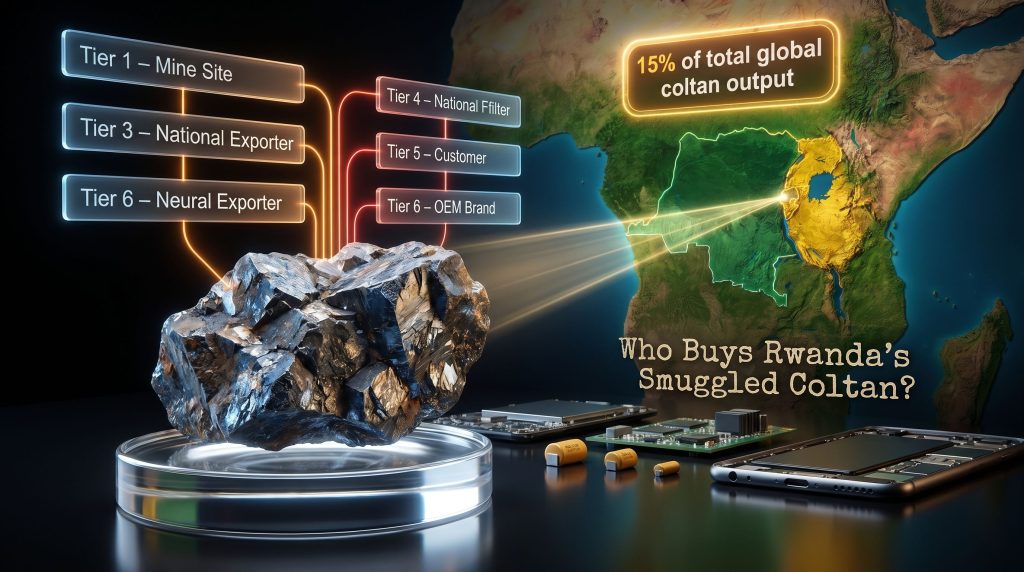
This geological reality has a deeply uncomfortable commercial implication. The Rubaya mining district in North Kivu province alone accounts for approximately 15% of total global coltan production, according to findings published by Global Witness in its 2025 investigation. A single conflict-affected district in one of the world's least stable regions supplies roughly one-seventh of the tantalum feedstock underpinning the global electronics industry. No risk model built for a responsible supply chain can treat that concentration as peripheral.
The global tantalum market is also structurally thin compared to base metals. Annual production is measured in thousands of tonnes rather than millions, which means even modest disruptions to key producing areas can exert meaningful pressure on downstream pricing and availability. This market thinness is precisely why the Rubaya district's share of output matters so much: its loss, or the contamination of its output with conflict-origin material, sends ripple effects through smelters in Asia and Europe that supply component manufacturers worldwide.
How Armed Groups Turned Eastern DRC's Mineral Wealth Into a Financing Machine
The Historical Roots of Resource Exploitation
The entanglement of armed groups with mineral extraction in eastern DRC did not begin recently. The Second Congo War, which formally ran from 1998 to 2003 but whose armed factions persisted in various forms for decades, drew regional actors into North Kivu, South Kivu, and Ituri specifically because of their mineral endowment. Coltan prices surged dramatically during the global technology boom of the late 1990s, and armed groups rapidly recognised that controlling mine access was more financially rewarding than controlling agricultural land or road corridors.
A critical distinction that is frequently misunderstood: armed groups in the DRC do not primarily engage in direct mining. Their role is that of a violent intermediary. They tax production, charge access fees, extort transport operators, and sometimes physically control the movement of mineral bags from extraction point to aggregation point. Furthermore, this means coltan can be mined by ordinary artisanal miners, often earning subsistence wages, while the value extracted flows upward to armed actors who provide no productive contribution whatsoever.
Coltan functions less as a conflict cause and more as a conflict sustainer: it provides the financial oxygen that keeps armed groups operational long after their original political or military rationale has dissipated. As documented by conflict minerals researchers at Genocide Watch, this self-perpetuating dynamic has made mineral revenue interdiction one of the most complex challenges in conflict resolution.
M23 and the Rubaya District: Recent Territorial Control
The M23 rebel movement represents the most recent and significant iteration of this dynamic. Following a resurgence of territorial activity in North Kivu beginning in 2022, M23 consolidated control over substantial portions of the province, including the Rubaya mining district, during the 2023 to 2025 period documented by the Global Witness investigation.
With physical control over Rubaya established, M23 was positioned to extract revenues from coltan operations at scale. Investigators documented patterns consistent with systematic taxation of artisanal mining output, forced displacement of communities unwilling to operate under armed group oversight, and the creation of economic dependencies that bound local mining populations to armed group structures.
Human rights observers have connected M23's territorial control in North Kivu to patterns of serious abuses, including forced displacement and documented incidents of gender-based violence in affected communities. The gender dimension of conflict mining deserves specific attention. Women and girls in communities adjacent to armed group-controlled mining zones face disproportionate exposure to violence, and North Kivu has been among the provinces most severely affected by conflict-related sexual violence.
The Rwanda Transit Mechanism: How Conflict Material Gains Legitimate Documentation
Geography provides the architecture for laundering. Eastern DRC shares a border with Rwanda, and Rwanda has developed a significant formal coltan export industry. However, the problem, as documented by Global Witness across the 2023 to September 2025 investigation period, is that five of Rwanda's seven largest coltan exporters were found to have purchased material originating from M23-controlled areas in the Rubaya district.
The transit mechanism works through aggregation. Coltan extracted under armed group influence crosses the DRC-Rwanda border through informal routes, where it enters the inventories of Rwandan comptoirs (trading houses). Once aggregated with material from other, potentially legitimate sources, the mixed inventory is exported under formal Rwandan trade documentation. At this point, the conflict origin of the DRC-sourced portion has been administratively dissolved.
The physical transformation that follows, the smelting of raw ore into tantalum powder, represents the final and most effective erasure of origin. Once tantalum powder from multiple source countries has been blended and processed at a smelter, backward traceability to any individual mine becomes operationally impossible without documentation that predates the blending event.
The Multi-Tier Supply Chain: Where Accountability Disappears
Mapping the Distance Between Mine and Market
The six-tier structure through which conflict coltan from Congo reaches consumer products is not a design flaw. It is, from a commercial perspective, an efficiency structure. Each tier adds value, reduces transaction costs, and increases the geographic and operational distance between raw extraction and finished product. Consequently, each tier also reduces accountability and traceability.
| Supply Chain Tier | Actor Type | Traceability Challenge |
|---|---|---|
| Tier 1 – Mine Site | Artisanal miners, armed group oversight | No formal documentation; cash transactions |
| Tier 2 – Local Aggregator | Informal traders, comptoirs | Mixed-origin material consolidated |
| Tier 3 – National Exporter | Licensed exporters (Rwanda-based) | Conflict origin obscured by transit |
| Tier 4 – International Smelter | Processing facilities in Asia and Europe | Blended with compliant material |
| Tier 5 – Component Manufacturer | Capacitor and electronics producers | Tantalum powder; origin untraceable |
| Tier 6 – OEM Brand | Consumer electronics, automotive OEMs | Reliant on supplier certifications |
By the time a tantalum capacitor is installed in a Sony PlayStation or a Microsoft Surface device, it has passed through at minimum five commercial transactions across multiple national jurisdictions. Each transaction creates new paperwork and new parties, none of whom necessarily has visibility into what happened three or four tiers earlier.
The Sectors Carrying the Greatest Exposure
Not all industries face equal risk from conflict coltan contamination. The sectors most dependent on tantalum capacitors, and therefore carrying the heaviest exposure to supply chain integrity failures, include:
- Consumer electronics: Smartphones remain the single largest end-use category for tantalum capacitors. A single high-end device may contain multiple tantalum capacitors across its power management, audio, and communications subsystems.
- Gaming hardware: Gaming consoles require high-density capacitor arrays for graphics processing and power stability, making them structurally dependent on tantalum supply.
- Cloud and data infrastructure: Hyperscale data centres deploy tantalum capacitors at enormous aggregate volumes, creating significant but diffuse exposure across cloud platform operators.
- Telecommunications networks: Base station and network switching equipment require tantalum-based components for high-frequency signal management.
- Electric vehicles: The electrification of automotive transport has substantially increased per-vehicle tantalum demand, as battery management systems, onboard computing, and advanced driver assistance electronics all incorporate tantalum capacitors.
The Global Witness investigation, drawing on trade data analysis and interviews with more than 70 sources over approximately two years, identified supply chain exposure extending across consumer electronics, gaming, cloud platforms, telecommunications, and automotive sectors. Named companies including Sony, Microsoft, Amazon, LG Display, Ericsson, Toyota, Nvidia, and Vodafone were implicated, though the nature of allegations varied by company and several disputed the findings.
Why Certification Systems Are Failing: A Critical Evaluation
Three Frameworks, Three Structural Weaknesses
The electronics industry has invested substantially in traceability and due diligence frameworks designed to keep conflict minerals out of supply chains. The Global Witness findings suggest that, in the context of conflict coltan from Congo, these investments have not delivered the assurance they were designed to provide.
ITSCI (ITRI Tin Supply Chain Initiative): Designed as a field-based mineral tagging system operating at the point of extraction in the DRC and Rwanda, ITSCI applies physical bag tags to certified mineral lots. The investigation alleged that the system has been used to apply legitimate certification tags to material originating from M23-controlled areas, effectively providing a compliance veneer to conflict-origin coltan. ITSCI has publicly maintained that its system remains operational and functional, disputing the characterisation of its effectiveness.
Better Mining: Positioned as a responsible sourcing programme with field-level operations at artisanal mine sites, Better Mining has faced allegations in the investigation that conflict-linked material may have entered supply chains carrying its certification. The organisation denied having tagged conflict-affected coltan.
Responsible Minerals Initiative (RMI) Smelter Audits: The RMI's Responsible Minerals Assurance Process (RMAP) functions as the primary mechanism through which technology brands verify compliance at the smelter level. The investigation alleged that RMI audits failed to detect meaningful volumes of conflict-origin coltan moving through certified smelter supply chains. Ericsson, for instance, cited RMI smelter compliance as the foundation of its sourcing confidence, a position the investigation directly challenged.
All three frameworks share a fundamental architectural weakness: they rely on documentation integrity at the point of origin. When armed groups physically control the mine site, no paper-based or tag-based system can guarantee that the documentation accurately reflects reality. The armed group's interest is in ensuring the documentation says whatever is necessary to move material into formal channels.
The Concept of Audit Theatre
A phenomenon that analysts of conflict mineral governance describe as audit theatre has become increasingly relevant to evaluating the DRC situation. Audit theatre refers to compliance processes that generate technically satisfactory documentation and audit outcomes without meaningfully reducing conflict mineral flows at the source. Periodic third-party smelter audits, conducted perhaps annually by external reviewers with limited field access, cannot realistically detect real-time smuggling operations conducted across porous borders.
This is not a criticism of auditors as individuals. It is a structural critique of applying an instrument designed for industrial supply chains to a context characterised by armed group territorial control, border permeability, and systematic falsification of origin documentation. In addition, the broader geopolitical dimensions of Congo's strategic minerals make purely commercial due diligence frameworks an inadequate response to what is fundamentally a governance and security challenge.
The Regulatory Framework: What Law Requires and What It Leaves Undone
Jurisdictional Gaps in Existing Conflict Mineral Legislation
| Regulation | Jurisdiction | Scope | Key Limitation |
|---|---|---|---|
| Dodd-Frank Act Section 1502 | United States | 3TG minerals for SEC-listed companies | Disclosure-based; no sourcing prohibition |
| EU Conflict Minerals Regulation (2021) | European Union | 3TG importers above volume thresholds | Exempts downstream manufacturers |
| OECD Due Diligence Guidance | International | Supply chain due diligence framework | Voluntary adoption; no enforcement mechanism |
| DRC National Legislation | Democratic Republic of Congo | Artisanal mining regulation | Enforcement capacity severely limited |
The most consequential gap in current regulatory architecture is the distinction between disclosure and prohibition. The US Dodd-Frank framework, which has been the primary legislative lever on conflict minerals since 2010, requires SEC-listed companies to report whether their products contain 3TG minerals from conflict-affected areas. It does not prohibit sourcing from those areas. A company can disclose conflict mineral exposure and remain fully compliant with the law.
The EU Conflict Minerals Regulation, which entered force in 2021, extends due diligence obligations to importers of 3TG minerals but exempts downstream manufacturers. This means the companies whose brand names appear on finished consumer products face no direct regulatory obligation under EU law to verify the conflict status of their mineral inputs. The vulnerabilities in critical minerals supply chains, furthermore, extend well beyond the DRC and represent a systemic challenge for which current regulatory frameworks remain inadequate.
Sanctions and the Limits of Naming
The UN Group of Experts on the DRC has documented armed group mineral revenues with considerable rigour across successive annual reports. However, the documentation is detailed, credible, and largely ignored in terms of operational consequence. Targeted financial sanctions against individuals and entities financing or benefiting from conflict mineral revenues in eastern DRC have been discussed in policy circles for years.
Implementation has been inconsistent, complicated by the geopolitical complexity of a region where multiple state actors, including neighbouring countries with their own strategic interests, are implicated in the mineral trade's structure. The DRC cobalt export ban provides one example of how export controls in the region can reshape trade flows, though such measures also carry significant unintended consequences for legitimate producers.
The next major ASX story will hit our subscribers first
What Genuine Accountability Would Actually Require
Immediate Corporate Actions
Companies with exposure to tantalum supply chains cannot credibly claim ignorance following the Global Witness investigation. Meaningful immediate responses would include:
- Suspending procurement from smelters unable to demonstrate verified upstream traceability to mine-of-origin level, not merely smelter-level audit certification
- Requiring enhanced due diligence from all Tier 1 and Tier 2 suppliers operating in or adjacent to conflict-affected regions in eastern DRC
- Publicly disclosing the specific smelters used and their current audit status, moving beyond aggregated annual compliance reporting that provides no actionable information to external stakeholders
Medium-Term Structural Reform
The traceability architecture currently deployed in the DRC was designed for a different risk environment. Upgrading it requires:
- Investment in blockchain-based mineral provenance systems capable of creating immutable records from extraction point to smelter input, removing the vulnerability of paper-based documentation to falsification
- Support for community-based monitoring programmes that embed local verification capacity alongside formal audit processes, creating ground-level accountability that periodic external audits cannot replicate
- Advocacy for mandatory country-of-origin disclosure at the smelter level across all major consumer markets, establishing a regulatory baseline that currently does not exist
The Congo minerals security partnership framework represents one emerging model for how international engagement can support both governance reform and responsible supply chain development simultaneously, though its implementation remains at an early stage.
Long-Term: Addressing Root Causes
Supply chain compliance programmes, however well-designed, operate downstream of the actual problem. The structural conditions enabling conflict mineral extraction in eastern DRC are political and economic: weak state governance, active armed group presence, limited alternative economic opportunities for artisanal mining populations, and a regional political economy in which mineral revenues sustain armed actors who have no interest in peace.
Traceability systems and audit frameworks are necessary but insufficient. No compliance programme designed at the supply chain level can solve a problem whose roots lie in the political economy of armed conflict. The two interventions must proceed in parallel, not sequentially.
Al Jazeera's on-the-ground reporting on DRC coltan miners illustrates how the human cost of this system falls most heavily on the individuals doing the physical work of extraction, who often earn subsistence-level returns regardless of whether armed groups are present.
Frequently Asked Questions: Conflict Coltan from Congo
What Exactly Is Conflict Coltan and Why Does So Much of It Originate in the DRC?
Conflict coltan refers to columbite-tantalite ore extracted from mining areas under the control or influence of armed groups in eastern DRC. The region's geology, specifically its pegmatite-hosted deposits in North Kivu and South Kivu, makes it one of the world's most significant sources of accessible coltan. The combination of exceptional mineral endowment, weak state authority, and decades of armed group activity has created conditions in which mineral revenues persistently flow to non-state armed actors rather than to the state or local communities.
How Does Conflict-Origin Coltan Reach Finished Consumer Electronics Without Detection?
The transit mechanism relies on aggregation and administrative transformation. Coltan crosses from DRC into Rwanda through informal routes, where it is mixed with material from other sources by Rwandan exporters. It then enters formal export channels with Rwandan documentation that conceals its DRC conflict origin. After smelting into tantalum powder, which blends material from multiple sources, backward traceability to the original mine becomes operationally impossible without pre-existing documentation chains that the conflict environment prevents from forming.
Are ITSCI and RMI Certifications Reliable Indicators of Conflict-Free Sourcing?
The Global Witness investigation raised serious questions about reliability in conflict-affected environments specifically. These systems function adequately in stable industrial mining contexts. In environments where armed groups control physical mine sites and have an incentive to ensure documentation says whatever is necessary to move material into formal channels, the integrity of any documentation-dependent system is structurally compromised regardless of the system's design quality.
What Do Existing Laws Actually Require Companies to Do?
In the United States, Dodd-Frank Section 1502 requires disclosure of whether products contain 3TG minerals from conflict-affected areas in the DRC or adjoining countries. The EU Conflict Minerals Regulation requires due diligence from importers above certain volume thresholds. Neither framework prohibits sourcing from conflict-affected regions. The legal standard is disclosure and due diligence, not verified exclusion.
What Role Does M23 Play in the Coltan Trade Specifically?
During the 2023 to 2025 period, M23's territorial control over the Rubaya mining district in North Kivu enabled it to extract revenues from coltan operations that account for approximately 15% of global coltan production. This was achieved primarily through taxation and access control over artisanal mining operations rather than through direct mining activity.
Compliance Without Accountability: The Structural Diagnosis
The conflict coltan from Congo problem is not primarily a technical traceability failure, although traceability systems have clearly fallen short. It is a structural outcome produced by the interaction of three forces: regulatory frameworks designed for transparency rather than elimination, corporate incentive structures that treat minimum compliance as sufficient, and the political economy of armed conflict in eastern DRC that makes mineral-revenue extraction a rational strategy for armed actors operating in a governance vacuum.
Rubaya's 15% share of global coltan output is not a detail. It is the central fact that makes this a systemic supply chain integrity challenge for the entire technology sector, not a peripheral sourcing concern affecting a few niche components. Every major consumer electronics brand, automotive manufacturer with electrified vehicle ambitions, and cloud platform operator building data centre capacity has tantalum exposure.
Meaningful progress requires three simultaneous commitments: binding regulation that moves beyond disclosure to verified sourcing exclusion, traceability infrastructure that can withstand the specific adversarial conditions of conflict-affected mining environments, and sustained political and economic investment in the governance conditions that would allow eastern DRC's mineral wealth to benefit its people rather than finance their oppression. Any strategy that pursues only one or two of these simultaneously will produce compliance documentation without producing change.
This article is intended for informational and educational purposes. It draws on published investigative findings, regulatory frameworks, and publicly available market data. Readers should conduct independent research and seek professional advice before making decisions based on information contained herein. Allegations cited from the Global Witness investigation represent the findings of that organisation and are subject to the responses and disputes noted by named companies and programmes.
Want to Stay Ahead of Significant ASX Mineral Discoveries as They Happen?
Discovery Alert's proprietary Discovery IQ model delivers real-time alerts on significant ASX mineral discoveries — cutting through complex data across more than 30 commodities to surface actionable opportunities the moment they emerge. Explore historic discoveries and the returns they generated, then begin your 14-day free trial to position yourself ahead of the broader market.