June 17, 2026
The Archive That Could Reshape the Global Critical Minerals Map
The Congo Belgium colonial-era geological records transfer debate has become far more than an archival question. Long before satellite imaging, airborne geophysics, or machine learning, geologists working across central Africa from 1885 to 1960 compiled an immense subsurface record. Those files were later shipped to Europe, where much of the collection still sits today.
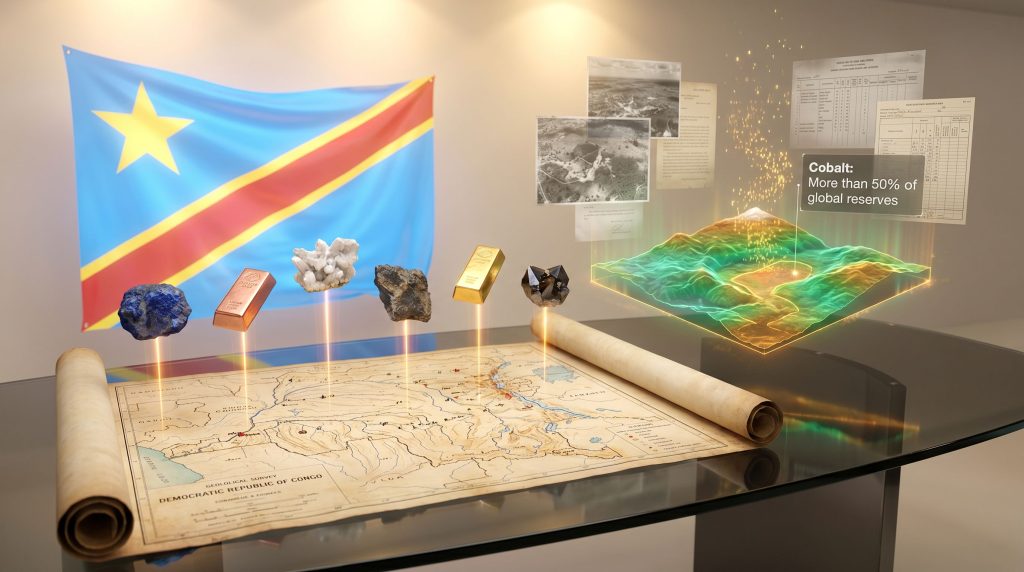
These documents include survey maps, drill logs, field notes, aerial photographs, and rock samples gathered across millions of square kilometres of what is now the Democratic Republic of Congo. Consequently, they now sit at the heart of a dispute tied to sovereignty, exploration speed, and access to future mineral wealth.
The DRC's Mineral Endowment: Why These Archives Matter More Here Than Anywhere Else
To grasp the stakes, it helps to understand the sheer scale of Congolese mineral potential. The DRC is not just a major mining jurisdiction. Rather, it is one of the world’s most concentrated repositories of transition-critical resources, as highlighted by its broader DRC mineral wealth.
- Cobalt: more than 50% of global reserves
- Copper: the world’s second-largest producer
- Coltan: a major global supplier
- Lithium: significant emerging deposits
- Gold, uranium, tin, tungsten: substantial but underexplored
However, much of the country remains poorly assessed by modern methods. Congolese officials have said established mining districts account for only a fraction of total potential. In other words, a country already central to battery and electrification markets may still be operating on only part of its geological inheritance.
That is why the archive held at the Royal Museum for Central Africa in Tervuren matters so much. Rebuilding even part of this dataset through fresh fieldwork would likely cost billions of dollars and take decades. By contrast, digitisation and return of the data could compress that process significantly.
Understanding the Congo-Belgium Colonial Geological Records Transfer
What the diplomatic process has produced so far
In mid-2026, Congo’s mining minister Louis Watum Kabamba met Belgian and EU officials to push the digitisation and restitution agenda forward. The discussions produced a joint roadmap and a dedicated task force to coordinate implementation with Congolese institutions.
Furthermore, Belgium confirmed that an EU-funded digitisation programme is already under way. Digital copies are being progressively shared with Congolese authorities, while priorities are being set jointly between the museum and Congolese partners.
The Financial Times reported that Congo’s mining ministry argued large parts of the country have never been explored with modern techniques, underscoring why archived data is an active exploration tool rather than a historical curiosity. In parallel, wider reporting on the dispute, including this FT coverage of the archives row, has highlighted how closely investors and policymakers are watching the process.
The joint roadmap signals a shift from diplomatic negotiation to operational execution. However, the pace of transfer, the scope of access, and who ultimately controls the data remain contested.
Why the physical archive remains under Belgian control
Despite progress, Belgium has maintained that the physical collections cannot simply be handed over wholesale. Public scientific collections are bound by Belgian law and institutional obligations, which officials say limit full physical restitution.
That distinction matters. Physical rock samples often preserve information that digital copies cannot fully capture. For instance, petrographic sections, geochemical signatures, and core textures still hold value for advanced technical analysis. Therefore, the question of repatriating physical specimens remains unresolved.
For additional institutional context, Belgium’s own State Archives overview of colonial records shows how politically and administratively complex the archive issue has become.
The Three-Way Tension: State, Museum, and Private Capital
How a US exploration company entered the equation
The Congo Belgium colonial-era geological records transfer issue became even more complex when KoBold Metals entered the picture. In 2025, the AI-focused exploration company signed agreements with the Congolese government to digitise historical geological data and make it publicly accessible.
Belgian authorities and museum officials, however, refused to grant exclusive archive access to a private foreign operator. Their stance was clear: any digitisation must remain under public institutional control, with data shared with Congolese state authorities rather than commercial entities.
This has created a three-way tension:
- DRC government: wants faster restitution and control
- Belgian institutions: want legal and institutional safeguards
- Private firms: want timely access for competitive exploration analysis
The public versus private access fault line
This access debate has enormous commercial consequences. If the archive becomes broadly available, junior miners, national geological agencies, and researchers could all benefit. That would spread opportunity more evenly.
If access is concentrated through one private platform, it could create an intelligence advantage worth tens of billions of dollars in discovery value. As a result, the current dispute is being watched well beyond Congo.
In addition, the wider geopolitical backdrop matters. The DRC’s role in Western supply diversification is increasingly tied to efforts such as the Congo minerals partnership, which aims to strengthen supply security outside dominant processing chains.
Geoscientific Sovereignty: A New Dimension of Resource Nationalism
Why the concept is reshaping African mining policy
Geoscientific sovereignty extends resource nationalism into the data sphere. Traditionally, governments focused on royalties, licences, and physical extraction rights. Now, they are also asserting control over geological information generated within their borders.
For post-colonial states, that shift is profound. Colonial surveys were not conducted to benefit local populations. Instead, the data was extracted alongside the minerals, leaving an informational imbalance that persisted long after independence.
The DRC case is especially high-stakes because of the country’s mineral concentration and the current surge in critical minerals demand. Consequently, archive access is no longer merely symbolic; it could shape the next generation of discoveries.
The DRC-Belgium dispute represents the leading edge of a broader shift in how resource-rich nations seek control over the full value chain of mineral discovery.
How AI and Digital Exploration Technology Have Transformed Historical Geological Data
Why decades-old survey data is now more valuable
The strategic value of old geological records has risen sharply because modern AI can reinterpret them at scale. Systems can process millions of data points, comparing maps, sample logs, structural notes, and geochemical anomalies far faster than any manual workflow.
Therefore, records once seen as fragmented or outdated can now be used to identify overlooked deposit signatures. This is particularly true in frontier jurisdictions where historical coverage is broad but modern drilling remains limited.
One underappreciated factor is the role of pathfinder elements. Old geochemical surveys often recorded trace minerals that seemed irrelevant at the time. Today, those same traces can help AI models detect conditions linked to major copper-cobalt or lithium systems.
This is where AI in mineral exploration becomes especially relevant. The combination of historical data and machine learning can turn dormant archives into highly actionable targeting systems.
How AI reprocessing works in practice
- Digitisation of maps, photos, logs, and field reports
- Standardisation into machine-readable formats
- Feature extraction of faults, contacts, alteration, and anomalies
- Cross-referencing with satellite and geophysical datasets
- Target generation using probability-based ranking
- Field validation through drilling and sampling
Critical Mineral Supply Chains and the Exploration Timeline Problem
Connecting archive access to energy transition timelines
The Congo Belgium colonial-era geological records transfer dispute is inseparable from the energy transition. Congolese cobalt is central to battery cathodes, while its copper supports electrification infrastructure across renewable systems and grids.
Yet exploration takes time. From target identification to production, a major greenfield copper-cobalt project can take 10 to 15 years. If archival reprocessing shortens the early-stage search by even two to three years, it could materially affect supply in the late 2030s.
Furthermore, concerns around DRC cobalt supply risks have already shown how sensitive global markets are to disruption. Faster discovery pipelines would not solve every bottleneck, but they could improve long-term resilience.
Three possible outcomes
- Full public digitisation: wider access and faster exploration activity
- Phased bilateral transfer: moderate progress but slower timelines
- Stalled restitution: continued underperformance against mineral potential
Western governments are following the issue closely because the DRC sits at the centre of strategic mineral supply concerns. Accordingly, the archive dispute has become directly relevant to energy security policy.
Frequently Asked Questions
What records are being transferred from Belgium to the DRC?
The collection includes millions of documents from Belgium’s administration of the Congo, including geological maps, field reports, drill data, aerial photographs, and physical mineral samples.
Why does the DRC want them now?
Because large parts of the country remain underexplored by modern methods. The archive could accelerate discovery of copper, cobalt, lithium, and other strategic minerals.
What is Belgium’s position?
Belgium supports digitisation and progressive data-sharing. However, it maintains that physical collections remain under Belgian institutional governance.
How does AI fit into the dispute?
AI can extract new patterns from old maps and logs, turning historical records into commercially significant exploration tools. That is a key reason the Congo Belgium colonial-era geological records transfer issue has become so strategically important.
Key Takeaways
- Colonial geological archives have become strategic assets in the age of AI
- The DRC’s mineral endowment makes these records unusually valuable
- Digital access and physical restitution remain separate issues
- Private-sector involvement has added commercial tension
- Archive access could affect future mineral supply chains and timelines
This article contains forward-looking analysis and scenario projections. These are analytical views based on publicly available information and should not be treated as investment advice.
Could The Next Major Discovery Be Hidden In Historic Data?
Discovery Alert’s proprietary Discovery IQ model helps investors identify significant ASX mineral discoveries the moment they are announced, turning complex exploration signals into actionable opportunities across critical minerals and beyond. See how historic discoveries have delivered exceptional returns on Discovery Alert’s discoveries page and start a 14-day free trial at the Discovery Alert home page.