
June 15, 2026
Why Depth Is the Metric That Separates Good PGM Projects From Great Ones
In the world of layered mafic intrusion deposits, strike length often captures the headlines. But among geologists who specialise in platinum group metal systems, it is the vertical dimension that ultimately defines a project's long-term economic ceiling. A deposit that extends only 200 to 300 metres below surface, regardless of how impressive its horizontal footprint appears, is inherently constrained. One that can demonstrate consistent mineralisation through 400, 500 metres and beyond enters an entirely different category of resource potential.
This is precisely the context within which the Podium Minerals Parks Reef depth extension story becomes technically compelling. The latest drilling results from Parks Reef in Western Australia have not simply nudged the mineralised boundary downward by a modest increment. They have raised a genuine question about whether the existing Mineral Resource Estimate represents only a fraction of what the system actually contains.
Understanding why that question matters, and what the data does and does not yet confirm, requires looking at the geology, the methodology, and the gap between what drilling has intersected and what has formally been counted.
When big ASX news breaks, our subscribers know first
Parks Reef as a Geological System: More Than a Single Number
The Layered Mafic Intrusion Framework
Parks Reef is classified as a layered mafic intrusion hosted PGM deposit, a deposit type that forms when magma rich in iron and magnesium cools slowly within the crust, allowing dense minerals to settle and crystallise in distinct horizontal layers. The platinum group metals, including platinum, palladium, rhodium, ruthenium, and iridium, concentrate within specific chromite-rich or sulphide-bearing horizons during this process.
What makes this deposit type particularly attractive from a resource modelling perspective is the inherent lateral and vertical continuity that comes with the geological setting. Unlike structurally controlled vein deposits where grade can be erratic and geometry unpredictable, layered intrusions tend to preserve their mineralised horizons across substantial distances, both along strike and down dip. Understanding mineral deposit tiers helps contextualise why this continuity is so valuable in long-term resource planning.
This is why the Bushveld Igneous Complex in South Africa, which hosts the vast majority of the world's PGM production, has been mined at progressively greater depths for over a century. The same geological logic that underpins those operations applies, in principle, to Parks Reef.
The April 2024 Mineral Resource Estimate at a Glance
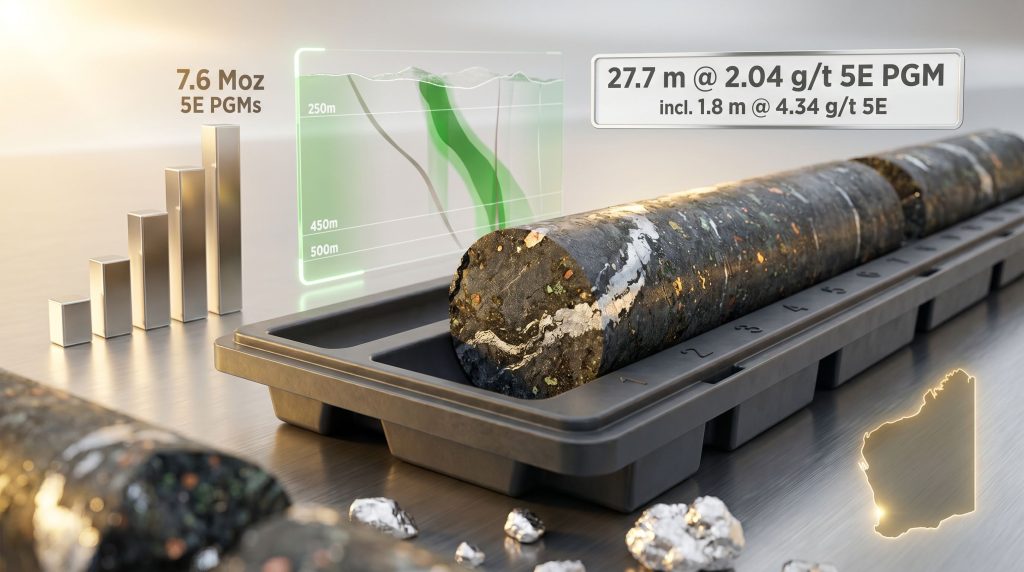
The most recent formal resource estimate for Parks Reef, updated in April 2024, established an Inferred Mineral Resource of 183 million tonnes grading to deliver 7.6 million ounces of combined 5E PGMs. The 5E designation refers to the five principal platinum group elements measured in the assay suite.
Beyond the PGM content, the deposit carries meaningful base metal credits that materially strengthen its economic profile:
| Commodity | Estimated Quantity | MRE Depth Constraint |
|---|---|---|
| 5E PGMs | 7.6 Moz | 250 metres |
| Copper | ~103,000 tonnes | 250 metres |
| Nickel | ~143,000 tonnes | 250 metres |
| Cobalt | ~27,000 tonnes | 250 metres |
Every figure in that table is currently constrained to a 250 metre vertical depth boundary. That boundary is not a geological ceiling. It is simply the limit of what has been formally modelled and classified. The new drilling programme was designed specifically to test what lies below it.
The Multi-Commodity Architecture: Why the Copper-Gold Zone Matters
One feature of Parks Reef that often receives insufficient attention is its multi-layer commodity architecture. The deposit hosts not only the primary PGM zone but also a spatially distinct copper-gold zone that sits alongside and stratigraphically above the PGM horizon. In shallow drilling, both zones have been clearly delineated.
The confirmation that the copper-gold zone also persists at depth is significant for two reasons. First, it validates that the overall host geological sequence is intact at lower depths, not just one isolated horizon. Second, it reinforces the economic case for any future deep mining scenario by providing a secondary revenue stream that could offset the higher costs associated with deeper extraction.
What the Latest Six-Hole Drilling Programme Actually Tested
Design Logic and Target Depth Window
The recently completed diamond drilling programme comprised six holes engineered to reach vertical target depths of approximately 300 to 450 metres, sitting materially below the existing 250 metre MRE boundary. Crucially, these holes were not purely exploratory. They were designed with a dual purpose: testing the spatial extent of PGM mineralisation below the resource envelope and simultaneously collecting core samples for ongoing metallurgical test work.
This dual-function design is a capital-efficient strategy that is increasingly common in junior PGM exploration, where the cost of each diamond hole is significant relative to market capitalisation. By embedding metallurgical sampling objectives within the extension drilling programme, the company advances two parallel workstreams without doubling its drilling expenditure.
Reading the Nine-Hole Dataset as a System
The six new holes do not stand alone. When combined with three historic holes drilled in 2022 that intersected mineralisation at approximately 500 metres vertical depth, a nine-hole deep dataset emerges that covers multiple locations across a 2 kilometre strike length within the priority starter mine area.
The statistical picture from this combined dataset is notable:
- Five of the six new holes confirmed continuity of both the PGM zone and the copper-gold zone at depth
- Historic 2022 intersections at approximately 500 metres provide independent corroboration at greater vertical extent
- The 2 km strike coverage within the starter mine area mirrors the zone prioritised for early development
- Grade profiles at depth are consistent with those that underpin the existing near-surface resource estimate
The standout result from the programme came from hole PRDD027, which returned 27.7 metres at 2.04 g/t 5E PGM, including a high-grade internal interval of 1.8 metres at 4.34 g/t 5E. Furthermore, interpreting drill results of this calibre requires understanding how width and tenor together signal system quality. The width and tenor of this intersection is directly comparable to results used in constructing the existing 250 metre resource, which is a meaningful data point in assessing whether depth degrades the system.
Key Analytical Observation: In many PGM deposits hosted within layered intrusions, grade tends to diminish as weathering and near-surface oxidation effects transition to fresh sulphide rock. The fact that Parks Reef is demonstrating equivalent or better grade characteristics at 300 to 450 metres compared to the shallow resource profile suggests the system is maturing into its primary sulphide domain rather than deteriorating.
High-Grade Domains at Depth: Selective Mining Implications
Beyond the average grade results, the identification of discrete high-grade domains exceeding 2.5 g/t 5E at depth carries specific operational implications. In PGM mining, the ability to identify and selectively target higher-grade pods within a broader mineralised sequence can significantly improve mill feed quality and reduce processing costs per ounce. This is a technique well established at South African operations, where grade engineering within the mining sequence is used to optimise plant throughput and metal recovery economics.
The presence of analogous high-grade domains at Parks Reef at depth introduces the possibility of similar feed optimisation strategies in any future mining scenario, a consideration that becomes more economically relevant as depth increases and selectivity becomes more important to maintain project returns.
Geophysics as a Depth Indicator: What Aeromagnetic Reprocessing Suggests
How Aeromagnetic Surveys Are Used in Layered Intrusion Exploration
Aeromagnetic surveying measures variations in the Earth's magnetic field caused by differences in the magnetic susceptibility of subsurface rocks. In layered mafic intrusions, the dense iron-rich rocks of the host sequence generate a distinctive magnetic signature that can be traced at depth, even without direct drilling.
When this raw magnetic data is reprocessed using modern inversion modelling techniques, geologists can construct three-dimensional interpretations of where the host geological package extends beneath the surface. This is not a resource estimation tool. It is a targeting and hypothesis-generation tool that informs where drill holes should be placed.
The 2 km Depth Hypothesis
Reprocessed aeromagnetic data at Parks Reef has produced an interpretation suggesting the host geological sequence may extend to depths exceeding 2 kilometres below surface. To contextualise the potential significance of this, consider the following depth scenario comparison:
| Depth Scenario | Description | Current Status |
|---|---|---|
| 250 metres | Current MRE boundary, 7.6 Moz 5E | Formally classified Inferred Resource |
| 300 to 450 metres | Six new diamond holes confirm PGM zone continuity | Drill-confirmed, not yet in MRE |
| ~500 metres | Historic 2022 holes confirm mineralisation | Drill-confirmed, not yet in MRE |
| Beyond 2,000 metres | Aeromagnetic model interpretation | Conceptual only, requires drill validation |
Critical Disclaimer: The aeromagnetic interpretation suggesting host geology extending to 2 kilometres is a geophysical model, not a mineral resource. It cannot be used to estimate metal quantities, assign economic value, or infer mineralisation grade. It represents a geological hypothesis that requires systematic drilling validation before any formal resource conclusions can be drawn. Investors should treat this figure as directional context only.
The more immediately material observation is the gap between the 250 metre MRE boundary and the vertical depth potential of 500 metre drill-confirmed mineralisation. That 250 metre interval of down-dip extension represents a substantial volume of rock hosting PGM and copper-gold mineralisation that has been physically intersected but not yet incorporated into any formal resource estimate. Closing that gap through infill and step-out drilling represents the most logical near-term pathway to resource growth.
Parks Reef Within the Global PGM Supply Picture
Concentration Risk and the Case for Supply Diversification
Global platinum group metal production remains extraordinarily concentrated. South Africa accounts for approximately 70 to 75 percent of annual platinum supply and around 35 to 40 percent of palladium output. Russia, primarily through the Norilsk Nickel operation, contributes a further significant share of global palladium. This geographic concentration creates a supply chain vulnerability that has become increasingly visible to industrial consumers, particularly in the automotive sector and the emerging hydrogen economy.
The critical minerals demand environment reinforces this point, as the demand outlook for PGMs is driven by two converging structural forces:
- Autocatalyst demand for platinum and palladium in internal combustion engine emissions control, which remains robust in the near to medium term
- Hydrogen economy demand where platinum-group catalysts are fundamental to both PEM technology fuel cells and green hydrogen electrolysers
Against this backdrop, new PGM resources outside South Africa and Russia carry intrinsic strategic value to industrial supply chains seeking diversification. Australia, with its stable regulatory environment and established mining infrastructure, is a natural beneficiary of this supply chain reorientation.
Where Parks Reef Sits in Australia's PGM Landscape
Australia is not traditionally associated with large-scale PGM production. Most domestic PGM output has historically been a byproduct of nickel mining in Western Australia. Parks Reef, with its 15 kilometre total strike length and 7.6 million ounce existing resource, represents a genuine primary PGM deposit of considerable scale by any global benchmark.
The focus of current development planning is the starter mine area, a prioritised 2 kilometre section of the broader deposit where geological confidence is highest, infrastructure positioning is most practical, and the Podium Minerals Parks Reef depth extension work described above is being concentrated. This staged development logic is standard practice in large low-grade bulk tonnage deposits, where capital efficiency in early production is essential to building investor confidence and project economics before committing to larger-scale development.
What Comes Next: Technical Milestones and the Path to Resource Growth
Transitioning Drill Results Into a Formal MRE Update
The process of converting drill-confirmed intersections into an updated Mineral Resource Estimate involves several sequential steps:
- Geological modelling to extend the three-dimensional wireframe of the mineralised zone to the newly confirmed depths
- Geostatistical analysis to assess grade continuity and variability between drill holes
- Classification of newly modelled volumes as Inferred Resource under the JORC Code, which requires demonstrated geological continuity but not close-spaced infill drilling
- Formal reporting of the updated MRE with updated tonnage and contained metal figures
For the newly confirmed 300 to 500 metre material to achieve Inferred classification, additional infill drilling between the current deep holes may be required to demonstrate spatial continuity at the spacing needed to support JORC Inferred confidence levels. The exact infill requirements will depend on the variogram analysis from the existing deep dataset.
Metallurgical Work: The Often-Overlooked Variable
Resource scale is only one component of a project's development case. Processing economics, specifically the ability to liberate and recover PGMs and base metals from the ore at acceptable cost, are equally critical. The integration of deep core samples from this drilling programme into the ongoing metallurgical test work programme means that processing behaviour at depth can be characterised independently of shallow zone assumptions.
This distinction matters because mineralogy can evolve with depth. Sulphide species, grain size distributions, and mineral associations that govern flotation performance can differ between the oxidised near-surface zone and the fresh primary sulphide material encountered at 300 to 500 metres. Establishing that deep mineralisation responds predictably to standard processing methods is a prerequisite for any credible definitive feasibility study level economic analysis.
The combination of extending the resource envelope and simultaneously de-risking the processing pathway represents a disciplined, parallel-track approach to advancing a large-scale PGM project within the capital constraints of a junior explorer.
This article is intended for informational purposes only and does not constitute financial or investment advice. All figures related to mineral resources are subject to the inherent uncertainties of the JORC Code classification system. Geophysical interpretations, including aeromagnetic depth modelling, should not be treated as resource estimates. Investors should conduct their own due diligence and seek independent financial advice before making investment decisions.
The next major ASX story will hit our subscribers first
FAQ: Podium Minerals Parks Reef Depth Extension
What is the current depth of the Parks Reef Mineral Resource Estimate?
The Parks Reef MRE is constrained to a vertical depth of 250 metres, representing the boundary of the April 2024 Inferred Resource of 183 million tonnes at 7.6 million ounces 5E PGMs.
How deep has mineralisation now been confirmed at Parks Reef?
The recent six-hole diamond drilling programme confirmed PGM mineralisation at vertical depths of 300 to 450 metres. When combined with 2022 historic drilling, mineralisation has been physically intersected at approximately 500 metres below surface across multiple locations.
What does the aeromagnetic data suggest about Parks Reef's ultimate depth potential?
Reprocessed aeromagnetic data indicates the host geological sequence may extend to depths beyond 2 kilometres. This remains a geophysical interpretation that requires drilling validation and cannot be used to estimate resources or metal content.
What was the best intercept from the latest deep drilling programme?
Hole PRDD027 returned 27.7 metres at 2.04 g/t 5E PGM, including a high-grade interval of 1.8 metres at 4.34 g/t 5E, at depths comparable to the grade profile that underpins the existing near-surface resource.
Does the copper-gold zone also extend to depth?
Yes. The recent deep drilling confirmed the presence of the copper-gold zone alongside and above the PGM zone at depth, reinforcing the multi-commodity character of the system beyond the current MRE boundary.
What is the total strike length of Parks Reef?
Parks Reef extends across a total strike length of 15 kilometres, with the current Podium Minerals Parks Reef depth extension drilling focused on a 2 kilometre section within the priority starter mine area.
For additional market-focused reporting on this drilling programme, readers can refer to coverage published by The Market Online at themarketonline.com.au.
Want to Track the Next Significant PGM Discovery the Moment It Hits the ASX?
Discovery Alert's proprietary Discovery IQ model scans ASX announcements in real time, instantly identifying high-potential mineral discoveries across platinum group metals and more than 30 other commodities — turning complex data into clear, actionable insights. Explore historic examples of major discoveries and their market returns, then begin your 14-day free trial at Discovery Alert to position yourself ahead of the broader market.