May 22, 2026
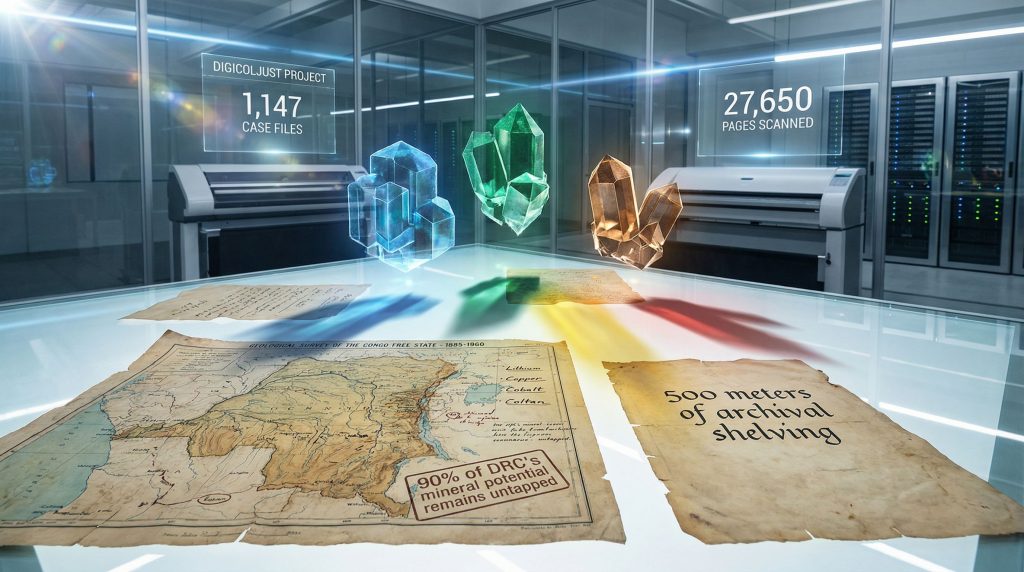
The digitization of Congo colonial archives has emerged as a critical intersection between historical preservation and contemporary mineral development needs. While modern mining companies increasingly rely on data-driven mining operations to identify resource deposits, some of the world's most valuable mineral intelligence remains locked in Belgian colonial-era archives. This unique convergence demonstrates how century-old handwritten surveys could accelerate critical minerals energy transition supply chains that power today's renewable energy infrastructure.
The Democratic Republic of Congo exemplifies this phenomenon, where 90% of the nation's mineral potential remains untapped according to government estimates, yet comprehensive geological data exists in Belgian colonial archives spanning the 1885-1960 period. Furthermore, this creates an intriguing dynamic where digitization of Congo colonial archives could unlock mineral exploration importance opportunities worth billions while simultaneously addressing questions of digital sovereignty and cultural heritage preservation.
The Strategic Value of Belgium's Colonial Geological Archive
The Royal Museum for Central Africa in Tervuren houses one of the world's most comprehensive colonial-era geological datasets. Consequently, this collection stretches across 500 meters of archival shelving containing millions of documents that meticulously recorded Congo's mineral wealth during Belgian colonial rule. These handwritten surveys, fragile and requiring specialised preservation techniques, represent a systematic mapping effort that identified deposits of lithium, copper, cobalt, and coltan across the vast Congolese territory.
The economic implications of this archive extend far beyond historical curiosity. In addition, current global competition for critical minerals has intensified demand for geological intelligence, particularly as nations seek to reduce dependence on Chinese supply chains for materials essential to battery manufacturing, electronics, and defence applications. However, the colonial-era surveys provide baseline geological data that could significantly reduce exploration risk and accelerate mineral development timelines.
Digital Access Economics and Exploration Efficiency
Traditional archive access requires physical visits to Belgium, creating logistical barriers for exploration companies and government agencies seeking to evaluate mineral prospects. For instance, digital platforms would enable real-time geological data analysis while reducing costs associated with international research trips and document reproduction fees.
The transformation from physical to digital access fundamentally alters the economics of mineral exploration in the DRC. Rather than limited access through government letters of support and museum protocols, digitised archives could democratise geological information. Furthermore, this would enable smaller mining companies and local institutions to participate in resource development planning.
Enhanced transparency through public digital access could also strengthen governance frameworks for mineral resource management. Consequently, this addresses long-standing concerns about information asymmetries in mining negotiations between international companies and local authorities.
When big ASX news breaks, our subscribers know first
Competing Institutional Models for Archive Control
The digitization of Congo colonial archives has become a complex institutional standoff involving multiple stakeholders with divergent timelines and governance philosophies. US mining startup KoBold Metals has proposed immediate public digitisation with technical and financial support. However, Belgium's Royal Museum for Central Africa maintains a slower, institutionally controlled approach backed by European Union funding.
Benjamin Katabuka, director general for KoBold Metals in the DRC, has emphasised the urgency of data accessibility for mineral development. According to Reuters reporting on Belgian-US mining disputes, Katabuka stated that immediate digitisation would make documents accessible to the public while supporting the country's need for increased exploration investment.
Timeline Disparities and Governance Frameworks
The competing approaches reflect fundamentally different priorities and institutional constraints:
- KoBold's Rapid Deployment Model: Immediate digitisation with private sector efficiency
- Belgium's Institutional Framework: 4-5 year timeline emphasising scientific protocols and European legal compliance
- Government Authority Questions: DRC backing for accelerated partnerships versus Belgian sovereignty over public assets
Museum director Bart Ouvry has defended the institutional approach. In addition, he stated to Reuters that delegating collection management to private companies would contradict scientific and institutional ethics. The museum is collaborating with Congo's National Geological Service on a digitisation project expected to span five years, with data available in both countries under Belgian and European law.
Belgian government spokesperson Florinda Baleci has clarified the legal framework. Furthermore, she confirmed that geological archives constitute public assets and that Belgium cannot grant exclusive access to foreign companies without contractual relationships established through proper governmental channels.
Legal Framework and Sovereignty Considerations
A 2022 Belgian law created frameworks for returning colonial-era collections to African states. However, archives are explicitly excluded from these repatriation requirements. This legal distinction maintains Belgian institutional control over historical documents while acknowledging moral obligations for cultural artefact returns.
The exclusion of archives from repatriation frameworks raises questions about digital sovereignty and equitable access to historical geological data. Consequently, while physical artefacts may return to originating countries, informational assets remain under European institutional management despite their direct relevance to contemporary African resource development.
Current Digitisation Implementation Strategies
Existing digitisation efforts provide insights into viable models for large-scale colonial archive processing. The Royal Museum for Central Africa has established a collaborative framework with Congo's National Geological Service. For instance, this represents a government-to-government partnership that respects institutional protocols while addressing DRC data access needs.
Belgian-Congolese Institutional Partnership Model
The current implementation strategy emphasises bilateral cooperation with specific operational parameters:
| Project Element | Specification | Timeline |
|---|---|---|
| Institutional Partners | Royal Museum for Central Africa, Congo's National Geological Service | Ongoing |
| Expected Duration | Up to 5 years | 2024-2029 |
| Data Availability | Both Belgium and DRC | Upon completion |
| Legal Framework | Belgian and European law compliance | Permanent |
| Access Protocol | Government-authorised requests with supporting documentation | Current |
This partnership model addresses sovereignty concerns while maintaining scientific standards for document preservation and digitisation quality. Furthermore, the extended timeline reflects the complexity of processing handwritten, fragile materials that require specialised scanning equipment and metadata creation.
Technical Infrastructure Requirements
The digitization of Congo colonial archives presents significant technical challenges beyond simple document scanning. Handwritten materials require optical character recognition (OCR) technology capable of processing multiple languages and historical writing styles. In addition, fragile document conditions necessitate specialised preservation protocols during the scanning process.
Metadata creation for millions of documents requires substantial human expertise to categorise geological surveys, administrative records, and mineral mapping data. Consequently, this intellectual labour represents a significant portion of project costs and timeline requirements, explaining the multi-year implementation schedule.
Technical and Economic Barriers to Large-Scale Implementation
Infrastructure limitations across African nations create disparities in digital archive utilisation even after successful digitisation completion. Internet connectivity rates and computer access vary significantly between urban centres and mining regions where geological data proves most valuable for exploration activities. However, these challenges must be addressed as part of the broader mining industry evolution towards digital transformation.
Digital Divide Implications
Successful archive digitisation must consider end-user technical capabilities:
- Bandwidth Requirements: High-resolution geological maps require substantial data transfer capacity
- Hardware Access: Specialised mapping software may require advanced computing resources
- Technical Training: Geological data interpretation requires expertise not universally available
- Language Barriers: Colonial-era documents may require translation for effective utilisation
Funding Sustainability and Maintenance Costs
Long-term digital platform maintenance presents ongoing economic challenges beyond initial digitisation investments. Server hosting, software updates, user support, and data backup systems require sustained funding commitments from sponsoring institutions.
European Union funding models typically provide initial project support but may not guarantee perpetual platform maintenance. Furthermore, this creates sustainability risks for digitised archives that could become inaccessible if funding priorities shift or institutional partnerships change.
Private sector involvement, while controversial from institutional ethics perspectives, could provide more reliable long-term funding through commercial applications of geological data. However, this approach raises concerns about equitable public access and potential commercialisation of historical information.
Impact on Critical Mineral Supply Chain Security
The digitization of Congo colonial archives directly addresses contemporary supply chain vulnerabilities in critical mineral markets. As global competition for battery materials intensifies, comprehensive geological intelligence becomes a strategic asset for nations seeking supply chain diversification. Consequently, this intersects with broader concerns about US-China trade impact on global mineral markets.
Strategic Mineral Identification and Development
Colonial-era geological surveys identified extensive deposits of materials now essential for renewable energy infrastructure:
- Lithium: Critical for battery energy storage systems
- Copper: Essential for electric vehicle wiring and renewable energy transmission
- Cobalt: Key component in lithium-ion battery cathodes
- Coltan: Vital for electronic device capacitors and military applications
The systematic colonial mapping effort, while conducted for exploitative purposes, created comprehensive geological baselines that remain scientifically valid. Furthermore, modern exploration companies can use this historical data to prioritise survey areas and reduce initial prospecting risks.
Investment Flow Implications
Enhanced due diligence capabilities through digital archive access could attract foreign direct investment by reducing information asymmetries in mineral exploration projects. Transparent access to geological data enables more accurate project valuations and risk assessments. Consequently, this could potentially increase investor confidence in DRC mining ventures.
The United States has deepened strategic partnerships with Kinshasa to secure critical mineral supplies and reduce reliance on Chinese supply chains. KoBold Metals represents one of several US companies expanding operations in Congo as part of this broader supply chain security initiative.
Washington's strategic partnership with the DRC reflects recognition that geological intelligence significantly impacts supply chain resilience. In addition, digital archive access could accelerate mineral development timelines, supporting Western nations' efforts to establish alternative supply sources for materials needed in batteries, electronics, and defence applications.
Legal and Ethical Frameworks Governing Archive Access
The governance of colonial archives involves complex intersections of institutional ethics, international law, and practical development needs. Scientific institutions maintain collection management standards that emphasise preservation and academic access. However, developing nations prioritise economic development and resource sovereignty.
Institutional Ethics Versus Development Urgency
Museum institutions argue that collection management requires specialised expertise and institutional continuity that private companies cannot guarantee. Scientific integrity standards emphasise long-term preservation over short-term access optimisation. Consequently, this creates tension with immediate development needs.
The Royal Museum for Central Africa's position reflects broader museum community concerns about commercial entities managing cultural heritage assets. Furthermore, even when private companies offer technical expertise and financial resources, institutional ethics frameworks resist delegating collection management responsibilities.
Digital Repatriation and Shared Custody Models
Digital repatriation presents alternative approaches to physical artefact returns while addressing sovereignty concerns. Shared digital custody allows originating countries to access historical materials without requiring physical transfer of fragile documents.
However, digital repatriation raises questions about platform control, access restrictions, and long-term availability. If digitised archives remain on European servers under European legal frameworks, practical sovereignty may remain limited despite formal data sharing agreements.
International law precedents for colonial archive management remain underdeveloped. Consequently, this creates uncertainty about applicable governance frameworks. The exclusion of archives from Belgium's 2022 repatriation law suggests legislative recognition of distinct considerations for informational versus physical cultural assets.
The next major ASX story will hit our subscribers first
Long-Term Resource Governance and Development Outcomes
Transparent access to geological survey data through digitised colonial archives could fundamentally transform resource governance in the Democratic Republic of Congo. Public availability of mineral mapping information would enhance government oversight capabilities while enabling civil society monitoring of extraction activities. According to Brussels Times analysis, these developments have significant implications for governance structures.
Anti-Corruption and Transparency Benefits
Historical geological data provides baseline information for evaluating mining concession proposals and government resource allocation decisions. Public access to this information could reduce opportunities for corruption by creating informed constituencies capable of monitoring resource extraction negotiations.
Enhanced transparency mechanisms could also support international certification programmes for responsible mineral sourcing. Furthermore, this addresses consumer and regulatory demands for ethical supply chains in electronics and battery manufacturing.
Regional Development and Capacity Building
Successful digitization of Congo colonial archives could establish precedents for similar projects across sub-Saharan Africa. Extensive colonial documentation remains in European institutions across the region. Regional coordination could create economies of scale for digitisation technology and expertise development.
Local technical expertise development through archive digitisation projects could strengthen geological service capabilities across African nations. Consequently, this supports broader resource development goals while building institutional capacity for long-term mineral sector management.
Resolving Stakeholder Conflicts Through Hybrid Partnerships
The current standoff between institutional preservation priorities and development urgency requires innovative governance models that address multiple stakeholder concerns. Hybrid partnership structures could combine private sector efficiency with institutional oversight while respecting sovereignty principles.
Multi-Stakeholder Governance Frameworks
Successful resolution could involve:
- Joint Oversight Committees: Belgian, DRC, and private sector representation in project governance
- Phased Implementation: Milestone-based access with progressive capability building
- Technology Transfer Components: Capacity building for local institutions alongside digitisation
- Revenue-Sharing Mechanisms: Commercial application revenues supporting ongoing archive maintenance
International Best Practice Integration
Hybrid models should incorporate established frameworks from UNESCO cultural heritage protection standards, World Bank governance guidelines, and African Union resource sovereignty principles. Furthermore, multilateral development bank financing could provide neutral oversight while supporting sustainable digitisation funding.
The digitization of Congo colonial archives represents a microcosm of broader challenges in balancing historical preservation with contemporary development needs. Successful resolution could establish precedents for similar conflicts between institutional control and practical access requirements across post-colonial contexts.
Disclaimer: This analysis involves predictions about mineral exploration outcomes, investment flows, and institutional partnerships that are subject to significant uncertainty. Geological data interpretation, mining project development, and international partnership negotiations involve substantial risks that may affect actual outcomes. Readers should conduct independent research and consult qualified professionals before making investment or policy decisions based on this information.
Ready to Capitalise on Africa's Untapped Mineral Potential?
While colonial archives may hold clues to Africa's geological wealth, Discovery Alert's proprietary Discovery IQ model delivers real-time notifications on significant ASX mineral discoveries as they're announced today. Discover how major mineral discoveries can generate exceptional market returns and begin your 14-day free trial to position yourself ahead of the competition in this rapidly evolving sector.