
August 6, 2026
When Public Health Becomes a Minerals Security Crisis
Resource geopolitics rarely unfolds in a straight line. The countries that hold the most strategically critical mineral deposits are frequently the same ones navigating fragile governance structures, contested territories, and underfunded public institutions. For decades, analysts and policymakers treated these risks as separate variables, manageable in isolation. The 2026 Congo Ebola outbreak has collapsed that assumption entirely, demonstrating in real time how a public health emergency can unravel years of careful diplomatic groundwork in the critical minerals space.
The Congo Ebola outbreak disrupts US-backed minerals talks at precisely the moment when Washington's engagement with Kinshasa was beginning to generate tangible momentum. Understanding why this matters requires a close look at three interlocking dimensions: the irreplaceable role of the Democratic Republic of Congo in global supply chains, the architecture of the US-DRC minerals partnership, and the cascading operational effects of a health crisis that has killed hundreds and infected thousands.
When big ASX news breaks, our subscribers know first
The DRC's Structural Role in Clean Energy Supply Chains
The Democratic Republic of Congo is not simply an important source of critical minerals. It is, for several key materials, the only viable source at meaningful scale. The DRC mineral wealth accounts for roughly 70% of global cobalt production, a material central to lithium-ion battery chemistry used in electric vehicles, grid storage systems, and portable electronics. It is also the world's second-largest copper producer, with copper serving as the foundational conductor material for everything from EV motors to renewable energy infrastructure.
Beyond cobalt and copper, the DRC's mineral endowment extends to:
- Germanium, critical to semiconductor fabrication and fibre optics
- Lithium, essential to battery cell production
- Tantalum, used in electronic capacitors for smartphones and aerospace applications
- Tin and tungsten, key to industrial and defence manufacturing
- Gold, with significant artisanal and industrial production across eastern provinces
The geographic concentration of this wealth is one of the defining structural realities of the global clean energy transition. Eastern DRC provinces, particularly Ituri, North Kivu, and South Kivu, sit atop some of the richest 3TG (tin, tantalum, tungsten, and gold) deposits on the planet. These same zones are simultaneously the most conflict-prone, the least institutionally governed, and now, the epicentre of the 2026 Ebola emergency.
No substitute geography currently exists that can replicate DRC cobalt output at scale. Australia, the Philippines, and Russia hold cobalt reserves, but production volumes and ore grades fall significantly short of what Congolese operations deliver to global markets.
The Washington Accords and the Strategic Logic of US-DRC Engagement
The United States formalised its minerals engagement with the DRC through a Strategic Partnership Agreement, commonly referenced under the Washington Accords framework. This agreement, sealed by late 2025, was designed to create preferential pathways for US companies seeking access to Congolese mineral reserves. Furthermore, it was intended to reduce the outsized influence China has built through decades of infrastructure investment and offtake agreements.
The Lobito Corridor stands as the flagship infrastructure element of this engagement. The railway corridor, connecting mineral-rich interior DRC through Angola to the Atlantic coast, represents one of the most significant infrastructure bets Washington has placed on the African continent. Consequently, it is intended to offer an alternative export route for Congolese minerals, reducing dependence on Chinese-controlled logistics networks.
China's position in the DRC is not a recent development. Beijing has spent well over a decade embedding itself into the country's copper and cobalt infrastructure through a combination of state-backed loans, mining concession agreements, and processing facility investments. The US-China cobalt rivalry that the Washington Accords were designed to challenge is deeply entrenched, which is precisely why the momentum generated through 2025 and early 2026 was considered so consequential by diplomatic observers.
The 2026 Ebola Outbreak: Origins, Scale, and Strategic Overlap
The outbreak declared in mid-May 2026 involves the Bundibugyo virus strain, a variant of the Ebola family that is less commonly encountered than the Zaire strain responsible for the 2014-2016 West Africa epidemic. Bundibugyo was first identified in Uganda in 2007 and carries a case fatality rate lower than Zaire Ebola but remains highly dangerous and difficult to contain without robust health infrastructure.
The outbreak's epicentre in Ituri province is the detail that elevates this from a public health emergency to a minerals security crisis. Ituri is a primary production zone for tantalum, gold, and other 3TG materials. The geographic overlap between the health emergency and active mining territories is not incidental, as it directly disrupts extraction operations, workforce mobility, and the logistical chains that move material from mine site to export point.
Outbreak Data at a Glance
| Metric | Recorded Figure |
|---|---|
| Outbreak declared | Mid-May 2026 |
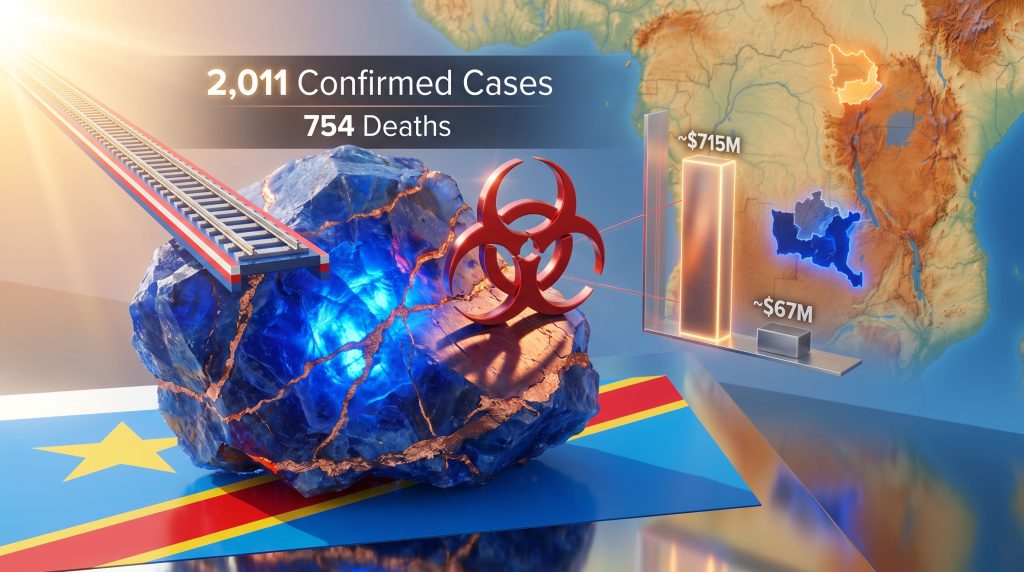
| Total confirmed infections | 2,011 |
| Total confirmed fatalities | 754 |
| Early-phase estimates (May) | ~750 cases / 177 suspected deaths |
| Confirmed cases by late June | 1,003+ |
| US travel advisory issued | July 11, 2026 |
| Quarantine period for exposed travellers | Up to 21 days, at personal expense |
The outbreak's rapid escalation has been partially attributed by observers to the dismantling of health security infrastructure that had previously provided early-detection capacity across DRC provinces. The closure of USAID on July 1, 2025, and the reduction of US health funding to the DRC from approximately $715 million to roughly $67 million created a significant surveillance and response gap. According to reporting on the DRC Ebola crisis, experts have linked this structural deterioration to the weeks of undetected community transmission that allowed the outbreak to gain momentum before containment measures were activated.
In a development that carries considerable geopolitical symbolism, Chinese medical crews have been deployed to the DRC as part of Beijing's response to the outbreak, filling a soft power vacuum created by the withdrawal of US-funded health programs.
The strategic irony here is significant. The reduction in US health investment that weakened DRC disease surveillance has now produced the precise conditions, a deteriorating public health environment, that are stalling the US minerals investment agenda. The two policy failures are not coincidental; they are structurally linked.
How the Outbreak Is Directly Disrupting Minerals Diplomacy
The operational impact of the Congo Ebola outbreak on US-backed minerals talks is now concrete and documented. On July 11, 2026, the US Embassy in Kinshasa issued a travel advisory urging American citizens not to travel to the DRC for any reason, citing Ebola risk and the potential for quarantine requirements of up to 21 days at personal expense. For officials, investors, and advisors operating within the minerals partnership framework, this advisory did not merely complicate logistics — it effectively grounded the human networks through which deal-making happens.
The specific diplomatic consequences include:
- A Washington-based review meeting assessing US corporate interest in Congolese projects was postponed after key partners were unable to travel from the United States
- A planned July 2026 review of Congolese projects was cancelled entirely due to travel constraints
- Deal discussions have shifted to Paris, Brussels, and London, fragmenting the institutional coherence of the engagement process
- A diplomatic source confirmed to Reuters that the minerals partnership discussions have been formally delayed, though specific details were withheld
The relocation of meetings to European capitals is more than a logistical inconvenience. Diplomatic momentum is a perishable asset. When the physical infrastructure of deal-making — the face-to-face meetings, site reviews, and relationship-building sessions — migrates away from its intended geography, the pace of decision-making slows and the alignment between parties begins to erode.
Operational Mining Disruptions in Eastern DRC
Beyond diplomatic delays, the outbreak has contributed to operational suspensions at the mine site level. The DRC government has suspended mining operations in Mwenga and Shabunda territories, while artisanal processing centres have been shut down amid health and security concerns. These suspensions carry potential compliance implications for companies operating under the US-Congo minerals partnership agreement, adding a legal and contractual dimension to what was already a complex operational environment.
The eastern DRC's mining disruptions are compounded by the continued presence of armed groups, including M23 and the Allied Democratic Forces (AFC), which exercise territorial control over portions of mineral-rich land. The convergence of a health emergency, active conflict, and suspended artisanal operations represents a multi-layered risk environment that no single diplomatic initiative can resolve in isolation.
Geopolitical Beneficiaries: China's Structural Advantage
Every week that US minerals diplomacy loses momentum in the DRC is a week that China's existing infrastructure investments deepen their economic and relational hold on Kinshasa. China's position in Congolese copper and cobalt is not merely about mining concessions. It encompasses processing facilities, logistics networks, community relationships, and financial instruments that have been built over more than fifteen years of sustained engagement.
The deployment of Chinese medical teams during the Ebola crisis reinforces this dynamic. Health diplomacy is a well-established tool in Beijing's foreign policy toolkit, and the DRC is a textbook case of its application. By providing visible, tangible assistance at a moment of acute crisis, China strengthens its political relationships with Congolese authorities at the precise moment when US engagement is being forced into retreat.
For US manufacturers and defence contractors that depend on Congolese cobalt and tantalum for battery and semiconductor supply chains, the prolonged delay in partnership formalisation translates into procurement uncertainty and continued exposure to Chinese-dominated supply pathways. The DRC cobalt supply risks created by this disruption extend well beyond the immediate health crisis.
The next major ASX story will hit our subscribers first
The Katanga-Eastern DRC Risk Divide
One important distinction that investors and policymakers should understand is the geographic separation between the outbreak epicentre and the DRC's cobalt heartland. Cobalt production is concentrated in Katanga province in the far south of the country, a significant distance from the Ituri-based outbreak epicentre. Major industrial cobalt operations in Katanga, run by companies including Glencore and CMOC, have not reported direct operational disruptions linked to the outbreak as of mid-July 2026.
However, this geographic distance does not insulate Katanga from systemic risk. A collapsed national health infrastructure creates workforce vulnerability across all provinces, not just those adjacent to the outbreak. Logistics chains that move through affected regions, expatriate workers unwilling to enter the country under any circumstances, and the reputational signal that a Level 4 travel advisory sends to the entire investment community all affect Katanga operations indirectly.
Cobalt supply continuity from Katanga may be maintained in the short term, but the conditions required for new investment, exploration programs, partnership agreements, and project financing are being actively undermined by DRC-wide instability.
Washington's Financial Response and Its Limitations
The US government has committed $23 million in emergency Ebola response funding alongside $112 million in broader bilateral assistance announced by the State Department. These are not trivial figures in isolation, but they must be viewed against the scale of the funding withdrawal that preceded the crisis. Reducing annual US health support from approximately $715 million to $67 million represents a structural gap that a one-time emergency allocation cannot bridge.
US Policy Position: Commitments vs. Structural Gaps
| Strategic Element | Current US Position | Identified Gap |
|---|---|---|
| Annual health security funding | Reduced from ~$715M to ~$67M | Severe structural underfunding |
| Emergency Ebola response | $23M committed | Short-term, reactive only |
| Bilateral assistance | $112M announced | Scope relative to need unclear |
| Diplomatic engagement | Meetings relocated to Europe | Momentum fragmentation risk |
| Infrastructure investment | Lobito Corridor ongoing | Long-term, not crisis-responsive |
The State Department has publicly stated that Washington is simultaneously working to contain the outbreak and advance its minerals partnership with the DRC. The tension embedded in that statement is significant. Advancing a minerals partnership requires the stable, investment-ready environment that the health crisis is actively eroding.
Three Scenarios for US-DRC Minerals Engagement
The outcome trajectory for the Washington Accords minerals partnership depends heavily on how quickly the outbreak is brought under control and whether the diplomatic infrastructure can maintain coherence through a prolonged disruption. Three plausible scenarios emerge:
Scenario 1: Rapid Containment and Recovery
The outbreak is contained within approximately 90 days, travel restrictions ease by Q4 2026, and US diplomatic engagement resumes at pace. Partnership milestones are achievable by Q1 2027, with limited long-term damage to deal momentum.
Scenario 2: Prolonged Crisis with Managed Diplomacy
The outbreak persists for six to twelve months. Meetings continue in European capitals but lose institutional focus. Deal timelines slip by twelve to eighteen months, and Chinese partners use the period to consolidate relationships with Kinshasa. US private sector interest softens but does not collapse.
Scenario 3: Systemic Deterioration and Partnership Suspension
Health system failure triggers broader instability. Armed group activity escalates in mineral-producing zones. US private sector withdraws from active deal consideration. China consolidates dominant positioning across DRC copper, cobalt, and 3TG asset classes. The Washington Accords framework becomes dormant.
The Broader Lesson: Health Security as a Minerals Security Prerequisite
The 2026 Congo Ebola crisis offers a case study in strategic interdependency that extends well beyond the DRC. Resource-rich but institutionally fragile states present a category of investment risk that conventional mining due diligence frameworks are not designed to capture. As analysis from The Guardian highlights, a country can hold irreplaceable mineral wealth and simultaneously lack the public health architecture, governance capacity, and conflict-management mechanisms that sustained investment requires.
Durable minerals diplomacy in environments like the DRC must integrate at least four elements that the Washington Accords framework, in its current form, does not fully address. Furthermore, the broader surge in critical minerals demand driven by the energy transition makes resolving these gaps all the more urgent:
- Sustained health security investment sufficient to maintain disease surveillance and rapid response capacity across mining-adjacent provinces
- Conflict resolution architecture that reduces the territorial leverage of armed groups over mineral-producing zones
- Governance support programs that strengthen Congolese institutional capacity to manage and benefit from extractive industries
- Infrastructure investment that is not purely export-oriented but also improves internal logistics, reducing the vulnerability of supply chains to localised disruptions
The competitive pressure from China makes this integrated approach more urgent, not less. Beijing's long-term engagement model in the DRC has combined infrastructure finance, medical diplomacy, and community-level relationship building in ways that narrow mining partnership agreements cannot replicate.
The Congo Ebola outbreak does not merely disrupt US-backed minerals talks. It reveals a fundamental fragility in the strategic logic of securing critical mineral supply chains through bilateral agreements alone, without the accompanying investment in the conditions that make those agreements durable.
This article contains forward-looking assessments and scenario projections based on information available as of July 2026. Geopolitical, health, and market conditions in the DRC remain fluid. Readers should not rely on scenario modelling as investment advice. Figures relating to outbreak statistics, financial commitments, and funding levels are sourced from publicly available reporting by Reuters and the US State Department.
Want to Stay Ahead of Critical Mineral Discoveries as Supply Chains Shift?
Discovery Alert's proprietary Discovery IQ model delivers real-time alerts on significant ASX mineral discoveries, transforming complex geological and commodity data into actionable investment insights — precisely the kind of edge that matters when global supply chains face disruption. Explore historic discoveries and their market returns, then begin your 14-day free trial at Discovery Alert to position yourself ahead of the market.