August 6, 2026
The Hidden Fragility of Critical Mineral Trade Agreements
When governments sign bilateral frameworks pledging cooperation on critical minerals, the assumption embedded in those agreements is that trade will follow diplomatic intent. The reality, as one Australian silicon producer has now discovered, is considerably more complicated. Trade remedy mechanisms, operating independently of any diplomatic framework, can render market access economically impossible within months of a partnership agreement being signed. This is not a theoretical risk. It is now a documented outcome.
Understanding why Simcoa leaving the US after tariff imposition matters requires looking beyond the company itself. The case functions as a live stress test of what allied-nation trade agreements actually deliver when domestic US industry interests are directly threatened.
When big ASX news breaks, our subscribers know first
Silicon Metal: A Critical Mineral With a Concentration Problem
Silicon metal sits at the upstream end of some of the most consequential supply chains in modern industry. It is a primary input for photovoltaic solar cells, an alloying agent in high-performance aluminium, and a precursor material in semiconductor manufacturing. Despite this strategic importance, global production is heavily concentrated. China accounts for roughly 65 to 70 percent of global silicon metal output, a dominance that has made Western policymakers increasingly nervous as the critical minerals demand surge accelerates alongside clean energy and defence-related needs.
This concentration is precisely why Australia's Simcoa Operations, operating out of Western Australia as the country's sole domestic silicon metal producer, was considered a meaningful contributor to Western supply chain diversification efforts. Owned entirely by Japan's Shin-Etsu Chemical, one of the world's largest producers of silicon-based materials, Simcoa brings industrial-grade production capability to a market where non-Chinese supply is genuinely scarce.
Why Silicon Purity and Grade Matter More Than Most Investors Realise
One dimension of this story that rarely surfaces in mainstream coverage is the grade and purity specifications required for different end uses. Silicon metal destined for solar panel polysilicon production requires different purity profiles than metallurgical-grade material used in aluminium alloys. Simcoa produces high-purity silicon metal that meets the specifications demanded by advanced manufacturing sectors, which is part of why US buyers had historically sought it out.
This is not a commodity where one source is interchangeable with another, and substitution from Chinese suppliers often involves navigating both quality consistency issues and geopolitical exposure. Furthermore, China's export restrictions on critical materials have only heightened the strategic value of alternative Western-aligned producers.
The assumption that a bilateral critical minerals agreement provides commercial protection for individual producers has now been empirically tested. The result was not encouraging for future agreement-holders.
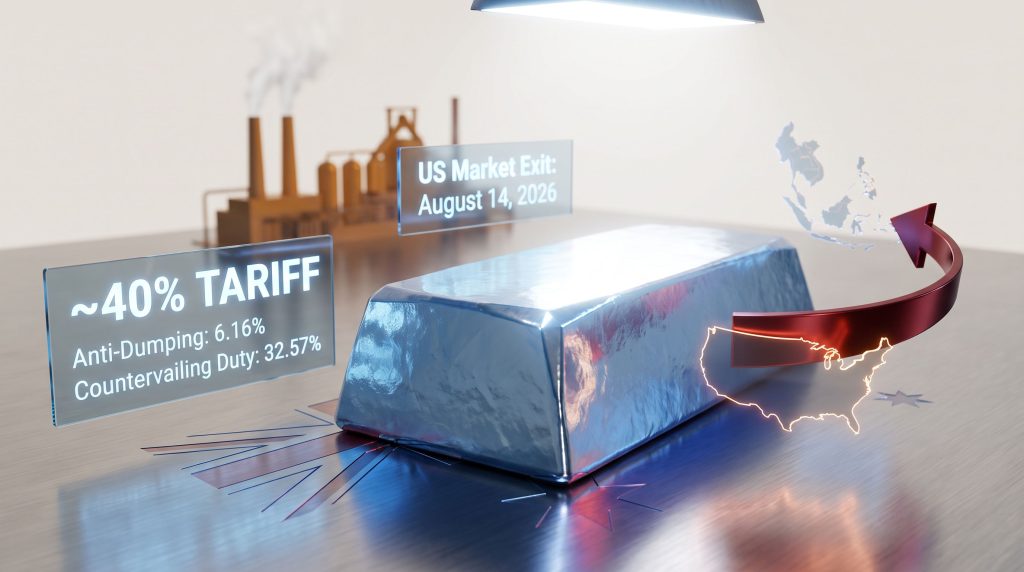
How a ~40% Tariff Made the US Market Mathematically Unviable
On June 25, 2026, the US Department of Commerce issued its final affirmative determination across anti-dumping duty and countervailing duty investigations targeting silicon metal imports from Australia and Norway. The findings against Simcoa were specific and financially decisive. Bulk Handling Review's coverage of these proceedings highlights the scale of the regulatory intervention involved.
| Tariff Component | Rate Applied to Simcoa |
|---|---|
| Anti-Dumping Duty Margin | 6.16% |
| Countervailing Duty Rate | 32.57% |
| Combined Effective Tariff | ~40% |
The anti-dumping component reflects a finding that Simcoa was selling product in the US below fair market value. The countervailing duty component reflects a finding that Australian government subsidies were being passed through to the exporter, distorting competition. Simcoa's position, stated publicly, is that neither finding accurately reflects the commercial reality of its US pricing practices.
The Countervailing Duty Mechanism: How It Works and Why It Is Controversial
A countervailing duty is a targeted import levy designed to neutralise the competitive advantage conferred by foreign government subsidies. In theory, it levels the playing field. In practice, the mechanism is frequently contested because the definition of what constitutes a "subsidy" under US trade law is often broader than what most exporters would recognise as direct financial support.
Critically, anti-dumping and countervailing duty investigations in the United States can be initiated by domestic industry petitioners, not just by government agencies. This creates a structural feature where competitors, including non-American corporations operating through US subsidiaries, can trigger formal investigations against foreign rivals. The broader consequences of such protectionist measures are increasingly visible in how tariffs on supply chains are reshaping global trade relationships.
When trade remedy processes are initiated by private industry petitioners rather than government regulators, the distinction between legitimate anti-dumping enforcement and competitive exclusion strategy becomes difficult to identify from the outside.
Simcoa's vice-president indicated publicly that the investigation was effectively driven by two domestic competitors, neither of which is American-owned, using US trade law to close off foreign competition. Whether or not that characterisation is legally accurate, it reflects a growing pattern of trade remedy actions being deployed as market protection instruments in the critical minerals space.
The Commercial Fallout: Market Exit and Revenue Reorientation
Simcoa formally withdrew from the US market on August 14, 2026. Pre-sold warehouse inventory will be cleared, and the company has confirmed this is a permanent departure rather than a strategic pause. The vice-president's assessment was unambiguous: the US market is effectively closed for a multi-year period under the current trade remedy framework.
The revenue replacement challenge is significant for three interconnected reasons:
- Volume displacement is not instantaneous. Replacement markets need time to develop contractual relationships, logistics infrastructure, and payment terms.
- Price compression risk is real. Redirecting meaningful export volume into alternative markets without depressing spot prices requires careful staging.
- The Western Australian smelter's operating economics depend on throughput. Partial utilisation is financially inefficient for energy-intensive smelting operations.
The markets Simcoa is targeting as substitutes include Southeast Asia, particularly Vietnam, Malaysia, and Thailand, where solar panel manufacturing capacity is expanding rapidly as an alternative to Chinese production. India is also a priority, given the scale of its renewable energy buildout and its stated ambitions to develop domestic solar manufacturing. Europe represents an existing relationship that could absorb incremental volume, though that market has its own supply dynamics.
The Southeast Asian Solar Manufacturing Opportunity
The pivot toward Southeast Asia is strategically coherent for reasons that extend well beyond simply replacing lost US revenue. Across Vietnam, Malaysia, Thailand, and Indonesia, governments and private investors are scaling solar panel manufacturing capacity at a pace that is creating genuine upstream demand for non-Chinese silicon metal. This expansion is partly driven by US import restrictions on Chinese-manufactured solar panels, which has incentivised panel production in third countries.
This creates a scenario with genuine irony. US tariff policy that excludes Australian silicon from the American market is simultaneously creating downstream demand for that same silicon in Southeast Asian facilities that manufacture the solar panels the US itself is seeking to import. The supply chain logic loops back in ways that suggest the tariff determination may ultimately constrain US solar deployment ambitions.
The Critical Minerals Agreement Contradiction
In October 2025, Prime Minister Anthony Albanese and President Donald Trump formalised a bilateral critical minerals framework at the White House, committing both nations to joint pursuit of supply chain development across minerals including silicon metal. The agreement was framed as a strategic partnership designed to reduce dependence on Chinese-controlled supply chains. Indeed, the US critical minerals order signed earlier that year had specifically emphasised the importance of allied-nation supply partnerships.
The USITC ruling that triggered Simcoa's market exit was issued after that agreement was signed. This sequencing matters because it establishes that diplomatic commitments at the framework level do not create legal protections or override trade remedy processes at the regulatory level. The two systems operate independently.
Australia's Resources Minister Madeleine King stated clearly that the tariffs should not have been applied at any rate and that the government would continue engaging with Washington on the issue. The government's position, however, also acknowledged the need to maintain broader bilateral relationships across defence, investment, and strategic cooperation, creating an inherent tension between forcefully challenging the tariff and preserving other partnership dimensions. Consequently, the broader US-China trade war impacts on allied producers like Simcoa are becoming increasingly difficult to separate from purely bilateral trade disputes.
What This Means for Other Critical Mineral Exporters
The Simcoa case is not an isolated commercial dispute. It is a precedent-setting data point for how bilateral critical mineral agreements interact with unilateral trade remedy mechanisms. Australian producers across lithium, rare earths, cobalt, and manganese should note the following structural vulnerabilities exposed by this case:
| Risk Factor | Silicon Metal (Simcoa) | Broader Critical Minerals Sector |
|---|---|---|
| Market concentration risk | High US dependency | Varies by commodity |
| Trade remedy exposure | Confirmed (~40% duty) | Elevated under protectionist environment |
| Agreement enforceability | Unconfirmed at producer level | Structurally untested |
| Diversification readiness | Partial (SE Asia, India, Europe) | Mixed across producers |
| Response timeline | Months to years | Dependent on contract terms |
The lesson is that market diversification is not merely a growth strategy. For critical mineral producers with significant exposure to any single export destination, it is a risk management imperative. As the AFR previously reported, this is not the first time Simcoa has navigated US trade remedy challenges, making the current situation part of a longer pattern of market access uncertainty.
The next major ASX story will hit our subscribers first
Frequently Asked Questions: Simcoa, US Tariffs, and Australian Silicon
What does Simcoa produce and where does it operate?
Simcoa Operations Pty Ltd produces silicon metal at a smelting facility in Western Australia. It is the only domestic silicon metal producer in Australia and operates as a wholly owned subsidiary of Shin-Etsu Chemical, a major Japanese industrial chemicals company.
Why did the US impose anti-dumping and countervailing duties?
The US Department of Commerce found a 6.16% dumping margin and a 32.57% countervailing duty rate against Simcoa, on the basis that silicon was being sold below fair value in the US and that Australian producers had received government subsidies. Simcoa disputes both findings.
When did Simcoa exit the US market?
The company's formal market withdrawal took effect from August 14, 2026, following clearance of pre-sold warehouse inventory.
Is the exit permanent?
Based on Simcoa's own assessment, the exclusion is expected to persist for multiple years under the current trade remedy framework. The company is not treating this as a temporary disruption.
Does the critical minerals agreement between Australia and the US protect against this kind of tariff?
The agreement does not appear to carry enforceable commercial protections at the individual exporter level. The Simcoa leaving the US after tariff case demonstrated that trade remedy processes can proceed independently of bilateral framework agreements.
Where is Simcoa directing its exports instead?
The company is actively pursuing replacement volumes in Southeast Asia, India, and through expansion of existing European supply relationships.
Disclaimer: This article is for informational purposes only and does not constitute financial or investment advice. Forecasts, market projections, and scenario analyses discussed herein are speculative in nature and subject to significant uncertainty. Readers should conduct independent research before making any investment or commercial decisions.
Want to Stay Ahead of the Next Major ASX Mineral Discovery?
The shifting dynamics in critical mineral supply chains — from silicon metal to rare earths — are creating real opportunities for investors who can act quickly on new discoveries. Discovery Alert's proprietary Discovery IQ model delivers real-time alerts on significant ASX mineral discoveries, transforming complex mineral data into clear, actionable insights for traders and long-term investors alike — start your 14-day free trial today and see why historic discoveries have generated extraordinary returns by visiting Discovery Alert's dedicated discoveries page.