June 13, 2026
What Makes Congo's Iron Ore Deposits Globally Significant?
The Congo Basin's iron ore formations represent some of the world's most substantial untapped mineral resources, positioned to reshape global steel production supply chains. These Congo iron ore project developments offer unique geological advantages that distinguish them from established mining regions, particularly their exceptional grade quality and massive resource scale. Furthermore, the region's strategic location provides compelling opportunities for iron ore demand insights that could influence global market dynamics.
Resource Quality and Scale Assessment
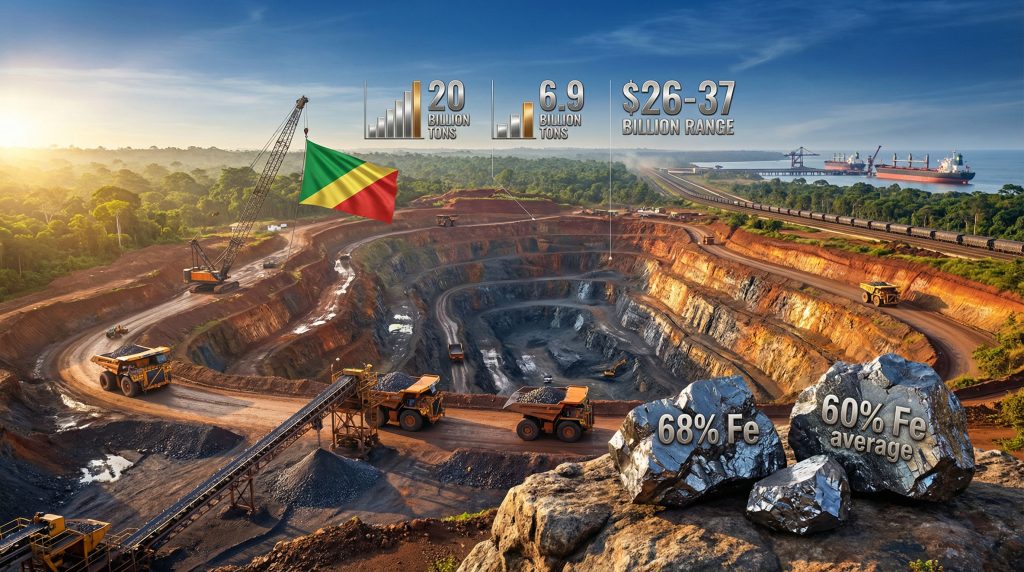
Central Africa's iron ore deposits demonstrate remarkable consistency in both size and mineral composition. The Democratic Republic of Congo's MIFOR project encompasses an estimated 20 billion tons of iron ore resources at an average grade of 60% iron content, representing one of the largest iron ore mines globally. This resource base exceeds many established mining operations by significant margins.
Congo Basin Iron Ore Resource Comparison
| Deposit | Resource Size | Grade Quality | Development Stage |
|---|---|---|---|
| MIFOR (DRC) | 20 billion tons | 60% Fe average | Government planning |
| Zanaga (RoC) | 6.9 billion tons | 68%+ Fe premium | Private development |
| Mbalam-Nabeba | 6.44+ billion tons | Up to 57.3% Fe | Chinese-backed |
The Republic of Congo's Zanaga deposit presents particularly compelling specifications with 6.9 billion tons of resources grading at 68% iron content or higher. This premium specification positions Zanaga's ore within the top tier of global iron ore quality, comparable to the finest Australian Pilbara products. In addition, these deposits align perfectly with current iron ore price trends favouring high-grade materials.
Geographic Advantages for Global Supply Chains
Congo's Atlantic Ocean positioning provides strategic maritime access to both Asian steel mills and European industrial consumers. Unlike landlocked mineral provinces, these deposits benefit from direct oceanic shipping routes that can reduce transportation costs and delivery timeframes.
The Congo River system offers natural transportation corridors connecting interior mining regions to coastal ports. This riverine infrastructure, combined with planned rail networks, creates multi-modal logistics solutions that established mining regions often lack.
Regional proximity to existing mining infrastructure provides operational synergies. The area's established copper and cobalt mining operations have developed workforce expertise, equipment supply chains, and regulatory frameworks that support expanded mineral extraction activities.
Mineral Quality Standards for Steel Production
Congo's iron ore deposits meet stringent specifications required for modern steel production processes. The 60% iron content at MIFOR positions the ore for beneficiation into premium pellet feed products used in blast furnace operations. After concentration processing, these ores can achieve 65-68% iron content specifications demanded by direct reduction iron facilities.
Zanaga's 68% iron content represents direct-feed quality suitable for premium steel applications without extensive processing. This grade specification exceeds many established suppliers and commands premium pricing in international markets.
Metallurgical testing indicates Congo's ores demonstrate favourable chemical composition for steel production, with low impurity levels and appropriate gangue mineral characteristics. These properties ensure compatibility with both traditional blast furnace operations and emerging direct reduction technologies.
When big ASX news breaks, our subscribers know first
How Do Infrastructure Requirements Shape Project Economics?
Infrastructure development costs represent the primary economic factor determining project viability across Congo's iron ore initiatives. The remote location of major deposits necessitates comprehensive transportation, power, and port facility construction that significantly influences overall project economics. However, successful iron haulage operations in other regions demonstrate the viability of such ambitious logistical undertakings.
Transportation Network Development Costs
The MIFOR project's first phase requires an estimated $28.9 billion infrastructure investment, representing one of the largest mining-related infrastructure commitments globally. This investment encompasses multiple integrated systems designed to move 50 million tons annually from remote northern regions to international markets.
Infrastructure Investment Breakdown:
- Heavy rail construction: $15-20 billion estimated
- River transport upgrades: $3-5 billion
- Deep-water port facilities: $8-12 billion
- Total logistics investment: $26-37 billion range
Rail infrastructure requirements include heavy-gauge lines capable of sustained bulk commodity transportation across challenging terrain. The proposed railway system must traverse dense forest regions with limited existing transportation corridors, requiring extensive engineering solutions for bridges, cuttings, and gradient management.
Multi-Modal Logistics Solutions
Congo's iron ore projects utilise integrated transportation systems combining rail, riverine, and maritime components. This multi-modal approach leverages natural geographic features while addressing the technical challenges of moving massive ore volumes from interior locations.
The Congo River provides natural transportation capacity through large-capacity barge systems capable of handling 10,000-50,000 ton loads per vessel. However, seasonal water level variations require careful logistics planning and potentially infrastructure modifications to maintain year-round operation.
Pipeline technology represents an alternative ore concentrate delivery method under consideration for certain projects. Slurry pipeline systems can transport processed ore concentrates over long distances with lower ongoing operational costs compared to rail transportation, though requiring substantial initial capital investment.
Energy Infrastructure Dependencies
Current power generation capacity in the Democratic Republic of Congo approximates 600 megawatts operational capacity. Mining operations at projected scales require an estimated 200-400 megawatts sustained power supply, necessitating significant grid expansion beyond current national infrastructure capabilities.
Renewable energy integration opportunities exist through hydroelectric potential along Congo River systems. These sustainable power sources could provide competitive electricity costs for energy-intensive ore processing operations while reducing environmental impacts.
Grid connectivity requirements extend beyond mining operations to encompass transportation infrastructure, port facilities, and supporting community development. This comprehensive energy infrastructure development represents both challenges and opportunities for regional economic advancement.
Which Investment Models Are Driving Congo Iron Ore Development?
Three distinct investment approaches characterise Congo's major iron ore development initiatives, each reflecting different strategic priorities and risk management philosophies. These models demonstrate how various stakeholder groups approach large-scale resource development in emerging mining regions, offering valuable mining investment perspectives for potential investors.
Government-Led Strategic Initiatives
The Democratic Republic of Congo established an inter-ministerial commission dedicated to MIFOR project development, indicating high-level institutional commitment to treating iron ore as a strategic national priority. This government-led approach positions the state as primary project coordinator while accepting strategic investor participation.
The inter-ministerial structure requires coordination across multiple governmental portfolios including mining, infrastructure, finance, trade, and environmental ministries. This comprehensive governmental engagement reflects recognition that Congo iron ore project development extends beyond traditional mining operations to encompass national economic transformation.
Institutional investor engagement has reportedly begun, though specific investor identities remain undisclosed in official announcements. Government statements indicate confidence in attracting international capital despite substantial infrastructure investment requirements exceeding $28 billion for the first phase alone.
Private Equity and International Partnerships
Zanaga Iron Ore Company achieved complete project control after acquiring Glencore's remaining stake for $21.5 million in March 2025. This transaction attracted multiple new investors including Arise IIP, Greymont Bay, and Gulf Iron and Steel, demonstrating private market confidence in Congo iron ore project prospects.
The investor consortium represents diverse strategic interests. Arise IIP specialises in African infrastructure investment platforms, Greymont Bay focuses on natural resource development funding, and Gulf Iron and Steel seeks long-term ore supply relationships for steel production operations.
Zanaga Iron Ore's strategic positioning demonstrates how private equity can drive project advancement through focused capital allocation. Furthermore, Zanaga's staged development approach begins with 2 million tons per year capacity, allowing operational validation and market penetration before expanding to full production levels.
Chinese Infrastructure Investment Patterns
The Mbalam-Nabeba project operates within China's Belt and Road Initiative framework, utilising Chinese state-backed financing through Bestway Finance and operational expertise from China Railway 20th Bureau. This model integrates infrastructure development with strategic supply chain positioning for Chinese steel industries.
Chinese investment structures typically provide equipment and services through state-affiliated entities while securing long-term supply arrangements benefiting Chinese industrial consumers. AustSino Resources maintains strategic positioning within this investment framework, facilitating operational coordination.
Belt and Road Initiative alignment extends Chinese geopolitical influence in Central Africa while securing resource access for domestic steel production. This dual-purpose approach differentiates Chinese investment from purely commercial private equity models.
What Are the Production Timeline Projections?
Production timeline variations across Congo's major iron ore projects reflect different development stages, financing structures, and technical complexity levels. These timelines provide insight into when global steel markets can expect new supply sources from Central African operations.
Phased Development Strategies
Standard iron ore project development follows predictable phases designed to validate technical, financial, and operational assumptions before full-scale production commitment. Understanding these phases helps investors and industry participants anticipate realistic production timelines.
Typical Iron Ore Project Phases:
- Feasibility and permitting (2-3 years) – Technical studies, environmental assessments, regulatory approvals
- Infrastructure construction (4-6 years) – Rail, port, power, and processing facility development
- Mine development and commissioning (2-3 years) – Pit preparation, equipment installation, operational testing
- Production ramp-up to full capacity (1-2 years) – Gradual volume increases to designed throughput levels
These phases can overlap in advanced projects, potentially reducing total development timeframes. However, infrastructure-intensive projects like Congo's iron ore developments typically require sequential completion of major construction phases.
Capacity Scaling Models
MIFOR's initial production target of 50 million tons annually with expansion potential to 300 million tons demonstrates the substantial scaling opportunities available once base infrastructure becomes operational. This expansion ratio reflects economies of scale achievable in large-scale mining operations.
Infrastructure investments supporting initial production phases can accommodate multiple expansion phases at incremental costs significantly lower than initial development expenses. Rail capacity, port facilities, and power systems designed for larger throughput enable cost-effective production increases.
Staged development reduces initial capital concentration while allowing market condition adjustments between expansion phases. This flexibility proves particularly valuable in volatile commodity markets where timing production increases with favourable pricing conditions enhances project economics.
Market Entry Timeline Analysis
Mbalam-Nabeba targets December 2025 production commencement, positioning it as the first major Congo iron ore project reaching commercial operation. This timeline reflects advanced development status and Chinese infrastructure investment capabilities.
Zanaga's staged approach beginning with 2 million tons per year allows near-term market entry while developing operational expertise for subsequent expansion phases. The specific timing for initial production remains undisclosed in available project documentation.
MIFOR's timeline extends significantly longer due to infrastructure complexity and governmental coordination requirements. The $28.9 billion first phase investment necessitates comprehensive planning and financing arrangements that typically require several years for completion.
How Do Regulatory Frameworks Impact Development Success?
Mining project success in Congo depends heavily on navigating complex regulatory environments across multiple jurisdictions and maintaining compliance with evolving international standards. Understanding these frameworks helps assess project risks and development probabilities.
Mining Code Evolution and Stability
The Republic of Congo operates under mining legislation established in 2005, providing a established legal framework for mineral development activities. This regulatory foundation has supported various mining projects while maintaining governmental revenue participation through royalty and taxation structures.
Democratic Republic of Congo's mining code has undergone periodic revisions, reflecting governmental efforts to balance investor attractiveness with national revenue optimisation. Recent regulatory stability has encouraged renewed international investment interest in large-scale mining developments.
Cross-border project coordination requirements apply to initiatives spanning multiple national jurisdictions. The Mbalam-Nabeba project operates across both Congo and Cameroon, necessitating regulatory compliance in multiple legal systems simultaneously.
Permit Management and Compliance
Historical permit management in Congo has included both successful long-term operations and occasional revocations under changing political conditions. In 2020, permits for Avima, Badondo, and Nabeba projects were revoked, though legal challenges and resolution processes have since addressed these situations.
Permit stability requires ongoing compliance with environmental, social, and operational requirements specified in mining agreements. International financing often demands additional compliance standards exceeding local regulatory minimums.
Current permit structures for major iron ore projects appear designed to provide long-term operational security while ensuring governmental revenue participation. These arrangements typically include staged development obligations and production timeline commitments.
Environmental and Social Governance Standards
International financing for large-scale mining projects increasingly requires compliance with comprehensive environmental and social governance standards. These requirements often exceed local regulatory minimums and reflect global best practices for sustainable mining operations.
Community engagement protocols form essential components of modern mining project development. Successful projects typically establish ongoing consultation processes with local communities, addressing employment opportunities, infrastructure development, and environmental impact mitigation.
Environmental impact mitigation strategies must address potential effects on local ecosystems, water resources, and air quality. Large-scale iron ore operations require comprehensive monitoring and mitigation programs throughout operational lifecycles.
What Market Dynamics Influence Congo Iron Ore Competitiveness?
Global iron ore markets operate through complex relationships between established suppliers, steel mill customers, and emerging producers. Understanding these dynamics helps assess Congo's competitive positioning and market penetration potential.
Global Supply Chain Integration
Current global iron ore supply concentrates heavily in Australia and Brazil, which together control approximately 75% of seaborne trade volumes. This concentration creates opportunities for new suppliers offering supply chain diversification benefits to steel producers.
Asian steel mills, particularly in China, represent the largest demand centres for seaborne iron ore. Congo's Atlantic positioning provides competitive shipping routes to both Asian and European markets, potentially offering transportation cost advantages compared to some established suppliers.
European steel producers increasingly value supply source diversification for strategic security and operational flexibility. Congo's proximity to European markets via Atlantic shipping routes positions its iron ore favourably for these industrial consumers.
Price Positioning and Quality Premiums
High-grade iron ore specifications command premium pricing in global markets. Zanaga's 68% iron content positions it within the premium tier typically trading at $5-15 per ton above standard specifications.
Direct reduction iron pellet feed markets offer additional premium opportunities for high-grade ores suitable for emerging steel production technologies. These specifications require minimal processing and command higher prices than standard blast furnace feed materials.
Transportation costs significantly influence final delivered pricing competitiveness. Congo's infrastructure development costs must be offset by operational efficiencies and quality premiums to achieve competitive positioning against established suppliers.
Strategic Resource Diversification Benefits
Congo's economic diversification away from copper and cobalt dependence represents a strategic national priority. Iron ore development provides export revenue diversification reducing vulnerability to single-commodity price volatility.
Portfolio balancing across multiple mineral commodities enhances national economic stability during commodity price cycles. Iron ore's different market dynamics compared to battery minerals provide natural hedging benefits.
Steel production represents fundamental global industrial demand less susceptible to technology transitions affecting specialised minerals like cobalt. This demand stability offers more predictable long-term revenue streams compared to emerging technology minerals.
The next major ASX story will hit our subscribers first
Investment Risk Assessment and Mitigation Strategies
Large-scale iron ore development in emerging regions involves substantial risks requiring sophisticated mitigation strategies. Understanding these risks helps investors and project developers make informed decisions about capital allocation and project structuring.
Infrastructure Development Risks
Construction timeline delays and cost overruns represent primary risks for infrastructure-intensive projects. The $28.9 billion MIFOR infrastructure requirement involves multiple complex systems where delays in one component can cascade throughout project schedules.
Technical challenges in remote locations include limited local contractor availability, equipment transportation difficulties, and specialised expertise requirements. These factors often result in higher costs and extended timelines compared to projects in established mining regions.
Currency fluctuation impacts affect international financing arrangements and equipment procurement costs. Long-term projects spanning multiple years face exposure to exchange rate variations that can significantly affect overall project economics.
Political and Regulatory Stability Factors
Government policy consistency requirements extend beyond initial project approvals to encompass ongoing operational conditions. Changes in royalty rates, taxation structures, or environmental requirements can substantially impact project profitability.
Cross-border project coordination complexities apply to initiatives like Mbalam-Nabeba spanning multiple national jurisdictions. Political relationships between neighbouring countries can influence project development progress and operational continuity.
International relations impacts particularly affect Chinese-backed projects operating within geopolitical frameworks. Changes in bilateral relationships or international sanctions can disrupt financing, equipment supply, or operational arrangements.
Market Access and Competition Analysis
Established supplier relationships with steel mills create barriers for new producers seeking market penetration. Long-term supply contracts between major mining companies and steel producers can limit available market opportunities for new entrants.
Transportation cost competitiveness requires achieving operational efficiencies offsetting infrastructure development costs. New projects must demonstrate sustained cost advantages or quality premiums justifying customer switching costs.
Quality specification advantages provide market differentiation opportunities but require consistent production meeting customer technical requirements. Initial market penetration often requires acceptance of lower pricing during operational validation periods.
Long-Term Strategic Implications for Central African Mining
Congo's iron ore development represents broader transformational trends affecting Central African mining, regional economic integration, and global mineral supply chain evolution. These implications extend beyond individual project success to encompass regional development patterns.
Economic Transformation Potential
Iron ore sector development could contribute substantially to national GDP growth through direct mining revenues, employment generation, and economic multiplier effects. Large-scale mining operations typically generate employment for thousands of workers while supporting extensive service industries.
Technology transfer accompanying international investment brings advanced mining techniques, equipment maintenance capabilities, and operational management expertise to regional workforces. These skills often transfer to other industrial sectors, enhancing overall economic development.
Infrastructure investments supporting mining operations provide broader regional benefits including improved transportation networks, power generation capacity, and port facilities. These developments facilitate economic diversification beyond mining activities.
Regional Integration and Trade Corridors
Central African Economic and Monetary Union frameworks support regional trade integration that could benefit from enhanced transportation infrastructure developed for mining operations. Improved rail and port facilities enable increased intra-regional commerce.
Transportation network spillover effects extend benefits beyond mining operations to agricultural products, manufactured goods, and other commodities. Multi-purpose infrastructure utilisation enhances overall project economics while supporting regional development.
Cross-border economic development synergies emerge when infrastructure projects span multiple countries, creating shared benefits and encouraging regional cooperation. Joint infrastructure development can reduce per-country costs while enhancing regional connectivity. Moreover, Congo's strategic positioning in Central Africa positions it as a regional hub for mineral development.
Global Iron Ore Market Rebalancing
Supply source diversification for steel producers reduces dependence on concentrated supplier bases while providing operational flexibility during supply disruptions. Congo's entry into global markets could encourage additional investment in alternative supply sources.
Geopolitical considerations increasingly influence resource security planning among steel producing nations. Diversified supply sources reduce vulnerability to trade disputes, sanctions, or other political disruptions affecting established suppliers.
Impact on established mining regions' market share depends on Congo's production volumes and cost competitiveness. Successful development could pressure existing suppliers to improve operational efficiency or explore additional capacity expansion.
Disclaimer: This analysis contains forward-looking statements and projections based on currently available information. Actual development timelines, production volumes, and market conditions may differ materially from current expectations. Investment in mining projects involves substantial risks including commodity price volatility, regulatory changes, and operational challenges. Potential investors should conduct independent due diligence and consult with qualified professionals before making investment decisions.
Looking to Capitalise on ASX Iron Ore Mining Opportunities?
Discovery Alert's proprietary Discovery IQ model delivers instant notifications on significant ASX iron ore discoveries, empowering subscribers to identify actionable opportunities ahead of broader market movements. Explore Discovery Alert's dedicated discoveries page to understand how historic mineral discoveries have generated substantial returns, then begin your 30-day free trial to position yourself at the forefront of emerging opportunities.