August 6, 2026
The Fiscal Architecture Behind a Resource Superpower's Next Move
Sovereign resource nationalism rarely announces itself quietly. It accumulates in legal frameworks, ministerial decrees, and classification schedules that most investors never read until a project's economics shift overnight. The Democratic Republic of Congo's late May 2026 decision to reclassify lithium, tantalum, niobium, tungsten, uranium, and rare earth elements as strategic minerals is precisely this kind of Congo lithium royalty tax hike structural inflection point. Understanding what it means requires looking past the headline royalty figure and into the fiscal architecture that governs one of the world's most mineral-rich nations.
When big ASX news breaks, our subscribers know first
What the Congo Lithium Royalty Tax Hike Actually Changes
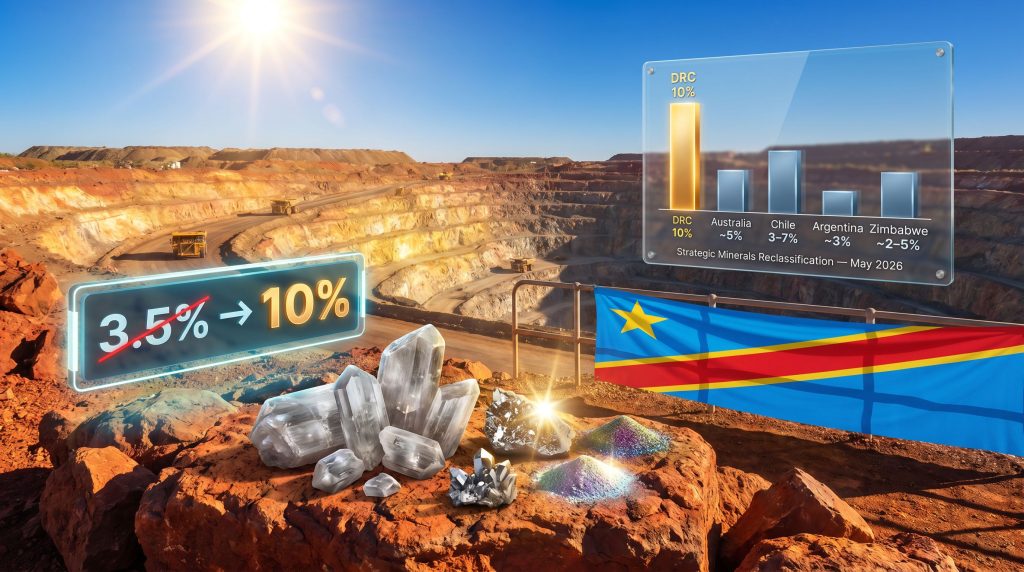
The mechanics are straightforward but the consequences are significant. Under the DRC's Mining Code, minerals designated as strategic attract a royalty rate of 10% on gross revenue. Minerals classified as standard non-ferrous metals carry a rate of 3.5%. The Council of Ministers approved a decree in late May 2026 elevating lithium into the strategic tier alongside tantalum, niobium, tungsten, uranium, and rare earths. The mines ministry publicised the decision through its official X account (@MinMinesRDC), signalling executive-level commitment to the reclassification.
The practical effect is a near-tripling of the applicable royalty burden for lithium producers operating within Congolese territory. This is not a marginal adjustment. For context, at a production scale generating $1 billion in annual lithium revenue, the differential between the old 3.5% rate and the new 10% rate represents approximately $65 million in additional annual royalty obligations. Across a 20-year mine life, which is a conservative estimate for a large hard-rock deposit, that cumulative fiscal transfer runs into the hundreds of millions of dollars.
Critically, this royalty applies to gross revenue, not net profit. This distinction matters enormously in commodity markets where prices are volatile. Even in years when lithium prices fall sharply and operating margins compress, the royalty obligation remains fixed as a percentage of top-line revenue. It functions, in effect, as a mandatory cost that operators cannot defer or offset against losses.
The DRC's stated rationale, drawn from the Council of Ministers meeting minutes, is that the reclassification is designed to ensure the country benefits from the critical and geo-strategic character of the mineral endowments within its territory. This framing is consistent with a global pattern of resource-rich nations reassessing whether legacy fiscal terms adequately reflect the geopolitical value of their mineral wealth in an era of energy transition.
Why the Timing Makes This Particularly Consequential
The decree did not arrive in a vacuum. It was approved in the same month that the DRC was preparing to enter commercial lithium production for the first time in its history. China's Zijin Mining Group was scheduled to commission the Manono lithium project in June 2026, making it the country's inaugural large-scale hard-rock lithium operation. Meanwhile, KoBold Metals launched what it described as the world's largest lithium exploration programme in the DRC in April 2026.
The convergence of these events creates an unusually compressed regulatory environment: a new royalty framework, a first-production milestone, and a major new exploration commitment all occurring within weeks of each other. Operators who built financial models under the previous 3.5% assumption now face immediate recalibration.
How the DRC's Strategic Minerals Tier System Works
The two-tier royalty structure is not new. It has existed within the DRC Mining Code for years, with cobalt, germanium, and coltan already occupying the strategic tier prior to the 2026 expansion.
| Mineral Category | Royalty Rate | Key Examples |
|---|---|---|
| Standard Non-Ferrous Metals | 3.5% | Copper, zinc, lead |
| Strategic Minerals | 10% | Cobalt, germanium, coltan, lithium*, tantalum*, niobium*, tungsten*, uranium*, rare earths* |
Newly added in May 2026
The 2018 Mining Code revision was the first major overhaul of this framework in over a decade, lifting copper royalties from 2% to 3.5% and elevating cobalt to the strategic tier at 10%. The industry response at the time was significant, with major producers arguing the new terms would deter investment. The 2026 expansion represents a second wave of escalation, now targeting the minerals most directly tied to battery supply chains and advanced technology manufacturing.
What qualifies a mineral as strategic under Congolese law is tied to two interrelated factors: the concentration of global reserves within DRC territory, and the downstream significance of the mineral in defence, technology, and energy applications. Both criteria are easily met by lithium, tantalum, and rare earths, which explains why their addition to the list was framed as an alignment of fiscal policy with geopolitical reality rather than an opportunistic revenue grab.
The Global Royalty Comparison: Where Does DRC Now Rank?
Placing the DRC's new 10% lithium royalty within a global peer context reveals the scale of the competitive shift.
| Jurisdiction | Lithium Royalty Rate | Royalty Base | Notes |
|---|---|---|---|
| DRC (post-May 2026) | 10% | Gross revenue | Newly elevated to strategic tier |
| Australia (Western Australia) | ~5% | Gross revenue | Applied to spodumene concentrate |
| Chile | 3–7% | Variable/tiered | Based on production volume thresholds |
| Argentina | ~3% | Provincial | Varies significantly by province |
| Zimbabwe | 2–5% | Gross revenue | Subject to ongoing legislative revision |
The DRC's new rate sits at or near the top of the global lithium royalty range, exceeding the benchmark set by Western Australia, which is the world's dominant hard-rock lithium producer. This cost differential is structural and permanent unless the Congolese government revisits the classification. For operators comparing project economics across jurisdictions, the gap between a 5% Australian royalty and a 10% DRC royalty can be decisive, particularly for projects at the margin of commercial viability.
However, the comparison is not purely mechanical. The DRC holds resource concentrations that have no direct equivalent elsewhere. The Manono deposit, for instance, is considered one of the largest and highest-grade hard-rock lithium resources on the planet. Grade and scale can partially offset fiscal disadvantage, but only to a point.
A Mineral-by-Mineral Look at the Strategic Reclassification
Lithium
Lithium's reclassification is the headline story, but its significance extends beyond the royalty rate. The DRC's entry into commercial lithium production in 2026 adds a new dimension to the global lithium market supply chain geography. For battery manufacturers and EV producers seeking to reduce dependence on Australian and Chilean supply, the DRC represents a compelling reserve base, though now at a materially higher fiscal cost.
Tantalum
According to the US Geological Survey, the DRC is the world's largest source of tantalum, which is extracted from coltan and used primarily in capacitors for portable electronics, smartphones, and aerospace systems. The vast majority of DRC tantalum is extracted through artisanal and small-scale mining (ASM) in the eastern provinces, which raises legitimate questions about the practical enforceability of the new royalty regime for this particular mineral. Formalising ASM revenue capture has historically proven difficult across African mining jurisdictions.
Niobium
Niobium is used principally in high-strength low-alloy steel and is increasingly relevant in superconducting applications. Brazil dominates global supply, making DRC reserves a potential diversification point, though commercial-scale niobium production in the DRC remains limited. The strategic designation may be as much about signalling future intent as capturing current revenue.
Tungsten
The DRC's eastern provinces are a significant source of tungsten alongside tantalum and niobium. Tungsten is critical for cutting tools, defence applications, and electronics manufacturing. It is also subject to conflict mineral scrutiny under international frameworks including OECD due diligence guidelines, which adds a layer of compliance complexity for operators seeking to develop formal tungsten production.
Uranium
The DRC's Shinkolobwe mine carries extraordinary historical weight as the source of uranium used in the Manhattan Project's atomic bomb programme. Industrial-scale uranium production has been dormant in the DRC for decades, and the strategic designation may reflect long-term aspirations rather than near-term production planning. Nevertheless, the inclusion of uranium in the strategic tier ensures that any future resumption of large-scale extraction will occur under the elevated fiscal framework.
Rare Earth Elements
The rare earth group encompasses 17 elements critical to permanent magnets, wind turbines, EV motors, and defence systems. China controls an overwhelming share of global rare earth processing capacity, making alternative supply development a strategic priority for Western governments and manufacturers. DRC rare earth reserves represent a longer-term opportunity, though processing infrastructure and logistics constraints remain significant barriers to near-term production at scale.
Investment Risk Calculus: The Case For and Against DRC Lithium
The irreplaceability of a resource base can partially compensate for elevated fiscal terms, but only within limits. When royalty rates exceed competing jurisdictions by a factor of two or more, the margin of safety for smaller operators shrinks considerably, and project financing becomes more complex.
Factors that may sustain investment despite the higher royalty:
- The DRC's reserve concentrations in lithium, cobalt, and tantalum are genuinely irreplaceable. Operators cannot simply relocate to a lower-royalty jurisdiction with equivalent resource quality.
- The Manono deposit's combination of scale and grade provides a natural economic buffer against cost escalation that smaller, lower-grade deposits in other jurisdictions do not possess.
- Western battery supply chain urgency, driven by the desire to reduce Chinese supply chain dependency, attaches a strategic premium to DRC production that may justify higher fiscal costs in the minds of policymakers and offtake partners.
- Long-term demand projections for battery-grade lithium remain robust, which supports revenue assumptions even at higher royalty rates.
Factors that may deter investment or reshape project structures:
- The royalty applies to gross revenue regardless of profitability, meaning loss-making operations still face the full fiscal obligation. This is structurally punishing during price downturns, as evidenced by the recent lithium market downturn.
- The reclassification of projects already in development or commissioning creates retroactive fiscal uncertainty that may trigger disputes under contract stability clause provisions embedded in earlier mining agreements.
- Junior miners and exploration-stage companies face disproportionate exposure. Unlike major operators, they lack the economies of scale to absorb royalty cost increases without significant impact on project returns.
- Sovereign risk perceptions in the DRC remain elevated due to historical precedent, including the 2018 Mining Code revisions that were implemented despite industry opposition.
Three Scenarios for How Investors May Respond
- Renegotiated bilateral terms: Major operators with committed capital seek project-specific agreements with the DRC government, potentially phasing in the new royalty rate or offsetting obligations through infrastructure commitments or local content provisions.
- Staged capital reallocation: Mid-tier developers pause or delay final investment decisions while seeking legal clarity on the royalty's application to projects with existing stability clause protections, redirecting near-term capital to lower-risk jurisdictions.
- Accelerated production timelines: Operators with advanced projects push to maximise revenue generation during any transitional period before full enforcement of the 10% rate becomes uniformly applied.
The next major ASX story will hit our subscribers first
The African Resource Nationalism Context
The DRC's fiscal move is not an isolated act of policy innovation. It reflects a continent-wide reassertion of sovereign resource rights that has been building since the early 2020s, accelerated by the energy transition's critical minerals demand surge for battery and technology metals.
Zimbabwe introduced lithium export restrictions and elevated royalty provisions in 2023. Zambia and Tanzania have revised mining fiscal frameworks in recent years. Indonesia implemented nickel ore export bans to capture downstream processing value. Chile has engaged in sustained political debate over lithium nationalisation. Mexico passed lithium nationalisation legislation in 2022.
The pattern is consistent across these cases: identify minerals with surging global demand, assert stronger sovereign control through either fiscal escalation or export restrictions, and use the policy shift as leverage to attract downstream processing investment rather than merely exporting raw materials. The African Union's Agenda 2063 framework articulates this logic explicitly, advocating for value addition and beneficiation within the continent rather than perpetuating raw material export dependency.
The DRC is following a recognisable playbook that has now been executed across multiple continents. The question for investors is not whether resource nationalism will continue, but how to construct project economics that remain viable within its constraints.
A complicating factor specific to the DRC is governance capacity. Enforcing a 10% royalty on large-scale formal sector operations is achievable through standard compliance mechanisms. Applying the same regime to the artisanal and small-scale sector, which accounts for a significant share of tantalum and tungsten extraction, is a materially different challenge and one that previous royalty regimes have not fully resolved. Furthermore, the earlier Congo cobalt export ban illustrated precisely how difficult enforcement can be across such a fragmented extraction landscape.
Supply Chain Implications for Global Lithium Markets
The DRC's emergence as a lithium producer coincides with a period of significant price volatility in the global lithium market. After the extraordinary price spike of 2022 and 2023, lithium prices corrected sharply through 2024 and 2025 as supply from Australia and Latin America expanded faster than near-term demand growth.
In this context, the Congo lithium royalty tax hike's effect on global pricing is asymmetric depending on market conditions:
- In a supply-constrained environment, higher DRC production costs may contribute to floor price support for global lithium benchmarks, as operators require higher prices to justify continued output.
- In an oversupplied market, higher-cost DRC production faces margin compression, potentially delaying ramp-up timelines and moderating supply growth. This would eventually support prices but over a longer time horizon.
- The pace of DRC production scale-up relative to global demand growth through 2030 will be the critical variable determining which dynamic prevails.
For Western battery manufacturers and EV producers, the DRC represents a supply diversification opportunity that is now more expensive than it was before May 2026. However, whether that additional cost is acceptable depends on how urgently these companies need to reduce exposure to Chinese-controlled lithium supply chains. Given that strategic calculus is increasingly being driven by geopolitical considerations rather than purely commercial ones, the higher royalty may prove less deterrent than the headline figure suggests. Consequently, the critical minerals demand trajectory will remain the ultimate arbiter of how much fiscal burden the market can absorb.
Frequently Asked Questions
What is the new royalty rate for lithium in the DRC?
Lithium has been reclassified as a strategic mineral under the DRC Mining Code and is now subject to a 10% royalty on gross revenue, up from the standard non-ferrous metals rate of 3.5%.
When did the Congo lithium royalty tax hike take effect?
The Council of Ministers approved the reclassification decree in late May 2026, coinciding with the DRC's entry into commercial lithium production.
Which other minerals were added to the strategic list?
Alongside lithium, the DRC added tantalum, niobium, tungsten, uranium, and rare earth elements to the strategic minerals classification.
Which minerals were already strategic before 2026?
The strategic tier previously included cobalt, germanium, and coltan (colombo-tantalite).
Does the royalty apply to exploration companies?
No. Royalties are triggered by production revenue. Exploration-stage companies are not directly impacted until they reach commercial production.
What is the Manono project?
The Manono project, located in the DRC's south-eastern region and being commissioned by Zijin Mining Group in June 2026, is considered one of the world's largest hard-rock lithium deposits. It marks the DRC's transition into commercial lithium production for the first time.
Disclaimer: This article is intended for informational purposes only and does not constitute financial or investment advice. Forecasts, scenario projections, and market analysis involve inherent uncertainty. Readers should conduct independent research and consult qualified advisors before making any investment decisions. Royalty rates, regulatory frameworks, and project timelines referenced in this article are based on information available as of publication and may be subject to change.
Want to Stay Ahead of the Next Major Mineral Discovery Before the Market Moves?
Discovery Alert's proprietary Discovery IQ model delivers real-time alerts on significant ASX mineral discoveries — cutting through complex data across 30+ commodities to surface actionable opportunities the moment they are announced. Explore historic discoveries and their returns to understand what's possible, then begin your 14-day free trial and position yourself ahead of the broader market.