
July 13, 2026
The Governance Gap That Threatens the World's Most Critical Mineral Corridor
Resource-rich nations face a paradox that plays out across generations: the more valuable the mineral endowment, the more complex the political economy surrounding its extraction becomes. In few places is this tension more acute than in the Democratic Republic of Congo, where extraordinary geological wealth has consistently outpaced the institutional capacity required to convert it into lasting fiscal benefit. The Congo mining sector revenue enforcement crisis is not a new phenomenon, but a 2025 state audit and a subsequent presidential intervention have brought its full dimensions into sharp relief.
Understanding what is at stake requires more than cataloguing losses. It demands a structural analysis of why enforcement mechanisms fail, how investor behaviour responds to administrative unpredictability, and what the downstream consequences look like for the global supply chains that depend on Congolese copper and cobalt. Furthermore, the critical minerals in the DRC represent stakes that extend well beyond any single government's fiscal position.
When big ASX news breaks, our subscribers know first
A Resource Giant With a Revenue Collection Problem
The DRC holds an estimated 50% of the world's cobalt reserves and ranks as the second-largest copper producer globally, trailing only Chile. These are not marginal contributions to global supply. According to the US Geological Survey, the DRC accounted for approximately 70% of global cobalt mine output in recent years, a concentration of supply with no near-term substitute. For electric vehicle battery manufacturers, consumer electronics producers, and defence sector procurement officers across Europe, North America, and Asia, Congolese cobalt is effectively irreplaceable at current volumes.
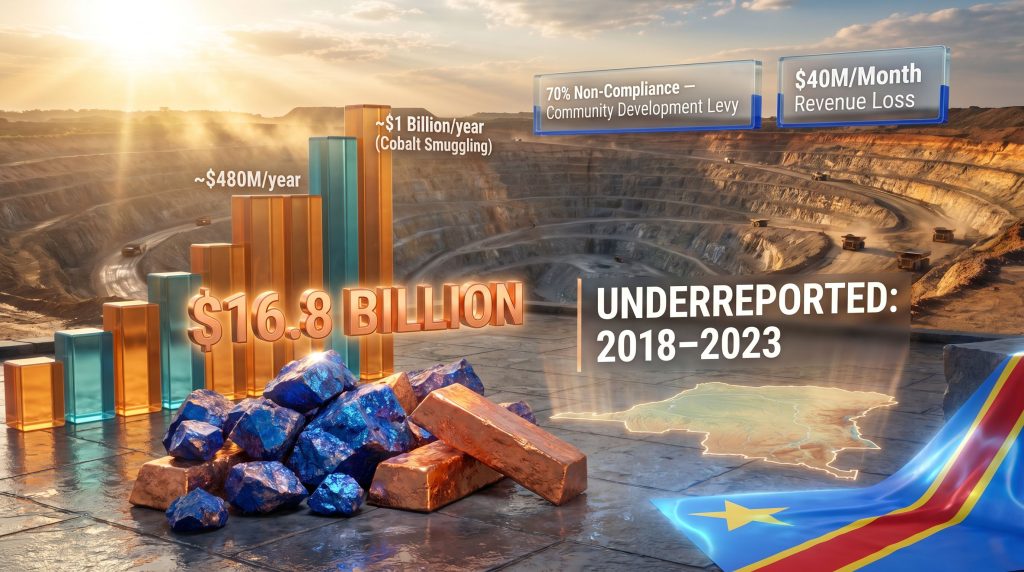
Yet this geological dominance has not translated proportionately into state revenue. The Court of Auditors' 2025 findings revealed that mining companies, including major operators such as CMOC and Glencore, collectively underreported approximately $16.8 billion in revenue between 2018 and 2023. The companies have denied the allegations, but the audit's scope alone signals a systemic failure rather than isolated accounting discrepancies.
Beyond underreporting, cobalt smuggling through cross-border routes, particularly via Rwanda, is estimated to drain a further $1 billion annually from the Congolese fiscal base. Combining these channels produces a monthly state revenue loss in the range of $40 million, a figure that accumulates into a structural deficit in the government's ability to fund public services and infrastructure from its primary economic sector.
Breaking Down the Revenue Loss Landscape
| Revenue Loss Category | Estimated Annual Impact | Primary Driver |
|---|---|---|
| Mining revenue underreporting | ~$480M+ per year | Transfer pricing, revenue concealment |
| Cobalt smuggling (Rwanda corridor) | ~$1 billion/year | Border corruption, artisanal mining leakage |
| Community levy non-compliance | Embedded in $16.8B total | ~70% corporate non-compliance rate |
| Combined monthly loss estimate | ~$40 million/month | Evasion and smuggling combined |
The 0.3% community development levy embedded in the DRC's mining regulatory framework illustrates how even modest obligations can become systemic failures. Operators are required to direct 0.3% of revenue toward community development funds in their operating regions. The 2025 audit found approximately 70% of companies were non-compliant with this obligation, suggesting that corporate attitudes toward sub-regulatory obligations track closely with confidence in enforcement credibility. For additional context, independent audit findings detail the full scope of the underreporting identified across this period.
Why Aggressive Enforcement Is Counterproductive
President Felix Tshisekedi's intervention in mid-2026 was triggered by a combination of escalating enforcement actions and clear signals that the approach was damaging investor sentiment. Cabinet minutes reviewed by Reuters revealed that the president specifically flagged recurring bank account seizures, asset freezes, and unpredictable fiscal charges as practices that were undermining sector competitiveness and inflating operating costs.
The Glencore episode made this tension concrete. DRC tax authorities sealed the offices of Glencore's Kamoto Copper operation as part of a payment dispute, prompting the company to publicly reiterate its position that it was engaging constructively with authorities while disputing the underlying liability. Regardless of the merits of the underlying claim, the act of office closure sent a visible signal to every other mining operator active in the country: administrative disputes in the DRC can escalate into operational disruptions without warning.
Tshisekedi directed the economy, finance, and mines ministries, along with revenue agencies, to ensure enforcement actions are legally justified and reserved only for exceptional circumstances. His stated objective was to build a sector characterised by a stable legal environment, predictable administrative decisions, and ongoing dialogue between state authorities and mining operators. The Congo cobalt export ban imposed earlier in 2025 had already demonstrated how abrupt policy shifts can reverberate through global markets.
Enforcement unpredictability, not resource scarcity, is currently the primary risk variable for mining operators in the DRC. The distinction matters enormously for how capital allocation decisions are made across competing jurisdictions.
The Investor Confidence Calculus
Mining investment operates on decade-long time horizons. A copper mine requires years of exploration, feasibility work, permitting, and construction before a single tonne of metal is produced. Investors making those commitments are not primarily concerned with today's royalty rate; they are pricing the probability that the regulatory environment will remain navigable across the full mine life.
When enforcement actions become unpredictable, that probability assessment deteriorates. Capital that might otherwise flow into Congolese copper development instead migrates toward Zambia, where the regulatory environment has historically been more stable, or toward Indonesian nickel and cobalt laterite projects that carry lower political risk premiums. The DRC does not need to be perfect to attract capital. It needs to be predictably imperfect in ways that experienced operators can model and manage.
The Structural Architecture of Enforcement Failure
The DRC's revenue collection challenges are partly a function of administrative architecture. The country operates hundreds of distinct tax categories spread across multiple agencies: the Direction Générale des Impôts (DGI) handles corporate taxation, the Direction Générale des Recettes Administratives (DGRAD) manages administrative fees and royalties, and the Direction Générale des Douanes et Accises (DGDA) oversees customs. These agencies share minimal data with one another, creating enforcement blind spots that sophisticated operators can exploit.
The 2018 Mining Code increased royalty rates and expanded tax obligations, but crucially, enforcement funding and audit capacity were not scaled to match the new obligations. This mismatch between legislative ambition and administrative capability is a recurring pattern in resource-rich developing economies. The result is compliance theatre: obligations exist on paper but are selectively enforced in ways that create uncertainty without generating commensurate revenue.
The Transfer Pricing Problem
One of the least-discussed but most consequential dimensions of the DRC's revenue loss involves transfer pricing arrangements between local mining subsidiaries and their offshore parent companies. In this practice, minerals or semi-processed ore are sold between related corporate entities at prices below market value, artificially deflating the taxable profit recorded in the DRC while accumulating value in lower-tax jurisdictions.
The DGI lacks a dedicated transfer pricing audit unit with the technical capacity to challenge these arrangements effectively. Corporate tax teams at major mining companies typically employ specialist transfer pricing economists whose entire function is to construct and defend these structures. Without equivalent expertise on the government side, even well-intentioned auditors lack the tools to quantify what is being lost. The DRC cobalt export suspension of early 2025 similarly exposed how policy decisions made without full fiscal visibility can produce unintended market consequences.
Corruption as a Force Multiplier
Enforcement failure does not occur in a vacuum. Law enforcement officials have been implicated in illicit cobalt procurement from artisanal miners, and border corruption enables the cross-border smuggling flows that account for an estimated $1 billion in annual revenue loss. Tshisekedi's separate directive ordering the immediate removal of soldiers and police officers illegally stationed on mining sites acknowledged a practice that is simultaneously a security risk, a source of fraud, and a reputational liability for the country's investment narrative.
The contradiction embedded in illegal security force presence is worth examining carefully. Mining companies in the DRC genuinely require security infrastructure given the operational context. When that security function is informally outsourced to military or police personnel operating outside their lawful mandate, it creates dependencies that can be leveraged for extortion, smuggling facilitation, or access control manipulation. The formal mine security ecosystem in the DRC remains underdeveloped relative to the risks operators face.
Reform Initiatives and Their Realistic Prospects
The Tshisekedi government has articulated several reform directions, though the gap between policy announcement and implementation has historically been wide in the DRC context.
| Reform Initiative | Target Outcome | Current Status |
|---|---|---|
| General Tax Code development | Consolidate hundreds of tax categories | In progress |
| Inter-agency information sharing | Reduce enforcement blind spots | Planning phase |
| Private security partnership (April 2025) | Curb mineral smuggling and tax evasion | Preliminary agreement stage |
| 5% Congolese employee ownership rule | Increase local economic participation | Enforcement deadline: July 2026 |
| EITI and Payments to Governments reporting | Improve revenue transparency | Delayed reporting undermines effectiveness |
The development of a General Tax Code represents one of the more substantive reform possibilities. Consolidating the fragmented tax architecture into a coherent, navigable framework would reduce compliance costs for legitimate operators, narrow the grey areas that facilitate evasion, and give revenue agencies clearer enforcement mandates. The challenge is political: each of the existing agencies and the bureaucratic interests embedded within them has reasons to resist simplification. In addition, the EITI reporting framework for the DRC provides an independent benchmark against which reform progress can be measured.
Three Preconditions for Sustainable Enforcement Reform
-
Administrative capacity investment: The DRC must fund specialist audit infrastructure capable of analysing transfer pricing arrangements, royalty valuations, and revenue recognition practices at the level of complexity that modern mining transactions involve.
-
Inter-agency data coordination: Breaking down the information silos between DGI, DGRAD, DGDA, and provincial authorities is a prerequisite for comprehensive enforcement. A mining operator should not be able to arbitrage gaps between agencies.
-
Anti-corruption prosecution: Meaningful reform requires that officials implicated in smuggling facilitation and illegal mine site operations face consequences. Without this, structural reforms operate on a compromised foundation.
What This Means for Global Supply Chains
The governance dynamics unfolding in Kinshasa carry consequences that extend far beyond the DRC's fiscal position. Battery manufacturers in Europe building electric vehicle supply chains, electronics producers in Asia sourcing cobalt for consumer devices, and defence contractors procuring copper for weapons systems are all downstream of Congolese extraction decisions. Consequently, the broader Congolese cobalt rivalry between major powers adds another layer of complexity to how enforcement reform is politically incentivised.
ESG compliance frameworks and responsible sourcing certifications require traceability from mine to market. When an estimated $1 billion in cobalt annually exits the DRC through untracked smuggling channels, it enters supply chains without the documentation that European due diligence regulations and US conflict minerals legislation require. This creates compliance exposure for downstream buyers who cannot verify the provenance of materials in their supply chains.
The integrity of global critical mineral supply chains depends partly on governance quality at the point of extraction. Revenue enforcement failure in the DRC is not simply a Congolese fiscal problem; it is a supply chain integrity problem for every company that sources cobalt or copper from the region.
The DRC's competitive positioning in the critical minerals landscape is not static. Indonesia has aggressively developed its nickel and cobalt laterite sector, and while Congolese high-grade cobalt sulphide deposits remain geologically superior for many battery chemistry applications, the processing cost advantages associated with laterite projects are narrowing. If enforcement instability continues to compress margins and elevate political risk premiums for DRC operators, capital will progressively favour jurisdictions where the fiscal environment is more navigable, regardless of underlying ore quality.
The next major ASX story will hit our subscribers first
The Path to a Functional Enforcement Framework by 2027
A realistic assessment of what meaningful reform would look like over the next 18 months centres on measurable outcomes rather than policy announcements:
- A simplified, consolidated tax framework with published compliance pathways that mining operators can plan around
- Functional inter-agency data sharing protocols that close the arbitrage opportunities currently embedded in the fragmented system
- Timely, complete EITI reporting that provides civil society and international investors with verified visibility into revenue flows
- A measurable reduction in the $40 million monthly revenue loss benchmark that currently frames the scale of the Congo mining sector revenue enforcement failure
- Prosecution outcomes in at least a subset of the most egregious underreporting cases identified in the Court of Auditors' findings
None of this is straightforward in a political environment where institutional reform competes with immediate revenue pressures, elite interests, and a fragmented security landscape. However, the Tshisekedi directive signals at minimum that there is recognition at the highest level of government that the current enforcement model is self-defeating. Aggressive tactics that destabilise operators and reduce investment flows ultimately shrink the tax base rather than expanding revenue recovery.
The US-Congo mining partnership announced in 2025 introduced an additional geopolitical dimension to Congo mining sector revenue enforcement, potentially linking fiscal reform progress to bilateral security and investment commitments. The DRC does not need to choose between enforcing its legitimate revenue rights and maintaining investor confidence. What it needs is an enforcement architecture sophisticated enough to distinguish between the two and disciplined enough to apply them consistently. That gap, more than any other factor, determines whether Congo's extraordinary mineral wealth translates into national development or continues to flow largely offshore.
This article contains forward-looking assessments and analysis based on publicly available information. Mining sector governance outcomes involve significant uncertainty, and readers should not interpret any element of this analysis as investment advice or as predictive of specific regulatory or market outcomes.
Want to Track ASX Mineral Discoveries Before the Broader Market Does?
Discovery Alert's proprietary Discovery IQ model delivers real-time alerts on significant ASX mineral discoveries across copper, cobalt, and more than 30 other commodities, turning complex mineral data into actionable insights for both short-term traders and long-term investors — explore historic discovery returns to understand the scale of opportunity, and begin your 14-day free trial at Discovery Alert to position yourself ahead of the market.