June 17, 2026
The Architecture of an Aluminium Upcycle: Upstream Power Versus Downstream Precision
Not all commodity cycles reward every participant equally. In metals markets, the distinction between upstream producers and downstream processors is rarely more consequential than during a genuine supply-demand tightening. The Constellium or Alcoa aluminium market upswing debate captures this divergence precisely — when aluminium prices move decisively higher, the question for investors is not simply whether to gain exposure, but where in the value chain that exposure delivers the most durable and risk-adjusted return.
The current aluminium upcycle unfolding through 2025 and into 2026 offers a textbook illustration of this divergence. Two of the industry's most closely watched names, Constellium SE and Alcoa Corporation, are both riding the same macro tailwinds. Yet the mechanics of how each company translates higher prices into shareholder value differ fundamentally, and those differences are now showing up clearly in stock performance, earnings quality, and capital strategy.
Understanding which model is winning, and why, requires looking beyond headline price charts and into the structural realities of the global aluminium market.
When big ASX news breaks, our subscribers know first
Why the 2026 Aluminium Market Upswing Matters for Investors
What Is Driving Aluminium Prices Toward Multi-Year Highs?
The forces lifting aluminium prices in 2026 are not a single-variable story. Several structural and cyclical pressures have converged simultaneously, creating a pricing environment that has caught many market participants off-guard in its persistence.
On the supply side, geopolitical instability across key producing and transit regions has contributed to tighter global availability of primary aluminium and alumina feedstock. Regional delivery premiums, particularly in Europe and North America, have strengthened materially as buyers compete for reliable supply. Furthermore, US aluminium tariffs have added another layer of complexity to the supply landscape, with London Metal Exchange and Shanghai Futures Exchange aluminium prices responding to historically low inventory levels.
On the demand side, the structural narrative is arguably more compelling than the cyclical one:
- Electric Vehicles: Aluminium-intensive body structures, battery enclosures, and crash management systems are becoming standard across EV platforms. Lightweighting mandates from regulators and automakers are accelerating rolled product consumption.
- Aerospace: Commercial aviation fleet renewal programmes and elevated defence procurement cycles are generating multi-year order backlogs for aerospace-grade aluminium sheet and plate.
- Sustainable Packaging: Consumer goods companies are making binding commitments to recyclable packaging formats, increasing demand for aluminium sheet, foil, and closures.
- Energy Infrastructure: Grid modernisation projects and renewable energy installations, including solar panel framing and high-voltage transmission cable, are expanding industrial aluminium consumption.
- Recycled Aluminium: Secondary production is growing as a proportion of total global supply. Because recycled aluminium requires roughly 95% less energy to produce than primary metal, it is attracting significant ESG-aligned procurement interest from automotive OEMs and packaging companies.
How Tight Is the Current Supply-Demand Balance?
Global aluminium inventories remain near historically low levels. This structural deficit in exchange-monitored stocks amplifies price sensitivity to any supply-side shock and creates a feedback loop where even modest demand acceleration can push prices meaningfully higher.
A less widely appreciated dynamic is the role of hidden inventory in aluminium markets. Unlike exchange-reported LME or SHFE stocks, significant volumes of aluminium are held in off-warrant, off-exchange locations including financing deals, producer stockpiles, and logistics bottlenecks. When financing economics shift, as they do with changes in interest rates and contango structures, this hidden inventory can re-enter the market with little warning — a risk factor that is not always adequately priced into analyst models.
"The current aluminium cycle is not purely commodity-driven. It reflects a structural convergence of lightweighting mandates, decarbonisation policy, and post-pandemic industrial recovery. Companies positioned across both upstream and downstream segments are capturing margin at multiple points in the value chain."
Constellium SE: Earnings Momentum in a Favourable Pricing Environment
How Is Constellium Translating Higher Aluminium Prices Into Earnings Growth?
Constellium operates as a downstream processor rather than a primary producer, meaning it purchases aluminium as a raw material input and transforms it into high-value rolled products and engineered structures for aerospace, automotive, and packaging customers. This positioning creates a fundamentally different earnings dynamic compared to upstream producers like Alcoa.
In Q1 2026, favourable aluminium pricing flowed through to revenue across all three of Constellium's major business divisions:
- Packaging and Automotive Rolled Products: Increased order volumes from both consumer goods packaging customers and automotive OEMs adopting aluminium body sheet for EV platforms.
- Aerospace and Transportation: Higher shipment volumes supported by commercial aviation recovery, with defence procurement cycles adding incremental demand visibility.
- Automotive Structures and Industry: Revenue growth supported by pricing tailwinds, with structural aluminium components for vehicle platforms benefiting from sustained OEM demand.
A critical but underappreciated aspect of Constellium's business model is its use of metal price pass-through mechanisms. For a large proportion of its contracts, Constellium effectively hedges its aluminium input cost exposure by pricing its products on a conversion cost basis. This means the company is primarily selling processing expertise rather than betting on metal prices — a structural advantage that moderates both upside and downside commodity sensitivity compared to Alcoa. For a detailed stock comparison, both companies present contrasting cases for aluminium investors.
What Does Constellium's Capital Allocation Strategy Signal to the Market?
Constellium's capital decisions in the current cycle reveal a management team with high conviction in the durability of current market conditions:
- Positive free cash flow generation in Q1 2026 demonstrates meaningful operational leverage.
- Approximately USD 28 million was deployed in share repurchases during the quarter alone.
- A board-approved buyback programme of up to USD 300 million has been authorised through the end of 2028.
- S&P revised its credit outlook on Constellium to Positive, reflecting a materially improving balance sheet trajectory.
- Full-year 2026 guidance was raised, signalling management confidence in sustained demand conditions across its end markets.
What Are the Risks to Constellium's Margin Trajectory?
| Cost Category | Trend | Implication |
|---|---|---|
| Production / Operating Costs | Rising | Margin compression risk if pricing softens |
| SG&A Expenses | Increasing | Requires revenue growth to offset |
| Free Cash Flow | Positive | Supports buyback execution |
| Credit Outlook (S&P) | Revised to Positive | Reduces refinancing risk |
Cost inflation across both manufacturing operations and administrative functions represents the primary near-term earnings risk. Margin sustainability ultimately depends on whether aluminium pricing and conversion premiums remain elevated through H2 2026 and into 2027.
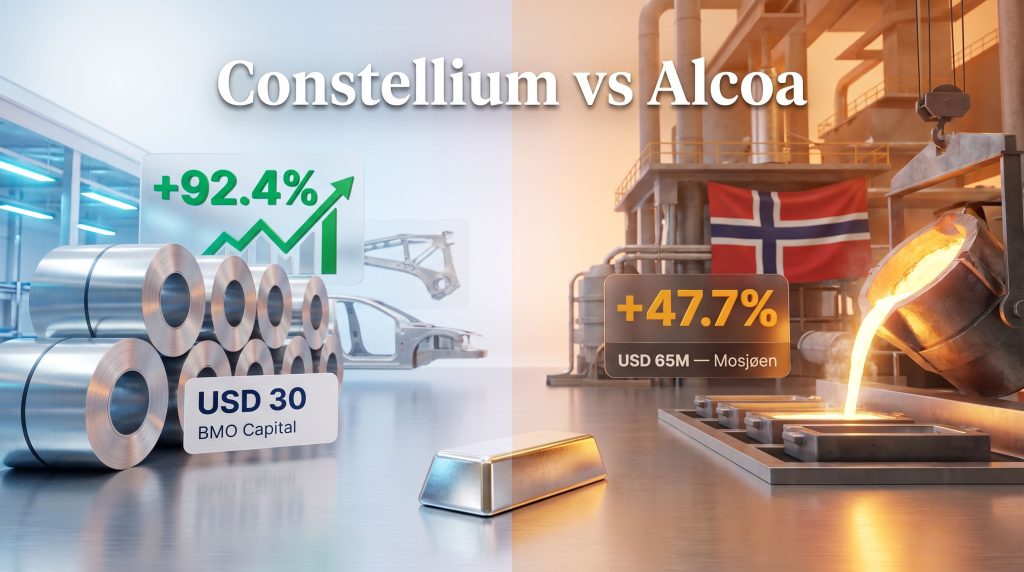
BMO Capital has assigned a USD 30 price target on Constellium, implying approximately 10% upside from recent levels. The thesis centres on earnings momentum driven by tighter supply conditions, higher aluminium prices, and resilient downstream demand from aerospace and EV platforms.
Alcoa Corporation: High-Beta Commodity Leverage With Expansion Ambitions
How Is Alcoa Positioned as a Direct Commodity Play in the Current Cycle?
Alcoa's business model operates at the opposite end of the aluminium value chain from Constellium. As a vertically integrated producer spanning bauxite mining, alumina refining, and primary aluminium smelting, Alcoa's earnings are directly and proportionally tied to commodity price movements. When aluminium prices rise, Alcoa's revenue and margins expand almost mechanically.
Several factors have amplified Alcoa's earnings leverage in the current cycle. Higher US tariffs on imported aluminium have strengthened domestic pricing dynamics, disproportionately benefiting domestic primary producers. Demand from packaging, transportation, and electrical end markets is providing broad-based volume support. In addition, the restart of previously idled smelter capacity is allowing Alcoa to capture higher prices at greater volumes.
It is worth noting a structural nuance often overlooked in basic analysis: Alcoa and alumina markets interact in ways that can diverge significantly from primary aluminium price movements. When the alumina-to-aluminium price ratio, known as the alumina index linkage, moves favourably, Alcoa captures margin at the refining stage before the metal is even smelted — creating earnings optionality that pure smelters do not possess.
What Is Alcoa's Production Expansion Strategy Through 2028?
| Facility | Country | Investment / Action | Estimated Output Impact |
|---|---|---|---|
| San Ciprián Smelter | Spain | Restart | Alumina shipment uplift |
| Alumar Smelter | Brazil | Restart | Primary aluminium volume growth |
| Lista Smelter | Norway | Restart | European supply base strengthening |
| Mosjøen Smelter | Norway | USD 65 million investment | Up to 75,000 additional tonnes |
The Mosjøen investment, announced in May 2026, is particularly noteworthy for two reasons. First, the capacity addition of up to 75,000 tonnes is meaningful in the context of European primary aluminium supply, where smelter restarts have been constrained by high energy costs for several years. Furthermore, the explicit integration of increased recycled aluminium usage in the casting process signals a deliberate strategic pivot toward circular economy credentials — an approach consistent with broader aluminium operations repowering trends being observed across the industry.
What Are Alcoa's Balance Sheet Considerations?
- Total debt of USD 2.55 billion as at end of Q1 2026.
- Cash and cash equivalents of USD 1.35 billion.
- Net debt of approximately USD 1.2 billion requires careful monitoring as capital expenditure commitments accumulate through the expansion cycle.
- Higher operating expenses reported in Q1 2026, consistent with broader industry-wide cost pressures including energy, labour, and raw material inflation.
Risk Flag: Alcoa's earnings profile carries elevated sensitivity to trade policy shifts, macro slowdown scenarios, and aluminium spot price reversals. The combination of significant existing debt and rising capital expenditure commitments across multiple smelter projects means the investment case carries a more binary character than Constellium's diversified downstream model.
Notably, Bank of America on Alcoa has highlighted these dynamics as central to its near-term rating considerations, underlining the degree to which institutional sentiment around Alcoa remains closely tied to the macro price environment.
Constellium vs Alcoa: A Side-by-Side Comparative Analysis
How Do the Two Companies Compare Across Key Investment Dimensions?
| Dimension | Constellium SE | Alcoa Corporation |
|---|---|---|
| Business Model | Downstream processor | Vertically integrated upstream producer |
| Price Sensitivity | Indirect via margin and volume | Direct high-beta to aluminium spot |
| Share Price Performance (6 months to June 2026) | +92.4% | +47.7% |
| Capital Returns | USD 300M buyback through 2028 | Focused on production expansion |
| Credit Outlook | S&P revised to Positive | Elevated debt load of USD 2.55B |
| 2026 Guidance | Raised | Subject to commodity price trajectory |
| Key Growth Driver | Packaging, aerospace, EV rolled products | Smelter restarts, low-carbon aluminium |
| Primary Risk | Operating cost inflation | Trade policy, commodity volatility, debt |
| Analyst Price Target | USD 30 (BMO Capital, ~10% upside) | Cyclically sensitive; macro-dependent |
Constellium's 92.4% share price appreciation over the six months to June 2026, compared to Alcoa's 47.7% gain, is a striking divergence that warrants careful interpretation. Part of this reflects market repricing of Constellium's earnings quality rather than simple commodity beta. Guidance upgrades, credit improvement, and active capital return programmes are the kinds of signals that attract quality-oriented institutional investors who would not otherwise allocate to a cyclical commodity name.
Which Company Offers Better Risk-Adjusted Exposure to the Aluminium Upswing?
The answer depends critically on investor time horizon and risk tolerance:
- For earnings-momentum investors: Constellium's diversified end-market exposure, improving credit profile, and active buyback programme present a more balanced risk-reward proposition. The conversion cost business model provides a degree of natural hedging against aluminium price volatility.
- For commodity-cycle traders: Alcoa's direct upstream leverage delivers higher upside in a sustained price rally, but with proportionally greater downside exposure in a reversal scenario. The current debt level means a prolonged price pullback could create meaningful balance sheet stress.
- For long-term structural investors: Both companies are well-positioned to benefit from the same macro tailwinds — including lightweighting mandates, EV adoption, and packaging sustainability transitions — but through fundamentally different business architectures with different risk profiles.
What Structural Trends Are Sustaining Aluminium Demand Beyond the Current Cycle?
How Are End-Use Markets Shaping Long-Term Aluminium Consumption?
The Constellium or Alcoa aluminium market upswing question is drawing considerable investor attention, but the more important consideration is whether the underlying demand drivers are durable or transitory. The evidence increasingly supports structural durability across multiple end-use categories.
Electric Vehicles remain the single most transformative demand driver. A modern battery electric vehicle contains significantly more aluminium than its internal combustion equivalent, driven by the need to offset battery weight with lightweight body structures and the thermal management requirements of battery enclosure systems.
Aerospace recovery is generating sustained demand for aerospace-grade 2xxx and 7xxx series aluminium alloys, which command significant fabrication premiums over commodity-grade rolled products. Constellium is particularly well-positioned in this segment given its long-term supply relationships with major airframe manufacturers.
Energy infrastructure represents an underappreciated demand vector. High-voltage direct current transmission cables, which are critical to renewable energy grid integration, rely on aluminium conductors. As grid investment accelerates globally, this end market could generate demand volumes not yet fully reflected in consensus aluminium demand forecasts.
How Does the Recycled Aluminium Trend Affect Constellium and Alcoa Differently?
The rise of recycled, or secondary, aluminium production is one of the most consequential structural shifts in the global aluminium industry. It affects upstream and downstream participants in materially different ways:
- Constellium operates closed-loop recycling systems with several major automotive customers, whereby scrap aluminium from vehicle production stamping operations is returned for remelting and reuse. This reduces input costs, lowers the carbon footprint of the finished product, and strengthens customer relationships through supply chain integration.
- Alcoa's Mosjøen investment directly targets increased recycled aluminium integration in its casting operations, acknowledging that European automotive and packaging customers are increasingly specifying low-embodied-carbon aluminium as a procurement condition rather than a preference.
The carbon intensity differential between primary and secondary aluminium production is now being formally priced by some industrial buyers through carbon border adjustment mechanisms, creating a growing financial incentive for recycled content that will compound over time.
The next major ASX story will hit our subscribers first
Frequently Asked Questions: Constellium vs Alcoa in the 2026 Aluminium Upswing
Is Constellium or Alcoa a Better Investment During an Aluminium Price Rally?
Constellium's downstream processing model offers more insulated earnings quality, with improving credit metrics and active shareholder returns through its USD 300 million buyback programme. Alcoa provides higher direct commodity leverage but carries greater sensitivity to price reversals, evolving trade policy, and its current net debt position. The preferred choice depends on an investor's risk tolerance and investment horizon, with no universally correct answer applicable across all portfolio contexts.
Why Has Constellium's Share Price Outperformed Alcoa Over the Past Six Months?
Constellium's approximately 92.4% share price appreciation over the six months to June 2026, against Alcoa's 47.7% gain, reflects the market's repricing of Constellium's earnings quality alongside simple commodity price leverage. Guidance upgrades, a positive credit outlook revision from S&P, and the signal value of a substantial buyback programme have attracted institutional buyers who value earnings durability over raw commodity beta. Consequently, among the top aluminium companies currently being assessed by fund managers, Constellium's profile is drawing renewed attention from quality-oriented allocators.
What Is Alcoa's USD 65 Million Norway Investment Designed to Achieve?
The Mosjøen smelter capital commitment is structured to add up to 75,000 tonnes of annual production capacity whilst simultaneously increasing the proportion of recycled aluminium in the casting process. The phased completion through 2028 is specifically targeted at European automotive and packaging customers seeking verifiable low-carbon aluminium supply — a segment where demand is expected to grow as carbon pricing mechanisms mature.
What Are the Biggest Risks Facing Both Companies in the Second Half of 2026?
- A reversal in aluminium spot prices driven by demand softening, macroeconomic slowdown, or supply normalisation from smelter restarts.
- Escalating operating cost pressures across manufacturing, energy, and administrative functions.
- Trade policy uncertainty, particularly around the sustainability of elevated US import tariff policy on aluminium.
- Hidden inventory re-entering the market as financing economics shift, potentially moderating regional delivery premiums.
- Macroeconomic scenarios reducing automotive and aerospace order volumes below current consensus forecasts.
How Do Alcoa's Smelter Restarts Affect the Global Supply Picture?
The sequential restart of San Ciprián, Alumar, and Lista, alongside the Mosjøen expansion, incrementally adds primary aluminium and alumina supply to global markets. Whilst this benefits Alcoa's revenue and volume metrics, it also contributes to the very supply normalisation that could moderate the price environment supporting both companies' current earnings performance — a self-limiting dynamic that long-cycle investors should factor into return expectations. Indeed, recent analyst commentary has flagged this dynamic as a key variable in determining whether Alcoa's current momentum can be sustained through 2027.
Strategic Outlook: Which Company Is Better Positioned for the Next Phase of the Aluminium Cycle?
What Happens to Each Company If Aluminium Prices Plateau or Pull Back?
Constellium's conversion cost business model and diversified end-market exposure provide meaningful earnings insulation through a combination of volume management, product mix optimisation, and the contractual pass-through of underlying metal price movements. A softening in aluminium prices does not automatically compress Constellium's fabrication margins if customer demand remains stable.
Alcoa faces a more direct and proportional impact from any price pullback. Rising capital expenditure commitments across multiple smelter projects, combined with a net debt position of approximately USD 1.2 billion, create a scenario where prolonged price weakness could test balance sheet resilience and force prioritisation decisions about the expansion timeline.
What Would Accelerate Upside for Each Company Through 2028?
Constellium upside accelerants:
- Sustained aerospace recovery driving higher volumes in the high-margin aerospace and transportation division.
- Accelerating EV platform rollouts creating incremental demand for automotive body sheet.
- Further credit rating upgrades reducing financing costs and expanding capital allocation flexibility.
- New closed-loop recycling agreements with automotive OEMs strengthening supply chain integration.
Alcoa upside accelerants:
- Successful on-schedule completion of all smelter restarts and the Mosjøen expansion.
- Sustained or rising aluminium and alumina prices through the capital expenditure cycle.
- Favourable continuation of US import tariff policy supporting domestic pricing premiums.
- Meaningful debt reduction improving balance sheet flexibility and reducing refinancing risk.
Strategic Summary: The Constellium or Alcoa aluminium market upswing is rewarding both companies, but through different mechanisms. Constellium is capturing the cycle through earnings quality and capital discipline, demonstrating that downstream processing expertise can generate superior risk-adjusted returns during a commodity upcycle. Alcoa is leveraging the cycle through volume expansion and direct commodity price sensitivity, offering higher potential returns in a fast-moving rally alongside proportionally greater risk. Investors seeking durability across the full commodity cycle may find Constellium's model more resilient, whilst those seeking maximum near-term commodity exposure will find Alcoa's architecture more aligned with that objective.
This article contains forward-looking statements, analyst price targets, and financial projections that are subject to change. Past share price performance is not indicative of future results. This content is provided for informational purposes only and does not constitute financial or investment advice. Readers should conduct independent due diligence before making investment decisions.
Want to Catch the Next Major Commodity Discovery Before the Market Does?
While Constellium and Alcoa illustrate how differently value is captured across the aluminium value chain, the most asymmetric returns in commodities often come from being early — and Discovery Alert's proprietary Discovery IQ model delivers real-time alerts on significant ASX mineral discoveries the moment they are announced, turning complex data across 30-plus commodities into clear, actionable insights. Explore historic discovery returns to understand the scale of opportunity, then begin your 14-day free trial at Discovery Alert to position yourself ahead of the broader market.