June 17, 2026
Offshore West Africa's Quiet Resurgence: Why Mature Basins Are Outperforming Expectations
Across the global upstream oil sector, investor attention has increasingly shifted toward frontier exploration and deepwater mega-projects. Yet some of the most commercially compelling well results of 2026 are emerging from mature, well-understood basins that were previously written off as past their peak. Gabon's offshore petroleum system is proving this assumption wrong in convincing fashion, and the Vaalco Gabon Ebouri-5H well production result sits at the centre of that reappraisal.
For operators with deep subsurface knowledge accumulated over decades, mature basins offer a counterintuitive advantage: lower geological uncertainty, existing infrastructure, and the ability to target high-graded reservoir intervals with surgical precision. The Ebouri-5H well outcome is a textbook illustration of this dynamic. Furthermore, the broader energy context — including shifting natural gas price trends and evolving commodity markets — makes well-executed upstream results like this increasingly relevant to investors.
When big ASX news breaks, our subscribers know first
Understanding the Geological Foundation Behind the Ebouri-5H Result
The Ebouri field sits within Gabon's prolific offshore Atlantic margin, a sedimentary province that has produced hydrocarbons commercially since the 1950s. The field is hosted within Gamba sandstone, one of the most geologically significant reservoir units in Central West Africa's petroleum history. Gamba sands are characterised by their exceptional porosity and permeability, properties that allow oil to flow freely toward the wellbore once penetrated.
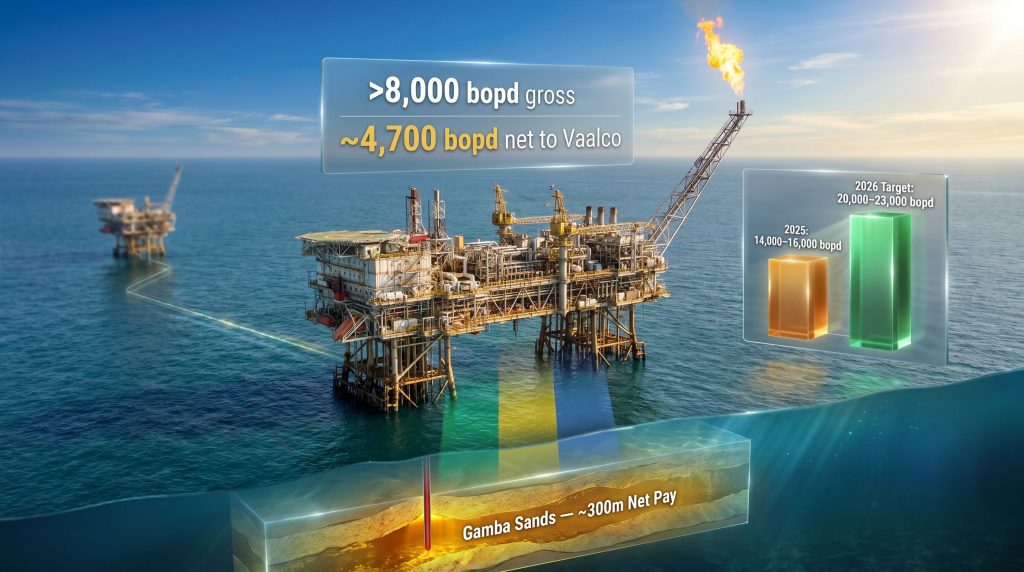
What makes the Vaalco Gabon Ebouri-5H well production result particularly noteworthy from a geological standpoint is the thickness of the productive interval. The well encountered approximately 300 metres of net pay within the Gamba formation. To put this in context, net pay refers to the vertical thickness of reservoir rock that is both hydrocarbon-bearing and capable of contributing to production.
A 300-metre net pay figure in an offshore development well is considered well above the regional norm and signals that the wellbore intersected a thick, continuous hydrocarbon column rather than a fragmented or partially saturated interval.
The combination of reservoir thickness, rock quality, and fluid characteristics in the Ebouri-5H well creates conditions that favour sustained production rates over an extended field life, reducing the risk of early natural decline.
Why Water Cut Matters for Long-Term Production
The very low water cut reported at initial production rates adds another layer of technical significance. Water cut describes the proportion of produced fluid that is water rather than oil. A low water cut at the start of production indicates the well is drawing from a pressure-supported zone well above the oil-water contact, which typically correlates with stronger, more consistent flow rates over time.
Wells with elevated early water cuts often require more intensive and costly artificial lift or water handling infrastructure, so a clean initial result like this materially improves the well's economic profile. Consequently, this outcome reinforces confidence in the Ebouri field's reservoir quality.
Ebouri-5H Well Performance: Key Metrics at a Glance
| Metric | Value |
|---|---|
| Gross Initial Flow Rate | More than 8,000 bopd |
| Net to Vaalco (working interest) | Approximately 4,700 bopd |
| Reservoir Formation | Gamba sandstone |
| Net Pay Thickness | Approximately 300 metres |
| Water Cut at Initial Production | Very low |
| Rig Next Location | SEENT platform, offshore Gabon |
The gross flow rate exceeding 8,000 barrels of oil per day positions this as one of the stronger single-well development outcomes in Gabon's offshore sector in recent years. For Vaalco specifically, it represents a meaningful inflection after a period during which Gabonese output had been trending lower. According to World Oil, this flow rate stands as one of the more notable offshore Gabon well results in recent memory.
How Two Decades of Operational Continuity Create a Subsurface Edge
Vaalco has maintained uninterrupted operational presence in Gabon since 2002, giving the company more than two decades of well performance data, seismic interpretation history, and production behaviour knowledge across the Etame-Marin block. This kind of institutional knowledge is difficult to replicate and provides a meaningful subsurface advantage when selecting well targets.
In early 2026, Vaalco had already launched a separate drilling campaign at the Etame field, which sits within the same broader offshore acreage. The Ebouri campaign followed as the second pillar of the Gabon growth strategy. Together, these programmes are designed to shift total Gabonese production from a 2025 baseline of 14,000 to 16,000 bopd toward a 2026 target range of 20,000 to 23,000 bopd.
The net contribution of approximately 4,700 bopd from Ebouri-5H alone represents a substantial portion of the incremental volume required to bridge that gap, before accounting for the SEENT platform wells still in progress. In addition, monitoring crude oil price trends will remain important in assessing how these production gains translate into revenue outcomes.
The SEENT Platform Campaign and the Gas-to-Power Strategy
Following the completion of Ebouri-5H, the drilling rig was mobilised to the SEENT platform within the same offshore Gabon operating area. Two additional development wells are planned from this platform, extending the 2026 Gabon drilling sequence and providing further opportunities to add production volume. Drilling Contractor has reported on this rig move as a key next step in Vaalco's Gabon campaign.
Alongside the development well programme, Vaalco is targeting a natural gas reservoir in the near-term drilling schedule. If successful, the produced gas would be used to generate power directly for offshore facilities, replacing the current dependency on diesel fuel transported by vessel. This gas-to-power approach carries multiple strategic benefits:
- Elimination of diesel vessel scheduling and associated logistics risk
- Direct reduction in operating expenditure at the field level
- Reduction in diesel combustion emissions, improving the carbon intensity profile of Gabon operations
- Decreased exposure to marine fuel price volatility
For a mid-cap operator like Vaalco, successful implementation of offshore gas-to-power would represent a structurally meaningful improvement in field-level margins. Larger West African operators have used this model for years, but its application at smaller-scale platforms requires successful gas discovery in the right proximity to existing infrastructure, which is precisely what the current drilling campaign is targeting. The broader LNG supply outlook also underscores the strategic value of integrating gas resources into offshore operational models.
Vaalco's Four-Country African Drilling Campaign in 2026
The Gabon results do not exist in isolation. Vaalco is simultaneously advancing drilling programmes across four African operating jurisdictions in what represents one of the company's most active execution years in its history.
| Country | 2026 Drilling Activity | Current Status |
|---|---|---|
| Gabon | Ebouri-5H plus SEENT platform wells plus gas well target | Ebouri-5H on production; rig at SEENT |
| Egypt | 2026 programme launched; first well on production | Active; full-year programme planned |
| Côte d'Ivoire | Baobab FPSO restart plus five-well development programme | Four wells restarted; three more near-term |
| Equatorial Guinea | Ongoing production operations | Maintained |
Baobab Field Restart in Côte d'Ivoire
The Baobab field in Côte d'Ivoire deserves particular attention. After a 17-month shutdown for the refurbishment of its floating production, storage and offloading vessel, Baobab resumed production approximately one week before the Ebouri-5H announcement. Four wells were brought back online at restart, with three additional wells expected to follow shortly.
A five-well development drilling programme is planned for the second half of 2026, which would deliver a substantial additional production uplift from the Côte d'Ivoire asset. In Egypt, Vaalco has brought the first well of its 2026 programme into production following a successful 2025 campaign, with drilling activity planned to continue throughout the year.
The geographic diversification of this programme is itself a risk management tool. By advancing wells across four countries simultaneously, Vaalco reduces its dependence on any single asset performing to plan. However, it also demands strong operational execution across multiple regulatory and logistical environments simultaneously.
The next major ASX story will hit our subscribers first
Production Targets and the Path to 225% Organic Growth by 2030
Vaalco's stated ambition of 225% organic production growth by 2030 is among the more aggressive growth targets within the mid-cap African-focused upstream space. Reaching that level requires not just successful individual well results, but the compounding of production gains across multiple assets over multiple years.
The company's Q1 2026 guidance projects total group output of between 20,100 and 22,400 barrels of oil equivalent per day across the full portfolio for 2026. The step-by-step execution pathway toward the 2030 target can be understood as follows:
- Reverse the production decline in Gabon through the Etame and Ebouri field drilling programmes in 2026
- Restore Côte d'Ivoire production capacity through the Baobab FPSO refurbishment and well restart sequence
- Sustain Egypt drilling momentum by building on the 2025 campaign's success
- Unlock gas-to-power cost efficiencies in Gabon through the near-term gas well
- Execute the two SEENT platform development wells with the rig already on location
- Deliver the Baobab five-well development programme in the second half of 2026
- Compound production gains across all four operating countries through to 2030
Each of these steps carries execution risk. FPSO reliability, reservoir deliverability from new wells, and commodity price conditions will all influence whether the 2030 target remains achievable. The Ebouri-5H result, however, confirms that the geological foundation supporting this strategy is sound.
Benchmarking Ebouri-5H Against West African Offshore Norms
Offshore West Africa encompasses a wide range of well productivity outcomes depending on basin maturity, reservoir type, structural setting, and field history. Development wells in mature Gabonese fields have historically delivered a broad spectrum of results, from modest producers of a few hundred barrels per day to high-rate completions exceeding 5,000 bopd gross.
Against this backdrop, an initial gross flow rate exceeding 8,000 bopd from a single development well in a mature field positions Ebouri-5H firmly in the upper tier of recent regional outcomes. The Gamba sandstone's track record as a high-deliverability reservoir formation helps explain why, but the specific well result also depends heavily on structural positioning, the absence of nearby water influx, and the integrity of the wellbore completion.
Vaalco Gabon Production Trajectory Comparison
| Period | Gabon Production Range |
|---|---|
| 2025 actual | 14,000 to 16,000 bopd |
| 2026 company target | 20,000 to 23,000 bopd |
| Ebouri-5H net contribution | Approximately 4,700 bopd |
| SEENT platform wells | Two wells in progress; volumes pending |
The incremental volume from Ebouri-5H alone closes a meaningful portion of the gap between 2025 actuals and 2026 targets before the SEENT wells or any Etame production uplift is included. This underlines why the result was characterised by Vaalco's leadership as a significant milestone rather than a routine development outcome. The broader context of Australia's resource and energy exports further illustrates how regional upstream performance feeds into global supply dynamics.
What Investors and Industry Observers Should Watch Next
Several near-term catalysts will determine whether Vaalco's 2026 momentum translates into a durable production re-rating across its African portfolio.
- SEENT platform well results: Two development wells are now being drilled. Their reservoir intersections and flow test outcomes will provide the next data points for Gabon production trajectory
- Gas well outcome: Success or failure of the gas-to-power well will determine whether the offshore opex reduction strategy proceeds, with meaningful implications for field-level margins
- Baobab five-well programme launch: Timing and execution of the H2 2026 Côte d'Ivoire drilling programme will be a major volume driver for the second half of the year
- Egypt 2026 well results: Continued drilling success in Egypt is needed to sustain the multi-country production growth narrative
- Full-year production guidance tracking: Investors should monitor how quarterly actuals track against the stated 20,100 to 22,400 boepd full-year guidance range
Furthermore, the prevailing oil price rally environment adds another variable to watch, as commodity price movements will materially influence the revenue impact of each barrel added through Vaalco's drilling campaigns.
The Vaalco Gabon Ebouri-5H well production result is best understood not as a standalone event, but as the opening chapter of a multi-asset, multi-year execution story whose full implications will only become clear as the 2026 drilling campaign progresses and the 2030 growth target comes into sharper focus.
This article is intended for informational purposes only and does not constitute financial advice. Forecasts, production targets, and growth projections referenced herein are forward-looking statements subject to material risks and uncertainties. Readers should conduct their own due diligence before making any investment decisions. Further reporting on West and Central African energy developments is available through Ecofin Agency.
Want to Catch the Next Major Resource Discovery Before the Broader Market Does?
Discovery Alert's proprietary Discovery IQ model delivers real-time alerts on significant ASX mineral discoveries, turning complex resource data into actionable investment insights for traders and long-term investors alike — explore historic discoveries and their exceptional returns to understand what early positioning can mean, then begin your 14-day free trial at Discovery Alert to secure your market-leading edge.