
June 17, 2026
The Inflation Illusion: Why Most Investors Are Misreading the Economic Signals
Monetary policy debates rarely age well. The assumptions that underpin them, built during one economic cycle, often prove misleading in the next. Right now, a widespread belief is circulating across financial media and social platforms: that inflation is primed for a dramatic resurgence, and that the Federal Reserve is the primary tool for managing it. Both of these assumptions deserve serious scrutiny.
Danielle DiMartino Booth inflation and interest rates analysis, developed through her role as CEO and chief strategist at QI Research and author of the widely read Daily Feather newsletter, cuts through the noise dominating mainstream financial commentary. Her analytical lens, shaped by years of experience inside the Federal Reserve system, reveals a more nuanced and structurally complex picture than headline figures suggest.
When big ASX news breaks, our subscribers know first
Why Rate Tools Are a Blunt Instrument Against Today's Inflation
Interest rate policy operates through a specific transmission mechanism: it raises borrowing costs, cools credit demand, slows corporate investment, and gradually reduces spending. This works reasonably well when inflation is demand-pull in nature, meaning it is driven by excess consumer spending chasing limited goods. However, when inflation is cost-push or structural in origin, driven by supply constraints, energy costs, childcare expenses, or educational fees, rate hikes offer limited relief.
This distinction is critical and is often missing from public discourse on Danielle DiMartino Booth inflation and interest rates analysis. The categories of spending causing the most pain for American households are largely insensitive to interest rate adjustments. A family struggling to afford childcare does not benefit meaningfully from a 25 basis point rate cut. The mechanism simply does not reach that far down the income distribution.
DiMartino Booth highlights a telling analytical question: outside of essentials like fuel, food, and childcare, where does the pricing power come from to sustain broad-based inflation? If full-time employment is contracting and wages are stagnating, consumers lack the purchasing power to absorb rising prices across discretionary categories. Inflation requires both rising input costs and a buyer willing and able to pay more. Remove the buyer, and structural inflation in non-essential categories becomes self-limiting.
Furthermore, as explored in detail on CNBC's coverage of DiMartino Booth's recession commentary, this framework challenges the conventional wisdom that rate adjustments alone can meaningfully address the type of inflation households are currently experiencing.
Inflation in essentials persists not because of demand strength, but because households have no choice but to pay. That is a fundamentally different economic problem than the kind monetary policy was designed to solve.
The Full-Time Employment Contraction Nobody Is Talking About
One of the more underreported labour market signals is the net loss of approximately 600,000 full-time positions over a 12-month period. Headline unemployment figures can remain relatively stable while this deterioration unfolds, because part-time employment, gig economy participation, and multiple job-holding can statistically offset full-time losses without replicating the income stability those positions provided.
This matters enormously for inflation analysis. Full-time employment is the foundation of household purchasing power. When full-time roles are replaced by part-time or contract work, household income becomes less predictable, less adequate, and less capable of sustaining spending above essential categories. The inflationary wave that social media commentators are predicting simply lacks the demand foundation to materialise in discretionary spending categories.
A related social indicator worth tracking is the acceleration of multigenerational household formation. When adult children return to live with parents specifically to share childcare costs and reduce living expenses, it reflects a level of budget stress that aggregate economic statistics fail to capture. This is a ground-level signal of financial pressure that sits well outside the frame of official CPI or GDP reporting.
How Does This Connect to the Broader Recession Risk?
The recession market outlook is increasingly difficult to ignore when full-time employment is contracting at this pace. Consequently, investors monitoring recession market outlook indicators should pay close attention to labour market composition, not just headline unemployment rates, as a more reliable leading signal.
The K-Shaped Economy and Who Actually Benefits from Policy Changes
The concept of a K-shaped economic recovery describes a bifurcation where upper-income households experience asset appreciation and financial gains while lower-income households face flat or declining real wages alongside rising essential costs. This divergence has profound implications for how inflation statistics are interpreted.
| Economic Cohort | Primary Benefit from Rate Cuts | Exposure to Inflation Pain |
|---|---|---|
| Top 10% (asset holders) | High: equity and property appreciation | Low: discretionary spending flexibility |
| Middle class | Moderate: mortgage refinancing opportunity | High: squeezed by essentials and debt |
| Bottom 50% | Minimal: low borrowing activity | Severe: essentials consume most income |
Rate reductions primarily benefit those with significant asset holdings or debt they wish to refinance at lower rates. For the roughly 90% of American earners who hold minimal financial assets relative to their income, cheaper borrowing does little to improve their financial position. As DiMartino Booth has noted, this cohort has been largely invisible in policy discussions that have focused almost exclusively on inflation control rather than labour market health.
The Federal Reserve operates under a dual mandate: price stability and maximum employment. When policy discourse becomes dominated by one side of that mandate to the exclusion of the other, the institutional framework itself is being misapplied.
FOMC Signals: What to Watch and Why Language Matters More Than Rate Decisions
For investors monitoring Federal Reserve communications, the rate decision itself is often the least informative part of any FOMC announcement. The language embedded in official statements carries substantially more forward guidance about policy direction than the headline number. In addition, two-year yield signals have historically provided some of the most reliable early indicators of where policy is heading next.
Key signals to watch for include:
- Introduction or removal of easing bias language in the statement
- Explicit acknowledgment of labour market deterioration as a policy concern
- Any shift away from inflation-first framing toward dual-mandate balance
- The presence of dissenting votes, which signal fracture lines within the committee
- Departures from boilerplate phrasing that suggest emerging consensus shifts
DiMartino Booth has specifically pointed to the significance of dissent within FOMC meetings. Behind closed doors, these meetings can involve extended debate over precise word choices in official statements. Whether an incoming Fed leadership figure insists on maintaining easing bias language in recognition of labour market concerns is a more meaningful signal than the rate decision itself. Unanimous statements project consensus; dissenting votes reveal where the next policy evolution is likely to originate.
A rate hike in the near term appears highly unlikely given visible disinflation in services, discretionary spending, and wages. The more probable trajectory involves a prolonged hold period followed by gradual easing, though the risk lies in the Fed moving too slowly and allowing labour market deterioration to deepen before action is taken.
Mismeasurement: The Gap Between Official Statistics and Economic Reality
A recurring theme in sophisticated macroeconomic analysis is the growing credibility gap between official statistical series and observed ground-level conditions. Inflation measurement methodology under the Bureau of Labor Statistics has been revised multiple times over recent decades. Alternative frameworks, including those that apply calculation methods used prior to these revisions, produce meaningfully higher inflation estimates, sometimes in the range of 8 to 9 percent under older methodologies, compared to current official readings.
This is not merely a technical debate. It has real implications for how monetary policy decisions are calibrated and how investor portfolios are positioned. Similar mismeasurement concerns extend to labour market data, where job creation figures have been subject to substantial retrospective revisions, and GDP calculations, which can be influenced by methodological choices in ways that are not always transparent to market participants.
When statistical series are systematically biased in a particular direction, policy responses built on those statistics will consistently miss their targets. The mismeasurement problem is not academic; it is a structural source of policy error.
It is important to note that alternative inflation measurement frameworks represent analytical perspectives and should be evaluated alongside official data rather than treated as definitive replacements for it.
The next major ASX story will hit our subscribers first
The Hyperinflation Question: Conditional Risk, Not Inevitable Outcome
Historical hyperinflationary episodes, from Weimar Germany to Zimbabwe, share a common structural trigger: governments printing currency to fund direct income transfers to large populations without corresponding productive output. The mechanism is specific. It is not simply high debt or fiscal deficits that produce hyperinflation, but the combination of money creation and income-for-non-production transfers at scale.
The United States experienced a real-world partial test of this dynamic following COVID-19, when direct payments to households coincided with a rapid acceleration in consumer prices that briefly reached double-digit territory by some measures. This episode provides empirical evidence for the relationship between transfer payments and inflation outcomes.
Danielle DiMartino Booth's analytical position on hyperinflation risk in the US is that it is not a likely near-term outcome under current policy frameworks. However, it becomes a meaningful conditional risk if domestic policy shifts toward large-scale universal basic income or Modern Monetary Theory-style spending programmes. Critically, she frames this as a domestic political choice rather than an externally imposed shock, making electoral cycles — particularly 2026 and 2028 — relevant macro risk variables for long-horizon investors.
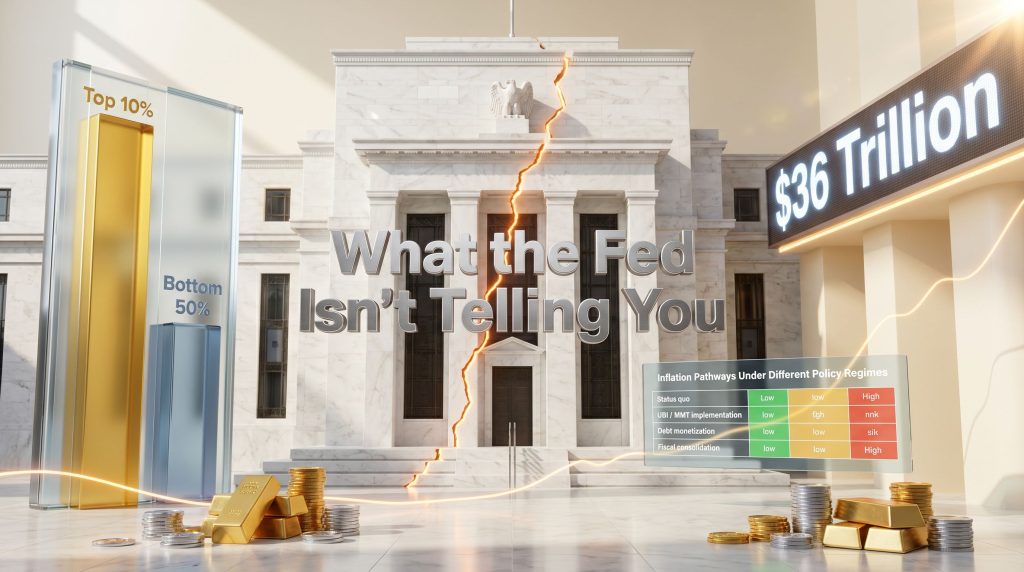
| Policy Scenario | Inflation Probability | Dollar Impact | Fed Response |
|---|---|---|---|
| Status quo trajectory | Moderate, easing trend | Stable to modest decline | Gradual cuts |
| UBI or MMT implementation | High: potential runaway | Significant depreciation | Forced aggressive tightening |
| Federal debt monetisation | High | Dollar debasement risk | Loss of credibility |
| Fiscal consolidation | Low | Strengthening | Accelerated cuts |
Fiscal Dominance and the $36 Trillion Constraint
With US national debt exceeding $36 trillion and annual debt servicing costs surpassing $1 trillion, there is a structural ceiling on how aggressively the Federal Reserve can raise rates without triggering a fiscal feedback loop. Higher rates increase the cost of rolling over existing Treasury debt, placing upward pressure on the federal deficit and creating implicit pressure on the Fed to keep rates below levels that pure inflation targeting might otherwise justify.
This dynamic, known as fiscal dominance, represents a subtle but significant constraint on Federal Reserve independence. It does not eliminate the Fed's ability to act, but it narrows the practical range of policy options available, particularly during periods of elevated deficit spending. Understanding the gold and bonds dynamics that emerge under fiscal dominance conditions is consequently becoming an increasingly important part of sophisticated portfolio construction.
Precious Metals: Hedging Function vs. Speculative Vehicle
When asset classes attract significant speculative capital, they typically pass through a predictable cycle: discovery, rapid appreciation, correction, and consolidation before fundamental buyers establish a price floor. Precious metals, which saw a dramatic run-up and subsequent correction in recent periods, appear to be in or approaching the consolidation phase of this cycle.
DiMartino Booth draws an important analytical distinction between what she terms travelers — meaning short-term momentum traders moving in and out of asset classes opportunistically — and fundamental holders who view precious metals as long-term portfolio insurance against systemic risk and currency debasement. Post-correction consolidation phases are historically when fundamental buyers become more active, while speculative capital has already exited.
The proliferation of leveraged single-name equity products, including leveraged ETFs on individual companies, represents a measurable increase in systemic speculative risk within equity markets. As leverage accumulates across the financial system, the hedging function of precious metals becomes more relevant, not less.
For investors considering exposure, gold safe-haven investing principles suggest entering during correction phases rather than at speculative peaks, treating precious metals as portfolio hedges against tail risk rather than primary growth vehicles.
Portfolio Positioning Framework for an Uncertain Rate Environment
In elevated valuation environments, the risk-reward calculus shifts decisively toward capital preservation over return maximisation. The following framework reflects a conservative approach appropriate for the current macro backdrop:
- Prioritise equities with well-covered, sustainable dividends where income is at no realistic risk of being cut
- Avoid high-leverage speculative positions in sectors displaying mania-like trading behaviour
- Consider precious metals exposure as a portfolio hedge during correction and consolidation phases
- Apply particular caution toward any asset class that has recently attracted heavy speculative inflows
- Maintain scepticism toward aggregate economic statistics and supplement official data with ground-level indicators
Furthermore, strategic gold investment frameworks that account for geopolitical variables are becoming an increasingly relevant layer of portfolio analysis for investors navigating the current environment.
| Asset Class | High Inflation Environment | Disinflation Environment | Rate Cut Cycle |
|---|---|---|---|
| Gold | Strong performer | Moderate: holds value | Positive as dollar weakens |
| Silver | Volatile: industrial and monetary | Underperforms gold | Positive with lag |
| Dividend equities | Mixed: depends on sector | Positive | Positive |
| Long-duration bonds | Negative | Positive | Strongly positive |
| Cash and short-term T-bills | Positive real yield | Declining yield | Negative |
| Leveraged equities | High risk, high reward | Positive | Positive short-term |
This framework is intended for informational and educational purposes only and does not constitute personalised financial advice. All investment decisions should be made in consultation with a qualified financial professional.
Frequently Asked Questions
Does raising interest rates reliably reduce inflation?
Rate hikes effectively address demand-pull inflation by raising borrowing costs and cooling excess spending. However, they have limited impact on supply-side, structural, or essentials-driven inflation. For lower-income households spending the majority of their income on non-discretionary categories, rate policy provides minimal direct relief.
What would realistically trigger hyperinflation in the United States?
The most credible domestic pathway involves large-scale government programmes distributing currency to non-working populations without corresponding productive output. The post-COVID stimulus period demonstrated how rapidly this dynamic translates into price acceleration. This makes it a policy choice risk rather than an externally imposed one.
How does national debt affect Fed independence?
High debt levels create fiscal dominance conditions where the government's sensitivity to interest rate increases places implicit constraints on how aggressively the Fed can tighten policy. With debt servicing already exceeding $1 trillion annually, rate increases carry significant fiscal consequences that narrow the Fed's effective policy range.
What is the most useful signal in an FOMC statement?
Language shifts within official statements frequently carry more forward guidance than the rate decision itself. The presence of easing bias language, acknowledgment of labour market concerns, and dissenting votes are among the most meaningful indicators of future policy direction. For additional context on this topic, DiMartino Booth's podcast discussion on recession signals and inflation trends provides valuable supplementary analysis.
How should investors think about precious metals right now?
Precious metals function most effectively as portfolio hedges against systemic financial stress, currency debasement risk, and tail-risk scenarios. Their performance is most consistent over multi-year holding periods, with post-correction consolidation phases historically representing more favourable entry points than periods of peak speculative activity.
Want to Know Which ASX Mineral Discoveries Are Generating the Most Significant Returns?
Discovery Alert's proprietary Discovery IQ model delivers real-time alerts on significant ASX mineral discoveries, transforming complex geological and market data into actionable investment insights suitable for both new and experienced investors — explore the historic returns achieved by major mineral discoveries to understand the scale of opportunity, then begin a 14-day free trial at Discovery Alert to position yourself ahead of the broader market.