
August 7, 2026
Constitutional Powers During Energy Crisis Management
Australia's federal system creates unique jurisdictional complexities when managing fuel supply disruptions. The Commonwealth retains constitutional authority over international trade and interstate commerce, while states maintain responsibility for retail distribution networks and regional supply coordination. This division of powers becomes particularly significant during emergency scenarios when rapid decision-making is essential for addressing australian cabinet fuel shortage fears.
Federal Emergency Response Mechanisms
The Prime Minister's office can invoke several emergency powers during fuel crises, including the temporary suspension of fuel quality standards and the release of strategic petroleum reserves. These mechanisms operate under the Liquid Fuel Emergency Act, which provides the legal framework for government intervention in petroleum markets during supply disruptions.
Emergency powers available to federal authorities include:
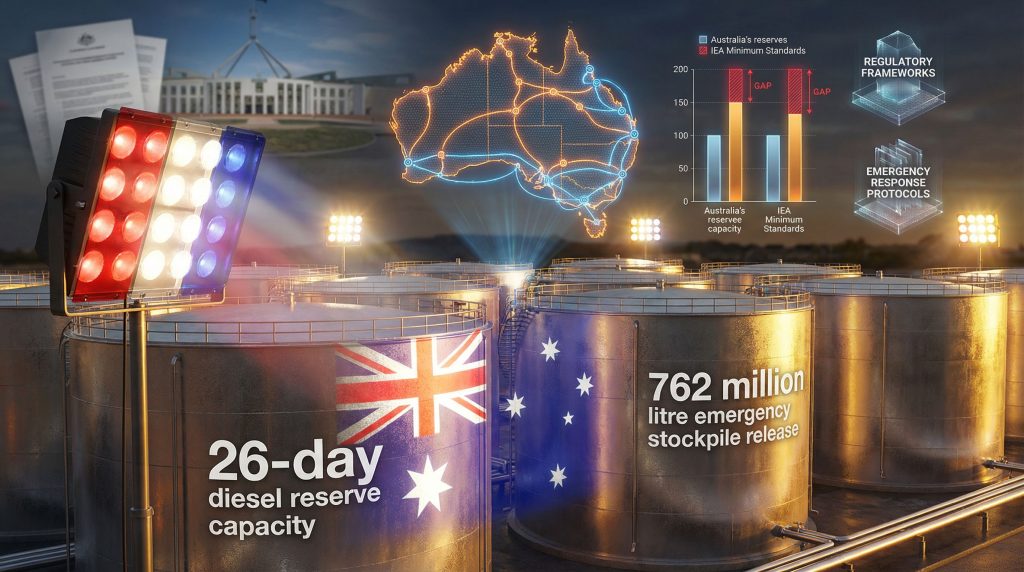
- Strategic reserve deployment with capacity to release up to 762 million litres of gasoline and diesel
- Temporary fuel quality standard modifications allowing higher sulphur content products (50ppm vs standard 10ppm)
- Import facilitation measures including expedited customs processing for emergency fuel shipments
- Price monitoring enforcement through Australian Competition and Consumer Commission oversight
The coordination between federal and state authorities requires formal consultation mechanisms, including emergency cabinet meetings with state and territory leaders. These meetings establish unified response protocols and resource allocation strategies during supply chain disruptions. Furthermore, recent developments have shown how oil price rally analysis can significantly impact fuel security planning across all jurisdictional levels.
State-Level Intervention Capabilities
State governments possess significant authority over fuel distribution networks within their jurisdictions, particularly regarding priority allocation to essential services and regional areas. New South Wales has demonstrated proactive approaches through roundtable discussions with industry stakeholders, establishing precedents for collaborative crisis management.
Regional fuel security considerations involve:
- Agricultural sector prioritisation during critical periods such as harvest seasons
- Essential services allocation including emergency vehicles and medical facilities
- Transportation network maintenance ensuring freight corridor accessibility
- Remote area supply guarantees addressing geographic distribution challenges
When big ASX news breaks, our subscribers know first
Australia's Strategic Fuel Reserve Analysis
Current Capacity vs International Standards
Australia maintains approximately 26 days of diesel reserves and 29 days of petrol capacity, figures that fall below International Energy Agency minimum recommendations. The IEA suggests member nations maintain 90 days of import equivalent reserves, highlighting the substantial gap in Australia's strategic preparedness.
| Reserve Type | Current Days | IEA Standard | Gap |
|---|---|---|---|
| Diesel | 26 days | 90 days | 64 days |
| Petrol | 29 days | 90 days | 61 days |
| Jet Fuel | 22 days | 90 days | 68 days |
| Total Distillates | 24 days | 90 days | 66 days |
The emergency stockpile release mechanism allows for the deployment of 762 million litres across multiple product categories. This volume represents approximately 4.8 million barrels of combined gasoline and diesel, distributed through existing commercial networks rather than dedicated government storage facilities.
Distribution Timeline and Regional Allocation
Emergency fuel distribution follows predetermined priority matrices that consider geographic remoteness, economic criticality, and population density. Regional areas receive preferential allocation due to limited alternative supply options and higher transportation costs. Additionally, the impact of trade war and oil markets continues to influence strategic stockpiling decisions.
The distribution framework operates through:
- Tier 1 Priority: Essential services including hospitals, emergency services, and critical infrastructure
- Tier 2 Priority: Food production and distribution networks, agricultural operations
- Tier 3 Priority: Public transportation and freight corridors
- Tier 4 Priority: General commercial and retail distribution
Regulatory Flexibility During Supply Disruptions
Temporary Fuel Quality Standard Modifications
The Australian government's decision to temporarily relax fuel quality standards represents a significant regulatory compromise between supply security and environmental protection. The modification allows refiners to produce gasoline with 50 parts per million sulphur content, five times higher than the standard 10ppm requirement.
This regulatory flexibility carries several implications:
Technical Impact: Higher sulphur content reduces fuel efficiency by approximately 2-3% in modern vehicles and may accelerate catalytic converter degradation in vehicles manufactured after 2009.
Environmental Considerations: The temporary increase in sulphur emissions contributes to regional air quality degradation, particularly in urban areas with high traffic density. Health authorities estimate a marginal increase in respiratory health impacts during the 60-day implementation period.
Implementation Timeline: The regulatory modification requires 72-hour notice periods to fuel retailers and automotive manufacturers, allowing time for public notification and technical adjustments. According to ABC News, Prime Minister Albanese has called an emergency national cabinet meeting to address escalating fuel shortage concerns.
Market Intervention Tools and Effectiveness
The Australian Competition and Consumer Commission maintains comprehensive price monitoring systems during fuel supply emergencies. These mechanisms include real-time data collection from major fuel retailers and automated alert systems for unusual price movements.
Anti-gouging enforcement measures include:
- Automatic price ceiling calculations based on pre-crisis pricing plus reasonable cost adjustments
- Penalty structures with fines up to $10 million for corporate violations
- Supply chain transparency requirements mandating detailed reporting on inventory levels and distribution costs
- Consumer complaint processing with expedited investigation protocols during emergency periods
Economic Impact Assessment Framework
Agricultural Sector Vulnerability Analysis
Australia's agricultural sector demonstrates extreme vulnerability to fuel supply disruptions, particularly during harvest seasons when demand peaks. Wheat, barley, and canola harvesting operations require continuous fuel availability for machinery operations and grain transportation.
Critical Dependencies Include:
- Harvesting equipment consuming approximately 15-20 litres per hectare
- Transportation networks moving grain from farms to storage facilities
- Irrigation system operations in water-intensive crops
- Livestock feeding and watering system maintenance
The economic multiplier effects of agricultural disruption extend through food processing, export logistics, and rural community sustainability. Treasury estimates suggest that a 7-day fuel shortage during peak harvest could reduce agricultural GDP by 2.3% quarterly. However, OPEC production impact continues to shape global supply dynamics affecting australian cabinet fuel shortage fears.
Inflation Control Mechanisms During Energy Crises
Fuel price increases demonstrate rapid pass-through effects across the broader economy, with transportation costs affecting virtually all consumer goods. The Reserve Bank of Australia monitors fuel price impacts on core inflation measures, adjusting monetary policy settings to prevent sustained inflationary spirals.
Price Pass-Through Analysis:
- Immediate Impact (0-2 weeks): Transportation and logistics cost increases
- Secondary Effects (2-8 weeks): Retail price adjustments for consumer goods
- Tertiary Impacts (8+ weeks): Wage pressure and housing cost adjustments
- Long-term Adjustments: Supply chain restructuring and efficiency improvements
Government intervention options include temporary fuel tax reductions, targeted subsidies for essential services, and price stabilisation funds drawn from previous petroleum revenue collections.
Long-term Structural Reform Requirements
Domestic Refinery Closure Impact Assessment
Australia's transition from domestic refining to import dependency represents a fundamental shift in energy security posture. The closure of multiple refineries over the past decade has reduced domestic production capacity by approximately 60%, increasing reliance on Asian and Middle Eastern suppliers.
Strategic Implications:
- Import Dependency: Currently 85% of refined products sourced internationally
- Supply Route Vulnerability: Heavy reliance on Strait of Malacca and Strait of Hormuz shipping lanes
- Quality Control Challenges: Reduced ability to modify fuel specifications during emergencies
- Economic Multiplier Loss: Elimination of high-value manufacturing jobs and technical expertise
Investment incentives for maintaining residual domestic production capability include:
- Tax depreciation accelerations for refinery modernisation projects
- Strategic industry classification providing regulatory certainty
- Research and development grants for advanced refining technologies
- Infrastructure development support for renewable fuel integration
Alternative Energy Transition Impact on Fuel Security
Electric vehicle adoption projections suggest petroleum demand reduction of 15-20% by 2035, fundamentally altering fuel security risk profiles. However, this transition creates new vulnerabilities in electricity generation and battery material supply chains.
Transition Considerations:
- Grid Resilience Requirements: Increased electricity demand during vehicle charging periods
- Battery Material Dependencies: Lithium, cobalt, and rare earth element import vulnerabilities including securing lithium supply
- Charging Infrastructure Development: Investment requirements for regional and remote area coverage
- Petroleum Product Evolution: Shift toward industrial and aviation fuel priorities
Hydrogen fuel development offers potential backup capabilities for heavy transportation and industrial applications. Government investment frameworks support hydrogen production facilities and distribution infrastructure development, though commercial viability remains dependent on technology cost reductions.
International Supply Chain Risk Management
Middle East Dependency and Diversification Strategies
Australia's fuel import profile demonstrates significant exposure to Middle Eastern supply disruptions, with approximately 40% of petroleum products sourced from the region. Recent conflicts affecting the Strait of Hormuz highlight the critical nature of this dependency.
Supply Route Risk Assessment:
| Supply Region | Share of Imports | Transit Risk Level | Alternative Routes |
|---|---|---|---|
| Middle East | 40% | High | East-West Pipeline |
| Singapore Refineries | 25% | Medium | Multiple Sea Lanes |
| South Korea | 20% | Low | Direct Shipping |
| US Gulf Coast | 10% | Low | Panama Canal |
| Other Sources | 5% | Variable | Multiple Options |
Diversification strategies focus on strengthening relationships with reliable suppliers in stable regions. The United States Gulf Coast represents a growing source of petroleum products, though transportation costs and delivery timeframes remain challenging factors.
Regional Cooperation Frameworks
ASEAN energy security cooperation mechanisms provide frameworks for emergency fuel sharing during crisis periods. Australia maintains observer status in several regional energy forums, facilitating dialogue on supply chain resilience and mutual assistance protocols.
Bilateral agreements with key trading partners include:
- Emergency supply protocols with South Korea and Japan
- Strategic reserve sharing arrangements with New Zealand
- Technical cooperation agreements on fuel quality standards and testing
- Information sharing systems for early warning of supply disruptions
Consequently, these frameworks become increasingly important as australian cabinet fuel shortage fears continue to shape regional energy policy discussions.
The next major ASX story will hit our subscribers first
Policy Recommendations for Enhanced Resilience
What Short-term Crisis Management Improvements Are Needed?
Enhanced early warning systems require integration of international supply chain monitoring with domestic distribution network oversight. Real-time data collection from major terminals, refineries, and distribution hubs enables proactive response to potential shortages.
Recommended Improvements:
- Automated alert systems linking international supply disruptions to domestic inventory projections
- Streamlined regulatory approval processes reducing emergency response timeframes from 72 hours to 24 hours
- Improved federal-state coordination protocols including dedicated communication channels and decision-making hierarchies
- Enhanced public communication strategies providing accurate information during crisis periods while preventing panic purchasing
Long-term Strategic Resilience Building
Diversified supply chain development requires sustained investment in alternative supply relationships and domestic capabilities. This includes exploring opportunities for renewable fuel production and advanced biofuel development. Moreover, addressing energy exports challenges remains crucial for long-term energy security planning.
Strategic Investment Priorities:
- Domestic production capacity maintenance through targeted incentives for remaining refinery operations
- Alternative fuel infrastructure development supporting hydrogen, electric, and biofuel adoption
- Regional storage capacity expansion particularly in remote and vulnerable areas
- Technology development programs focusing on fuel efficiency and alternative energy sources
The transition toward energy security resilience requires coordinated approaches encompassing immediate crisis response capabilities and long-term structural reforms. Success depends on effective coordination between federal and state authorities, private sector engagement, and international cooperation frameworks.
Furthermore, as highlighted by SBS News, the critical 90-day fuel reserve question continues to loom over Australia's fuel price challenges, emphasising the urgent need for comprehensive policy reform.
Disclaimer: This analysis contains forward-looking assessments based on current policy frameworks and market conditions. Actual outcomes may vary significantly based on geopolitical developments, technological changes, and regulatory modifications. Readers should consult current government sources and industry experts for the most recent information on fuel security policies and emergency response procedures.
Ready to Capitalise on Australia's Energy Security Challenges?
Australia's fuel vulnerability creates significant opportunities for investors in energy infrastructure, alternative fuels, and resource exploration companies. Discovery Alert's proprietary Discovery IQ model delivers real-time alerts on significant ASX mineral discoveries, empowering subscribers to identify actionable opportunities in the energy transition before the broader market recognises their potential.