August 7, 2026
Mexico's Steel Quality Crisis Was Never About Quality Alone
For decades, the structural integrity of Mexico's built environment rested on a patchwork of voluntary compliance mechanisms that, in practice, allowed inconsistent and sometimes dangerously substandard steel to flow freely through the construction supply chain. Builders could theoretically reference Mexican Standards (NMX guidelines), but without a binding verification requirement, those standards functioned more as suggestions than safeguards. The consequences extended beyond regulatory inefficiency: bridges, housing developments, and public infrastructure were built with materials whose mechanical properties and chemical composition had never been independently verified.
That era formally ends with Mexico NOM-251 steel certification, a mandatory conformity framework that transforms how steel enters, moves through, and gets consumed across Mexico's construction and industrial sectors. Understanding what this standard actually requires, who it affects, and what it signals about Mexico's broader trade posture reveals a regulatory shift with implications that reach far beyond the construction site.
When big ASX news breaks, our subscribers know first
From Voluntary Guidelines to Legally Binding Conformity
The Structural Gap That NMX Standards Left Behind
Mexico's previous steel quality framework operated through NMX standards, which established technical specifications for dimensions, weight, chemical composition, and mechanical performance. The critical weakness was enforcement architecture: NMX compliance was self-declared, meaning a manufacturer or importer could reference the standard without ever submitting products to independent laboratory verification.
This voluntary structure created exploitable gaps. Substandard steel could enter the Mexican market labelled as compliant, with no third-party body empowered to contradict that claim at the point of sale. Imported steel from countries with lower production standards faced no meaningful technical barrier beyond paper documentation. The result was an uneven competitive landscape where quality-committed producers competed against suppliers who cut costs by cutting corners on metallurgy.
Infrastructure risk was the inevitable downstream consequence. Steel rebar that fails to meet yield strength or elongation specifications does not announce its deficiency until it matters most, typically during seismic events or under sustained load.
The Regulatory Architecture of NOM-251-SE-2025
Published in the Diario Oficial de la Federación on February 13, 2026, through the Directorate General of Standards, NOM-251-SE-2025 was not drafted in isolation. The standard was formulated through a structured working group coordinated by CCONNSE, Mexico's National Advisory Committee on Standardization, with participation from industry bodies including CANACERO, ANTAAC, and ANCE.
Major domestic steelmakers were involved throughout the standard's development process, including ArcelorMittal México, DEACERO, Gerdau Corsa, Ternium México, TenarisTamsa, TYASA, and Villacero. Their participation reflects an important dynamic: the producers who helped design the framework are also best positioned to meet its requirements ahead of smaller or less-prepared competitors.
The legal transformation is fundamental. What previously required only voluntary acknowledgment now demands third-party certification, laboratory-verified test results, and an official conformity mark before any covered product can lawfully be sold, distributed, or imported into Mexico. Furthermore, this steel and metals policy shift mirrors broader global trends towards mandatory quality frameworks.
Which Steel Products Fall Under NOM-251 and When
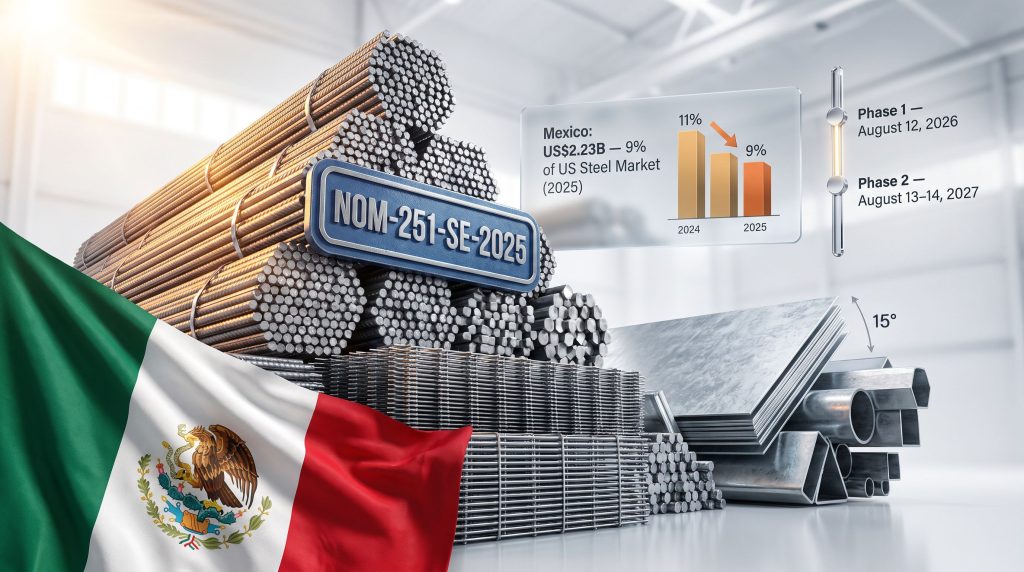
The standard covers 26 steel product categories in total, with implementation structured across two compliance phases to allow the market adequate preparation time.
Phase 1: August 12, 2026
The first phase targets the six reinforcing-steel product groups most commonly used in residential and standard infrastructure construction:
| Product Category | Phase | Effective Date |
|---|---|---|
| Standard rebar | Phase 1 | August 12, 2026 |
| Cold-rolled rebar | Phase 1 | August 12, 2026 |
| Low-alloy rebar | Phase 1 | August 12, 2026 |
| Welded wire mesh | Phase 1 | August 12, 2026 |
| Triangular steel trusses | Phase 1 | August 12, 2026 |
| Steel armatures for castles and lintels | Phase 1 | August 12, 2026 |
Critical Compliance Date: Phase 1 of NOM-251-SE-2025 takes effect on August 12, 2026. Any covered product sold, distributed, or imported after this date without a valid Product Certificate of Conformity constitutes a regulatory violation subject to administrative sanction.
Phase 2: August 13-14, 2027
The remaining 20 steel product families transition to mandatory certification under Phase 2, giving downstream-intensive sectors such as automotive manufacturing and large-scale infrastructure additional time to adapt procurement and supply chain processes. Phase 2 categories include:
- Structural tubing and hollow sections
- Steel plate and sheet products
- Galvanized sheet steel
- Structural profiles and beams
- Steel strands used in prestressed concrete
- Wire cables and related products
The two-phase structure is deliberate. Reinforcing steel products have the most direct link to residential building safety and are the most commonly counterfeited or downgraded category in the Mexican market. Addressing these products first reflects a risk-prioritized compliance sequence.
How NOM-251 Certification Works: A Step-by-Step Process
Step 1: Engage an Accredited Product Certification Body
All conformity assessments must be conducted through an officially accredited and approved Product Certification Body (OCP). The Ministry of Economy retains authority to act as certifier only in exceptional circumstances where no qualified OCP is accessible, which is expected to be rare in practice given Mexico's established accreditation infrastructure. Detailed guidance on mandatory certification requirements is available through specialist regulatory sources for companies requiring technical clarification.
Step 2: Laboratory Testing Against Mandatory Parameters
Products are submitted for testing in accredited laboratories against a defined set of verification criteria:
| Verification Criterion | What Is Assessed |
|---|---|
| Dimensional specifications | Physical measurements against defined tolerances |
| Unit weight | Weight per metre or per unit as applicable |
| Chemical composition | Alloy content and carbon equivalency thresholds |
| Mechanical properties | Tensile strength, yield strength, and elongation limits |
| Labeling compliance | Spanish-language identification and grade marking |
Step 3: Conformity Verification and Certificate Issuance
Sampling follows officially prescribed statistical protocols. When test results satisfy the technical thresholds defined within NOM-251-SE-2025, the OCP issues a Product Certificate of Conformity (CCP). This document is the legal authorisation for a product to be sold or imported within Mexico.
Step 4: Affixing the NOM Conformity Mark
Certified products must carry the official NOM conformity mark on all labeling and packaging. This mark serves as the primary compliance signal across the entire supply chain, enabling buyers, customs inspectors, and regulators to verify product status at a glance. Labeling must be in Spanish and include complete product identification data.
Step 5: Ongoing Enforcement Across Three Agencies
Enforcement authority is distributed across three distinct regulatory bodies, creating overlapping oversight coverage:
- SE (Ministry of Economy): Primary regulatory oversight and standard administration
- PROFECO (Federal Consumer Protection Agency): Market surveillance and consumer-facing enforcement
- Customs Authorities: Border-level verification of import compliance
Non-compliant products face administrative consequences including financial penalties, suspension of sales operations, physical immobilisation of stock, and mandatory market withdrawal.
Who Bears the Compliance Burden?
Domestic Steel Manufacturers
Producers must align quality systems, production documentation, and testing protocols with NOM-251 technical requirements. The major steelmakers who participated in the standard's formulation, including ArcelorMittal México, DEACERO, and Ternium México, enter the compliance period with a structural advantage: familiarity with the standard's precise technical thresholds. Smaller domestic producers face proportionally higher compliance costs relative to revenue, which may accelerate market consolidation over the medium term.
Importers and Foreign Steel Suppliers
All covered products must carry a valid CCP before entering Mexico, regardless of origin country. Foreign producers cannot rely on their home-country certifications as substitutes. They must either engage a Mexican-accredited OCP or establish a local certification pathway. Customs authorities function as the first enforcement checkpoint, meaning non-certified shipments face potential rejection at the border. Consequently, the tariff impacts on steel inputs compound the compliance costs already facing foreign suppliers.
Distributors and Construction Companies
Distributors bear verification responsibility for all stocked products before sale. Construction firms, particularly those working on infrastructure, housing, and public works contracts, must update procurement specifications to mandate NOM-251-certified materials. The regulatory liability for using non-certified steel does not sit exclusively with the original supplier: downstream parties who knowingly source or install non-compliant materials are also exposed.
Self-Build and Retail Consumers
The standard's reach extends to the retail level. Individuals purchasing steel directly for self-construction fall within the regulatory scope, meaning hardware retailers and building material suppliers must ensure all covered stock carries valid conformity marks.
Supply Chain Warning: The obligation to sell or distribute only certified products applies at every point in the chain. Once Phase 1 takes effect on August 12, 2026, there is no grace period for clearing legacy non-certified stock through the market.
NOM-251 vs. Previous NMX Standards: A Structural Comparison
| Dimension | Previous NMX Standards | NOM-251-SE-2025 |
|---|---|---|
| Legal status | Voluntary | Legally binding |
| Compliance verification | Self-declared | Third-party OCP certification required |
| Market access requirement | No certification needed | Valid CCP mandatory before sale or import |
| Oversight agencies | Limited | SE, PROFECO, and Customs |
| Sanctions for non-compliance | Minimal | Fines, suspension, immobilisation, withdrawal |
| Labeling requirements | Recommended | Mandatory (Spanish-language) |
| Product coverage | Fragmented by product type | 26 unified steel product categories |
The shift from recommended to required is not merely semantic. It fundamentally changes the incentive structure for every participant in the steel market. Under voluntary NMX standards, compliance was a cost with no competitive penalty for avoidance. Under NOM-251, non-compliance carries market exclusion as its consequence.
The next major ASX story will hit our subscribers first
Mexico NOM-251 Steel Certification Within the Broader Trade Context
Mexico's Declining US Steel Market Share
The timing of NOM-251's implementation coincides with a deteriorating export position for Mexican steel in the US market. According to US International Trade Commission (USITC) data, total US imports of iron and steel articles under HTS Chapter 73 reached US$22.85 billion in 2025. Canada held the largest supplier position at US$4.54 billion, representing 18% of total US imports. Mexico supplied US$2.23 billion, capturing 9% of the market, a decline from 11% in 2024.
This erosion reflects the compounding pressure of Section 232 tariff modifications. In April 2025, the US expanded Section 232 duties to apply to derivative products based on their embedded steel content value rather than raw steel alone. The US steel tariffs impact has been particularly pronounced for Mexican exporters, who saw their market share shrink considerably over a single year. A further June 2025 modification reduced the North American steel content threshold required for preferential treatment from 95% to 85%.
Temporary tariff relief through 2027 was established for specific industrial equipment categories. As the Congressional Research Service has noted, US domestic steel producers support these measures as investment stimulants, while downstream consumers in automotive and construction sectors report materially higher input costs as a result. Canada, meanwhile, maintains retaliatory tariffs on US$11.13 billion worth of US steel and aluminium goods, adding further complexity to the regional trade environment.
USMCA Negotiations and Mexico's Origin Framework Proposal
Steel tariffs have emerged as one of the most contested issues in Mexico's USMCA joint review participation. Mexico has proposed a framework modelled on the US-UK trade agreement structure, conditioning tariff-free market access on strict origin verification combined with melt-and-pour requirements. This approach is designed to restrict third-country steel transshipment through Mexico while preserving preferential access for producers using genuinely North American-sourced material.
GBM Chief Economist Miriam Acuña has argued that the USMCA renegotiation presents a clear opportunity to resolve the steel tariff dispute, noting that the United States does not carry a bilateral trade deficit with Mexico specifically in steel and aluminium. From her perspective, that asymmetry undermines the economic rationale typically used to justify Section 232 protectionist measures between the two countries.
NOM-251 as a Technical Trade Barrier
NOM-251 functions simultaneously as a domestic quality standard and as a technical barrier against low-cost, low-quality steel imports. By requiring third-party certification before market entry, the standard raises the minimum compliance cost for any foreign supplier seeking access to Mexico's construction sector. Nations with weaker production standards face a meaningful hurdle that did not exist under the previous voluntary framework.
This dimension of NOM-251 is strategically coherent with Mexico's USMCA negotiating position. The global steel outlook further illustrates how domestic regulatory rigour increasingly functions as a trade posture tool. Demonstrating this rigour strengthens Mexico's argument that Section 232 tariff concerns about transshipment and standards arbitrage are being addressed through internal policy mechanisms rather than purely through trade agreement concessions. However, shifts in the China steel market also add pressure, as surplus Chinese production continues to seek alternative export destinations, including Latin America.
Frequently Asked Questions About Mexico NOM-251 Steel Certification
What is NOM-251-SE-2025?
NOM-251-SE-2025 is an Official Mexican Standard published on February 13, 2026, that makes mandatory conformity certification a legal requirement for 26 categories of steel products used in construction and infrastructure. It replaces voluntary NMX compliance with a binding framework enforced by the Ministry of Economy, PROFECO, and customs authorities.
When does Phase 1 take effect?
Phase 1 takes effect on August 12, 2026, covering six reinforcing-steel product categories: standard rebar, cold-rolled rebar, low-alloy rebar, welded wire mesh, triangular steel trusses, and steel armatures for castles and lintels.
When does Phase 2 take effect?
Phase 2 takes effect on August 13-14, 2027, covering the remaining 20 steel product families including structural tubing, steel plate, galvanised sheet, structural profiles, steel strands, and cables.
What happens if products are sold without certification after the effective date?
Non-compliant products are subject to administrative sanctions including financial penalties, suspension of commercial operations, physical immobilisation of stock, and mandatory market withdrawal.
Do foreign exporters need to comply?
Yes. All covered steel products must carry a valid CCP before entering Mexico regardless of country of origin. Customs authorities enforce this requirement at the border. In addition, the Mexico steel import regulations framework from the US Department of Commerce provides further context for exporters navigating cross-border compliance.
Who issues the Product Certificate of Conformity?
The CCP is issued by an accredited and approved Product Certification Body (OCP). The Ministry of Economy may act as certifying authority only in exceptional circumstances where no qualified OCP is available.
Does the standard apply to retail and self-build purchases?
Yes. The regulation applies at all distribution and sale points, including retail transactions by individuals undertaking self-construction projects.
What NOM-251 Signals About Mexico's Industrial Regulatory Direction
Several broader conclusions emerge from examining Mexico NOM-251 steel certification in its full context:
- Mandatory third-party certification replaces voluntary self-declaration across 26 steel product categories, creating a unified and enforceable quality baseline for the first time
- The phased implementation timeline, with Phase 1 on August 12, 2026 and Phase 2 on August 13-14, 2027, reflects a risk-prioritised rollout that addresses the most safety-critical products first
- The full supply chain is within regulatory scope, from domestic manufacturers and importers through to distributors, construction firms, and retail consumers
- Three overlapping enforcement agencies, SE, PROFECO, and customs, close the compliance gaps that undermined previous voluntary frameworks
- Producers who participated in the standard's formulation enter the compliance period with an advantage that smaller or foreign competitors will need to work to overcome
- Mexico's declining US steel export share, from 11% in 2024 to 9% in 2025, provides strategic urgency to domestic quality reforms that can support the country's broader trade negotiating position
Disclaimer: This article is intended for informational purposes only and does not constitute legal, regulatory, or investment advice. Companies operating within Mexico's steel sector should seek independent legal counsel to assess their specific compliance obligations under NOM-251-SE-2025. Trade statistics and regulatory timelines are based on information available at the time of publication and may be subject to revision.
Want to Stay Ahead of Major Mineral Discoveries on the ASX?
Discovery Alert's proprietary Discovery IQ model delivers real-time alerts the moment significant mineral discoveries are announced on the ASX, turning complex data across more than 30 commodities into clear, actionable insights for traders and investors alike — explore historic discovery returns to understand the scale of opportunity, then begin your 14-day free trial at Discovery Alert to position yourself ahead of the broader market.