June 13, 2026
The consumo eléctrico minería cobre Chile landscape is undergoing an unprecedented energy transformation, where traditional electricity consumption patterns are being redefined by converging geological, technological and environmental factors. This evolution reflects an operational reality where energy intensity per tonne of processed ore systematically increases, regardless of advances in technological efficiency. In Chile, the world's leading copper producer, this trend acquires strategic dimensions that transcend the sectoral scope to impact national energy planning.
Furthermore, examining the latest copper market trends reveals how global supply constraints are intensifying energy demands across mining operations worldwide.
Structural Transformation: The New Energy-Production Equation in Chilean Mining
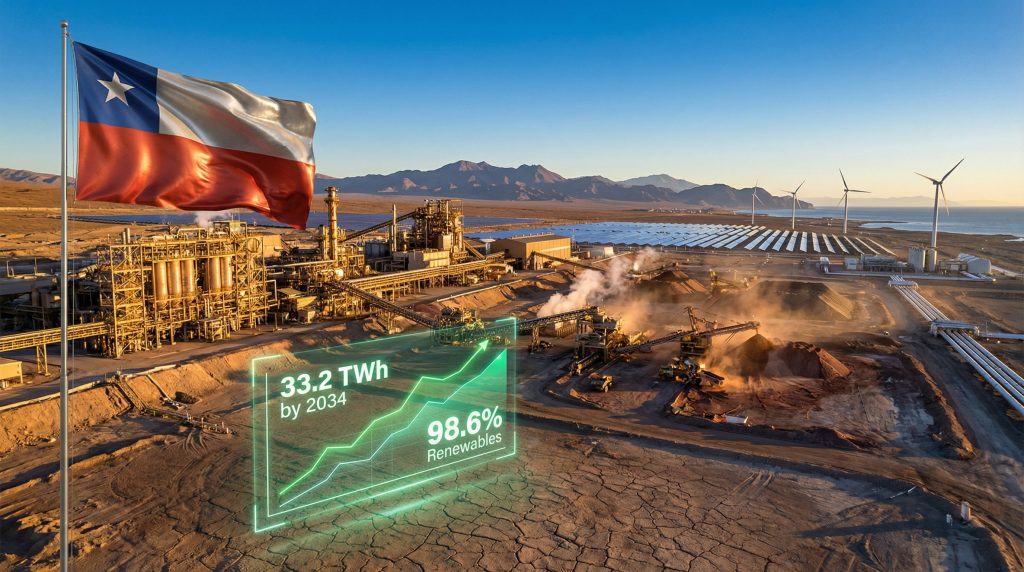
The projection of consumo eléctrico minería cobre Chile towards 2034 reveals a fundamental dislocation between energy and productive growth. According to Cochilco analysis, the sector's electricity consumption will scale from 27.6 TWh in 2025 to 33.2 TWh in 2034, representing a 20.2% increase, whilst copper production will grow only 8.3% in the same period.
This divergence illustrates a structural energy intensification that responds to multiple operational vectors:
-
Progressive depletion of high-grade deposits: Mature operations require processing increasing volumes of material to maintain stable production levels
-
Increasing mineralogical complexity: The shift towards sulphide deposits demands more energy-intensive concentration processes
-
Superior environmental requirements: Processing and waste disposal standards incorporate additional stages that increase electrical demand
-
Advanced recovery technologies: Modern processes maximise metallurgical recovery at the cost of higher unit energy consumption
Concentration Process Dominance
Concentration will consolidate its position as the dominant process in consumo eléctrico minería cobre Chile, scaling from the current 52% to a projected 55% by 2034. This 3 percentage point increase reflects the sectoral transition towards sulphide minerals, which require:
| Process | Energy Intensity | 2034 Participation |
|---|---|---|
| Flotation | 15-25 kWh/ton | 35% |
| Grinding | 12-18 kWh/ton | 15% |
| Thickening | 2-4 kWh/ton | 3% |
| Filtration | 1-3 kWh/ton | 2% |
Concentration will absorb approximately 18.3 TWh of the 33.2 TWh total projected, equivalent to the annual electricity consumption of a city of 2 million inhabitants.
Note: Projections are subject to variations based on the evolution of average ore grades and the incorporation of energy efficiency technologies.
When big ASX news breaks, our subscribers know first
Desalination and Seawater: The Fastest Growing Energy Vector
The use of seawater in mining operations will experience the most dynamic growth within consumo eléctrico minería cobre Chile, with a projected 60% expansion that will raise demand from 3.4 TWh currently to 5.4 TWh in 2034.
This exponential growth responds to severe water restrictions in northern producing regions, where continental water availability has systematically reduced during the last decade. Mining operations have identified desalination as the only viable alternative to guarantee long-term water sustainability.
Technical Analysis of Desalination Energy Consumption
The desalination and pumping process for mining operations in Chile demands between 5.5 and 8.0 kWh per cubic metre of processed water, broken down as follows:
Reverse Osmosis Desalination:
- Base consumption: 4.0-5.0 kWh/m³
- Pre-treatment: 0.5-1.0 kWh/m³
- Post-treatment: 0.3-0.7 kWh/m³
Coastal Pumping:
- Average elevation: 1,200-2,500 metres
- Typical distance: 15-80 kilometres
- Pumping consumption: 1.5-3.0 kWh/m³
Projecting the total volume of seawater required to reach 5.4 TWh consumption in 2034, operations will process approximately 830 million cubic metres annually, equivalent to the water consumption of a metropolis of 8 million inhabitants.
Regional Impact of Mining Desalination
The geographical concentration of desalination plants in the Antofagasta, Atacama and Coquimbo regions will generate additional pressure on regional electrical infrastructure:
Massive desalination for mining represents a paradigmatic shift in the electricity demand profile of northern Chile, requiring integrated planning between mining operators, generators and the national transmitter.
Risk warning: Desalination growth projections are subject to approval of new mining projects and availability of financing for water infrastructure.
Regional Distribution: Geographical Concentration and Transmission Challenges
The projection of consumo eléctrico minería cobre Chile towards 2034 maintains the historical geographical concentration in northern regions, with Antofagasta preserving its absolute leadership in demand, whilst Atacama and Coquimbo exhibit the highest relative growth rates.
Projected Distribution by Region
The development project portfolio suggests the following regional evolution:
Antofagasta:
- Maintains approximately 45-50% of national demand
- Concentrates the largest scale operations
- Houses the main expansion projects
Atacama:
- Relative growth exceeding 25%
- Incorporation of new greenfield projects
- Expansion of existing operations
Coquimbo:
- Activation of projects in development phase
- Growth from relatively small base
- Potential to double current demand
Transmission Infrastructure: Identified Bottlenecks
The 20.2% increase in consumo eléctrico minería cobre Chile will demand significant transmission investments, particularly in:
- 500 kV Lines: Coast-interior connection to evacuate renewable generation
- Transformation Substations: Adaptation to new demand levels
- Distribution Lines: Direct connection to remote mining operations
- Backup Systems: Operational continuity guarantee
The most critical congestion points are concentrated in corridors connecting coastal generation centres with interior mining operations, where Andean topography complicates infrastructure expansion.
Information limitation: Specific data on required transmission investment is not available in public sources and requires specialised technical analysis by the national transmission operator.
Energy Transition: Acceleration Towards Renewable Matrix
Chilean copper mining will experience an accelerated energy transformation, with projections of reaching 98.6% renewable electricity by 2030. This objective, significantly more ambitious than the national average, reflects corporate decarbonisation commitments and Chile's competitive advantages in renewable energies.
Renewable Transition Vectors
The increase from the current 85% renewable to 98.6% will be driven by:
Long-Term Contracts (PPAs):
- Typical duration: 15-25 years
- Prices: USD 25-35/MWh for solar projects
- Contracted volume: >20 TWh accumulated
Thermal Generation Retirement:
- Scheduled closure of coal plants
- Conversion of diesel plants to backup operation
- Gradual elimination of fuel oil
Enabling Technologies:
- Battery storage: 2-4 hours of autonomy
- Intelligent demand management: operational flexibility
- Green hydrogen: pilot applications in intensive processes
Variable Energy Integration Challenges
High renewable penetration in consumo eléctrico minería cobre Chile faces specific technical obstacles:
| Challenge | Impact | Technological Solution |
|---|---|---|
| Solar intermittency | 30-40% daily variation | Batteries + demand management |
| Wind variability | Seasonal fluctuation | Geographical diversification |
| Grid stability | Operational risk | Hybrid backup systems |
Mining, with its demand modulation capacity in certain processes, positions itself as a stability anchor for the renewable electrical system, providing flexibility that facilitates variable generation integration.
Economic Implications: Operational Cost Restructuring
The projected evolution of consumo eléctrico minería cobre Chile will redefine the operational cost structure (OPEX) of the sector, with electricity scaling its participation from the current 12-15% to a potential 18-22% of total operational costs by 2034.
Tariff Sensitivity Analysis
The economic impact of energy increase will be modulated by tariff evolution:
Base Scenario (Stable Tariffs):
- OPEX increase: 15-20% attributable to higher consumption
- Competitiveness: maintenance of global relative position
- Operating margin: marginal reduction 2-3%
Optimistic Scenario (Tariff Reduction):
- Benefit from renewable scale economies
- Potential reduction in unit electricity costs
- Improved international competitiveness
Pessimistic Scenario (Tariff Increase):
- Regulatory pressure or grid congestion
- Operating margin deterioration
- Need for accelerated energy efficiency
Energy Optimisation Strategies
Mining companies are implementing multiple efficiency vectors to mitigate the growth impact in consumo eléctrico minería cobre Chile:
-
Process Optimisation:
- High Pressure Grinding Rolls (HPGR): 10-15% consumption reduction
- Advanced process control: 3-5% efficiency improvement
- Waste heat recovery: energy utilisation
-
Disruptive Technologies:
- Microbubble flotation: lower energy consumption
- Sensor-based separation: efficient pre-concentration
- Artificial intelligence: predictive optimisation
-
Demand Management:
- Flexible operation according to renewable availability
- Thermal storage in industrial processes
- Coordination with national grid operator
In addition, industry leaders are studying mining electrification trends to identify further opportunities for energy optimisation and cost reduction.
Investment Perspectives: Opportunities in the Energy Value Chain
The projected growth in consumo eléctrico minería cobre Chile generates investment opportunities distributed throughout the energy value chain, with an estimated directional market of USD 8-12 billion during the 2025-2034 decade.
Highest Potential Sectors
Dedicated Renewable Generation:
- Incremental demand: 5.6 TWh towards 2034
- Required investment: USD 3-4 billion
- Priority technologies: Solar PV, wind, storage
Transmission Infrastructure:
- Grid expansion in northern Chile
- Estimated investment: USD 1.5-2.5 billion
- Critical lines: coast-interior, regional interconnection
Efficiency Technologies:
- Retrofit and optimisation market
- Market opportunity: USD 800 million-1.2 billion
- Segments: process control, efficient equipment
Desalination and Water Infrastructure:
- Industrial desalination plants
- High-capacity pumping systems
- Sectoral investment: USD 2-3 billion
Investment Risk Analysis
Opportunities in consumo eléctrico minería cobre Chile face multiple risk vectors:
Regulatory Risk: Changes in energy, environmental or tax policy may alter investment fundamentals in 15-20 year horizons typical of energy infrastructure.
Identified Specific Risks:
- Technological: Accelerated obsolescence through disruptive innovation
- Market: Volatility in energy and metallic commodity prices
- Operational: Demand intermittency due to mining maintenance cycles
- Environmental: Additional restrictions on resource use or emissions
For investors seeking comprehensive guidance, current copper investment insights provide valuable context for understanding market dynamics and investment timing considerations.
Investment Evaluation Framework
Investors in the mining energy ecosystem require specific analysis frameworks:
| Metric | Acceptable Range | Observations |
|---|---|---|
| LCOE (Levelised Cost) | USD 25-40/MWh | Variable by technology |
| Capacity Factor | >35% renewables | Critical for viability |
| Contract Duration | 15-25 years | Cash flow stability |
| Credit Rating | BBB+ or higher | Counterparty risk |
Investment warning: Electricity consumption growth projections are subject to materialisation of announced mining projects and copper price evolution in global markets.
The next major ASX story will hit our subscribers first
Strategic Conclusions: Navigating the New Mining Energy Era
The transformation of consumo eléctrico minería cobre Chile towards 2034 represents a convergence of structural forces that will redefine the sector's operation, competitiveness and sustainability. The projected 20.2% increase transcends simple quantitative growth to constitute a qualitative reconfiguration of the industry.
Furthermore, understanding broader renewable energy strategies becomes essential for miners looking to optimise their energy portfolios whilst maintaining operational flexibility.
Critical Success Factors for the Sector
Integrated Planning:
- Strategic coordination between miners, generators, transmitter and regulators
- Synchronisation of investments in generation and transmission capacity
- Development of flexibility markets and auxiliary services
Continuous Technological Innovation:
- Accelerated adoption of energy efficiency technologies
- Integration of intelligent demand management systems
- Development of local capabilities in critical technologies
Financial Sustainability:
- Structuring long-term financing models
- Diversification of energy and operational risks
- Development of hedging instruments for energy volatility
Stakeholder Recommendations
For Mining Companies:
- Integral Energy Strategy: Development of 20-year energy roadmaps aligned with production planning
- Diversified Supply Contracts: Combination of renewable PPAs, spot contracts and self-generation
- Efficiency Investment: Systematic optimisation programmes with ROI exceeding 15%
For Investors:
- Complete Value Chain Focus: Opportunities from generation to final efficiency technologies
- Country-Specific Risk Analysis: Consideration of Chilean regulatory stability as competitive advantage
- Extended Investment Horizon: 15-25 year structures to capture energy transition value
For Regulators:
- Predictable Regulatory Framework: Long-term signals to facilitate private investment
- Interinstitutional Coordination: Alignment between energy, mining and environmental policy
- Efficiency Incentives: Instruments that promote energy consumption optimisation
The success of this transformation aligns with broader energy transition security objectives, positioning Chile as a leader in responsible critical mineral supply.
Long-Term Perspective
The evolution of consumo eléctrico minería cobre Chile constitutes a global laboratory for industrial energy transition, where the combination of abundant renewable resources, sophisticated mining industry and stable regulatory framework positions the country as a world reference in sustainable mining.
The success of this transformation will determine not only the future competitiveness of the Chilean mining sector, but also its capacity to contribute positively to national decarbonisation and sustainable development objectives, consolidating the country's leadership in responsible supply of critical materials for global energy transition.
Additionally, insights from Chile's latest energy consumption report provide essential data supporting these projections and highlight the sector's commitment to transparency in energy planning.
| Key Indicator 2034 | Projection | Strategic Impact |
|---|---|---|
| Total Consumption | 33.2 TWh | +20.2% vs 2025 |
| Renewable Share | 98.6% | Global sectoral leader |
| Seawater | 5.4 TWh | +60% hybrid demand |
| Energy Intensity | +11% vs production | New operational reality |
Recent analyses from Cochilco's energy projection studies confirm these trends and provide additional validation for the energy transformation pathway outlined in this assessment.
Methodological note: Projections are based on Cochilco studies and require periodic updating based on the evolution of macroeconomic, technological and regulatory variables.
Looking to capitalise on Chile's energy-driven mining transformation?
Discovery Alert's proprietary Discovery IQ model delivers real-time alerts on significant ASX mineral discoveries, instantly empowering subscribers to identify actionable opportunities ahead of the broader market. Begin your 14-day free trial today and secure your market-leading advantage whilst the global energy transition reshapes mining operations worldwide.