May 21, 2026
Continental Gas Resources Positioning Africa's Strategic Energy Advantage
The global liquefied natural gas landscape faces unprecedented transformation as traditional supply chains encounter mounting disruption. While conventional energy corridors grapple with geopolitical volatility, a fundamental shift toward geographic diversification has accelerated institutional buyer preferences for alternative sourcing strategies. This structural realignment reveals how Africa's rise in LNG exports represents more than cyclical market adjustments, instead signaling a permanent reconfiguration of international energy security frameworks.
Strategic positioning analysis indicates African producers now occupy uniquely advantageous market positions due to their isolation from conflict-prone transit routes. This geographic insulation delivers measurable operational benefits including reduced insurance premiums, predictable delivery schedules, and enhanced supply chain reliability compared to traditional Middle Eastern alternatives.
When big ASX news breaks, our subscribers know first
Strategic Market Position Through Reserve Assessment and Production Analysis
Continental Gas Reserve Distribution and Utilization Metrics
African energy infrastructure encompasses substantial untapped potential across diverse geological formations. Nigeria alone maintains proven gas reserves exceeding 200 trillion cubic feet, representing a cornerstone of continental production capacity that remains significantly underutilised relative to global consumption patterns.
Current production utilisation rates demonstrate substantial expansion opportunities across multiple regional corridors. The continent's proven reserves support aggressive capacity development programmes, with Sub-Saharan African LNG exports projected to increase by 175% by 2034, rising from 30.9 billion cubic metres in 2024 to 44.5 billion cubic metres according to industry analysis.
Regional distribution patterns reveal concentrated development potential across East and West African corridors:
- Nigeria: 200+ trillion cubic feet proven reserves
- Major producing nations: Libya, Angola, Gabon, Mozambique, Namibia, Tanzania
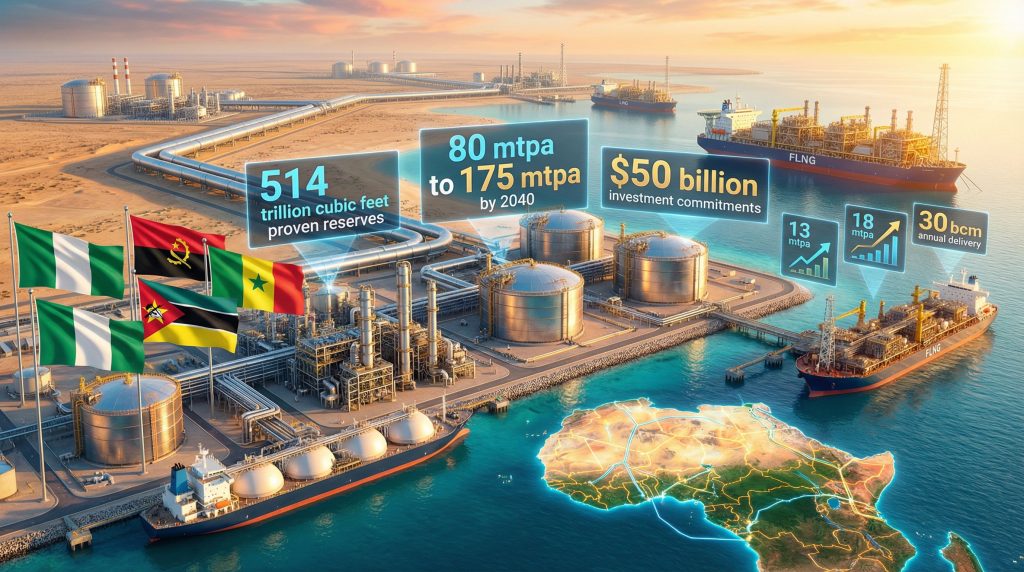
- Export capacity trajectory: 80 million tons per year (2025) to 175+ million tons per year (2040)
- Growth acceleration zones: Mozambique, Nigeria, Angola, Equatorial Guinea, Cameroon
Market Share Evolution and Capacity Expansion Timeline
Continental LNG export capacity demonstrates remarkable growth trajectories driven by mega-project infrastructure development. The continent's total LNG export capacity projects expansion from approximately 80 million tons per year in 2025 to over 175 million tons per year by 2040, positioning Africa as a critical global LNG supplier.
This capacity doubling reflects coordinated investment strategies across multiple national jurisdictions, with particular emphasis on floating liquefied natural gas technology deployment for stranded gas monetisation. Sub-Saharan growth projections indicate accelerating market penetration as regional producers transition from domestic supply priorities to export-oriented development frameworks.
Investment flow patterns reveal sustained multinational commitment to African LNG infrastructure, with over $50 billion in confirmed project financing targeting Mozambique, Nigeria, Senegal, and Tanzania through 2030. This capital deployment supports both onshore liquefaction facilities and offshore floating platforms designed to maximise operational flexibility.
Infrastructure Mega-Projects Driving Export Capacity Expansion
East African LNG Development Corridor
Mozambique's Rovuma Basin represents the epicentre of East African LNG development, hosting multiple world-class projects with combined capacity exceeding 35 million tons per year. TotalEnergies' $20 billion Afungi project officially restarted following a five-year suspension due to security issues, with over 13 million tons per year capacity scheduled for 2029 production commencement.
The project restart signals improved operating conditions and demonstrates international confidence in Mozambique's long-term stability. Furthermore, security improvements enabled force majeure lifting across regional developments, facilitating accelerated investment decision timelines.
Eni's Coral field development employs innovative floating liquefied natural gas technology to monetise offshore reserves through modular production systems. Coral South FLNG achieved production in 2022 with 3.4 million tons per year capacity, while Coral North received final investment decision approval in 2025 for 3.5 million tons per year additional capacity targeting 2028 operations.
ExxonMobil leads the $30 billion Rovuma LNG onshore development featuring 18 million tons per year total capacity through integrated liquefaction trains fed by offshore gas fields. The project partnership includes:
- ExxonMobil: 25% operating stake
- Eni: 25% development partner
- China National Petroleum Corporation: 20% strategic investor
- Korea Gas Corporation: 10% supply agreement partner
- Abu Dhabi National Oil Company: 20% financing participant
Production timeline targets 2030-2031 operational commencement following current-year final investment decision execution. Recent force majeure lifting demonstrates security condition improvements enabling project advancement.
West African Pipeline and Export Networks
Nigeria's Trans-Saharan Gas Pipeline represents a $20 billion infrastructure transformation designed to deliver Nigerian gas through Niger and Algeria to European markets. The 4,128-kilometre corridor aims to transport 30 billion cubic metres annually by 2027, providing critical diversification away from Russian energy supplies.
Construction progress indicates approximately 60% completion across the total pipeline length, with 2,400 kilometres complete or advanced primarily within Nigerian and Algerian territories. Algeria's state energy giant Sonatrach leads construction and technical oversight following diplomatic resolution between Algeria and Niger in March 2026.
The project transition from decades-long planning to active construction reflects Europe's urgent diversification requirements following geopolitical disruptions. However, beyond immediate energy delivery, the Trans-Saharan Gas Pipeline facilitates broader West-to-North Africa economic integration while monetising Nigeria's 200+ trillion cubic feet gas reserves.
Pipeline completion supports regional economic development through:
- Direct European market access reducing transportation costs
- Regional integration connecting West and North African economies
- Domestic gas utilisation supporting Nigerian industrial development
- Strategic positioning as Russian alternative energy source
Global Supply Disruption Impact Accelerating African Demand
European Diversification Strategy Beyond Russian Dependence
European Union gas import transformation demonstrates radical supply chain restructuring following geopolitical realignment. Imports declined from roughly 155 billion cubic metres in 2021 to an estimated 30 billion cubic metres per year in 2025, representing an 80% reduction in Russian gas dependence.
Russian gas currently accounts for approximately 13% of EU imports through a combination of pipeline deliveries to Hungary and Slovakia alongside LNG shipments to Belgium, France, and other European destinations. Consequently, this dramatic supply reduction created substantial market opportunities for African producers positioned to offer reliable alternative volumes.
African energy producers gained distinctive structural advantages through geographic isolation from conflict zones affecting traditional supply routes. European and Asian buyers increasingly favour African volumes due to measurably lower insurance premiums and enhanced delivery predictability compared to shipments transiting high-risk corridors including the Strait of Hormuz and Red Sea passages.
The natural gas trends indicate continued volatility in global markets, while the US natural gas forecast suggests sustained demand for alternative suppliers.
Asian Market Penetration and Strategic Investment Flows
Asian energy security strategies increasingly incorporate African LNG supplies as portfolio diversification measures against Middle Eastern supply disruptions. Japanese and Korean energy companies maintain strategic stakes in major African projects, ensuring long-term supply access while supporting regional development objectives.
Chinese participation through China National Petroleum Corporation's 20% Rovuma LNG stake demonstrates strategic positioning within African energy infrastructure. Korean Gas Corporation's 10% Rovuma involvement similarly reflects Asian commitment to African LNG development as supply security enhancement.
Investment commitments exceeding $50 billion target capacity expansion across Mozambique, Nigeria, Senegal, and Tanzania, with particular focus on 2026-2030 delivery timelines. This capital deployment supports both immediate production targets and long-term supply agreement frameworks.
Regional Conflict Impact on Supply Chain Risk Assessment
Middle Eastern supply route disruptions affecting approximately 8 million barrels per day of oil and 20% of global LNG supply elevated African producers' comparative risk profiles. Geographic isolation provides measurable operational advantages through:
- Route independence from Strait of Hormuz and Red Sea transit risks
- Insurance cost reduction due to lower geopolitical exposure
- Delivery reliability enhanced by stable shipping corridors
- Contract security improved through predictable operational conditions
These structural advantages position African suppliers as preferred partners for European and Asian buyers prioritising supply chain resilience over purely cost-based procurement strategies. In addition, the US-China trade war impacts and OPEC production impact further complicate traditional energy partnerships.
Production Milestone Timeline Defining Export Growth Trajectory
Near-Term Capacity Additions Through 2028
Immediate capacity additions focus on completing construction phases for projects approaching operational readiness. Senegal's domestic gas supply targets 35 million standard cubic feet per day delivery to power sector applications, supporting both energy security and economic development objectives.
Coral North FLNG final investment decision implementation proceeds toward 2028 production targets, adding 3.5 million tons per year to Mozambique's export capacity. Nigeria's expanded LNG infrastructure development includes additional floating facility completion designed to monetise previously stranded gas resources.
Angola's non-associated gas field expansion programmes target increased production volumes supporting both domestic consumption and export opportunities. These developments collectively represent over 15 million tons per year additional capacity through 2028.
Medium-Term Infrastructure Completion Through 2035
TotalEnergies Afungi facility achievement of full 13 million tons per year production capacity anchors medium-term African export growth, with 2029 operational commencement supporting long-term supply agreement fulfilment. The Trans-Saharan Pipeline's 30 billion cubic metres annual delivery capacity provides direct European market access by 2027.
Rovuma LNG onshore trains operational phase targets 18 million tons per year production through integrated offshore-to-onshore processing systems. Continental gas production projections indicate achievement of 331 billion cubic metres annual output supporting both domestic requirements and export commitments.
These capacity additions establish Africa's rise in LNG exports as a major global supplier capability of meeting sustained European and Asian demand growth while supporting regional energy security objectives.
Long-Term Market Positioning Through 2050
Sub-Saharan LNG supply quadrupling projections reflect sustained infrastructure investment and technological advancement in floating production systems. North African production share evolution from 66% to 40% of continental output demonstrates geographic diversification across traditional and emerging producer regions.
West and East African output acceleration phases target coordinated development maximising regional integration benefits while serving international export markets. Domestic demand growth from 55 to 90 billion cubic metres represents a 60% increase, requiring balanced development strategies serving both local consumption and export revenue optimisation.
Long-term positioning strategies emphasise:
- Technology deployment maximising recovery from stranded gas resources
- Infrastructure integration connecting regional markets through pipeline networks
- Capacity optimisation balancing domestic energy security with export revenues
- Environmental compliance meeting international sustainability standards
Economic and Strategic Factors Supporting Sustained Growth
Investment Climate and International Financial Backing
Multinational energy corporation commitments demonstrate sustained confidence in African LNG development potential. Abu Dhabi National Oil Company's 20% Rovuma LNG stake represents strategic Middle Eastern investment in African energy infrastructure, facilitating technology transfer and operational expertise sharing.
TotalEnergies, ExxonMobil, and Eni maintain substantial African portfolios supporting both current production and future capacity expansion programmes. Natural gas industry 4.5% compound annual growth rate projections through 2034 provide fundamental demand growth supporting African export development.
Modular floating liquefied natural gas technology adoption enables economically viable development of previously stranded gas reserves through reduced infrastructure requirements. This technological advancement particularly benefits offshore African fields lacking pipeline connectivity to onshore processing facilities.
Domestic Energy Security and Industrial Development Balance
African energy planning increasingly emphasises balanced development serving domestic consumption requirements alongside export revenue generation. Gas-powered electricity generation averages 40% across continental markets, with North African utilisation reaching 32% of total power generation.
Energy security priorities require careful optimisation between export revenue maximisation and domestic supply reliability. Industrial development catalyst potential through reliable gas supply supports broader economic development objectives while generating employment and technology transfer benefits.
Infrastructure gap solutions through pipeline and terminal expansion enable both domestic market service and export capacity development through shared infrastructure utilisation. Regional integration through cross-border projects facilitates economic development while optimising resource utilisation efficiency.
Global LNG Market Dynamics and Competitive Positioning
Record global LNG supply reaching 42.39 million tonnes in January 2026 with 15% year-over-year growth creates competitive market conditions requiring cost-effective production and delivery strategies. Approximately 93 million tons per year of new capacity entering 2025-2026 generates oversupply conditions from 2026.
Oversupply market dynamics create opportunities for African projects featuring competitive cost structures and reliable delivery capabilities. Geographic advantages including reduced transportation distances to European markets enhance African producers' competitive positioning.
Furthermore, tariffs impact markets affecting global energy trade patterns, potentially benefiting African suppliers positioned advantageously for market access.
Market positioning strategies emphasise:
- Cost competitiveness through efficient production and transportation systems
- Delivery reliability enhanced by geographic advantages and stable operating conditions
- Supply security through diversified production sources and flexible delivery options
- Long-term partnerships supporting sustained market penetration and revenue optimisation
The next major ASX story will hit our subscribers first
Strategic Challenges and Development Opportunities
Technical Implementation and Operational Excellence
Stranded gas utilisation strategies require innovative technology deployment maximising recovery from geographically isolated reserves. Floating liquefied natural gas versus onshore liquefaction technology selection depends on specific field characteristics, water depths, and infrastructure connectivity considerations.
Security improvements in key production regions demonstrate successful risk mitigation enabling project advancement. Mozambique's experience provides templates for managing operational risks while maintaining international investment confidence and production continuity.
Force majeure risk mitigation requires comprehensive planning addressing security, environmental, and operational contingencies. Project continuity planning incorporates redundant systems and alternative operational scenarios ensuring supply agreement compliance regardless of localised disruptions.
For instance, unlocking Africa's LNG potential requires strategic infrastructure development across multiple countries.
Market Access and Distribution Network Optimisation
Pipeline connectivity to European and Asian markets requires coordinated infrastructure development spanning multiple national jurisdictions. Terminal capacity expansion requirements demand substantial capital investment supported by long-term supply agreements and financing commitments.
Regional integration through cross-border projects facilitates shared infrastructure costs while expanding market access opportunities. Transportation cost optimisation strategies focus on efficient routing and scheduling maximising delivered value while maintaining competitive pricing structures.
Distribution network development emphasises:
- Multi-modal connectivity integrating pipeline, shipping, and rail transportation
- Storage capacity providing operational flexibility and supply security
- Processing efficiency minimising costs while maintaining quality standards
- Market responsiveness adapting to demand variations and pricing dynamics
Regulatory Framework and Policy Development Evolution
Government revenue sharing and local content requirements balance international investment attraction with domestic benefit maximisation. Regulatory frameworks increasingly emphasise transparent, predictable policies supporting long-term investment planning while ensuring equitable resource benefit distribution.
Environmental impact management and sustainability standards alignment with international best practices supports market access and financing availability. Regional cooperation agreements for pipeline projects facilitate coordinated development while addressing cross-border regulatory coordination requirements.
Investment protection and stability mechanisms provide confidence for substantial capital commitments required for LNG infrastructure development. Legal frameworks increasingly incorporate international arbitration and dispute resolution mechanisms supporting investor confidence and project financing availability.
However, Africa's rise in LNG exports faces regulatory challenges requiring coordinated approaches. Africa's LNG expansion unlocking $375 billion demonstrates the continent's tremendous potential through strategic policy implementation.
This analysis is based on publicly available industry data and should not be considered investment advice. Readers should conduct independent research and consult qualified professionals before making investment decisions. Energy market developments involve substantial risks including regulatory changes, technological developments, and market volatility that may significantly impact project outcomes and investment returns.
Ready to Invest in the Next Energy Revolution?
Discovery Alert's proprietary Discovery IQ model delivers real-time alerts on significant ASX mineral discoveries, including emerging energy commodities, instantly empowering subscribers to identify actionable opportunities ahead of the broader market. Begin your 14-day free trial today and secure your market-leading advantage whilst positioning yourself at the forefront of the next major discovery.