
June 12, 2026
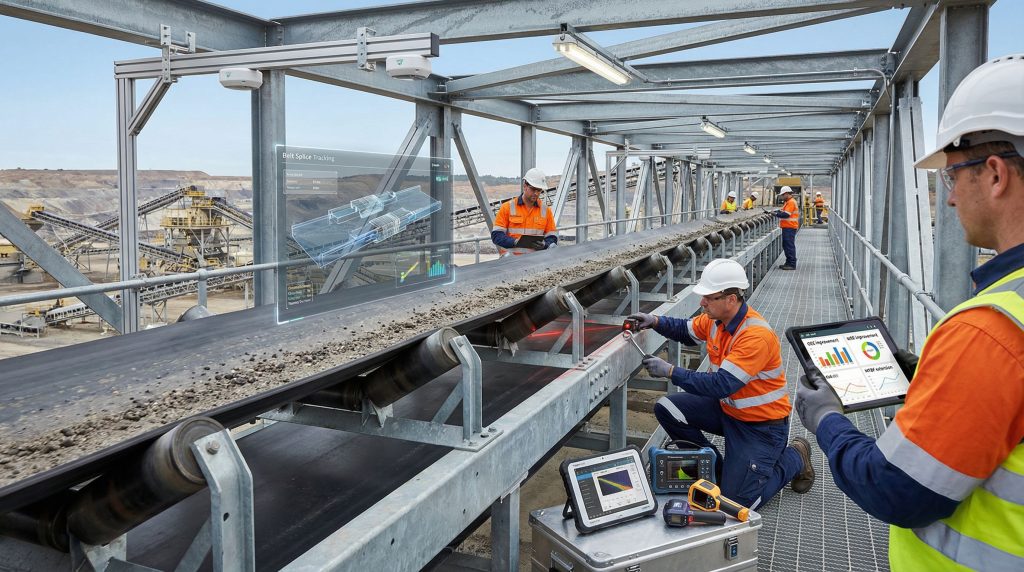
Industrial conveyor belt maintenance represents one of the most critical aspects of modern mining operations, serving as the backbone for material handling systems that transport millions of tonnes of ore across vast distances. These industrial workhorses operate under extreme conditions, facing abrasive materials, temperature fluctuations, and continuous mechanical stress that can rapidly deteriorate system performance. Furthermore, understanding the fundamental principles behind effective conveyor belt maintenance requires examining the complex interplay between mechanical engineering, operational dynamics, and predictive analytics that collectively determine system reliability.
Understanding the Foundation of Industrial Conveyor Belt Systems
Industrial conveyor belt maintenance encompasses far more than periodic inspections and component replacements. However, the complexity of these systems demands a comprehensive understanding of how individual components interact under operational stress. Belt structures consist of multiple layers, each serving specific functions from load bearing to surface protection, while drive mechanisms must synchronise perfectly to prevent catastrophic failures.
Critical Component Analysis and Monitoring
Belt construction involves sophisticated materials engineering, with cover compounds formulated to resist specific types of wear based on material characteristics. Rubber compounds containing specialised additives protect against oil, heat, and chemical exposure, while textile or steel cord carcasses provide tensile strength. The integrity of mechanical splices becomes particularly critical under heavy load conditions, where improper installation can lead to catastrophic belt failure.
Drive system components operate under significant mechanical stress, with electric motors typically ranging from 50 to 500 horsepower for major mining conveyors. For instance, drive system optimization has become increasingly important as operations seek to maximise efficiency. Gearbox systems must handle torque multiplication while maintaining precise speed control, often utilising helical or planetary gear configurations.
Coupling systems accommodate minor misalignments while transmitting power, though excessive misalignment can generate destructive vibrations throughout the entire system. Moreover, support infrastructure represents the foundation upon which reliable operation depends. Idler systems must be precisely positioned to maintain proper belt tracking, with carrying idlers typically spaced at 1.2 to 1.5-metre intervals depending on belt width and load characteristics.
Return idlers operate under different stress conditions but remain equally critical for preventing belt damage and material spillage. Additionally, modern mining operations increasingly rely on data-driven operations to monitor these critical components continuously.
Material Handling Impact Assessment
Different ore types create distinct wear patterns that influence maintenance scheduling. Abrasive materials like iron ore and copper concentrate generate predictable wear patterns on belt surfaces, while sticky materials such as coal and certain clay-based ores create different challenges related to material buildup and cleaning system effectiveness.
Key material characteristics affecting maintenance requirements:
- Particle size distribution – larger particles create point loading stresses
- Moisture content – affects material adhesion and cleaning effectiveness
- Chemical composition – determines corrosion potential and belt material compatibility
- Temperature variations – influence belt elasticity and dimensional stability
Load distribution across belt width significantly impacts system longevity. Uneven loading creates differential wear patterns and can induce tracking problems that compound over time. In addition, advanced loading systems incorporate flow control mechanisms to ensure consistent material distribution, though these systems require their own maintenance protocols.
When big ASX news breaks, our subscribers know first
Establishing Systematic Preventive Maintenance Protocols
Effective conveyor belt maintenance relies on structured inspection schedules that identify potential problems before they escalate into costly failures. Research indicates that properly implemented preventive maintenance can extend belt life by 40-60% while reducing unplanned downtime by similar margins.
Frequency-Based Inspection Framework
| Maintenance Level | Frequency | Key Activities | Personnel Required | Typical Duration |
|---|---|---|---|---|
| Operational | Daily | Visual inspection, debris clearing, tracking verification | Equipment operators | 15-30 minutes |
| Preventive | Weekly | Lubrication, detailed cleaning, safety system testing | Maintenance technicians | 2-4 hours |
| Predictive | Monthly | Vibration analysis, thermal imaging, belt measurement | Specialised teams | 4-8 hours |
| Comprehensive | Quarterly | Complete system analysis, alignment verification | Engineering support | 8-16 hours |
| Major Overhaul | Annual | Drive system rebuild, belt replacement planning | Full maintenance crew | 2-5 days |
Daily operational inspections focus on immediate safety concerns and obvious performance issues. Operators trained in conveyor fundamentals can identify material spillage, unusual noises, and tracking deviations that require immediate attention. These inspections typically reveal approximately 70% of potential problems before they require emergency intervention.
Advanced Condition Monitoring Technologies
Modern predictive maintenance incorporates sophisticated monitoring systems that provide continuous assessment of critical parameters. Vibration analysis using accelerometers mounted on bearing housings can detect developing problems 6-8 weeks before failure occurs. Frequency analysis reveals specific fault signatures associated with bearing wear, belt splice problems, and drive system misalignment.
Thermal imaging technology identifies heat patterns that indicate impending failures in electrical systems, bearing assemblies, and belt splice joints. Temperature differentials exceeding 10°C compared to baseline measurements typically warrant immediate investigation. Furthermore, advanced thermal cameras can detect hot spots while conveyors operate, minimising inspection downtime.
Ultrasonic belt thickness measurement provides quantitative data on wear progression:
- New belt baseline measurements establish reference points
- Monthly thickness monitoring tracks wear rates across belt width
- Critical thickness thresholds trigger replacement planning
- Wear pattern analysis identifies loading or alignment problems
Belt tracking systems utilise laser technology to continuously monitor belt position relative to centreline. Deviations exceeding ±25mm from centreline typically indicate adjustment requirements, while persistent tracking problems suggest structural issues requiring comprehensive analysis.
Critical Maintenance Procedures for System Optimisation
Systematic maintenance procedures address the most common failure modes while optimising system performance. Industry data indicates that improper maintenance procedures account for approximately 35% of premature conveyor belt failures, emphasising the importance of standardised protocols.
Belt Alignment and Tracking Optimisation
Belt tracking problems manifest through multiple symptoms including material spillage, edge wear, and structural damage to support components. Proper tracking adjustment requires understanding the relationship between belt tension, pulley crown configuration, and loading point design. Conveyor belt maintenance and cleaning strategies have evolved significantly to address these challenges.
Crown pulley specifications typically include:
- Crown height of 6-12mm for standard mining applications
- Gradual taper angle to prevent belt edge damage
- Surface finish requirements to optimise belt contact
- Diameter tolerances within ±3mm to prevent tracking issues
Idler adjustment procedures involve systematic evaluation of roller alignment using precision instruments. Laser alignment systems can detect angular deviations as small as 0.1 degrees, which may seem insignificant but can create substantial tracking forces over long conveyor distances. Training belt systems require particular attention to impact point design and material flow characteristics.
Drive System Maintenance Excellence
Electric motor performance diagnostics involve comprehensive analysis of electrical parameters, mechanical vibration, and thermal characteristics. Motor efficiency typically decreases 2-5% before other failure symptoms become apparent, making electrical monitoring particularly valuable for predictive maintenance programmes.
Gearbox maintenance protocols centre on oil analysis programmes that reveal wear patterns, contamination levels, and chemical degradation. Oil samples analysed at 500-1000 hour intervals provide trending data that enables planned maintenance rather than reactive repairs. Particle contamination analysis identifies specific component wear, while viscosity changes indicate thermal stress or chemical degradation.
Professional maintenance programmes demonstrate that systematic gearbox oil analysis can extend component life by 200-300% compared to time-based replacement schedules.
Coupling alignment verification requires precision measurement tools capable of detecting misalignment within 0.05mm parallel offset and 0.1 degrees angular deviation. These tolerances may appear excessive, but coupling misalignment creates forces that propagate throughout the drive train, causing premature bearing failure and excessive energy consumption.
Cleaning System Effectiveness Optimisation
Belt cleaning systems represent the front line of defence against material carryback and system contamination. Primary cleaners typically remove 85-90% of material adhering to belt surfaces, while secondary cleaners address residual contamination. Cleaning effectiveness directly impacts belt life, material spillage, and overall system cleanliness.
Primary cleaner positioning specifications:
- Blade contact angle between 15-45 degrees relative to belt surface
- Contact pressure sufficient for material removal without excessive belt wear
- Positioning within 150-300mm of head pulley discharge point
- Blade material selection based on belt surface characteristics
Secondary cleaner maintenance involves regular blade inspection and replacement scheduling. Polyurethane blades typically provide 2000-4000 hours of service life under normal conditions, though abrasive materials may reduce this significantly. Consequently, carbide-tipped blades offer extended life but require careful handling during installation and adjustment procedures.
Systematic Problem Diagnosis and Resolution
Effective troubleshooting requires structured diagnostic approaches that identify root causes rather than addressing symptoms. Industry experience demonstrates that systematic problem analysis reduces recurring failures by approximately 60% compared to reactive repair approaches.
Comprehensive Diagnostic Methodology
Root cause analysis follows established protocols:
- Symptom documentation – detailed recording of performance deviations
- Historical data review – analysis of previous maintenance records and failure patterns
- Physical inspection – systematic examination of all related components
- Performance measurement – quantitative assessment of system parameters
- Solution development – engineering analysis and repair planning
- Implementation verification – confirmation of problem resolution
Fishbone diagrams provide structured frameworks for identifying potential causes across multiple categories including mechanical, electrical, operational, and environmental factors. This systematic approach prevents overlooking subtle contributing factors that may not be immediately obvious during initial problem assessment.
Advanced Diagnostic Technologies
Laser alignment systems enable precision measurement of conveyor geometry with accuracies approaching ±1mm over distances exceeding 1000 metres. These systems identify subtle structural problems that traditional measurement methods cannot detect, particularly important for long-distance mining conveyors where small deviations compound over distance.
Acoustic monitoring technology analyses sound signatures to identify developing mechanical problems. Bearing failure signatures typically appear 4-6 weeks before traditional vibration analysis methods detect problems. High-frequency acoustic emissions can identify lubrication problems, contamination ingress, and early-stage component wear.
Belt tension measurement requires specialised equipment capable of:
- Non-contact measurement while conveyors operate
- Accuracy within ±5% of actual tension values
- Multiple measurement points across belt width
- Data logging capability for trend analysis
Splice integrity testing involves both visual inspection and specialised testing equipment. Ultrasonic testing can detect internal splice defects, while pull testing verifies splice strength. Properly executed mechanical splices should achieve 85-90% of original belt strength, though this requires precise installation procedures and appropriate fastener selection.
Essential Safety Protocols During Maintenance Operations
Conveyor belt maintenance involves significant safety risks requiring comprehensive protocols and specialised training. Industry statistics indicate that conveyor-related injuries account for approximately 25% of mining equipment accidents, emphasising the critical importance of systematic safety procedures. The integration of safety boosting operations has become increasingly vital across the industry.
Lockout/Tagout (LOTO) Implementation
Energy isolation procedures must address multiple energy sources including electrical power, stored mechanical energy in tensioning systems, and gravitational forces from elevated components. Comprehensive LOTO procedures typically involve 8-12 distinct isolation points for major mining conveyors, each requiring verification before maintenance begins.
Critical energy isolation points include:
- Primary electrical disconnect with circuit breaker lockout
- Control system isolation to prevent inadvertent startup
- Emergency stop circuit verification throughout conveyor length
- Belt tensioning system energy dissipation procedures
- Auxiliary equipment shutdown including cleaners and transfer points
Group lockout procedures become essential when multiple technicians work simultaneously on different conveyor sections. Each worker must apply individual locks to a common lockout device, ensuring no single person can restore energy without group consensus. Emergency response protocols must account for medical evacuation procedures from elevated or confined spaces.
Working at Height Safety Requirements
Elevated conveyor maintenance requires fall protection systems designed for industrial environments. Fall arrest systems must limit fall distances to less than 1.8 metres while accounting for system stretch and safety factor requirements. Personal fall arrest equipment requires regular inspection and certification to maintain effectiveness.
Mobile platform specifications for conveyor maintenance include stability requirements, load ratings, and positioning accuracy. Platform stability ratios should not exceed 1:4 height to base width under maximum load conditions. Guardrail systems must meet industrial safety standards while accommodating maintenance tool requirements and worker mobility.
Cost Optimisation and Efficiency Enhancement Strategies
Maintenance cost optimisation requires balancing immediate repair expenses against long-term system reliability and production continuity. Industry benchmarking indicates that maintenance costs typically represent 15-25% of total conveyor system operating expenses, though this varies significantly based on application severity and maintenance strategy.
Predictive Maintenance Technology Integration
Internet of Things (IoT) sensor networks provide continuous monitoring capability that transforms maintenance from reactive to predictive. Typical IoT installations include 15-25 sensors per kilometre of conveyor length, monitoring parameters including vibration, temperature, belt tracking, and material flow characteristics.
Machine learning algorithms analyse sensor data to identify patterns preceding component failures. Properly trained algorithms can predict failures 2-4 weeks in advance with accuracy rates exceeding 85%. This advanced warning enables planned maintenance during scheduled shutdowns rather than emergency repairs during production periods. Modern AI mining innovations continue to enhance these predictive capabilities.
Return on investment for predictive maintenance typically includes:
- Maintenance cost reduction of 20-30% through optimised scheduling
- Production loss prevention worth 5-10 times maintenance cost savings
- Component life extension of 25-40% through condition-based replacement
- Emergency repair elimination reducing overtime and expedited parts costs
Performance Measurement and Optimisation
Overall Equipment Effectiveness (OEE) improvements of 5-15% are achievable through systematic maintenance optimisation, representing millions of dollars in production value for major mining operations.
Key performance indicators for maintenance effectiveness:
- Mean Time Between Failures (MTBF) trending to identify improvement opportunities
- Maintenance cost per tonne handled benchmarked against industry standards
- Planned vs. unplanned maintenance ratios targeting 80:20 planned maintenance
- First-time fix rates measuring maintenance quality and diagnostic accuracy
Spare parts management strategies balance inventory costs against equipment availability requirements. Critical component identification typically covers 20% of parts representing 80% of downtime risk, following established Pareto principles. Vendor-managed inventory programmes can reduce carrying costs while ensuring availability of essential components.
The next major ASX story will hit our subscribers first
Workforce Development and Documentation Standards
Effective maintenance requires skilled technicians trained in both traditional mechanical principles and modern diagnostic technologies. Industry surveys indicate that 60% of maintenance problems result from inadequate training or procedural non-compliance, highlighting the critical importance of comprehensive workforce development.
Competency-Based Training Programmes
Technical competency development requires structured progression from basic mechanical principles through advanced diagnostic techniques. Entry-level technicians typically require 6-12 months to develop basic conveyor belt maintenance skills, while advanced diagnostic capabilities may require 2-3 years of guided experience.
Training progression typically includes:
- Mechanical fundamentals – basic component identification and function
- Safety procedures – comprehensive LOTO and confined space training
- Diagnostic techniques – vibration analysis and thermal imaging certification
- Predictive technologies – sensor network management and data interpretation
- Emergency response – rapid diagnosis and temporary repair procedures
Cross-training initiatives ensure maintenance capability continuity during personnel changes or emergency situations. Multi-skilled technicians capable of addressing electrical, mechanical, and instrumentation issues provide operational flexibility that becomes critical during extended maintenance projects.
Digital Documentation Systems
Modern maintenance management systems integrate work order management, parts inventory, and performance trending in unified databases. Digital maintenance records enable statistical analysis that reveals patterns invisible in traditional paper-based systems. Maintenance tips and practices emphasise the importance of comprehensive documentation.
Comprehensive documentation systems typically include:
- Equipment history databases tracking all maintenance activities and component replacements
- Standard operating procedures with embedded safety requirements and quality checkpoints
- Failure mode libraries containing diagnostic guides and repair procedures
- Parts cross-reference systems ensuring compatibility and availability information
- Performance trending dashboards providing visual representation of system health
Regulatory compliance documentation requires systematic record-keeping that demonstrates adherence to safety and environmental standards. Inspection records must be maintained for 5-7 years in most jurisdictions, with electronic systems providing search and reporting capabilities that simplify compliance audits.
Environmental Adaptation and Operational Flexibility
Environmental conditions significantly influence maintenance requirements, with temperature extremes, humidity, and contamination creating distinct challenges requiring specialised approaches. Arctic mining operations may experience temperature variations exceeding 80°C between summer and winter conditions, while tropical environments present corrosion and biological contamination challenges.
Climate-Specific Maintenance Adaptations
Temperature extremes affect multiple system parameters:
- Belt elasticity changes requiring tension adjustment procedures
- Lubricant viscosity variations affecting bearing performance and energy consumption
- Thermal expansion influencing structural alignment and clearances
- Condensation formation creating corrosion and electrical safety concerns
Seasonal maintenance scheduling accommodates weather-related access restrictions and operational priorities. Surface mining operations typically schedule major maintenance during winter months when production demands decrease, while underground operations maintain more consistent scheduling throughout the year.
Underground vs. Surface Operational Requirements
Underground conveyor systems face unique challenges including limited access for maintenance equipment, atmospheric contamination, and potential explosive atmospheres. Maintenance procedures must account for ventilation requirements and emergency evacuation procedures that don't apply to surface installations.
Underground-specific considerations include:
- Explosion-proof electrical equipment requiring specialised maintenance procedures
- Limited crane access necessitating modular component design
- Atmospheric monitoring during maintenance activities in potentially hazardous locations
- Emergency communication systems ensuring worker safety during extended maintenance
Surface conveyors experience different environmental stresses including weather exposure, dust accumulation, and potential vandalism or wildlife interference. Weather protection systems require maintenance that becomes part of overall system reliability planning.
Emerging Technologies and Future Maintenance Trends
Technological advancement continues transforming conveyor belt maintenance from reactive repair toward predictive optimisation. Investment in maintenance technology typically generates returns of 300-500% through improved reliability and reduced operating costs.
Autonomous Maintenance Systems
Drone-based inspection systems provide access to elevated conveyor sections without requiring personnel exposure to fall hazards. High-resolution cameras and thermal imaging sensors mounted on autonomous drones can inspect kilometres of conveyor length in hours rather than days required for manual inspection.
Autonomous inspection capabilities include:
- Visual damage assessment using machine vision algorithms trained on failure patterns
- Thermal anomaly detection identifying bearing problems and electrical hotspots
- Dimensional measurement tracking belt wear and structural deformation
- Environmental monitoring assessing dust accumulation and weather damage
Augmented reality (AR) technology transforms maintenance training and field procedures. Technicians wearing AR headsets can access real-time diagnostic information, maintenance procedures, and expert consultation during complex repairs. This technology proves particularly valuable for training new personnel and addressing unusual failure modes.
Sustainable Maintenance Practices
Circular economy principles increasingly influence maintenance strategies, with emphasis on component refurbishment, material recycling, and energy efficiency optimisation. Belt recycling programmes can recover 60-80% of original material value while reducing waste disposal costs.
3D printing technology enables on-site production of specialised maintenance components, reducing inventory costs and delivery delays for remote mining operations. Metal printing capabilities now extend to bearing components and structural elements, though quality verification procedures remain critical for safety-critical applications.
Advanced materials research focuses on self-healing polymers and smart materials that can automatically compensate for minor damage. Self-lubricating bearing systems and corrosion-resistant alloys promise extended component life and reduced conveyor belt maintenance requirements.
Digital twin technology creates virtual models of conveyor systems that enable simulation-based maintenance planning and training scenarios. These systems integrate real-time sensor data with engineering models to predict system behaviour under various operating conditions.
This analysis provides frameworks for understanding conveyor belt maintenance complexity while emphasising the critical importance of systematic approaches, advanced technology integration, and skilled workforce development in achieving operational excellence.
Are You Looking to Capitalise on Mining Discoveries?
Discovery Alert's proprietary Discovery IQ model instantly scans ASX announcements to identify significant mineral discoveries, transforming complex exploration data into actionable insights for both short-term traders and long-term investors. Explore how major discoveries have historically delivered exceptional returns by visiting Discovery Alert's dedicated discoveries page and begin your 14-day free trial today to position yourself ahead of the market.