
June 6, 2026
What Economic Forces Make Copper Cable Theft a Persistent Transit Security Challenge?
The economics driving copper cable thefts DMRC aluminium switch reflects fundamental commodity market dynamics and criminal enterprise calculations. Modern metropolitan rail systems face a unique vulnerability where their essential infrastructure becomes the target of organised theft operations, creating cascading operational disruptions that extend far beyond simple material replacement costs.
Commodity Price Differentials and Black Market Dynamics
Current copper pricing on international markets creates substantial incentive structures for organised theft operations targeting transit infrastructure. London Metal Exchange data indicates copper scrap values consistently command INR 200-300 per kilogram in secondary markets, while aluminium equivalents trade at approximately INR 80-120 per kilogram. This 60-70% price differential establishes the fundamental economic motivation driving systematic copper cable thefts from metro systems.
Regional variations in scrap metal pricing across Indian metropolitan areas amplify these incentive structures. Delhi's secondary metal markets demonstrate particularly efficient absorption capacity for stolen copper materials, with minimal traceability barriers enabling rapid conversion from theft to monetisation within days. The low-friction economic cycle connecting theft operations to scrap value recovery creates persistent criminal enterprise opportunities.
Transit systems like Delhi Metro represent especially attractive targets due to several converging factors:
• Extensive elevated viaduct networks providing accessible copper cable installations
• High-value copper content concentrated in easily transportable cable segments
• Operational schedules creating predictable low-surveillance periods during off-peak hours
• Geographic distribution across multiple jurisdictions complicating coordinated enforcement response
Furthermore, the global copper supply forecast indicates continued price pressure on copper commodities, potentially intensifying theft incentives across infrastructure sectors.
Operational Cost Impact Assessment Framework
The Delhi Metro Rail Corporation documented 89 cable theft incidents throughout 2025, with concentrated disruptions occurring on the Red Line during March creating system-wide service interruptions. Each incident generates complex operational cost calculations extending beyond immediate material replacement expenses.
Service disruption quantification encompasses multiple operational impact categories:
• Signal system interruptions requiring manual override protocols and reduced operational speeds
• Power supply disruptions to traction systems necessitating alternative routing and capacity reductions
• Passenger delay accumulation creating revenue loss through service credits and customer satisfaction impacts
• Emergency maintenance deployment requiring specialised technical teams and expedited material procurement
The cascading nature of these disruptions means single cable theft incidents can affect service reliability across entire network segments for 24-48 hour periods while repairs are completed. Revenue calculations must account for both direct passenger fare losses and indirect impacts on ridership patterns following service reliability incidents.
When big ASX news breaks, our subscribers know first
Why Are Traditional Security Measures Insufficient Against Infrastructure Theft?
Physical security approaches implemented by transit authorities typically focus on hardening infrastructure targets rather than addressing underlying theft economics. However, tariff impacts on markets and evolving commodity dynamics require more sophisticated approaches than conventional security measures.
Physical Security Investment ROI Analysis
Traditional security implementations at DMRC included multiple defensive layers designed to create physical barriers between potential thieves and copper cable installations. These measures encompassed cemented cable encasing systems, specialised anti-theft clamps, and concertina coil barrier installations along vulnerable viaduct segments.
Cemented encasing systems create substantial additional weight loads on viaduct structures while providing limited theft deterrence value. Criminal enterprises equipped with portable power tools can circumvent concrete encasing within 15-30 minutes under optimal conditions, rendering the security investment ineffective while creating ongoing maintenance obligations for damaged encasing materials.
| Security Method | Initial Investment | Maintenance Burden | Theft Prevention Success |
|---|---|---|---|
| Cemented Cable Encasing | High capital cost | Structural weight management | Limited effectiveness |
| Anti-Theft Clamps | Moderate deployment cost | Periodic replacement required | Circumvented by power tools |
| Concertina Coil Barriers | Low initial installation | 18-24 month degradation cycle | Psychological deterrence only |
Anti-theft clamp technology operates through mechanical resistance principles but demonstrates documented failure modes when targeted with specialised cutting equipment. The clamps add installation complexity and ongoing inspection requirements without achieving reliable theft prevention outcomes.
Enforcement Response Limitations
Metropolitan police departments operating across Indian urban areas face resource allocation challenges that limit effective transit infrastructure monitoring capabilities. Delhi Metro's 389-kilometre operational network spans multiple police jurisdictions, making comprehensive surveillance coverage operationally impractical and fiscally unsustainable.
Detection lag time between theft occurrence and discovery typically ranges from 8-16 hours, allowing criminal enterprises sufficient opportunity to complete cable removal and transportation to secondary markets. This detection delay eliminates most recovery possibilities and enables repeated targeting of successfully accessed locations.
Consequently, legal framework gaps in infrastructure crime prosecution create additional enforcement challenges. Theft prosecutions often focus on material value rather than service disruption impacts, resulting in penalties insufficient to deter organised criminal enterprises calculating risk-versus-reward ratios.
How Does Material Substitution Strategy Address Root Economic Incentives?
The Delhi Metro Rail Corporation's strategic transition to aluminium cabling represents a fundamental approach shift from reactive security measures to proactive theft deterrence through material selection. This INR 325.9 million investment program targets 175 kilometres of vulnerable network segments with comprehensive copper-to-aluminium replacement across priority corridors.
The copper cable thefts DMRC aluminium switch represents a pragmatic response to persistent security challenges facing metropolitan transit infrastructure.
Aluminium vs. Copper: Total Cost of Ownership Analysis
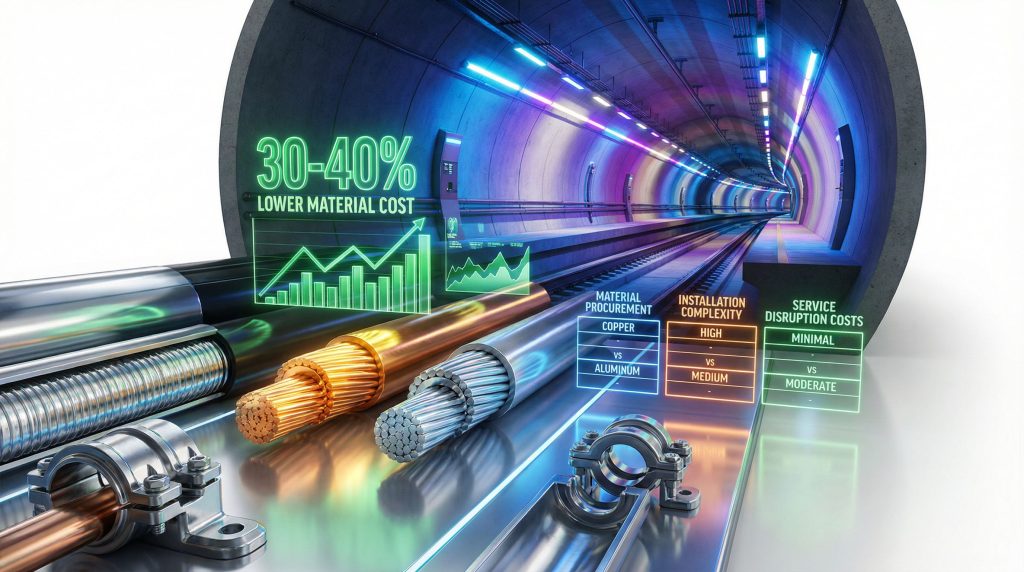
Material procurement costs for aluminium demonstrate substantial advantages over copper equivalents, with commodity pricing indicating 30-40% lower base material costs for equivalent electrical capacity installations. The London Metal Exchange pricing differential creates immediate capital expenditure savings while simultaneously reducing theft attractiveness.
Aluminium cable installations require modified technical specifications to maintain 33kV system compatibility. Engineering calculations indicate aluminium conductors need approximately 1.6 times larger cross-sectional area compared to copper for equivalent conductivity performance, but the material cost savings more than compensate for increased conductor sizing requirements.
The trefoil formation cable installation methodology provides additional operational benefits beyond theft deterrence:
• Three-phase configuration reduces electromagnetic interference improving signal system reliability
• Distributed load characteristics enhance power distribution efficiency across metro network segments
• Installation methodology compatibility with existing viaduct infrastructure minimising retrofit complexity
Performance characteristics analysis indicates aluminium cables maintain comparable operational reliability to copper systems when properly specified for transit applications. Conductivity at 61% of copper levels requires larger conductor cross-sections but achieves identical voltage handling and thermal management performance within existing system parameters.
Implementation Timeline and Resource Requirements
The phased replacement programme prioritises highest vulnerability corridors including Yamuna Bank Line, Airport Express Line, and Pink Line segments where theft incidents concentrated during 2025. This targeted approach enables maximum security improvement per investment rupee whilst maintaining service continuity throughout transition periods.
Furthermore, specialised workforce training requirements encompass modified handling procedures for aluminium cable installations due to material malleability differences compared to copper rigidity. Installation teams require certification for trefoil formation techniques and proper connection methodologies between aluminium conductors and existing copper interface points.
Supply chain considerations for large-scale material transitions favour domestic aluminium sourcing over international copper procurement. India's aluminium production capacity of approximately 4.0 million tonnes annually provides sufficient domestic supply security whilst reducing international commodity price exposure compared to copper import dependencies.
What Broader Industry Implications Emerge from Transit Material Strategy Shifts?
Material substitution strategies in critical infrastructure represent paradigm evolution from reactive security approaches toward proactive vulnerability mitigation through design-phase decision making. In addition, the mining innovation trends demonstrate how technological advancement continues reshaping resource extraction and utilisation patterns.
Infrastructure Resilience Planning Evolution
Risk-based material selection frameworks now incorporate theft vulnerability assessments alongside traditional engineering specifications for electrical performance and environmental durability. Infrastructure planners employ decision matrices evaluating scrap value per unit weight, supply chain vulnerability scoring, and long-term cost of ownership including criminal activity externalities.
The strategic implications extend beyond individual transit systems toward national infrastructure security considerations. Critical infrastructure dependencies on high-value materials create systemic vulnerabilities affecting:
• Power distribution networks managing comparable cable theft challenges across utility service territories
• Telecommunications infrastructure experiencing fibre optic cable theft disrupting data services
• Water distribution systems targeting copper valve and fitting installations
• Railway signalling networks vulnerable to copper component theft operations
Moreover, strategic minerals reserve 2025 planning demonstrates how nations increasingly recognise material security as fundamental to infrastructure resilience and economic stability.
Economic Security Considerations for Public Infrastructure
Domestic material sourcing preferences emerge from both economic security and operational reliability considerations. India's substantial aluminium production capacity reduces foreign exchange exposure whilst providing supply chain resilience against international commodity market volatility affecting copper pricing.
Strategic resource dependency assessments indicate aluminium-based infrastructure systems offer multiple advantages:
• Reduced international price exposure through domestic sourcing capabilities
• Lower theft attractiveness due to reduced scrap value recovery potential
• Enhanced supply security through established domestic production capacity
• Long-term cost stability insulated from global copper market fluctuations
How Do Global Transit Networks Address Similar Material Security Challenges?
International approaches to transit infrastructure security vary significantly based on system architecture, regulatory frameworks, and regional criminal activity patterns. For instance, modern copper investment strategies consider security risks alongside traditional market fundamentals.
International Best Practice Benchmarking
European metropolitan systems including Paris RATP, Berlin U-Bahn, and London Underground primarily utilise underground cable routing strategies that inherently reduce theft accessibility compared to elevated viaduct installations. This architectural approach provides natural security advantages but requires substantial additional construction investment compared to elevated metro designs.
Underground installations offer theft deterrence through:
• Limited access requiring specialised excavation equipment beyond typical criminal enterprise capabilities
• Integrated monitoring systems detecting unauthorised subsurface activity
• Coordinated security protocols with national police forces providing rapid response capabilities
• Redundant system architectures enabling continued operation during localised infrastructure damage
The fundamental architectural differences between European underground systems and South Asian elevated metro networks limit direct technology transfer opportunities for theft prevention strategies.
Technology Integration Opportunities
Advanced monitoring systems for cable integrity detection represent emerging technology applications in transit infrastructure security. Internet of Things sensors can provide real-time cable continuity monitoring with immediate alerting capabilities for unauthorised disconnection or damage events.
Predictive analytics frameworks analysing theft pattern data enable resource allocation optimisation for security patrol deployment and surveillance system positioning. Machine learning algorithms processing historical incident data, commodity price fluctuations, and seasonal crime patterns can identify elevated risk periods and geographic locations.
Smart infrastructure monitoring integration includes:
• Continuous electrical monitoring detecting cable disconnection within minutes rather than hours
• Geographic information system mapping identifying highest vulnerability corridor segments
• Automated alerting systems enabling rapid response deployment minimising theft completion opportunities
• Integration with existing surveillance networks providing visual confirmation of security incidents
Furthermore, utilities worldwide are exploring similar transitions. Ergon Energy's aluminium initiatives demonstrate how infrastructure operators globally recognise material substitution as an effective strategy against copper theft.
What Financial and Operational Metrics Define Successful Material Transition Programs?
Performance measurement frameworks for infrastructure material substitution programmes require comprehensive metrics encompassing immediate theft reduction outcomes and long-term operational reliability improvements. Success quantification extends beyond simple incident counting toward total cost of ownership optimisation across multi-year operational periods.
Performance Measurement Framework
The Delhi Metro Rail Corporation's transition programme establishes baseline metrics against the documented 89 cable theft incidents from 2025, with success targets including:
• 75-85% reduction in cable theft incidents within priority corridor segments post-aluminium installation
• Service reliability improvement measured through reduced unscheduled maintenance interventions
• Customer satisfaction metrics reflecting improved on-time performance and service predictability
• Total cost of ownership calculations including reduced security deployment and emergency repair expenses
Theft incident reduction percentages require statistical validation accounting for seasonal crime pattern variations and broader economic factors affecting criminal enterprise activity levels. Multi-year trend analysis provides more reliable success assessment than short-term incident counting approaches.
Investment Recovery Timeline Analysis
Break-even calculations for the INR 325.9 million material substitution investment incorporate multiple cost savings categories beyond direct theft incident elimination. Recovery timeline projections account for:
• Eliminated emergency repair costs averaging INR 2-4 million per major theft incident
• Reduced security deployment expenses through decreased patrol requirements in transitioned corridors
• Service reliability improvements generating customer retention and ridership growth
• Long-term maintenance cost reductions through aluminium's superior environmental durability characteristics
Risk-adjusted return projections incorporate commodity price volatility affecting both copper and aluminium material costs over the investment recovery period. Sensitivity analysis examines break-even timeline variations under different copper price scenarios and theft incident frequency assumptions.
The financial analysis indicates investment recovery within 18-24 months under baseline assumptions, with accelerated recovery possible if copper price premiums increase or theft incident frequencies exceed historical patterns in non-transitioned network segments.
The next major ASX story will hit our subscribers first
Frequently Asked Questions About Transit Infrastructure Material Security
Understanding the technical and operational implications of material substitution in critical infrastructure requires addressing common concerns about performance, implementation complexity, and cost-effectiveness compared to traditional security approaches.
Technical Performance Considerations
Aluminium cable installations in 33kV transit applications maintain electrical performance equivalent to copper systems when properly engineered for specific voltage and load requirements. The primary technical considerations include:
Conductivity differences require larger cross-sectional area calculations, with aluminium needing approximately 1.6 times the cross-section of copper for equivalent electrical capacity. This sizing adjustment maintains voltage drop characteristics and thermal management performance within existing system specifications.
Environmental durability characteristics of aluminium cables demonstrate superior long-term performance in outdoor installations compared to copper alternatives. Anodised aluminium coatings provide excellent corrosion resistance in varied weather conditions, whilst copper installations require ongoing oxidation management and periodic replacement due to environmental degradation.
Connection methodology between aluminium conductors and existing copper interface points requires specialised techniques preventing galvanic corrosion at dissimilar metal junctions. Proper installation procedures eliminate long-term reliability concerns whilst maintaining electrical continuity across material transitions.
Implementation and Cost Factors
Large-scale cable replacement projects typically require 12-18 month implementation timelines for comprehensive network segments, with phased approaches minimising service disruptions during transition periods. The Delhi Metro's 175-kilometre replacement scope represents substantial logistical coordination requirements but achieves maximum security improvement per investment rupee.
Transit authorities finance major infrastructure material transitions through:
• Capital improvement budget allocation from passenger fare revenue streams
• Government infrastructure development grants targeted at system security enhancements
• International development bank financing for critical infrastructure resilience programmes
• Public-private partnership arrangements incorporating long-term operational cost savings
Regulatory approval requirements vary by jurisdiction but typically encompass electrical safety certifications, environmental impact assessments, and compliance with national electrical codes. Indian Standards specifications provide framework guidance for aluminium cable installations in transit applications, with local authority approval processes generally completed within 6-8 months.
Strategic Recommendations for Transit Infrastructure Material Planning
Future infrastructure development projects should incorporate theft vulnerability assessments during initial design phases rather than implementing reactive security measures following criminal activity establishment. Proactive material selection provides superior long-term cost-effectiveness compared to physical hardening approaches.
Risk Assessment Integration
Comprehensive threat modelling for infrastructure vulnerability should evaluate material theft attractiveness alongside traditional engineering requirements for electrical performance and environmental durability. Decision-making frameworks incorporating scrap value analysis enable informed material selection reducing long-term security investment requirements.
The integration methodology encompasses:
• Commodity price trend analysis projecting theft incentive structures over infrastructure lifecycle periods
• Geographic crime pattern assessment identifying high-vulnerability installation locations
• Economic impact quantification including service disruption costs and customer satisfaction implications
• Alternative material performance evaluation ensuring operational reliability maintenance throughout security improvements
Future-Proofing Considerations
Emerging material technologies in transit applications include composite conductor systems providing enhanced security characteristics alongside superior electrical performance compared to traditional metal installations. Advanced conductor materials eliminate scrap value recovery entirely whilst offering improved operational characteristics.
Long-term sustainability planning should anticipate evolving security threat landscapes as criminal enterprises adapt to defensive measure implementations. Material selection strategies require periodic reassessment accounting for changing commodity markets and criminal activity patterns affecting infrastructure vulnerability profiles.
Technology integration opportunities continue expanding through smart infrastructure monitoring systems, predictive analytics for threat assessment, and automated response capabilities reducing human surveillance requirements whilst improving incident detection and response effectiveness across metropolitan transit networks.
This analysis incorporates publicly available information from transit authority reports, commodity market data, and infrastructure security research. Specific operational details may vary based on individual system requirements and regional regulatory frameworks. Investment decisions should consider comprehensive risk assessments and professional engineering consultation for specific applications.
Looking to Capitalise on Commodity Market Volatility?
Discovery Alert's proprietary Discovery IQ model delivers real-time alerts on significant mineral discoveries across the ASX, enabling investors to position themselves ahead of major market movements like those affecting copper and aluminium prices. With commodity-driven infrastructure challenges creating both risks and opportunities, subscribers gain immediate insights into mining companies discovering the materials driving global supply dynamics, ensuring they're positioned before the broader market recognises emerging trends.